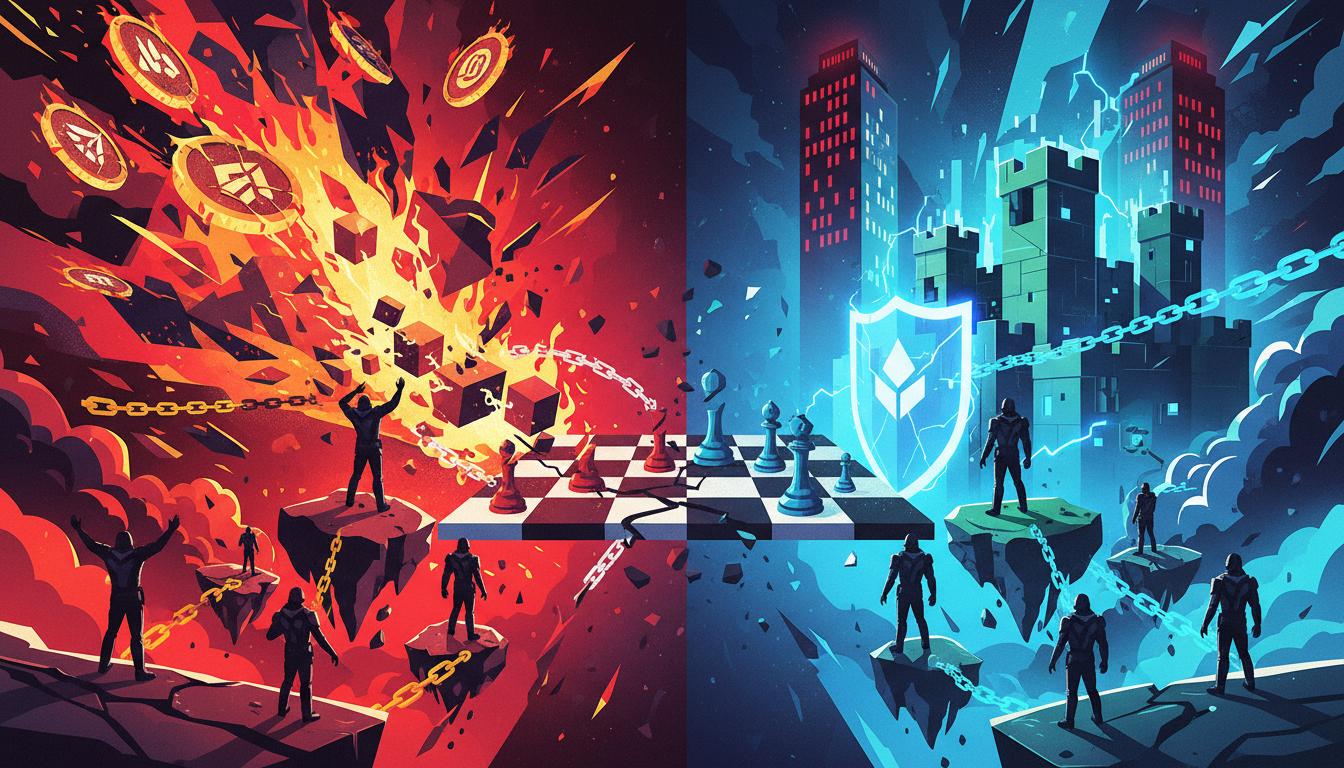
At 9 a.m. on March 23, 2026, East 8 Time, SpaceX and Tesla simultaneously launched a live broadcast on Elon Musk's X platform, jointly announcing a new project named TERAFAB, which brought both companies into the spotlight at the intersection of space computing power and the semiconductor industry. According to public information, the goal of this project is to achieve an annual production capacity of 1 terawatt-level computing power, with an explicit initial plan indicating that about 80% of the capacity will serve space application scenarios. This means that chips are no longer just serving mobile phones, data centers, and in-car systems, but are directly aimed at higher-dimensional battlefields such as satellite internet, deep space exploration, and orbital computing. For the traditional semiconductor landscape, this represents a reshuffling of pricing power and demand-side narratives; for the cryptocurrency market, which has already regarded "computing power" as a core asset, this space-prioritized capacity layout opens a new realm of imagination that is further and harder to price.
The Night of the Turning Point Where Space Steals the Spotlight from Chips
This live broadcast on the X platform was tightly paced, with Musk's usual "engineer-style" expression placed at the back of the story. The first thing thrown out was a set of data capable of tearing at the boundaries of imagination: 1 terawatt-level annual production capacity, 80% of capacity directed at space. Market commentary generally noted that this time the official narrative no longer placed cars, phones, or cloud data centers as the main scenes, but for the first time publicly included "space" in the main title of chip applications, which many observers see as a turning point signal of "space stealing the main stage from chips."
From an industry chain coverage perspective, TERAFAB is not merely "patching" one segment but claims to focus on logic chips, memory chips, and packaging processes, attempting to construct a vertically extended value chain in key processes relevant to high-end computing power. Logic chips determine power density and energy efficiency, memory chips carry models and data, while packaging directly relates to heat dissipation, reliability, and cost structure—this means that TERAFAB is not a single-point breakthrough but is establishing "space priority" gates at multiple key positions in high-performance computing.
The media's evaluation of this release further amplified the signal strength of "space as the main scene for the first time." Rhythm bluntly stated: "This is the first time a company has clearly defined space scenarios as a major chip application direction," defining this press conference as a turning point in industrial narrative; Planet Daily pointed out, "The 80% share of space applications shows that Musk is building a closed-loop space infrastructure," emphasizing that this is not just a new product line but a system project built around the space economy. Both media descriptions highly focused on the four words "space priority," forming an intuitive feeling: chips are no longer passively following end devices but need to proactively customize rules for space scenarios.
Aiming for 80% of Capacity Targeting Space
The most controversial setup of TERAFAB is the 80% space applications / 20% ground applications capacity distribution. For any high-end manufacturing project, so aggressively allocating most of the capacity to a still maturing space market is a strategic declaration in itself. This means that ground applications—including automotive AI, traditional data centers, consumer electronics—are proactively "downgraded" in this project, treated as secondary roles for cash flow and risk hedging, while the true target for profits and barriers is placed in orbit.
From the scene disassembly perspective, behind this 80% space application is a few demand curves that have already surfaced: first, the number of satellite internet nodes and bandwidth is highly likely to continue expanding in the coming years, requiring stronger yet more energy-efficient computing power chips for signal processing, edge computing, and autonomous management; second, the deep space exploration missions will continuously enhance their on-orbit autonomy, needing customized chips that can operate continuously in high-radiation, extreme temperature environments for detectors, orbiters, and future lunar/mars facilities; third, the oft-mentioned orbital data center concept, if to move from PPT to physical reality, also requires a complete set of computing power stacks rewritten for the orbital environment under constraints of energy consumption, cooling, and radiation protection.
In this context, the concept of "closed-loop space infrastructure" becomes the key to understanding Musk's ambition: Starship is responsible for pushing larger, heavier payloads; Starlink builds a globally covered low-orbit network; TERAFAB attempts to provide these on-orbit assets with customized computing power hearts. By filling its rockets with its chips and sending up its satellites and on-orbit computing nodes, Musk is attempting to control the entire chain from "launch to computing power" within the same group’s technological and capital system. This is not just business synergy but a defensive layout: in this new battlefield of space, whoever masters customized chips will have a greater right to set the standards.
A Terawatt-Level Computing Power Ready to Disrupt the Old Market Order
Public information shows that TERAFAB's goal is to achieve an annual production capacity of 1 terawatt-level computing power. If we put this number back into the current market context, the magnitude of the impact becomes clearer: leading global AI chip manufacturers often measure each generation of their products in hundreds to thousands of TOPS, while cloud service giants continue to expand the total computing power laid out on the data center side. Although there are differing metrics from various units, making one-to-one comparisons difficult, treating 1 terawatt-level annual computing power as a benchmark can be understood as: this is an increment of computing power sufficient to support a medium to large cloud service provider's new round of AI cluster expansion, but is stated up front to primarily target space.
In terms of commitment in manufacturing and packaging processes, this capacity will inevitably pressure the order structures of traditional IDM and foundry factories. If TERAFAB achieves substantial capacity in any of the three stages: logic chips, memory chips, and packaging, it could "pull away" part of the advanced process capacity that was originally flowing to general data centers, consumer electronics, or automotive platforms and reallocate it to space-customized chips. For existing IDMs and foundry factories, this represents a new category of major client; however, in the long run, those willing to lock down long-term agreements for "space-priority" capacity will need to balance on other business lines.
More importantly, the space-priority capacity allocation will change the pricing power of high-end chips and the long-term capacity distribution game. When the 1 terawatt-level annual computing power is bound to satellites, orbital nodes, and deep space missions, the pricing logic will no longer just be "cost per watt of computing power" or "cost per TOPS performance," but will also include new variables such as launch windows, orbital lifespan, and on-orbit maintenance costs. Traditionally, cloud vendors could drive down prices through mass purchases, but faced with the higher technical thresholds and rigid demands of space missions, this bargaining model will be weakened. If TERAFAB successfully turns the space scenario into a "priority customer" for high-end chips, then cloud service providers, automotive companies, and even large internet companies may need to make more concessions between price and supply stability.
Musk's Matrix Synergy: Rockets, Electricity...
From the perspective of internal synergy within the group, TERAFAB is not an isolated project but a key node hanging on Musk's "industrial matrix." SpaceX has already built a complete industrial system and supply chain bargaining ability in rocket launches, satellite manufacturing, and on-orbit operations; Tesla has accumulated a wealth of engineering experience in high-automation factories, power and control electronics, and vehicle-grade chip selection and verification. These capabilities, when combined, provide a natural synergy space for TERAFAB in manufacturing processes, supply chain integration, and quality management, also enabling it to possibly obtain scaled orders and lower marginal costs early on.
If further deducing the demand side, Tesla itself has a rapidly rising demand for autonomous driving and in-car AI computing power. Whether it is the evolution of the FSD system or large model inference inside vehicles in the future, it indicates continuous demands for dedicated acceleration chips and high-bandwidth storage. Additionally, Tesla is continually introducing more robots and vision systems in factory automation, also pushing new computing power consumption toward the edge. While TERAFAB explicitly aims 80% of its capacity at space, the remaining 20% of ground capacity can very well achieve closed-loop digestion internally—Tesla and SpaceX themselves are the most natural and stable initial customer groups.
This internal closed-loop order is particularly critical for the early operation of a new project. In the absence of disclosed details about the technical route and external customer list, locking in orders from within the group can provide a safety net for TERAFAB's capacity utilization and cash flow for several years. SpaceX needs a large number of on-orbit computing nodes and Starlink terminal chips, Tesla needs in-car and factory computing power modules, and the sum of these can provide a fundamental base for TERAFAB, allowing it to avoid being immediately drawn into a comprehensive price war with traditional chip giants at its inception stage. This model of "using one's own demand to support one's own factory" has appeared multiple times in Tesla's battery and component supply, and is now replicated at the level of space computing power and high-end chips.
A New Technology Story Amid Rising Risk Aversion
The announcement of TERAFAB did not occur during a macro calm period. According to a briefing, during the same period as the project announcement, geopolitical risks in the Middle East are escalating: Iran has openly threatened to strike American energy facilities, and military frictions between the U.S. and Iran have already caused approximately $800 million in losses (according to BBC and CSIS data). In this context, global risk assets are facing a rising trend of risk aversion, with capital switching back and forth between the stock market, commodities, and safe-haven assets.
Expectations in the cryptocurrency market have also correspondingly weakened. Predictions from Polymarket show that the market assigns a probability of about 47% for Bitcoin to drop to $45,000, which does not imply a certainty of a single direction but clearly illustrates that investors are raising the risk pricing for short-term adjustments. When geopolitical conflicts, uncertainty, and risk aversion dominate the narrative, crypto assets struggle to maintain the previously optimistic one-sidedness of "only telling growth stories."
In this macro and emotional context, TERAFAB’s technology narrative of "space computing power + chips" just happens to constitute another main line that capital may chase. On one end is the rising risk aversion demand due to geopolitical risks and macro uncertainties, driving some capital toward cash, government bonds, or gold; on the other end is Musk's novel growth imagination, attempting to reignite risk preferences with space infrastructure and computing power stories. For participants in the cryptocurrency market, capital wavers between these two narratives: on one hand, there is worry about further drops in Bitcoin prices, while on the other hand, there is the realization that "computing power, space, chips" may give rise to foundational infrastructure opportunities for the next long cycle.
The Distant Echo from Space Computing Power to On-Chain World
From a longer cycle view, the significance of TERAFAB for semiconductors, the space economy, and Musk's business landscape goes far beyond a single press conference. It signifies the first time that chip production capacity planning explicitly places space applications at the forefront at a project level, forcing traditional semiconductor companies and foundries to reassess the demand structure for the next decade; it also adds a "computing power foundation" for the space economy, giving opportunities for originally fragmented scenarios like satellite internet, deep space exploration, and orbital data centers to be integrated into a unified hardware and computing power system; for Musk personally, this binds rockets, satellites, electric vehicles, factory automation, and chips together into a higher-dimensional business narrative, giving the "closed loop from ground to orbit" a self-consistent layer of computing power.
For the cryptocurrency industry, all of this is still just a distant echo, but it is already enough to spark imaginations about restructuring infrastructure and computing power distribution: when more computing power is transported to orbit, when low-latency global networks and on-orbit computing nodes become a reality, the infrastructure styles of public chain node layouts, oracle networks, cross-border payments and settlements, and on-chain AI inference may all be forced to redesign. Some may envision the future emergence of "on-orbit nodes," "space oracles," or even on-chain security modules optimized for orbital environments; others may remind that the boundaries of such deductions must be strictly controlled within the "conceptual layer" to avoid excessive financialization or storytelling when key technologies and commercial pathways remain unclear.
It is also important to emphasize that the current key information about TERAFAB is still highly incomplete. When the project was announced, specific chip technology routes, process techniques, project investment amounts, or external partner lists were not disclosed, and related data does not yet exist in public channels. For any participant attempting to make investment judgments based on this, these missing pieces represent substantial uncertainty: whether the capacity goals can be achieved, how costs and yields will be controlled, and how the relationship with existing IDMs and foundries will be defined all need time and more public information for validation. Until then, TERAFAB is more like a spotlight shining on the intersection of space and computing power, illuminating a path that may reshape the semiconductor and on-chain worlds, but is still shrouded by thick layers of technology, capital, and time fog.
Join our community to discuss and become stronger together!
Official Telegram community: https://t.me/aicoincn
AiCoin Chinese Twitter: https://x.com/AiCoinzh
OKX Benefits Group: https://aicoin.com/link/chat?cid=l61eM4owQ
Binance Benefits Group: https://aicoin.com/link/chat?cid=ynr7d1P6Z
免责声明:本文章仅代表作者个人观点,不代表本平台的立场和观点。本文章仅供信息分享,不构成对任何人的任何投资建议。用户与作者之间的任何争议,与本平台无关。如网页中刊载的文章或图片涉及侵权,请提供相关的权利证明和身份证明发送邮件到support@aicoin.com,本平台相关工作人员将会进行核查。