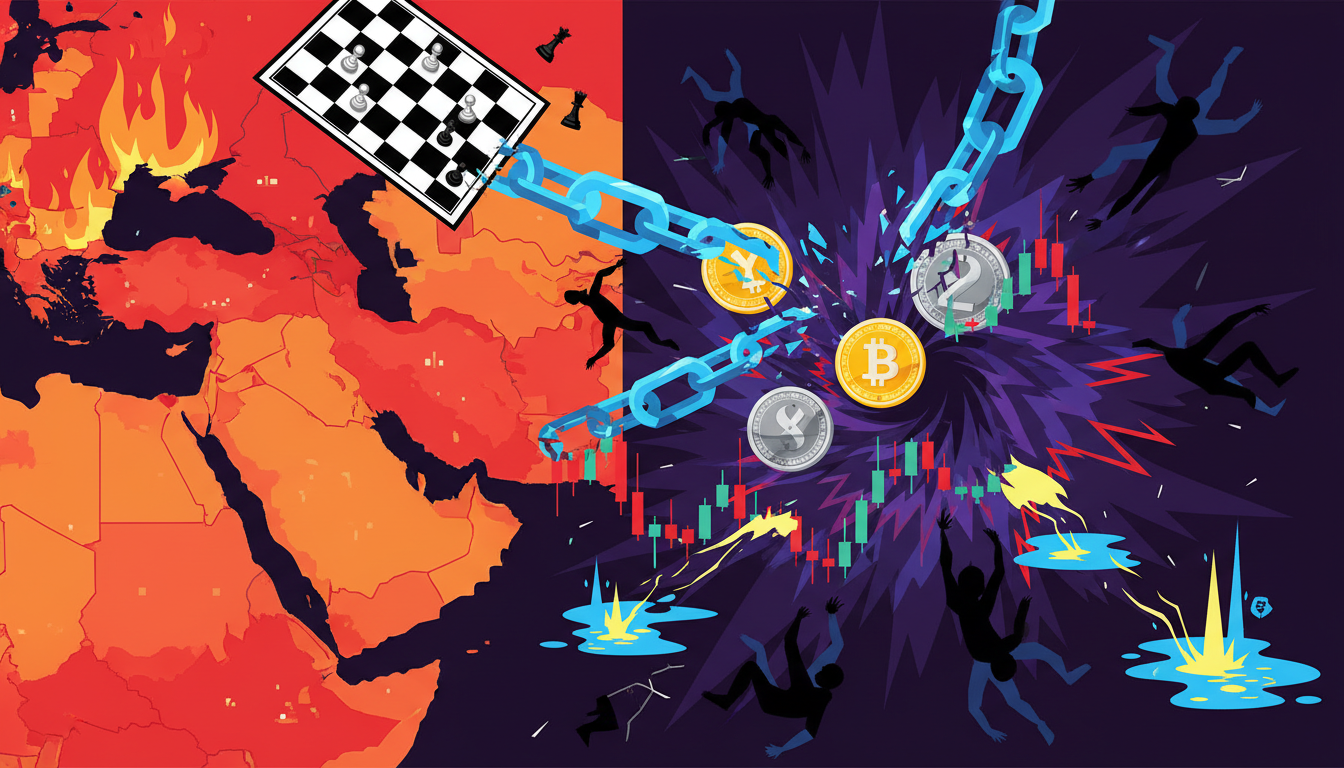
This week in East Eight Time, the situation in the Middle East has rapidly escalated again around the Strait of Hormuz. Iran has raised its rhetoric, publicly threatening that if its energy facilities are attacked, it will target "all American energy assets"; conversely, the United States is directing its attention to this globally critical oil and gas corridor, demanding that the Strait be "completely open and free of threats," otherwise it will consider destroying energy lifelines such as power plants within Iran. Both parties' statements directly target each other's energy infrastructure, intertwining military deterrence with energy security. The Strait of Hormuz handles about 20% of global oil transportation and is a typical "single point of failure" chokepoint; once obstructed, it would not only be a regional security issue but could also shake the global energy system. This article will outline the energy confrontation between Iran and the US-UK along the main line of "who controls the strait's gateway, who possesses nuclear and missile deterrence," and its deep implications for the reshaping of regional power dynamics.
Energy Fortress Under Target: The Lifeline Contest of the Strait of Hormuz
The Strait of Hormuz, located between Iran and Oman, is a narrow waterway connecting the Persian Gulf with the Gulf of Oman and the Arabian Sea. At its narrowest, it is only a few dozen kilometers wide, yet it carries about 20% of global oil shipping volume, making it a "throat" of the world energy system. Vast amounts of crude oil and natural gas from Gulf oil-producing countries must pass through this single shipping lane to reach eastern and western markets, and this high concentration gives the Strait a natural strategic premium: any blockade, disturbance, or skyrocketing insurance costs will ripple through the supply chain.
Because of this, if the Strait of Hormuz is obstructed, its impact cannot merely be measured through specific oil price numbers; it is sufficient to change market expectations and asset pricing logic. For energy-consuming countries, even short-term "passage uncertainties" will be amplified into transportation risk premiums and inventory security anxieties; for oil-producing countries and shipping companies, the accumulation of premiums, detours, and contract compliance risks may push back production plans and export rhythms. The core significance of the Strait of Hormuz is not just the 20% of current flow but its status as a critical node that is difficult to replace and not easily replicated.
On a geopolitical level, Iran is on the northern shore of the Strait, possessing geographic advantages such as a coastline and nearby islands, which gives it a natural surveillance and intervention capability over surface and underwater movements. The United States, on the other hand, has long deployed the Fifth Fleet in the Persian Gulf, maintaining a continuous presence and strategic suppression over this vital passage through carrier strike groups, patrol formations, and intelligence monitoring forces. This long-standing confrontation between "shore-based control" and "blue-water naval power" constitutes the basic security structure of the Strait of Hormuz for decades.
Therefore, the real focus of the conflict is not just whether the "Strait can be opened," but rather "who has the authority to control the switch of this oil lifeline at what time and in what manner." Is it defined by Iran, which sets risk thresholds through shore-based missiles, fast boat formations, and legal declarations, or is it set by the US, with the Fifth Fleet protecting and allied actions establishing "normal passage" boundaries? The competition for control of this switch is essentially a struggle for bargaining power and dominant security order across the entire Gulf region.
Threats and Countermeasures: Energy Infrastructure Becomes Core Chip in the War of Words
In the latest round of confrontation, the Iranian military officially stated, "Once our energy facilities are attacked, all American energy targets will be hit." This statement shifts the focus of the dispute from traditional navigation rights and naval standoff directly to the energy infrastructure itself: not only including oil and gas fields, pipelines, and storage facilities but also extending to power plants and refining units as high-value nodes. Iran's deterrence mindset is clear—if the US breaks the traditional boundary of "military against military" and directly attacks its energy lifeblood, then the US must face equivalent or even higher uncertainty costs on its global energy layout.
In contrast, Trump used extreme wording in response, demanding that Iran "completely and threat-free open the Strait, or else destroy power plants." This statement locks the focus of American retaliation on Iran's domestic power and energy systems, sending two signals: first, that it will not tolerate Iran using the Strait as a continuing leverage; second, that when necessary, it is willing to expand its strike range to a level "where the consequences of war would deeply harm the opponent's economic and social operations." Both sides' language directly targets energy lifelines, using "depictable and understandable" civilian infrastructure as a stage to showcase their "determination and bottom line" to domestic and foreign audiences.
In this process, power plants and oil and gas facilities have become core carriers of psychological warfare and public opinion battles. Iran emphasizes the vulnerability and irreplaceability of its energy facilities to convey to the outside world that "if attacked, it will be forced to escalate completely." The US and its allies also discuss options to strike Iran's energy system loudly, attempting to establish pressure in advance to compel Iran to be more restrained in actual actions. The mutual "sword flashing" in public opinion is, in itself, an accumulation of bargaining chips at the negotiation table: whoever can make the other side believe that crossing the line will bring costs too high to bear will hold a better negotiating position in the next round.
Regarding loss assessments, a single source claims Iran's counterattack actions have caused about 800 million dollars in losses to the United States. This figure lacks multiple corroborations in public information, and there has been no authoritative disclosure of its composition, involved facility types, and specific regions, so it can only be seen as a reference coordinate in the war of words, rather than an accurate account. For market and policy analysis, it is more important to understand the signals behind this number — Iran is trying to prove it can impose costs on the US that make them "feel the price," thereby increasing its bargaining power in subsequent games, rather than getting bogged down in the details of whether the loss is 800 million, 500 million, or 1 billion.
Missile Web Collides with the Fifth Fleet: Dual-Track Confrontation under Nuclear Shadows
In terms of hard power, Iran is widely regarded as having the most densely packed ballistic missile network in the Middle East, covering multiple ranges of short and medium-range missiles, aimed at the shores of the Persian Gulf and further areas. The strategic significance of this network lies in its provision of "asymmetrical tools" for Iran to bridge the traditional naval power gap: even lacking a surface fleet comparable to the US military, it can deter US bases, oil and gas facilities, and key maritime routes in the vicinity through shore-based missiles. For the highly concentrated ports, loading terminals, and storage facilities in the Gulf region, this reach itself constitutes a perpetual geopolitical financial risk.
In contrast, the US has long deployed the Fifth Fleet in the direction of the Persian Gulf, a critical element in the US military's global naval layout. The core intention of its presence is to implement "normalized presence" in the waters of Hormuz and its surrounding sea areas through carrier strike groups, destroyers, and support vessels, responsible for escort and monitoring at the tactical level, while strategically providing quickly upgradable strike capabilities to suppress Iran's ability to translate missiles and maritime blockade capabilities into actual actions. The significance of the Fifth Fleet lies not only in wartime force projection but also in daily operations that shape the rules—by determining "who patrols here, who has the authority to inspect, and who defines provocative behavior," a US-centric security order is maintained.
In this region, Iran's missile web and the US naval power do not simply engage in one-dimensional confrontation; they are also under the long shadow of nuclear deterrence. Various parties publicly avoid getting into the specifics of nuclear operational plans, but the existence of "nuclear capabilities" and the potential compatibility with conventional missiles serves to create implicit constraints in decision-making: any misjudgment could be interpreted by the other side as a slide toward a higher level of conflict. It is under this dual framework of "nuclear shadows + conventional missiles" that every military drill, test launch, and blockade threat in Hormuz will be interpreted with heightened sensitivity by external observers.
Thus, Iran and the US-UK are adopting a typical "dual-track strategy" around Hormuz. On one hand, military postures continue to rise: missile drills, maritime interceptions, and fleet enhancements are deployed in succession to demonstrate to the other side that "the bottom line is not easily tested"; on the other hand, diplomatic contacts have not completely ceased, using public statements, third-party mediation, and indirect communication to continuously explore the "red line price" acceptable to the other party at the negotiation table. This operation of ramping up deterrence while reserving negotiation space is essentially a high-risk game: any escalation of posture could bring bargaining chips but also increases the probability of losing control and misjudgment.
British Nuclear Submarine Enters the Arabian Sea: Misjudgment Risks After Multinational Additions
Based on the US-Iran game, the UK's actions add another layer of uncertainty to the situation. Public information shows that the British Royal Navy's submarine "Anson" has been deployed in the direction of the Arabian Sea; this move itself carries strong symbolic meaning: first, it demonstrates that the UK is willing to take a more proactive role in the US-led regional layout; second, showcasing a high-value strategic platform adds extra deterrence weight to the Persian Gulf and even broader waters. Currently, the external world cannot confirm the more detailed position and specific tasks of the "Anson," nor are there publicly disclosed operational plans; this vagueness, conversely, amplifies its deterrent effect at the psychological warfare level — the submarine "could be anywhere."
From a historical and alliance structure perspective, the UK and US have consistently maintained close coordination in the Gulf region. This demonstration alongside the US in the Hormuz game both endorses the "transatlantic alliance" and reflects the UK's proactive choice to retain a certain degree of discourse power on Middle Eastern security issues. For London, energy transport security is not only an economic issue but also part of its traditional maritime power identity and international status. By visibly deploying nuclear submarines in the Arabian Sea, the UK presents itself as a "reliable partner" to its allies while sending a signal to potential adversaries that "any challenge will trigger a wider response from Western powers."
For Iran, the UK's deep involvement means that if the situation in Hormuz deteriorates further, it will face not only a singular US-Iran confrontation but the potential for a multinational joint response framework. This signal inherently raises the cost of misjudgment: any hard moves against US targets may be perceived by other Western countries as indirect challenges to their own interests, prompting a broader response. In other words, the accumulation of multinational military power significantly raises the difficulty of orchestrating "limited conflicts."
When the US Fifth Fleet, Iran's missile web, and the British nuclear submarine are present in the same geopolitical narrative, the difficulty of "cooling down" the regional situation naturally increases. The cross-deployment of forces from different countries, operational guidelines under varying rule systems, and respective domestic political pressures will impose more complex constraints on frontline commanders and decision-makers. The potential for inadvertent escalation does not stem from a single party's proactive risk-taking but often results from the cumulative effect of minor errors by multiple powers in a high-pressure environment.
From the Strait to Oil Prices: Where Will This Game Spill Over?
Viewing the comprehensive elements of military deterrence, critical energy passages, and high-profile threats, the current situation in Hormuz is characterized by a "fragile balance under high pressure." On one hand, Iran continuously reminds the outside world through missiles and geographic advantages that this passage is not naturally open but exists based on its "tolerance"; on the other hand, the US, UK, and other nations maintain an external framework of "freedom of navigation" through fleet presence and strategic platform deployment. All parties understand that once this lifeline for about 20% of global oil transport is genuinely interrupted for an extended time, it will trigger not just regional security incidents, but a systemic shock to the global energy and financial systems — this is also the fundamental reason why vocal threats are frequent, yet actual crossing of lines has so far been cautiously controlled.
In the absence of a reliable diplomatic timetable and transparent coordination mechanism, for some time to come, the Strait of Hormuz may oscillate between "limited probing" and "localized escalation." Limited probing manifests in high-profile but controllable actions such as maritime interceptions, close military aircraft flights, and missile test launches, aimed at testing the other party's reactions and allies' limits; localized escalation may manifest as a small-scale firefight arising from a certain boarding or a retaliation chain triggered by an attack on specific facilities. Without a clearly visible "cooling timetable" mutually recognized by multiple parties, every small friction has the potential for upward escalation.
From a medium to long-term structural perspective, this round of crisis will further strengthen both energy consuming and producing nations' recognition of the "single corridor dependency risk," accelerating diversified layouts: on one hand, diversifying rigid dependence on the Strait of Hormuz through the development of additional land pipelines and alternative ports; on the other hand, increasing combinations of different regions and energy types in supply sources to hedge against political risks at specific geopolitical nodes. Even if short-term market fluctuations have not fully reflected all geopolitical uncertainties, adjustments in long-term capital expenditures and infrastructure directions are often seen to continue emerging post-crisis.
For readers focused on macro and bulk assets, it is more important to monitor key variables rather than pursuing unverified combat rumors, specific details, or conspiracy narratives: first, whether actual military actions cross established "red lines," such as outright attacks on key energy facilities; second, whether public policy signals shift from "deterrent posture" to "cooling mechanisms"; third, the long-term adjustment pace of major consuming and producing countries in infrastructure and supply chain layouts. Whether the Hormuz powder keg will truly be ignited ultimately depends on whether all parties are willing to continue incurring compromise and management costs to maintain the "usable but unstable" state of this lifeline.
Join our community to discuss and become stronger together!
Official Telegram group: https://t.me/aicoincn
AiCoin Chinese Twitter: https://x.com/AiCoinzh
OKX福利群: https://aicoin.com/link/chat?cid=l61eM4owQ
Binance福利群: https://aicoin.com/link/chat?cid=ynr7d1P6Z
免责声明:本文章仅代表作者个人观点,不代表本平台的立场和观点。本文章仅供信息分享,不构成对任何人的任何投资建议。用户与作者之间的任何争议,与本平台无关。如网页中刊载的文章或图片涉及侵权,请提供相关的权利证明和身份证明发送邮件到support@aicoin.com,本平台相关工作人员将会进行核查。