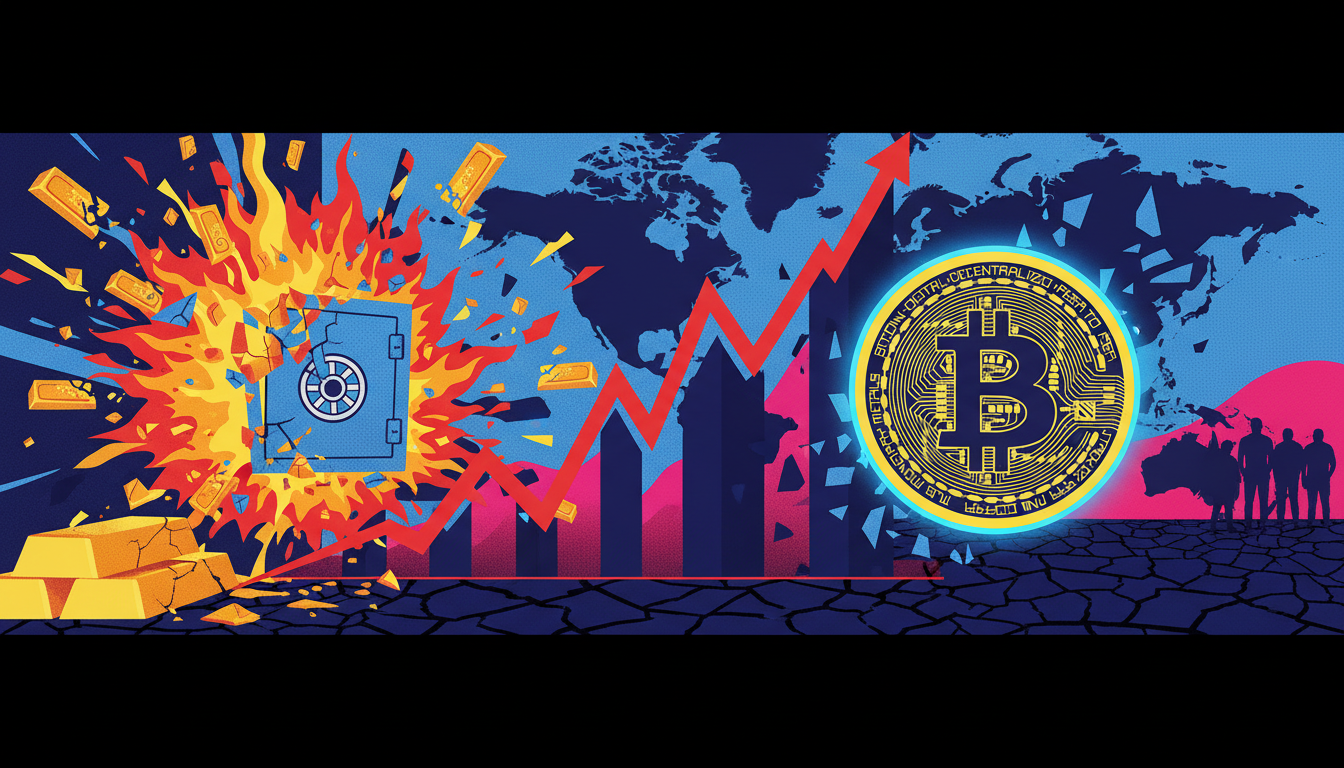
As of March 21, Eastern Standard Time, the price of Bitcoin has been oscillating slightly above $60,000, with Galaxy Digital transferring over 2,000 BTC since March 17, becoming a variable of great interest both inside and outside the market. On-chain data shows that on March 17, a single transfer of about 1,346 BTC occurred, followed by another movement of about 700 BTC. In the current market structure, where institutional and ETF positions are highly concentrated, such a scale can be regarded as an "institutional-grade event." Some traders interpret it directly as a signal for a new wave of selling, while others believe it is more likely to be for off-exchange settlement or internal asset reorganization. This article will unpack this divergence based on data from sources like CryptoQuant, examining transfer scale, on-chain and derivative indicators, regulation, and media narratives from multiple dimensions, rather than merely staying at the emotional "dumping" label.
Two Large Transfers: Institutional Wallets Begin to Move
On March 17, CryptoQuant detected a transfer of approximately 1,346 BTC from an address marked as related to Galaxy Digital, with a nominal scale close to $100 million based on that day's price. Shortly after, within the subsequent "recent" observation window, about 700 BTC was transferred from the same institution's attributed wallet, bringing the cumulative on-chain movement to over 2,000 BTC. Although the specific receiving addresses and subsequent flows after the transfers have not been disclosed, the market generally attributes these actions to Galaxy based on on-chain labels and historical behavior patterns.
Comparing these operations to previous single institutional BTC movements, both transactions are, in terms of "single transaction volume" and "continuity," among the largest scales in recent times this year. Under the structure where spot ETFs, miners, and trading institutions dominate the supply side, a concentrated movement of over a thousand BTC is often amplified and tracked within a short time by various monitoring tools, becoming an important anchor point for price and sentiment. Especially during phases when the liquidity of altcoins has significantly receded and the trading volume of mainstream coins has increased, equivalent institutional actions exert far greater marginal impact than during high liquidity periods.
Historical experience indicates that when concentration-holding institutional wallets show signs of reduction or redistribution, the market's risk pricing often displays a "first emotions, then data" trajectory. Short-term traders tend to view any large outflow as a potential precursor to selling pressure, preemptively reducing positions or hedging near key price levels; while medium to long-term capital is more focused on whether it is accompanied by sustained net outflows, reductions in ETF holdings, and amplified spot selling. In other words, a single transfer alone is not enough to constitute a trend reversal signal, but within sensitive ranges, it magnifies both long and short sides' imagination about downward or upward momentum.
Sale or Reorganization: Multiple Possibilities in Galaxy's Fund Pathways
Regarding the transfer of over 2,000 BTC by Galaxy, mainstream market interpretations generally concentrate on several pathways: first, it is seen as a potential off-exchange settlement, that is, transferring a large amount of BTC to off-exchange counterparties or market makers to fulfill liquidity provision and cross-settlement; second, it may involve internal asset reorganization or account system adjustments, including position transfers between trading and asset management departments, or merging sub-accounts; third, it may relate to staking, custody migration, or compliance arrangements, such as moving assets to a new custodian or satisfying certain audit or compliance requirements. Currently, none of the above possibilities have been officially confirmed by Galaxy, and the specific purpose of the incident remains in a state of information vacuum.
From a business structure perspective, Galaxy plays a dual role as both a proprietary trading institution and an asset management entity, making significant on-chain movements not uncommon in its daily operations. Typical scenarios include: pre-allocating margin for hedging or arbitrage strategies, supplementing inventory to market-making accounts to maintain liquidity; executing large off-exchange buy-sell or structured product deliveries for institutional clients, requiring centralized settlement on-chain; and consolidating the underlying BTC for new fund products or custody solutions. In these scenarios, on-chain transfers are more of an operational "funds relocation," with actual selling pressure depending on subsequent trading and position changes, rather than the transfer actions themselves.
In the past, there have been multiple cases where institutional coin transfers were misinterpreted by the market as selling. For example, large withdrawals by mining giants, exchanges, or ETF custodians are quickly amplified in social media as “dumping is imminent.” However, it is often found afterward that some funds merely circulate between different custodians or internal accounts, or even involve aggregation and拆分操作 for compliance and auditing needs. Equating "transfer" with "sell" makes it easy, in the absence of supporting data such as trading, order books, and positions, to form excessively tense erroneous expectations; this also applies when interpreting Galaxy's actions this time.
On-chain and Market Data: Did the Market Respond with Panic?
If we pull the perspective back from a single on-chain event to the price and transaction itself, it helps better determine whether the market produced a panic reaction to Galaxy's transfer. Analyzing data from March 17 and a few days before and after, although Bitcoin's price fluctuated, typical combinations such as "instant waterfall + large-scale forced liquidations" did not occur, nor were there extreme situations of billions of dollars in settlement seen in deep fall cycles of 2021 and 2022. In terms of trading volume, spot and derivatives data show a marginal increase rather than an abnormal explosion, more closely resembling normal fluctuations within a trend, which does not align with the typical characteristics of "institutional massive selling causing a cascade."
A more macro background is that CryptoQuant data indicates that during the same period, the trading volume of altcoins has shrunk by about 80%-85%, indicating that the overall market's risk appetite has significantly receded, and liquidity is retreating from high-beta assets. In this environment, BTC's relative performance against altcoins has not completely faltered; rather, it has maintained a certain "safe-haven cushion" within mainstream capital's preferences. This resembles a process of capital flowing back to top assets, rather than a comprehensive panic triggered by a single institutional action. Galaxy's large BTC transfer is more of a localized amplification point above the main line of liquidity contraction and preference switching.
From a derivatives perspective, indicators such as futures basis and funding rates did not show synchronized systematic "deterioration" signals before and after the event, with no evidence of large-scale shifts to deep discounts or excessively negative funding rates indicating that the market is turning extremely bearish in the short term. If a strong causal relationship existed between Galaxy’s transfer and price drop, we would typically see corresponding events such as concentrated liquidation of long leverages, sharp reversals in perpetual funding rates, and enlarged futures discounts at the same time. Currently, these data tend to indicate that while there is correlation between Galaxy's transfer and market volatility, it is not sufficient to demonstrate a strong linear causal chain.
Regulatory and Institutional Trends: The Broader Context of Galaxy's Actions
When interpreting Galaxy's large on-chain operations, the evolution of regulatory and compliant trading channels is a macro context that is easily overlooked. During the same period, news that Coinbase has opened trading for four types of tokens in New York reflects that the scope of tradable assets is gradually expanding between U.S. local regulations and mainstream compliant platforms. For participants like Galaxy that serve both institutions and high-net-worth clients, the richer the compliance channels and the larger the asset options, the more frequent adjustments need to be made between on-chain and custody accounts to match new product and strategy needs; thus, large on-chain migrations are likely to become a part of "everyday operations" rather than a "single point extreme event."
At the same time, traditional capital markets and the crypto space are both playing out a resonance of repurchases and capital increases: on one hand, many listed companies are continuously buying back their stocks, while on the other hand, some crypto-related enterprises and funds express confidence in their own and the industry's prospects by repurchasing tokens and increasing positions in top assets. In this environment, the overall behavioral patterns of institutional capital are more akin to "dynamic allocation among major types of assets," rather than merely unilateral liquidation and exit. Galaxy, as a bridge connecting traditional capital and the crypto market, likely optimizes and rebalances its on-chain position within a broader asset allocation framework.
In the context of advancing compliance and diversifying asset allocations, frequent adjustments of on-chain asset positions by institutions themselves are evolving from "abnormal signals" to "the new normal." Top institutions need to shuttle between different custodians and trading venues, switching underlying collateral among spot, derivatives, and structured products, and their on-chain footprints will naturally become denser. For market participants, a more effective approach isn't to emotionally amplify each large transfer but to incorporate it into a longer-term tracking framework to observe whether it is accompanied by sustained net outflows, price structure damage, and liquidity exhaustion, rather than isolating each relocation as a "black swan."
Media Amplification and Panic Pricing
In the realm of public opinion, several Chinese media outlets, including Deep Tide TechFlow, PANews, have packaged the recent large BTC transfer by Galaxy as a potential "institutional selling signal," with headlines and introductions revolving around "liquidating," "exiting," thus reinforcing the narrative of "whales dumping." Such frameworks often assume that large on-chain outflows equate to imminent selling, neglecting more neutral possibilities like off-exchange settlements, custody migrations, and internal reorganizations, creating strong psychological implications for small and medium investors facing information asymmetry. During phases when liquidity in altcoins has already dried up and the market is highly sensitive to incremental news, this narrative can easily trigger a short-term game of collective reduction and fear of missing out.
In contrast, CryptoQuant analysts expressed relatively restrained views in their related briefings, emphasizing this as one of the "largest single institutional BTC movements recently," without providing a biased "sell-off" judgment on the data level. This "data neutrality" versus "emotional orientation" gap reflects how information tends to be repackaged and amplified as it flows from professional monitoring tools to mainstream media and social platforms. For ordinary traders, if they only encounter a processed emotional version, neglecting the original data and uncertainty boundaries, it is easy to prematurely enter panic pricing before the price gives clear signals.
During sensitive periods when trading volume of altcoins has sharply declined and volatility of mainstream coins has intensified, the amplifying effects of media headlines and social discourse regarding a single on-chain event are particularly pronounced. On one hand, narratives like "large whales selling" can easily spread on social platforms, combined with short-term K-line corrections, creating a self-verifying panic cycle; on the other hand, short-sellers may also actively exploit such emotions to amplify volatility in the derivatives market for profit. The result is that what may merely be a regular relocation by institutions regarding asset structure and custody arrangements is quickly treated by the market as a "systemic risk signal" and undergoes excessive pricing, exacerbating an already fragile liquidity environment.
How Will Institutional Large Transfers Rewrite the Next Phase?
In summary, Galaxy's transfer of over 2,000 BTC is one of the most notable institutional-grade on-chain events of the year in terms of scale, showing a continuous movement feature—first 1,346 BTC, then 700 BTC—and in terms of market reaction, reflecting a typical "narrative premium," with prices and derivative indicators fluctuating gently while public sentiment has relative amplification. The true points of uncertainty lie in the fact that we lack Galaxy's official explanation for the purpose of this operation. We also lack transparent tracking of the specific receiving addresses, custodians, and subsequent transactions. Thus, it is difficult to accurately classify these two large outflows as "reduction," "reallocation," or "expanding the balance sheet."
In the absence of complete information, directly equating this transfer with a deterministic sale risks conflating the dimensions of "fund position changes" and "directional selling." Current on-chain and derivatives data are insufficient to support the conclusion of "Galaxy systematically shrinking BTC holdings," and price action has yet to establish a typical waterfall and forced liquidation resonance structure. For traders, a more rational approach is to acknowledge uncertainty, accept the premise that "institutions may be making multiple business arrangements," rather than allowing a single narrative to drive emotions.
From a mid-term perspective, it is more worthwhile to build a continuous observation framework:
● On one hand, continuously track the net changes in holdings of Galaxy and other leading institutional wallets to see if these large transfers evolve into sustained net outflows or are merely temporary reorganizations;
● On the other hand, monitor the activity of off-exchange trading and the flow of funds on mainstream compliant platforms to judge whether institutions are quietly adjusting Bitcoin exposure through OTC and ETF channels;
● Simultaneously, include the rhythm of recovering altcoin trading volume to observe whether capital is exiting overall or repeatedly switching between top and high-risk assets. When these dimensions collectively point to a restart or continued contraction of risk appetite, a single institutional relocation action will then genuinely possess the explanatory power to "rewrite the next phase."
Join our community to discuss and become stronger together!
Official Telegram community: https://t.me/aicoincn
AiCoin Chinese Twitter: https://x.com/AiCoinzh
OKX Welfare Group: https://aicoin.com/link/chat?cid=l61eM4owQ
Binance Welfare Group: https://aicoin.com/link/chat?cid=ynr7d1P6Z
免责声明:本文章仅代表作者个人观点,不代表本平台的立场和观点。本文章仅供信息分享,不构成对任何人的任何投资建议。用户与作者之间的任何争议,与本平台无关。如网页中刊载的文章或图片涉及侵权,请提供相关的权利证明和身份证明发送邮件到support@aicoin.com,本平台相关工作人员将会进行核查。