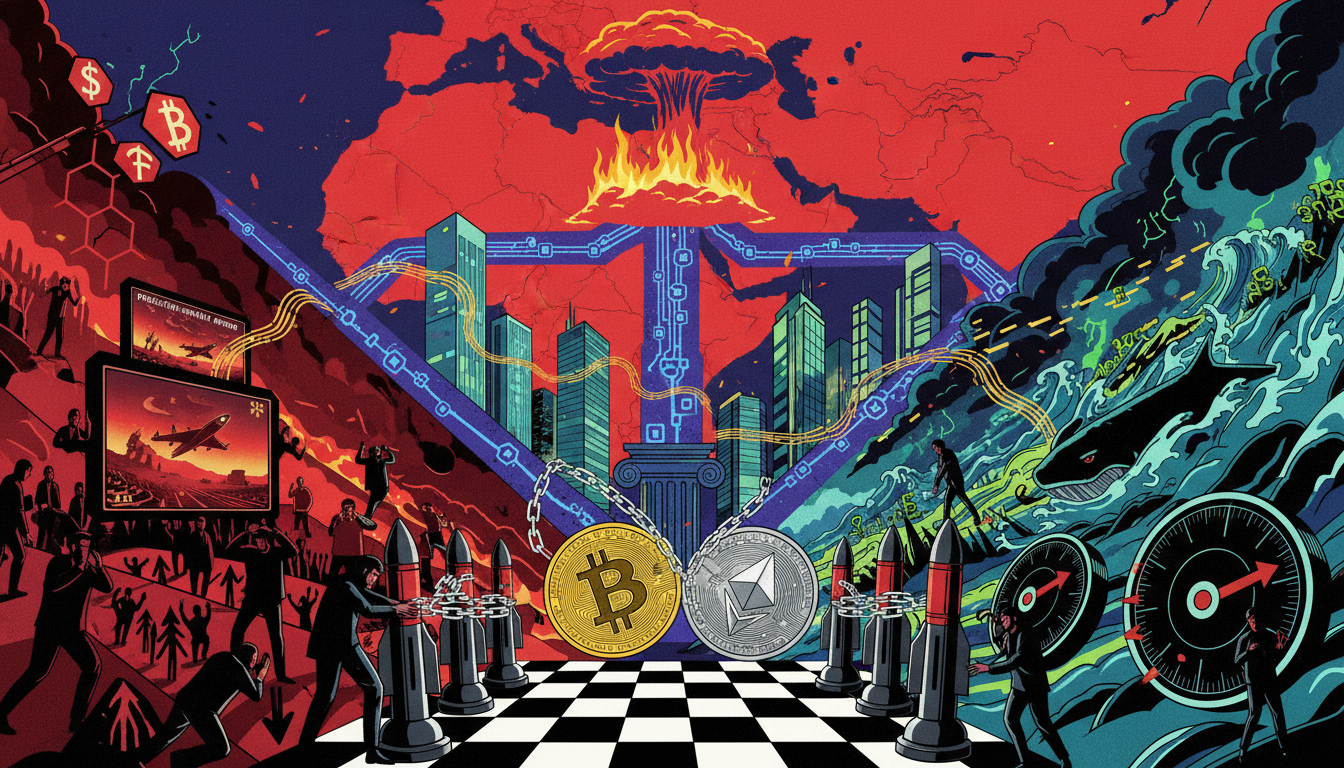
This week in East Eight District time, the precious metals and cryptocurrency markets experienced dramatic fluctuations within the same trading window: spot gold fell below $4,500 per ounce, plunging about 3% in a single day, while silver dropped to $67.8 per ounce, falling nearly 6.84% in a single day. At almost the same time, compliant cryptocurrency products were also unsettled—the U.S. Bitcoin ETF saw a passive net outflow of 1,488 BTC (according to a single source), with some funds quietly withdrawing from on-chain and brokerage accounts. According to traditional macroeconomic textbooks, under the circumstances of heightened geopolitical risks and market re-pricing of a “longer and higher” interest rate path, gold and silver should be actively embraced as safe havens, while crypto assets should bear greater selling pressure. However, this time, traditional hedging and high-volatility assets resonated and declined on the same trading candlestick, exposing cracks in the old narrative: how do funds migrate between gold and crypto? Furthermore, will the emerging regulatory new rules reshape the “safe haven landscape” in the minds of global funds before the next shock arrives?
Gold and Silver Plunge Together: A Tear in the Safe Haven Script
This week, the precious metals market exhibited a “dislocating” decline: gold prices rapidly broke through the $4,500 per ounce barrier, with a single-day drop of about 3%, with multiple instances of thick liquidity being directly pierced by large orders during the trading session; silver's trajectory was even more dire, hitting a low of $67.8 per ounce, with a single-day decrease of nearly 6.84%, technically retracing most of its previous gains. The sequence of price movements almost overlapped: first, gold faced persistent pressure during the Asian and European trading sessions, followed by a concentrated plunge in silver during the U.S. session, with futures and spot markets amplifying the volatility, leading to a collective failure of the traditional “hedging combination” at key price points within a matter of hours.
The catalyst for this sharp decline was not merely a singular sell order but a convergence of macro narratives: on one hand, the uncertainties brought about by escalating geopolitical conflicts should have favored precious metals, yet the market was more sensitive to the increased likelihood that the Federal Reserve would maintain high interest rates for longer, or even restart rate hikes under the conflict's disturbances. In the process of re-pricing “long-term high interest rates,” the holding costs of non-interest-bearing assets rose sharply, leading to a reassessment of the discount logic for gold and silver. On the other hand, the dollar and short-term interest rate assets regained attractiveness under the advantage of interest rate differentials, leading to a withdrawal of arbitrage and asset allocation from precious metals, providing “fuel” for this downward plunge.
This reality contrasts sharply with the classical narrative of “buying gold in times of peril” found in textbooks. In the old logic, gold was viewed as the ultimate safe haven during geopolitical crises and rising inflation expectations; however, in an environment of high interest rates and high cash yields, the market seems to be discarding all non-interest-bearing assets—regardless of their historical role as “safe anchors.” The hedging logic has not disappeared, but rather migrated: the previously almost automatic “risk rising = buy gold” formula is being replaced by more complex considerations of interest rates and liquidity.
From Gold Market to Crypto Market: Funds Shifting Amid the Storm
At the same time as precious metals plummeted, cryptocurrency compliant products also saw significant changes in fund flows. According to data from a single source, the U.S. Bitcoin ETF recorded a net outflow of 1,488 BTC during the same period, indicating that some compliant funds chose to reduce their short-term exposure to high-volatility risk assets amidst macro fluctuations. This “bloodletting” reflected through the ETF channel often represents a rebalancing of institutional or semi-institutional funds—they are more sensitive to risk budgets, margin requirements, and VaR constraints, and therefore tend to synchronously reduce their crypto positions during periods of overall heightened volatility in precious metals and stocks.
However, funds did not merely engage in mechanical “deallocation.” During the continuous plunge in gold and silver, some investors may have passively reduced their precious metals positions due to margin pressures, while others chose to actively take profits, lock in earlier gains, and then move some funds into higher liquidity, 24-hour continuous trading crypto assets to maintain maneuverability in macro event-driven markets. For traders with higher risk tolerance, transitioning from regulated gold and silver futures to seeking volatility premiums in crypto derivatives is also a reasonable path.
It should be emphasized that the net outflow of 1,488 BTC from the Bitcoin ETF in a single day and the net inflow of 301,187 SOL into the Solana ETF over a seven-day period both come from a single source. This means that when using such data to depict the migration of funds, it is essential to clearly mark the source and prudently keep the analysis within known limits, avoiding exaggerated extrapolations or assumptions about other products. The migration of funds between gold and crypto indeed exists, but in the face of deeply opaque cross-market structures, maintaining respect for the data boundaries is more important than weaving a perfect but distorted “linked story.”
Whales Shorting Gold with 4x Leverage: High Leverage Amplifies the Echo of Decline
Behind this round of precious metal declines, there exists a group of winners who use high leverage to gamble. According to information disclosed in reports, some whales bet on the downward direction of gold in advance, establishing large short positions with 4x leverage, resulting in floating profits of about $5 million during the market drop (according to a single source). From the perspective of individual stories, this trader is not merely “striking it rich”: prior to the re-pricing of geopolitical risks and interest rate expectations, they heavily positioned in directional shorts and assumed the liquidation risks brought by high leverage, which itself was a gamble on the macro narrative. The sharp drop was merely a validation and realization, while leverage geometrically amplified their correct directional gains.
However, for the overall market, high leverage shorts are not only the “beneficiaries” of the market but often also “amplifiers” of volatility. When prices break through key support levels, triggering technical sell-offs, the continuous adding, taking profit, and re-establishing of substantial shorts within the market creates downward transaction pressure on the order books. At the same time, the margin on the long side is eroded, triggering passive liquidations and forced liquidations, thus extending the selling chain downwards. Consequently, a price correction that could have been completed within a 1%-2% decline was amplified by the high-leverage structure into a waterfall decline of 3% or more.
This leverage amplification logic is even more extreme in the crypto market. Whether in perpetual contracts or options, the chain liquidations triggered by high-leverage positions during extreme market conditions can often execute price transitions in minutes that traditional markets might take hours or even days to experience. When precious metals and crypto assets are simultaneously under pressure from the same macro shocks, the leverage structures within the two markets may form a “negative resonance”: the decline of gold and silver amplifies risk aversion, leading to a clearing of leverage in Bitcoin and other mainstream cryptocurrencies, while the sharp corrections in crypto then deepen panic across the entire asset market, reinforcing the selling pressure on non-interest-bearing assets.
Regulatory Five-Class System Introduced: Official Boundaries of Safety and Risk
On the other side of short-term market tremors, a rewriting of regulation concerning “asset definitions” is silently advancing. The five-class digital asset guidance jointly issued by the U.S. SEC and CFTC aims not to label assets as “risk” once more, but rather to delineate at the regulatory level which crypto assets are closer to commodity properties and which are more akin to securities properties, designing differentiated regulatory and compliance pathways for different types of products. For institutional funds, this is equivalent to placing clear signposts in the originally ambiguous gray areas—indicating which can be allocated within the commodity trading framework, which must adhere to securities regulations, and which lie on the high-risk margins.
As Galaxy Digital's Research Director Alex Thorn stated, “the era of hostile regulatory stance under Gensler is entering history.” Behind this statement reflects a shift in regulatory attitudes from the defensive mode dominated by unilateral pressure and fines over the past few years to a more pragmatic thought process of “incorporating into a management framework.” With the support of the five-class guidance, regulatory bodies are beginning to acknowledge that some crypto assets already possess functions and market depths similar to traditional commodities or qualified securities. Rather than simply suppressing them, it is better to clarify boundaries and disclosure requirements to reduce systemic risk.
Meanwhile, the compliance push around the payment and settlement sectors is also advancing. According to Politico, both parties in the U.S. have reached a principle agreement on relevant bill clauses, described as “achieving bipartisan progress”; while in Asia, the Korean National Tax Service is advancing reforms in virtual asset custody, aiming to reshape the responsibility boundaries of the custody industry from tax and compliance angles. Although the specific provisions and execution details are still being refined, the directional signal is clear: regulators are no longer trying to push this asset category out of the traditional financial system, but rather paving a “compliance pathway” that can be utilized by institutions and hedging funds. From the perspective of the safe haven landscape, this means that in the future, when funds are choosing between gold, government bonds, and compliant crypto products, regulatory friction costs will no longer constitute overwhelming obstacles.
When Wall Street Rewrites the Safe Haven Script: The Triangular Relationship of Gold, Bitcoin, and Cash Yields
To understand why the current safe haven narrative is failing, one must return to the deeper logic of interest rates and opportunity costs. In a high-interest-rate environment, the opportunity cost of holding non-interest-bearing assets like gold becomes particularly pronounced: investors can achieve stable and not low nominal returns on short-term government bonds and money market funds, and even obtain yield curves linked to short bond rates in certain on-chain protocols. In contrast, gold and silver neither generate cash flow nor are immune to storage, custody, and transaction costs; as market expectations for “higher interest rates for longer” are reinforced, the rationale for holding onto precious metals while forsaking risk-free or low-risk yields is gradually being eroded.
In such an environment, Bitcoin and Ethereum are often defined in institutional perspectives as “high beta risk assets”, rather than pure “digital safe-haven tools.” When global risk appetites decline, institutions tend to simultaneously reduce their exposures in high beta stocks, growth stocks, and crypto assets; while when interest rate expectations shift towards easing and liquidity floods back, these assets gain opportunities for leveraged increases within the basket of risk assets. This explains why, during the plummet of precious metals and the overall turn towards defense, Bitcoin's price did not display a textbook-style “contrarian rise,” but rather faced downward pressure—it was seen by fund managers more as a “magnifying glass” pulled by macro winds rather than an “insurance policy” against all black swans.
Thus, a new narrative is forming: funds are no longer choosing between “gold vs Bitcoin” in a binary proposition but are dynamically switching between “cash and interest rate yields vs all risk assets”. When short bonds and money funds offer sufficiently attractive risk-free or low-risk yields, both gold and Bitcoin may be collectively reduced; whereas when the market begins to bet on a return to easing cycles and lower real interest rates, funds may then reallocate “beta weight” among different risk assets, at which point the ebb and flow between gold and crypto might come back into the spotlight. However, before that, debates over “who is the better safe haven” might be far less critical than asking “which asset offers a better risk-return ratio under the current interest rate and regulatory environment.”
Position Choices Before the Next Shock Arrives
From the interconnected volatility, it can be seen that the plummet in precious metals and the outflow of funds from crypto ETFs are the result of multiple intertwined factors such as geopolitical risks, interest rate hike expectations, regulatory frameworks, and leverage structures: geopolitical conflicts elevate uncertainty yet undermine the attractiveness of non-interest-bearing assets under high interest rate expectations; regulation moves from hostility to framework management, opening doors for compliant crypto products; while the interplay between whales and retail investors within high leverage structures amplifies every emotional fluctuation at critical price points, dragging prices to more extreme positions.
In the medium to short term, as long as the regulatory clarity continues to gradually ramp up without fully solidifying, the performance of risk assets will likely remain highly bound to macro liquidity and interest rate expectations, rather than returning to a one-dimensional “digital gold” narrative. Bitcoin, Ethereum, and precious metals will be seen to a greater extent as different points on the risk curve rather than distinctly separate “safe” and “speculative” camps. This means that the next time the market recalibrates the Fed’s path or experiences a new geopolitical shock, we are more likely to see “the entire basket of risk assets” being lifted or trampled together, rather than simple mirrored operations of “buy gold and sell crypto” or “sell gold and buy crypto.”
For traders and institutions, what truly needs to be considered is not “which is safer, gold or Bitcoin,” but rather how to redesign the weightings of gold, Bitcoin, and various yield assets in an environment where global regulatory reshaping and macro uncertainty coexist. During a high interest rate phase, moderately increasing cash and short bond proportions while compressing high beta exposures may be the main line of risk control; while in times of rising easing expectations, structured allocations adding layers to gold, Bitcoin, and on-chain yield products could be expected to amplify performance while controlling drawdowns. Hedging and yield have never been a strictly either/or question but rather a composite problem that needs continuous reevaluation and correction as macro and regulatory conditions evolve.
Join our community to discuss and grow stronger together!
Official Telegram community: https://t.me/aicoincn
AiCoin Chinese Twitter: https://x.com/AiCoinzh
OKX benefits group: https://aicoin.com/link/chat?cid=l61eM4owQ
Binance benefits group: https://aicoin.com/link/chat?cid=ynr7d1P6Z
免责声明:本文章仅代表作者个人观点,不代表本平台的立场和观点。本文章仅供信息分享,不构成对任何人的任何投资建议。用户与作者之间的任何争议,与本平台无关。如网页中刊载的文章或图片涉及侵权,请提供相关的权利证明和身份证明发送邮件到support@aicoin.com,本平台相关工作人员将会进行核查。