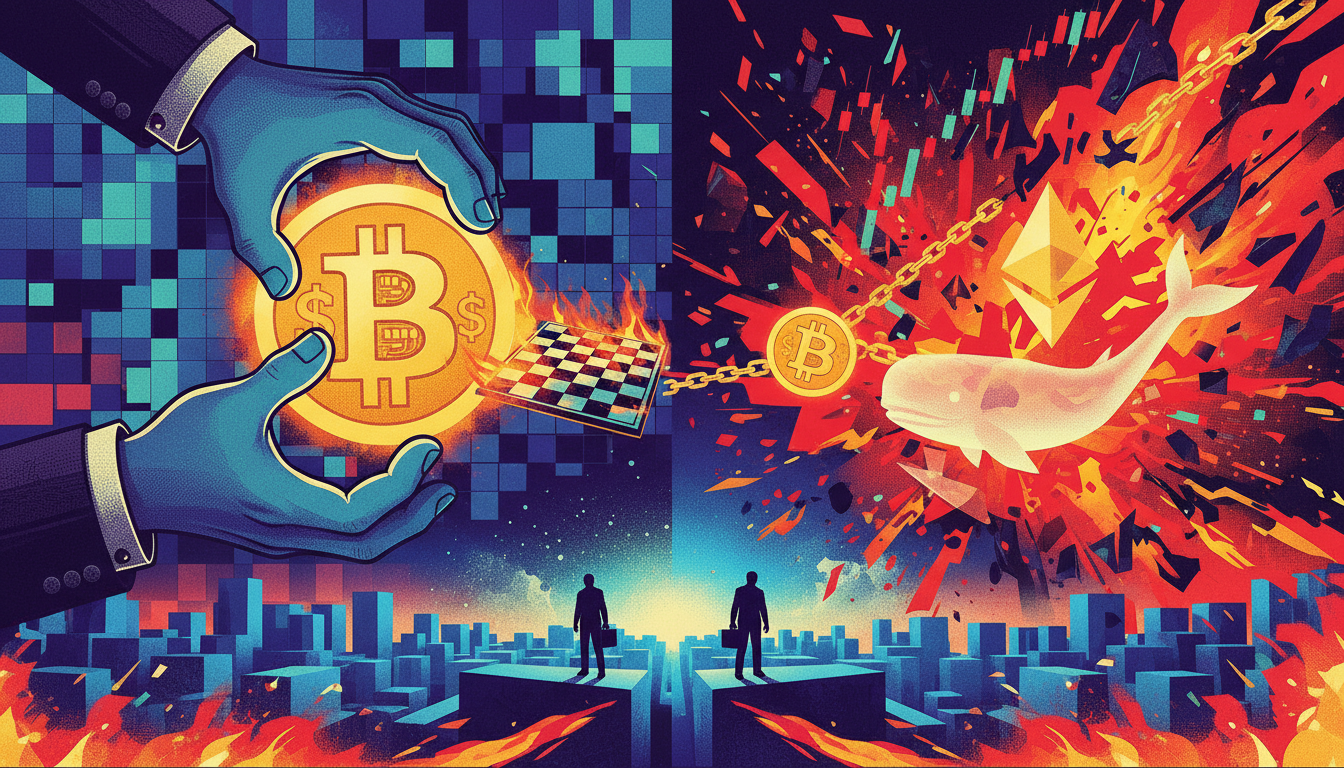
In late March 2026, Eastern Eight Zone Time, the market re-evaluated the Federal Reserve's interest rate hikes in October and December 2026 while digesting a series of regulatory and product signals, including the CFTC's FAQ on crypto business, Binance's announcement to delist some perpetual contracts, and Wirex's integration of the Morpho treasury. The expectation of rising interest rate probabilities stems from a single market pricing source, while the U.S. Commodity Futures Trading Commission (CFTC) aligned its regulatory stance, leading major exchanges to reduce risk exposures, and compliance fronts with DeFi infrastructure attempted to explore new funding pathways. Within this time slice, the pressure of high interest rate paths on liquidity, combined with newly opened channels from tokenized collateral, RWA, and institutionalized DeFi, formed the core axis of contradiction. It can be anticipated that interest rate expectations will continue to suppress the risk appetite and price centers of crypto assets in the short term, but institutional upgrades and infrastructure improvements are quietly reshaping the landscape and winner list for the next cycle.
Rising Interest Rate Expectations Lead Funds to Withdraw from High Volatility Assets
Surrounding the interest rate hike expectations of October and December 2026, market pricing has shown a significant increase in recent weeks: single-source data indicates that the probability of an interest rate hike in October 2026 has been traded at around 50%, while the implied probability of a December hike is generally seen as "high." This does not stem from official forward guidance but from the futures and interest rate swap markets reevaluating inflation resilience and growth paths. The steepening of the yield curve signifies that the previous consensus of "quickly lowering rates" is fracturing, with funds beginning to prepare for a longer duration of high rates.
A higher interest rate path directly raises the risk-free yield, making government bonds and money market funds attractive again, forcing the risk premium of crypto assets to narrow. In this environment, the opportunity cost of holding high volatility and high beta assets rises, and financing costs also increase: whether in OTC credit or on-exchange leverage, interest expenses are eroding nominal returns. For active traders, the value for maintaining high-leverage longs is rapidly decreasing, leading more funds to choose to reduce leverage, shorten durations, and flow back into tools that can lock in nominal returns.
Volatility signals have already provided feedback. Research briefs show that the crypto market volatility index CVI has increased by about 15% following the shift in Federal Reserve policy expectations, indicating that macro expectations are amplifying into significant asset price fluctuations. The uncertainty in macro interest rates has heightened hedging demand and amplified liquidation risks: leveraged funds in futures and perpetual contracts are more susceptible to triggering chain liquidations during sudden market fluctuations, leading to extreme "flash crash-rebound" price movements within a short time.
On the asset allocation front, decision-making logic between institutions and retail investors is gradually diverging in a high-interest-rate environment. Institutional investors, constrained by internal risk budgets and regulatory frameworks, tend to participate in crypto in a way characterized by "β compression and α outsourcing"—reducing overall exposure, increasing compliance requirements, and shifting towards more measurable sources of returns; retail investors, on the other hand, are becoming less tolerant of high-volatility assets against a backdrop of rising nominal rates and increased living costs, reducing short-term speculation and preferring assets that can provide stable returns or are supported by clear narratives. This shift provides a realistic foundation for subsequent regulatory guidance and product structural adjustments.
CFTC Throws out FAQ, Tokenized Collateral Moves to the Forefront
Simultaneously with the rise in high interest rate expectations, the U.S. CFTC released an FAQ on crypto-related businesses, providing clearer compliance guidelines for exchanges and brokers regarding the use of digital assets and tokenized collateral. The timing of the release, close to Binance's product adjustments and the macro expectation re-pricing, positions it as a key step in formally "connecting" traditional derivatives regulatory frameworks with on-chain assets. Market interpretations generally focus on its statements regarding tokenized collateral—clarifying how it is accepted, valued, and risk-controlled under existing rules.
Industry commentary stated directly, "The CFTC FAQ marks tokenized collateral entering mainstream financial infrastructure." The implication behind this statement is that regulatory narratives are shifting from past ambiguities and case-based enforcement to providing boundaries and conditions at the document level. For traditional financial institutions, having a framework means compliance departments can begin designing processes rather than simply rejecting all on-chain assets; for crypto-native institutions, this represents a narrative shift from the "regulatory gray area" to "regulated asset categories."
In terms of market direction, this FAQ offers a more predictable compliance pathway for tokenized RWA and other directions. The collateral position of tokenized treasury bonds, notes, and credit assets in the U.S. derivatives market is becoming increasingly clear, which helps bridge the margin system in traditional finance with on-chain assets—whether in exchange clearing, OTC structured products, or more complex hedging combinations, they can operate under a unified collateral pool. For "on-chain dollar assets," this represents the starting point for transitioning from purely arbitrage and yield strategies to being integrated into mainstream financial infrastructure.
Funding pricing has quickly given feedback. Research briefs indicate that tokens related to tokenized RWA directly benefiting from CFTC's new regulations have seen an overall increase of over 30% in the past week. Against the backdrop of rising macro interest rates and shrinking risk appetite, this performance is particularly notable: regulatory "recognition" not only reduces compliance uncertainty premiums but also drives the market to reassess valuations—projects capable of "connecting to mainstream financial pipelines" are willing to receive higher safety margins and longer growth expectations.
Binance Delists Contracts, Leverage Contracts Reduce, and Altcoin Liquidity
Under the dual pressures of regulation and interest rates, the risk management strategies of leading exchanges are also becoming more apparent. Binance announced it will delist APTUSD and OPUSD perpetual contracts on March 25, 2026, sparking widespread discussion in the market about Altcoin liquidity and derivatives depth. The event itself is not complex: the announcement specifies the delisting timeline and settlement arrangements, providing a transition period, but remains silent on the specific reasons for the internal decision.
Placed within the larger context of high interest rates and tightening regulations, this action resembles a step in the overall risk exposure optimization. More expensive capital means that margin gaps in extreme market conditions are harder to fill, and regulatory scrutiny on contract products is strengthening. In such an environment, major platforms tend to reduce leverage exposure to long tail and high volatility varieties, concentrating resources and risk budgets on more liquid and clearly regulated mainstream targets, in order to reduce the transmission of tail risk events to the platform level.
Combining this with the earlier mentioned CVI rising 15%, one can see the exchange's response logic more clearly: in a phase of rising systemic volatility and increasing liquidation risks, the strategy of delisting certain perpetual contracts, raising margin requirements, and compressing maximum leverage ratios guides the market to voluntarily deleverage, thereby structurally reducing the space for "waterfall forced liquidations." Binance's adjustments regarding the APT and OP contracts reflect this dimensional "brake" on products.
It is important to emphasize that the specific reasons for the delisting have not yet been disclosed, and speculation cannot be undertaken in the absence of information. Observably, the more direct impact is a decline in derivatives depth for the related Altcoins, forcing adjustments in some short-term strategies and hedging structures, and the price discovery function of the spot order books may weaken in the short term. For project parties and market makers, losing the important liquidity and price management tool of perpetual contracts on large platforms will compel them to re-evaluate token liquidity layouts on different exchanges and chains, and the overall logic of Altcoin's "long tail prosperity" will also be put to the test.
Wirex Bets on DeFi, Institutional Pathways Taking Shape
In contrast to the risk contraction on the exchange side, payment and asset management fronts are attempting to open compliant yield channels in DeFi. According to research briefs, payment and card service provider Wirex has integrated the Morpho treasury to manage over 10 million dollars in corporate funds and is collaborating with the risk management team Gauntlet. This combination links the compliant front familiar to traditional financial institutions, professional risk models, and highly efficient DeFi treasuries, attempting to provide institutions with auditable and explainable on-chain yield solutions.
Analysts' opinions are relatively consistent: "The Wirex-Gauntlet collaboration showcases the institutional-level DeFi risk management demand." A high interest rate era does not mean institutions simply withdraw from crypto and on-chain assets, but signifies a significant increase in the demand for "controllable returns and transparent risks." In the face of government bonds and money market funds that can provide nominal risk-free returns, attracting institutional funds into DeFi requires closely aligning or even benchmarking governance structures, contract security, exposure management, and audit visibility to traditional financial products.
Under the dual pressures of interest rate hikes and regulations, the combination of compliant front (Wirex) + auditing and risk model (Gauntlet) + efficient treasury (Morpho) is reshaping the funding channel's structure. Funds start from corporate accounts and enter on-chain treasuries through regulated interfaces, with risk exposure modeled and monitored by professional teams, ultimately forming a closed loop acceptable to risk control committees and audit institutions. This not only alleviates institutional concerns about "black box yield farms" but also provides a template for larger-scale on-chain asset allocation in the future.
This institutionalized DeFi practice resonates with the CFTC's attitude towards tokenized collateral in the FAQ: on one end, regulators are incorporating tokenized assets into mainstream financial infrastructure, and on the other, the front end and infrastructure are working together to build “regulatable and auditable” funding channels. For "on-chain dollar assets" and RWA narratives, this dual push (from regulatory top-down and product bottom-up) provides new support for competing for stock capital in a high interest rate era.
From OpenAI to the Redistribution of Crypto Tech Venture Capital
High interest rates not only reprice crypto assets but are also reshaping the internal structure of the entire tech risk asset pool. Research briefs indicate that investment firm Eightco plans to increase its holdings in OpenAI to about 90 million dollars, occurring against a global backdrop where tech stock valuations generally face interest rate suppression. High-growth tech companies, especially leading firms related to artificial intelligence, are becoming the preferred choice under the limited risk budget.
In terms of fund attributes, high-growth tech stocks and high-volatility crypto assets often share the same pool of risk capital—whether family offices, hedge funds, or some high-net-worth individuals. In a high interest rate environment, this capital is more inclined to weigh choices between “high growth + certainty” and “high volatility + unstable narratives.” Tech targets like OpenAI that have clear commercialization paths and potential cash flows naturally receive higher prioritization compared to crypto assets lacking predictable cash flows and facing greater policy uncertainty.
The narratives of AI and crypto are forming a subtle intertwining in the capital market. On one end, AI companies are priced through equity structures and future cash flow discounting, while on the other, crypto projects harbor expectations through tokens and on-chain yields. Within the broad category of “tech + risk assets,” rising interest rates effectively lower overall levels, forcing capital to redistribute among different sub-tracks: some capital originally willing to bear higher volatility and bet on on-chain ecosystems is now shifting to increase positions in leading AI stocks or publicly listed companies related to AI.
During this redistribution process, although the overall tech risk assets face interest rate suppression, those tracks providing real cash flow or supported by clear compliance frameworks clearly have a better chance to become "survivors." For crypto, those directions that can establish stable links with real assets and tangible businesses—like RWA, on-chain settlements, and certain AI + Crypto applications—are more likely to attract remaining risk capital in this round of selection. Interest rates become the unified discount rate, while compliance and cash flow become the key variables determining who gets discounted and who gets premium.
High Interest Rates and Regulatory Races: Who Will Change the Crypto Landscape First
From the above clues, a seemingly contradictory yet highly consistent picture is taking shape: on one hand, higher interest rate expectations and paths are continually suppressing crypto prices and risk appetite in the short term; on the other hand, initiatives such as the CFTC FAQ, Wirex—Morpho—Gauntlet, and other infrastructures and practices are quietly building a more solid institutional and technical foundation for the next cycle. Prices are currently governed by "high rates—high volatility," while structures and rules are silently upgrading during this adjustment period.
In terms of direction, the CFTC FAQ sets a regulatory tone for tokenized collateral and RWA, while Binance's delisting of some perpetual contracts and reduction of long tail risks conveys a more conservative attitude towards leverage and volatility, and Wirex and Morpho's cooperation showcases the embryonic form of institutionalized DeFi funding channels. Together, these trends point toward one conclusion: liquidation and leverage channels are tightening while the entry points for compliant funds are increasing. In other words, the difficulty of “betting on volatility” is increasing, while the paths for “profiting from spreads and structural returns” are becoming more standardized.
In the medium term, if the interest rate paths for October and December 2026 ultimately materialize and are realized as per current market pricing, high-cost funds will continue to drive speculative leverage unwinding, leading to a harsher reshuffle of strategies and projects in the crypto market that depend on high volatility and high leverage for survival; meanwhile, RWA linked to real assets, tokenized collateral incorporated into mainstream infrastructure, and DeFi products designed with institutional demands in mind are likely to attract some capital fleeing the purely speculative domains, becoming a new "safe haven" for crypto funding in a high interest rate era.
However, all of this is predicated on assumptions about macro and regulatory paths. It must be noted that there exists a significant possibility of deviation between the Federal Reserve's ultimate actual decisions and the current market's projected interest rate probabilities, as single-source pricing does not equate to official commitments. Similarly, the formulation of detailed rules, enforcement methods, and compliance costs following the CFTC FAQ may also exceed the market's current optimistic expectations, adding additional pressures to certain business models. For investors, in a phase where high interest rates and regulatory reshaping run parallel, it is important to recognize the structural opportunities brought about by institutional upgrades while also being mindful of the floating losses and volatility risks under the dual uncertainties of macro paths and policy implementations.
Join our community to discuss together and become stronger!
The official Telegram community: https://t.me/aicoincn
AiCoin Chinese Twitter: https://x.com/AiCoinzh
OKX benefits group: https://aicoin.com/link/chat?cid=l61eM4owQ
Binance benefits group: https://aicoin.com/link/chat?cid=ynr7d1P6Z
免责声明:本文章仅代表作者个人观点,不代表本平台的立场和观点。本文章仅供信息分享,不构成对任何人的任何投资建议。用户与作者之间的任何争议,与本平台无关。如网页中刊载的文章或图片涉及侵权,请提供相关的权利证明和身份证明发送邮件到support@aicoin.com,本平台相关工作人员将会进行核查。