On March 20, 2026, Eastern Eight Time, the United States Court of Appeals for the Ninth Circuit made a key ruling on the Kalshi case, while the SEC simultaneously released signals to reshape the digital asset regulatory framework. At the same time, on-chain monitoring detected that a large whale withdrew 4,154 ETH (approximately 8.87 million USD) in one day. The combination of these three forces within the same time window constitutes an extreme test of regulatory and market resonance. On the same day, in the traditional market, MSTR, seen as a representative of Bitcoin exposure, fell 1.65%, prediction market concept stock SBET dropped 2.41%, and the TVL of on-chain risk control giant Gauntlet plummeted 22.84% to 1.325 billion USD. The funding curve and stock price curve weakened together, outlining a vivid picture of "regulatory thunder." Under the pressure of the regulatory iron triangle—court, SEC, and Congress—the crypto market is being forced to oscillate between fear-driven reduction in positions and institutional self-rescue; the issue is no longer "whether to comply," but rather "at what cost to achieve self-transformation."
Court Endorsement of Prediction Market Ignites Regulatory Focus
At the starting point of this storm, the Ninth Circuit Court's ruling on Kalshi is viewed by many market participants as a milestone for prediction market products. Although public materials are insufficient to fully restore all the legal details, it can be confirmed that this is an important judicial judgment that directly touches on "whether tradable contracts can be designed around real-world events." For a sector that has long lingered in the regulatory gray area, the appellate court's statement itself shines a spotlight on the previously scattered vague boundaries in regulatory language and enforcement cases.
Market voices often carry highly generalized evaluations—this is "the first judicial endorsement of prediction market-type crypto products at the federal appellate court level." This expression spreads rapidly not only because of its striking wording but also because it brings "regulation" and "innovation" to the same table: on one side, there are entrepreneurial teams hoping to reshape the information market through event contracts and policy prediction markets; on the other side, there are regulators adhering to existing regulatory frameworks, concerned about speculation spilling into political and public decision-making. Kalshi has been pushed into the spotlight, becoming a symbolic carrier of this confrontation.
Thus, this case is seen by many project parties as a potential "touchstone" for future compliance paths. For other prediction markets and structured derivatives teams, the appellate court's attitude will be meticulously dissected: which design features are more likely to be tolerated, which boundaries may trigger immediate responses, and which project forms must avoid. Such precedents will not immediately become a clear operating manual but will quietly shape the product structure and geographical distribution of the entire sector through judicial hints about "what can be done" and "what cannot be done."
SEC Releases New Framework Signals Amid Congressional Pressure
Almost simultaneously with the court's ruling, the SEC has maintained a high-pressure stance across several sub-sectors. Research briefs show that in recent times, the SEC has been active in areas such as staking services, and USD-pegged asset issuers, launching severe inquiries regarding custody and yield structures and taking enforcement actions around issuance, redemption, and information disclosure. Although public documents have yet to outline a complete new regulatory framework for digital assets, the reality of "modular pressure" has effectively formed a high-pressure network.
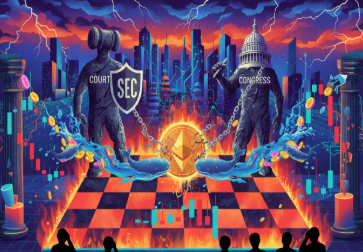
Behind this network, there is also legislative progress in Congress exerting simultaneous effort. The "Cryptocurrency Clarity Act" is at a critical window period, aiming to delineate clearer boundaries between securities and commodities for some crypto assets. Thus, a classic regulatory triangle is gradually taking shape: the SEC leads daily regulatory rhythms through enforcement and statements, the court provides judicial constraints and interpretative space through cases like Kalshi, and the Congress attempts to draw new boundaries for the game through legislation. The three parties restrain each other yet also leverage one another, while the boundaries of regulatory power are being rewritten in turbulence.
During this process, even though the SEC has not published a specific timeline for the new digital asset framework, it can still reshape market expectations through "strong signal management." The order of enforcement, the wording of public statements, and choices concerning exemptions or tightening in specific cases will all be interpreted as roadmaps by project teams. For staking services, USD-pegged asset issuers, and even prediction market teams, whether to conservatively reduce their positions early or to bet on a policy shift to increase investment largely depends on the strength and continuity of these signals. As a result, before formal rules have landed, project teams have already been forced to use real money to pay for their "predictions" about regulatory developments.
Whale Withdraws 4,154 ETH and TVL Responds with Cliff Divergence
As regulatory narratives ferment at the institutional level, on-chain funds are providing a colder response. On March 20, Eastern Eight Time, a single-day withdrawal of 4,154 ETH was captured by on-chain monitoring tools, translating to approximately 8.87 million USD based on that day's price. Such large transfers will naturally be interpreted by the market as "whales making a statement," but under limited information, we can only confirm its scale and timing, and cannot nor should speculate on the identity and real motives behind the address.
On the same day as this transfer, Gauntlet experienced a severe shrinkage in TVL—public data shows its total locked volume dropped 22.84% in one day to 1.325 billion USD. This is not simply a "slight retreat in line with market fluctuations," but a change resembling an abrupt "cliff" in the curve's shape. Against the backdrop of the overall market not experiencing a comparable magnitude of decline, such anomalies are particularly conspicuous. Market comments even directly point out: "The cliff-like decline in TVL reflects the extreme sensitivity of DeFi protocols to regulatory signals."
If we regard the actions of the court and SEC as "regulatory barometers," then the whale's transfer and the sharp decline in TVL represent the corresponding "funding barometers." The temporal overlap of the two leads many participants to attribute it to heightened regulatory expectations—even if this attribution may not be entirely accurate, it suffices to shape a collective emotion: under the shadow of high pressure, reducing leverage first and withdrawing exposure first is a safer instinctive reaction. Therefore, the regulatory narrative does not merely stay at the level of media headlines but is immediately inscribed in the flow curve of on-chain funds.
Secondary Market Chain Reaction from MSTR to SBET
This round of "regulatory thunder" is not limited to the on-chain world. On March 20, MicroStrategy (MSTR), seen as a representative of Bitcoin exposure, dropped 1.65%, while SBET, related to the concept of prediction markets, fell 2.41% (both sourced from a single source). These types of assets have long been used as indirect indicators of crypto sentiment— the former often amplifies confidence or concerns about BTC's future path due to its heavy Bitcoin holdings; the latter is closer to the "prediction market" narrative, serving as a carrier reflecting regulatory attitudes toward event contracts.
When MSTR and SBET synchronized in their pullbacks within the same trading day, coinciding with the timing of the Kalshi ruling and SEC's strong regulatory signals, the market finds it hard to view all of this as purely "technical fluctuations." The prediction market concept stocks and Bitcoin-exposed assets under pressure seem more like a cross-market repricing of risk— the triple game of the court, regulators, and legislative bodies is converted into valuation discounts, reflected in the prices of traditional financial assets.
For institutional investors, risk reduction in such an environment is often composite: on one hand, reducing or hedging equity exposure directly related to crypto, for example, by lowering weights of MSTR, SBET, etc., to avoid excessive shocks to net value from regulatory news; on the other hand, synchronously reducing positions or transferring in the on-chain asset side to lower exposure to highly uncertain sectors. The sense of division between traditional markets and the on-chain world is weakening, and when regulatory uncertainty heats up, risk control decisions often land simultaneously across both markets, creating a dual chain reaction of prices and liquidity.
Long-Term Compliance Migration Under Short-Term Regulatory Shadows
When extending the perspective, it can be seen that short-term price fluctuations and TVL withdrawals are merely a surface manifestation of a grander structural migration. The whale transfer on March 20 and Gauntlet's single-day TVL drop of 22.84% certainly enhanced market sensitivity to regulatory winds, but at the team level, many project parties have already begun seeking new compliant jurisdictions and business structures for prediction markets, DeFi protocols, and even staking services. These arrangements will not be publicly declared in high-profile announcements but will quietly complete through changes in registration locations, license applications, and product structural adjustments.
Tracks like prediction markets and staking services are likely to unfold a round of "dual migration in geography and structure" between the US and other judicial jurisdictions. In the United States, court cases and SEC enforcement are jointly tightening spaces, but at the same time, certain countries and regions that are more tolerant of financial innovation and have more inclusive regulatory frameworks may become experimental grounds for teams—validating compliant product models first in relatively friendly environments, then deciding whether to "reflow" to the mainstream market based on the legislative direction of the US "Cryptocurrency Clarity Act," etc.
During this long-term migration process, the gray period of "testing the waters before aligning with legislation" becomes the trickiest management problem. Project teams hope to seize the initiative and quickly accumulate users and liquidity, while at the same time having to consider the systemic risks of being enforced upon, delisted, or cut off from USD channels. This tension directly determines the upper limit of innovation speed: being too aggressive might lead to short-term outbreaks but fail to survive in the medium to long term, while being too conservative might result in being eliminated before the truly compliant new era arrives.
Fearful Sell-offs or Structural Redefinition After Regulatory Pressure
Considering the court ruling, SEC signals, and on-chain fund migration, March 20 can be viewed as a phased "regulatory shock stress test." From the critical progress of Kalshi in the Ninth Circuit Court, to the SEC's high-pressure stance on staking services and USD-pegged asset issuers, to the whale's 4,154 ETH transfer, Gauntlet’s TVL dropping to 1.325 billion USD, and the pullback of MSTR and SBET, this series of events acts like a continuous shock wave from institutions to funding to emotion, releasing concentrates in a short time.
From current data, this round of pullbacks and TVL contractions looks more like a rapidly repricing dominated by emotion rather than a confirmed "trend escape." The "cliff-like" decline in TVL does indicate the extreme sensitivity of DeFi protocols to regulatory winds, but this sensitivity itself is also a common feature in the late stages of bull-bear transitions: funds exhibit a sharply reduced tolerance for uncertainty, reacting magnifiedly to any news that might alter regulatory boundaries. For participants, the key lies in learning to distinguish between noise and turning points—what represents a gradual tightening along existing regulatory logic, and what are genuine structural fractures that change the rules of the game.
Looking ahead, once the "Cryptocurrency Clarity Act" is enacted, the US market is expected to welcome a round of "new order reconstruction": the survival space for compliant prediction markets and DeFi protocols will be delineated more clearly, and those projects that complete compliance migration, survive in regulatory gaps, or even align with regulatory requirements ahead of time may enjoy a premium from valuation repricing; while models lacking in compliance readiness or heavily reliant on policy vacuums for survival may quickly lose their foothold under the new rules. The high pressure of the regulatory iron triangle will not disappear in the short term, but for truly resilient crypto infrastructures, it seems more like a delayed "final exam" — only those who pass can enter the main stage of the next cycle.
Join our community to discuss and grow stronger together!
Official Telegram community: https://t.me/aicoincn
AiCoin Chinese Twitter: https://x.com/AiCoinzh
OKX Benefits Group: https://aicoin.com/link/chat?cid=l61eM4owQ
Binance Benefits Group: https://aicoin.com/link/chat?cid=ynr7d1P6Z
免责声明:本文章仅代表作者个人观点,不代表本平台的立场和观点。本文章仅供信息分享,不构成对任何人的任何投资建议。用户与作者之间的任何争议,与本平台无关。如网页中刊载的文章或图片涉及侵权,请提供相关的权利证明和身份证明发送邮件到support@aicoin.com,本平台相关工作人员将会进行核查。