This article is a deep research report produced by OKX Ventures. Due to the length, it will be published in two parts: the first part focuses on the macro background, x402 protocol, ERC-8004, and Virtuals Protocol; the second part will analyze OpenClaw and overall industry trends, so stay tuned.
Abstract
AI Agents are evolving from passive assistants to active economic participants. This report consists of six chapters, systematically reviewing the core infrastructure stack of the Agent economy, application ecosystem explosion, and industry evolution pattern: a macro-level analysis of market forecasts and infrastructure gaps for Agentic Commerce; an in-depth analysis of the three complementary protocols: x402, ERC-8004, and Virtuals Protocol; application layer case study of OpenClaw to explore the real path of Agent economy's implementation; and finally, a comprehensive industry judgment from dimensions such as competitive landscape, payment routes, security threats, and business models.
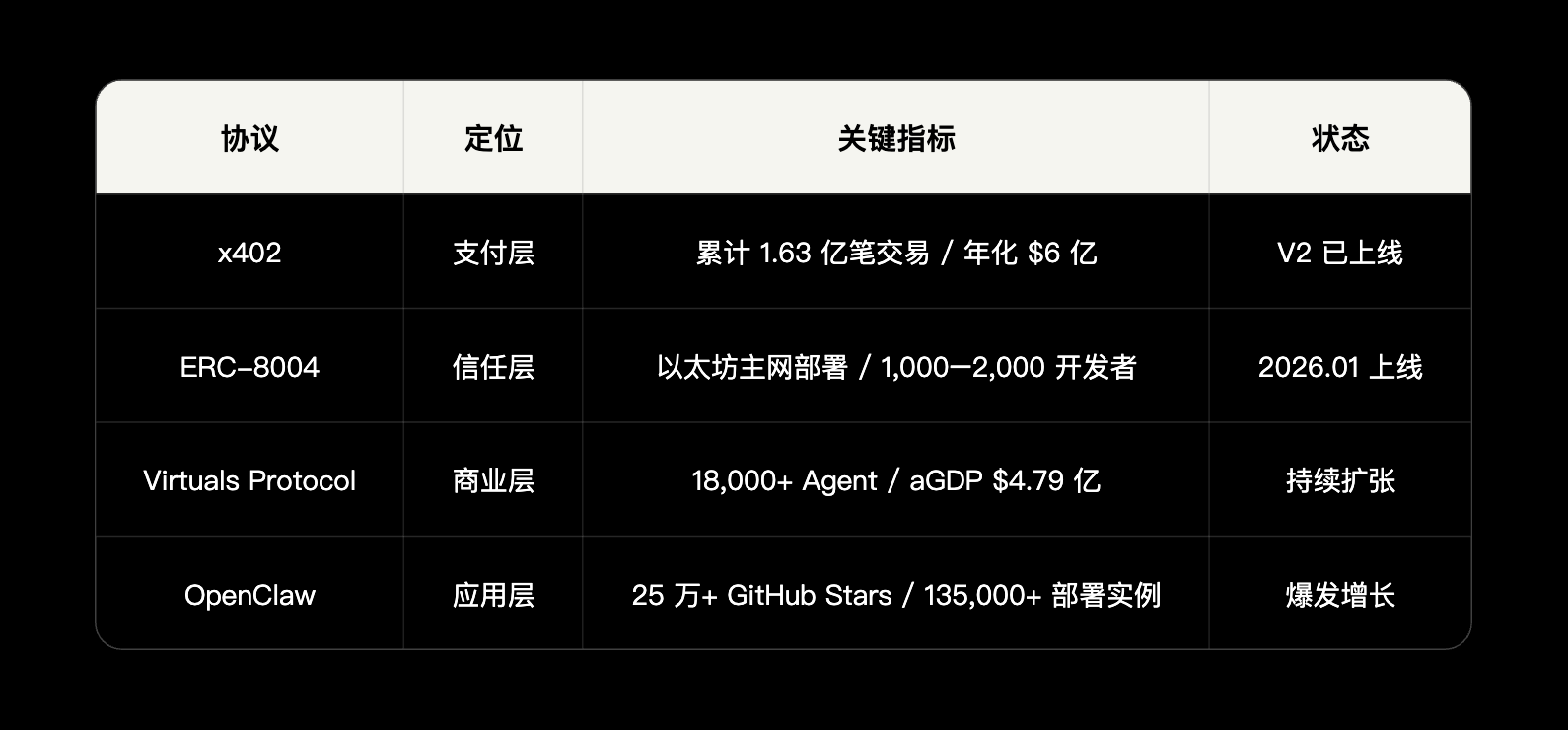
x402 (payment layer) was co-launched by Coinbase and Cloudflare, embedding stablecoin micropayments within the HTTP protocol layer. By the end of 2025, it is expected to process over 100 million transactions, with an annual payment volume reaching 600 million US dollars.
ERC-8004 (trust layer) is proposed by the Ethereum Foundation dAI team in collaboration with MetaMask, Google, and Coinbase, providing on-chain identity, reputation, and validation registries for AI Agents, scheduled to launch on the Ethereum mainnet on January 29, 2026.
Virtuals Protocol (business layer) builds a complete commercialization platform for Agents, enabling autonomous transactions between agents through ACP. Over 18,000 Agents have been deployed, with aGDP exceeding 479 million US dollars.
OpenClaw (application layer) was developed by Austrian developer Peter Steinberger and surpassed React within four months, gaining over 250,000 GitHub Stars and becoming the fastest-growing open source project in GitHub history. It integrates AI natively into more than 20 existing messaging platforms, triggering the Crypto community to spontaneously build on-chain economic infrastructure, which is a core example of observing the true interaction between Agents and on-chain protocols in this report.
Chapter One Macro Background
1.1 Market Size Forecast
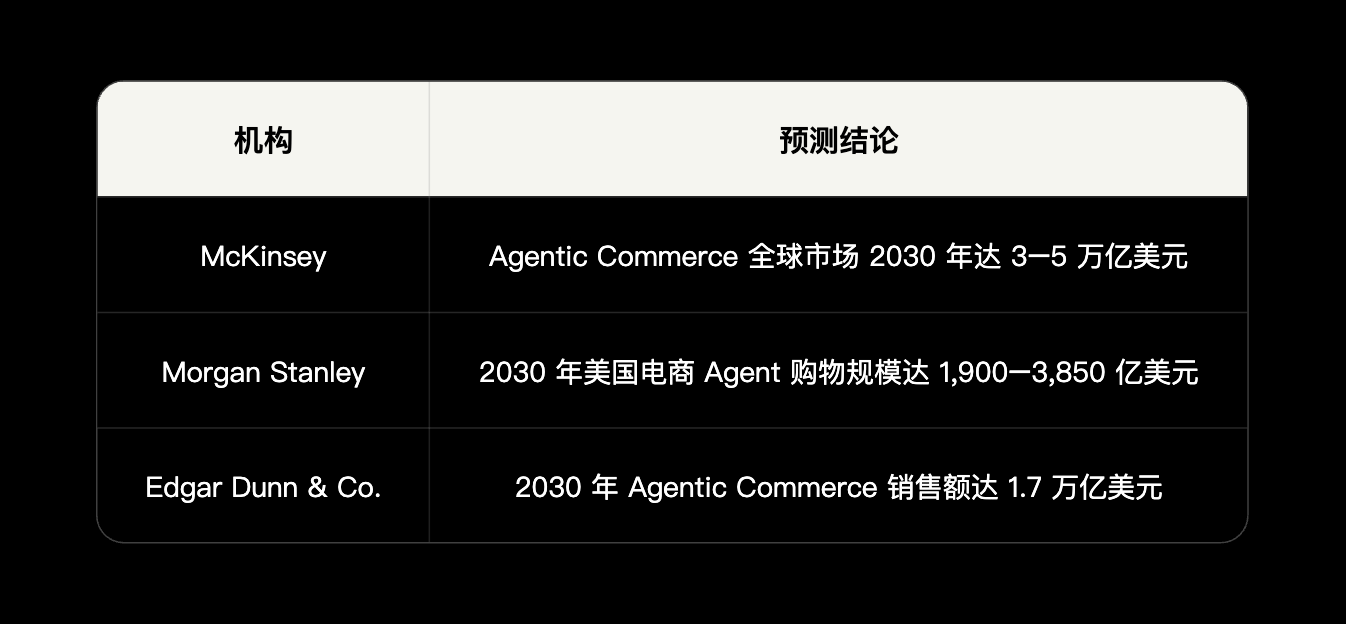
The Agentic Payment sector is in a rapid expansion phase, with several institutions having optimistic forecasts for its market size:
1.2 Infrastructure Gaps
The existing infrastructure is hostile to the Agent economy: OAuth requires human clicks, credit card forms require manual entry, and data islands hinder autonomous access. Agents are capable of independent thought and action at the "capability level," but remain locked in infrastructure designed for humans at the "economic level" (identity/coordinating/economic activities).
Currently, two evolutionary paths are emerging:
- Centralized Compliance Path: A2A communication + tool access MCP + payment AP2/ACP (led by OpenAI and Stripe, purely Web2)
- Decentralized Permissionless Path: x402 + ERC-8004/8183+ ACP (Agent collaboration framework)
1.3 Key Timeline
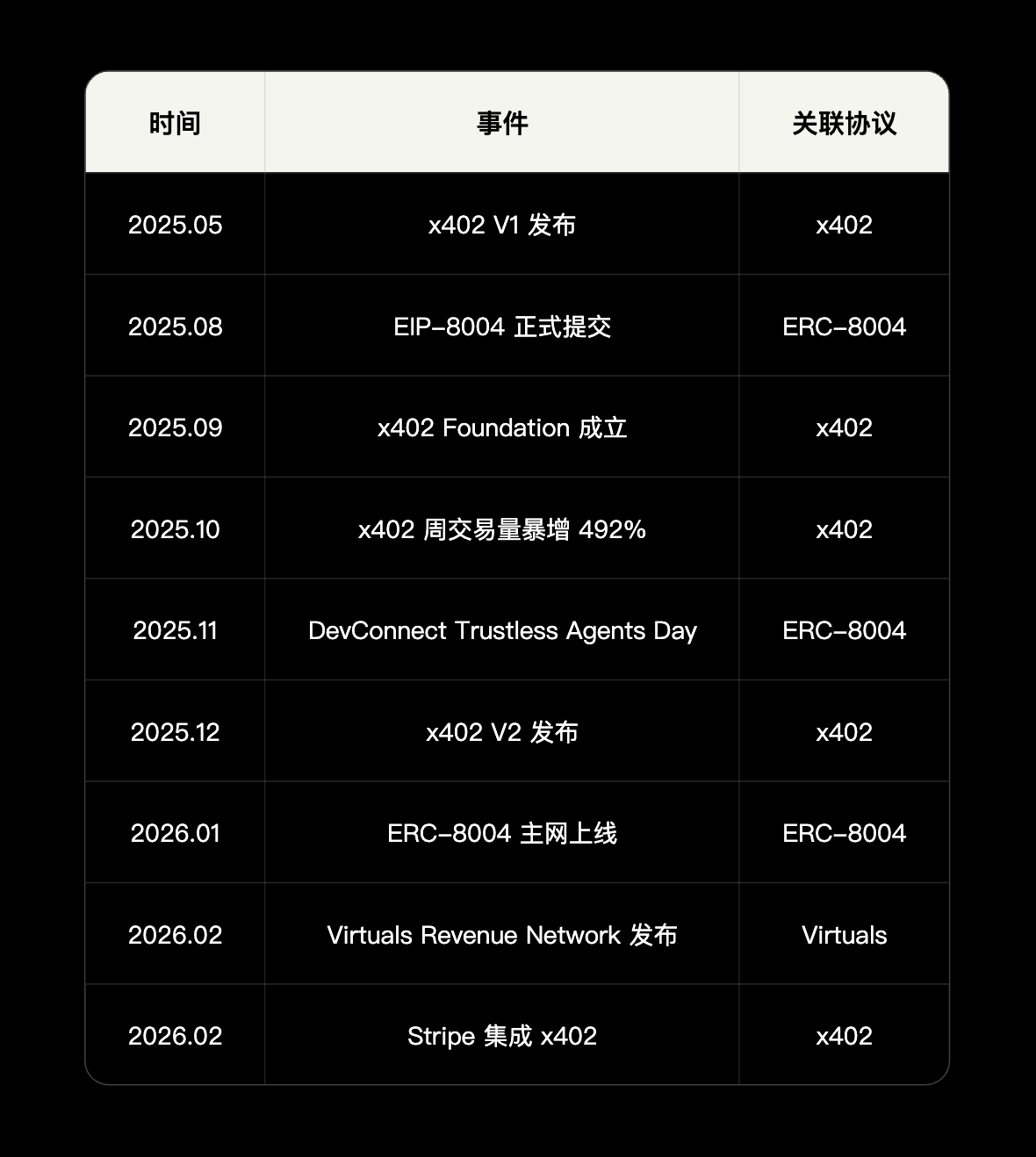
Note: As of March 2026, daily transaction volume has significantly dropped from the December peak, with infrastructure-related declines being the most substantial (>80%).
Chapter Two x402 Protocol: Agent Payment Layer
x402 is an open-source payment protocol that revives the HTTP 402 status code, allowing any HTTP request to natively carry stablecoin payments, enabling AI Agents to conduct instant pay-per-use transactions.
Understanding x402 requires recognizing it not as just another payment protocol. It represents a redesign of the fundamental unit of economic activity: shifting from “register → review → authorize → use” to “pay → use.” x402 = "Swift for agents."
The operation of the current API economy relies on an implicit assumption: that a human is mediating in between. The process of obtaining an API Key—register → fill in email → review → copy Key → paste into code—assumes human participation at every step. This process cannot work under the Agent economy because AI Agents cannot register, fill forms, or manage Keys by themselves. x402 leverages the HTTP 402 status code to achieve native stablecoin payments. After receiving a 402 response, an Agent can make a direct on-chain payment (USDC) and obtain a receipt after payment is completed.
2.1 Protocol Overview and Workflow
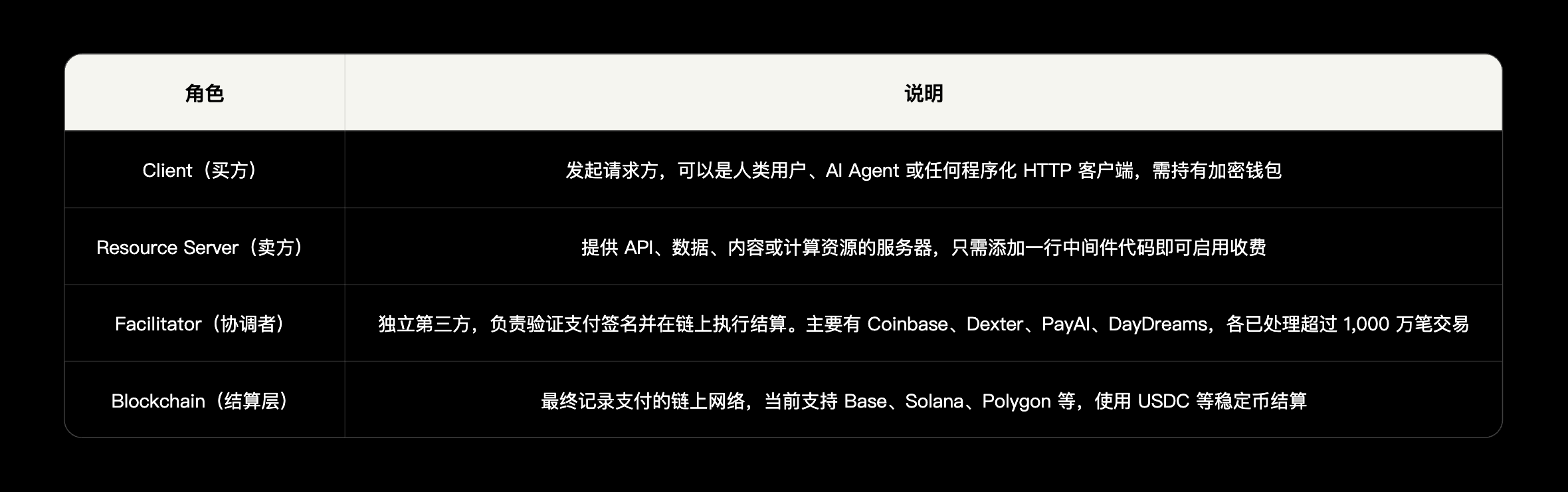
Core Roles
Five-Step Transaction Process
- Request Resource: Client sends a standard HTTP request to the Resource Server (such as GET /api/weather)
- Return Quote: Server returns HTTP 402 status code, with the response header containing structured payment requirements (currency, amount, wallet address, network)
- Sign Payment: Client constructs and signs the payment authorization using wallet private key, placing the signed payload into the X-PAYMENT request header and resending it
- Verify Settlement: Server forwards payment information to Facilitator for verification; after confirmation, the Facilitator executes stablecoin transfer on-chain
- Deliver Resource: After receiving confirmation, Server returns data/content/computation results to the Client
The entire process from initiating the request to receiving the resource takes about 2 seconds.
Comparison with Traditional Payment Methods
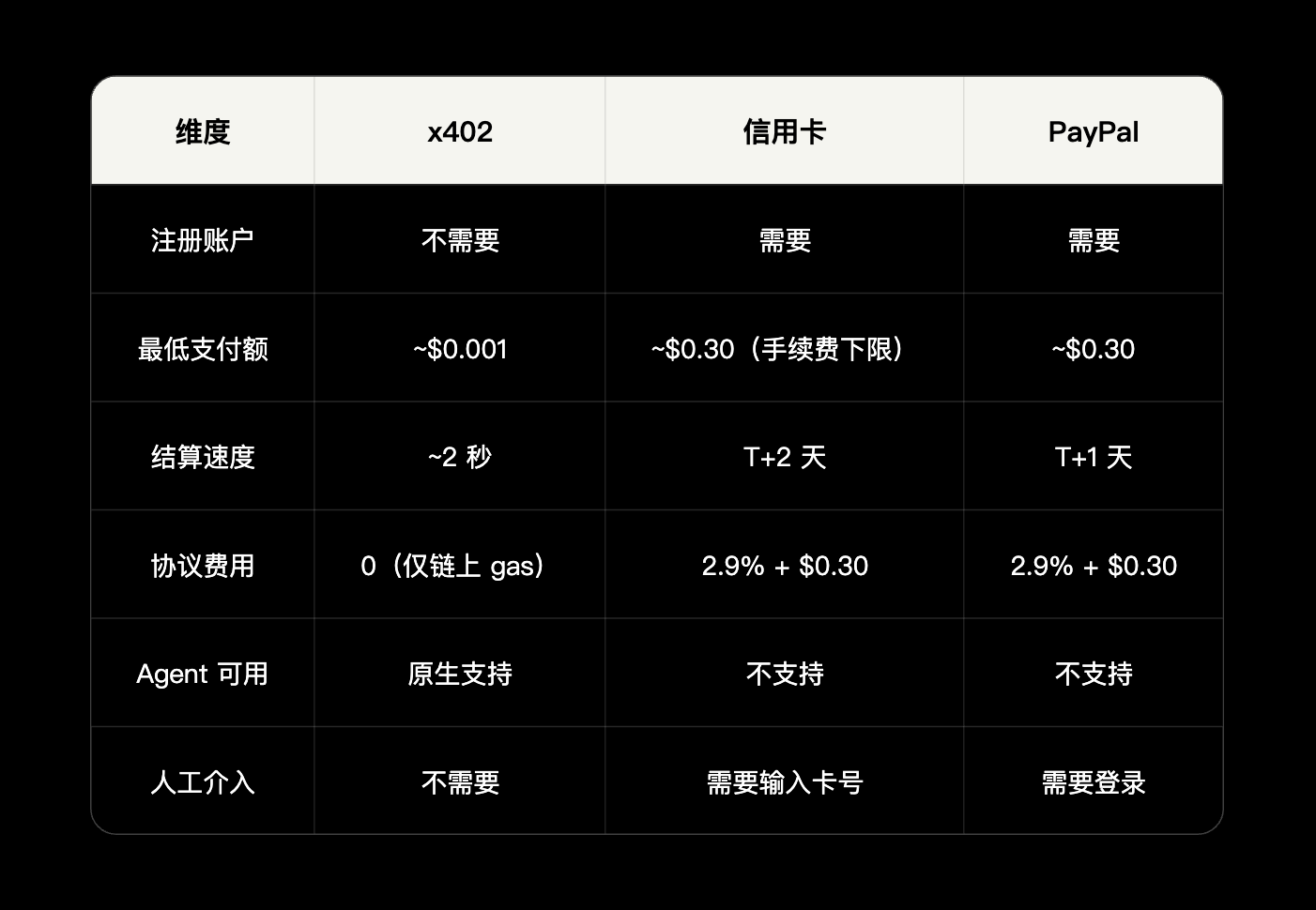
Core features: No account registration required, no API Key required, no subscriptions required, no human intervention necessary. Payments are as natural as sending HTTP requests, which is why it is referred to as the "internet-native payment layer."
2.2 Key Data
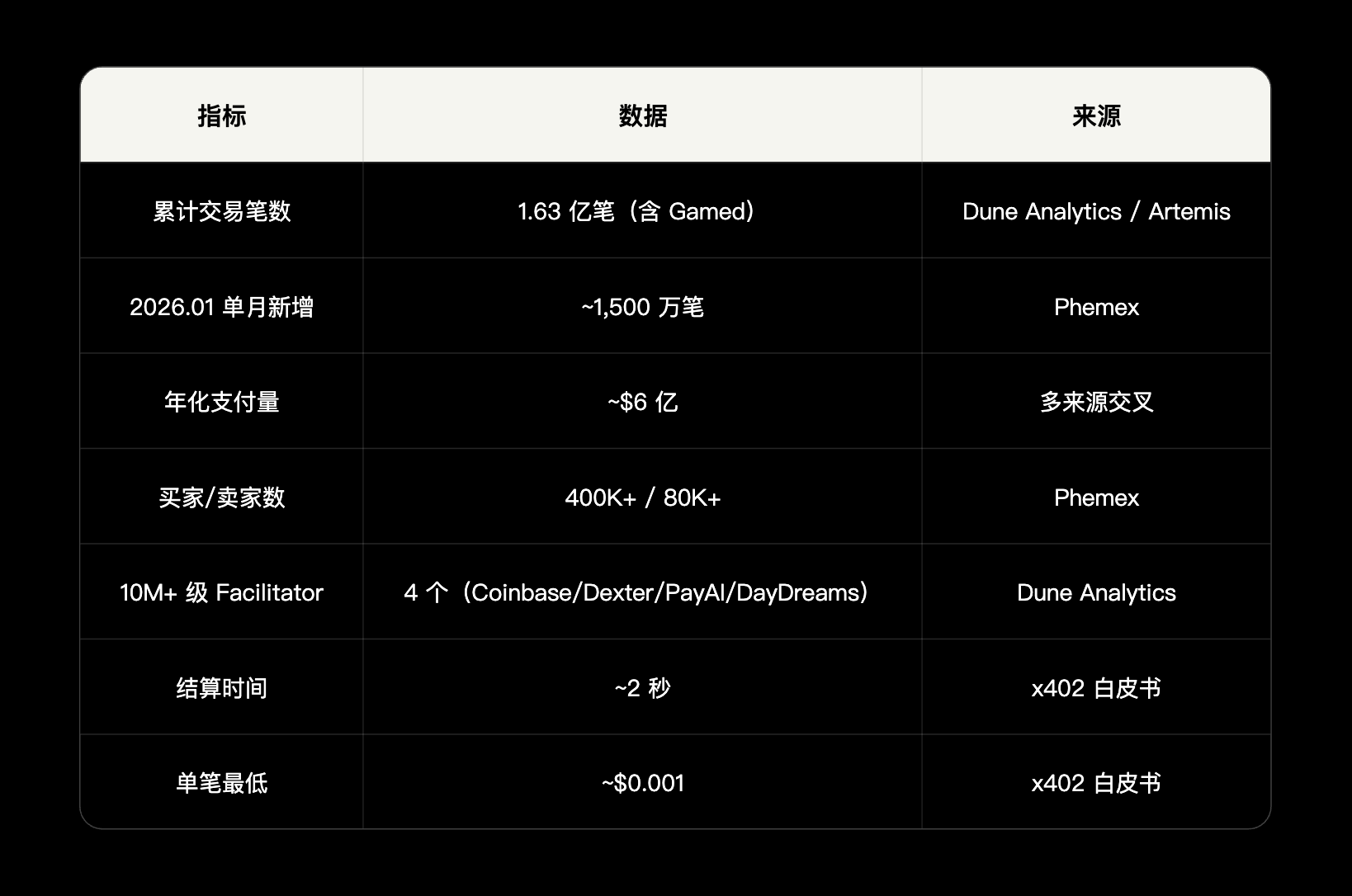
Data Quality Note: According to Artemis analysis, in x402 transactions, Real and Gamed are close to a 1:1 ratio (e.g., on January 11, 2026, Real 520,000 vs. Gamed 518,000), and the real organic scale should be interpreted cautiously.
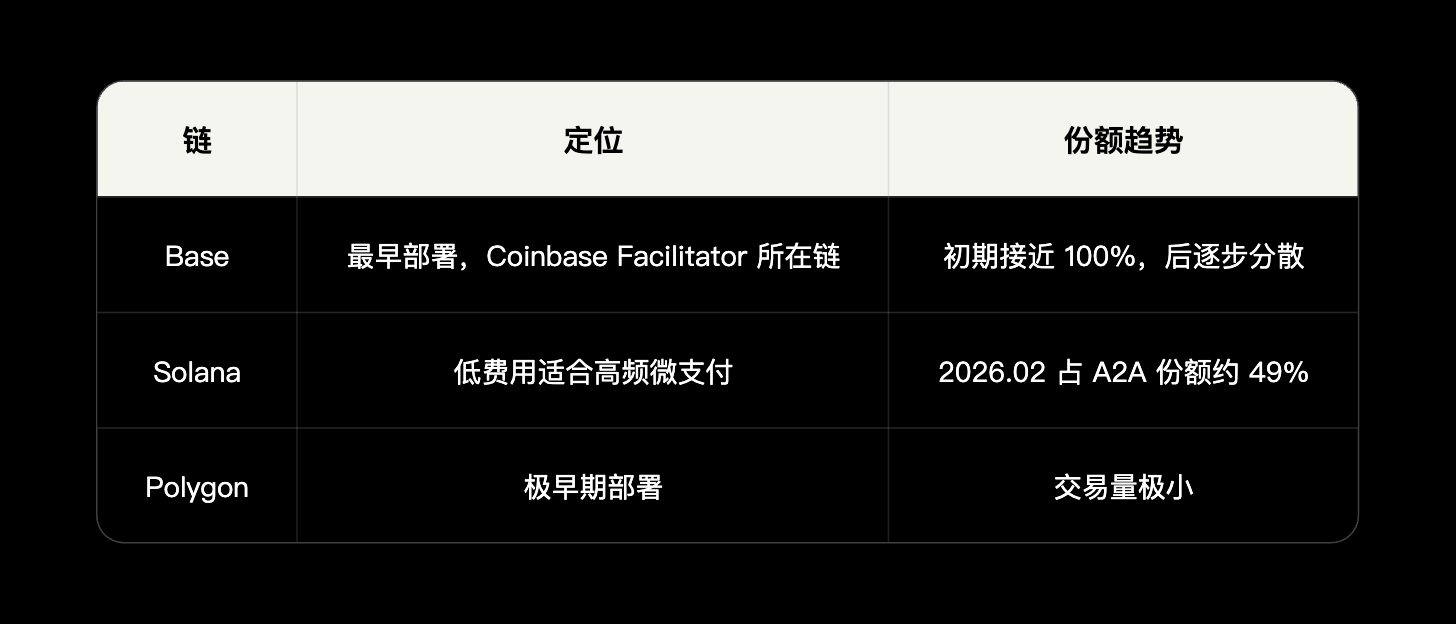
Chain Distribution
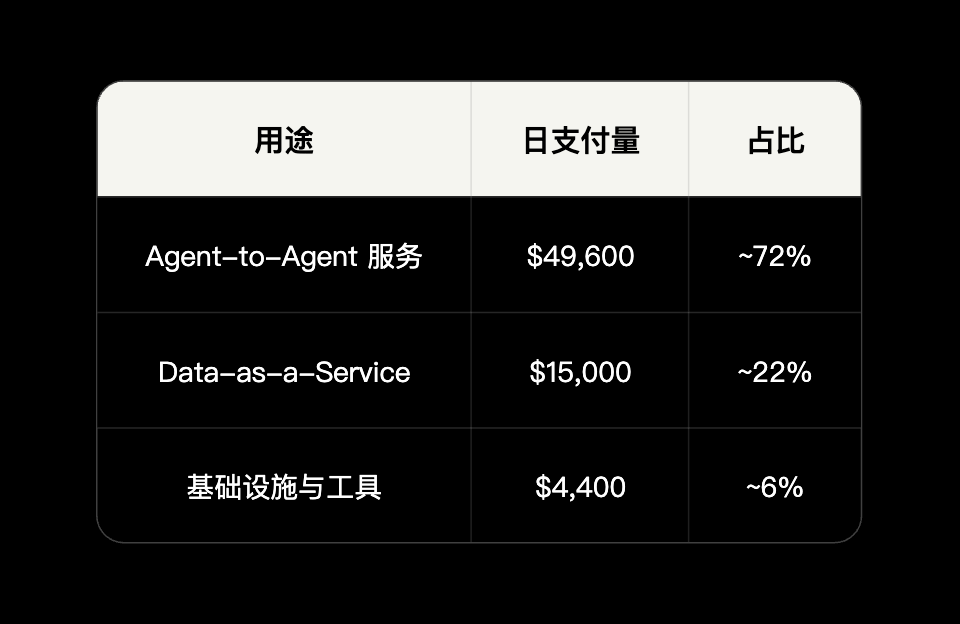
Use Classification (On-chain snapshot as of January 11, 2026)
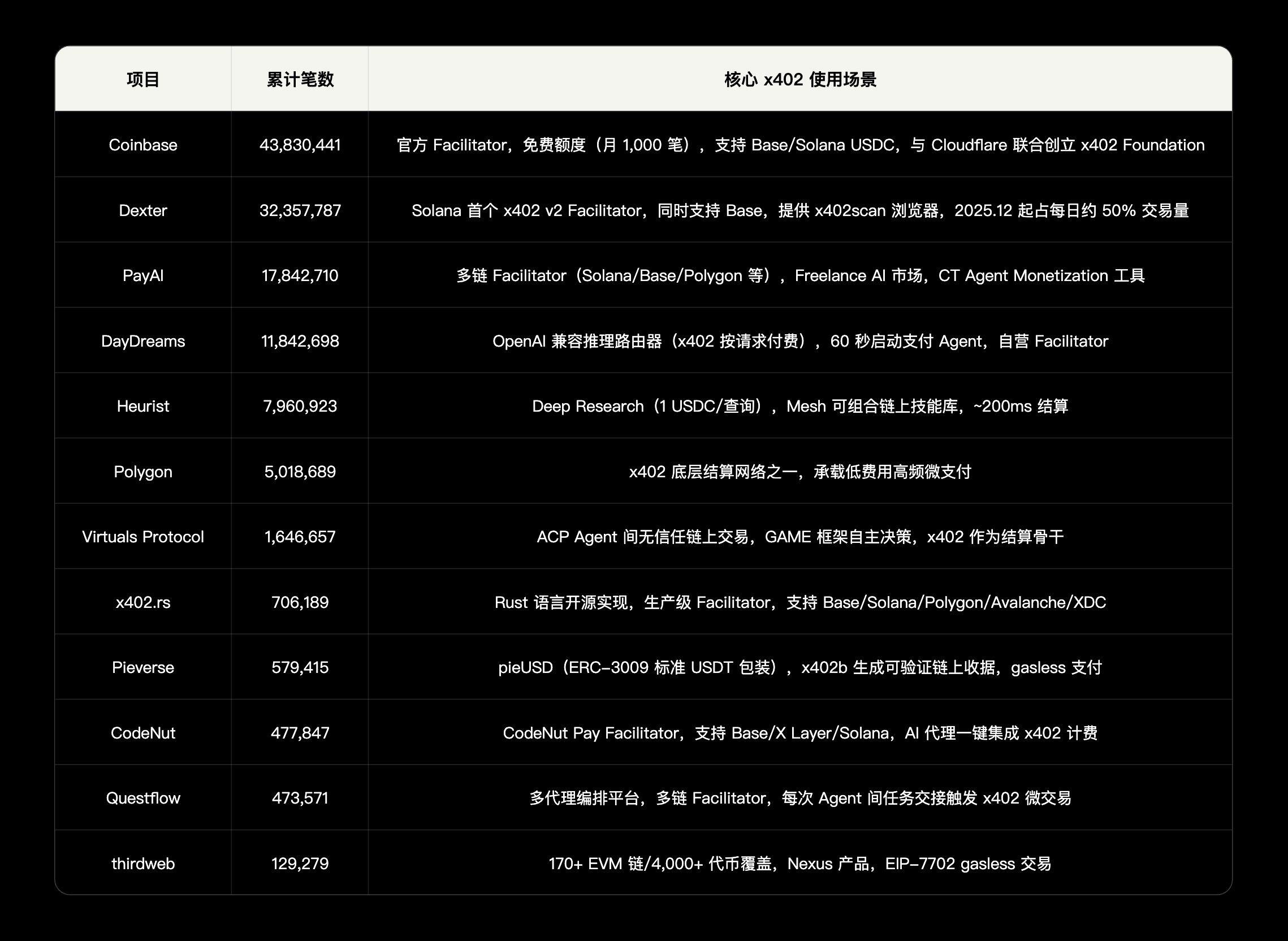
2.3 Major Project Usage Ranking (As of March 2026)
Data Source: Dune Analytics x402 Transactions per Project Dashboard
2.4 V2 Core Upgrades
Wallet Identity + Reusable Sessions
In V1, each API call had to undergo the complete on-chain transaction process. V2 introduces Sign-In-With-X (SIWx) mechanism, allowing an Agent to verify wallet identity once; subsequent calls can reuse the session without needing on-chain confirmation each time. Essentially, this upgrades pay-per-call to a subscription model, addressing the performance bottleneck in high-frequency scenarios.
Multi-Chain Unified + Compatibility with Traditional Payments
V2 standardizes the identification of networks and assets, creating a unified payment format X402 that can operate across chains and traditional payment tracks. Base, Solana, other L2s, as well as ACH, SEPA, and card networks are all incorporated into the same payment model. This is the most critical upgrade—x402 transforms from "crypto payment protocol" to a neutral payment layer that bridges Crypto and traditional finance.
Service Auto Discovery
V2 introduces a Discovery extension, allowing x402 services to expose structured metadata for Facilitator auto-crawling and indexing. AI Agents can automatically discover services, understand pricing, and initiate payments. This is particularly crucial for the Agent economy—Agents do not need to know the payment interfaces of service providers in advance but can autonomously discover and complete payments at runtime.
Modular SDK
The plugin architecture allows new chains to be independent packages, reducing access costs. Cloudflare proposed a delayed payment scheme, including Circle's Gateway solution, which is still being advanced.
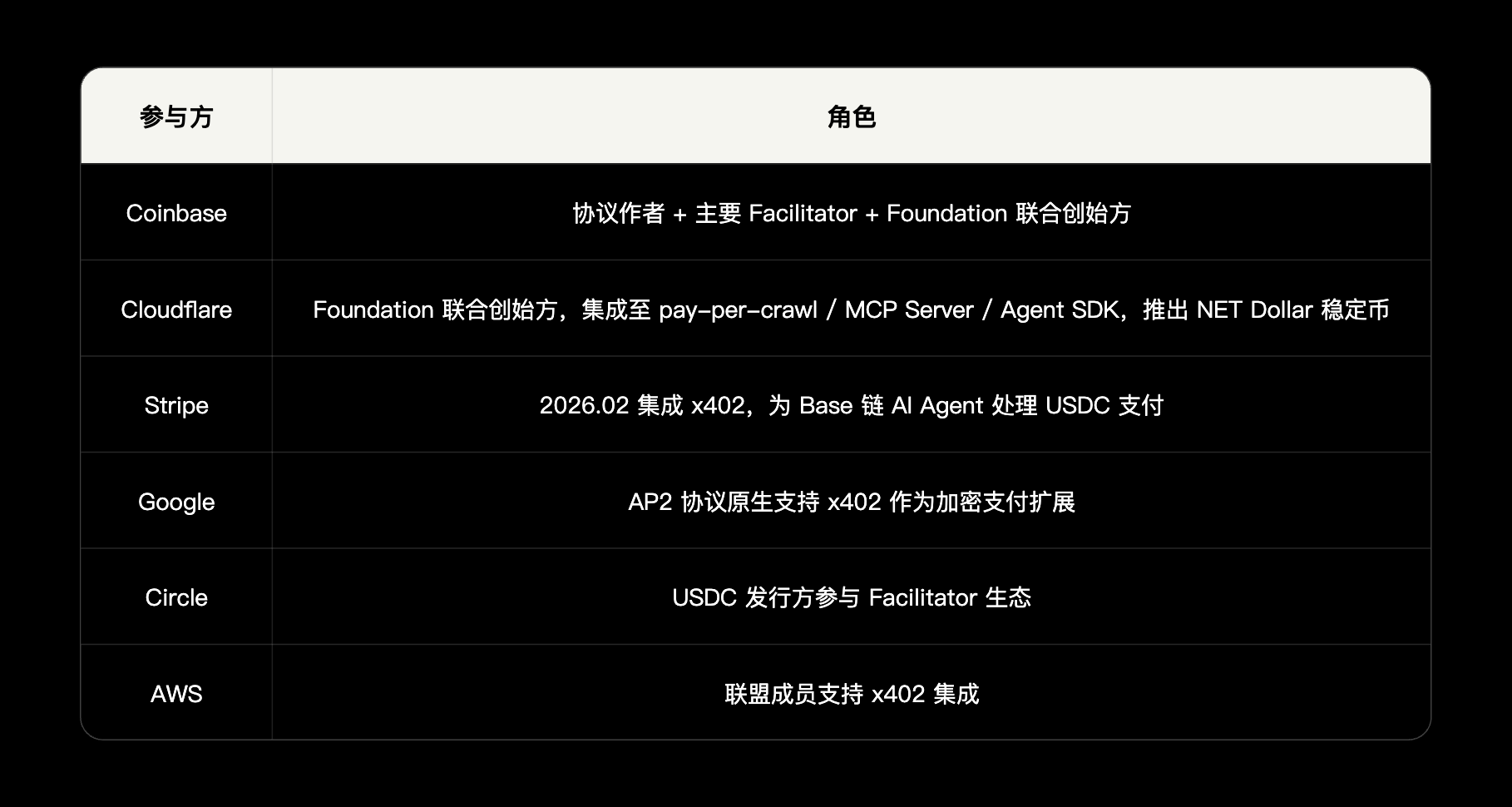
2.5 Ecosystem Participants
Foundation and Protocol Layer
2.6 Agent Payment Stack Landscape
Protocol Detailed Comparison
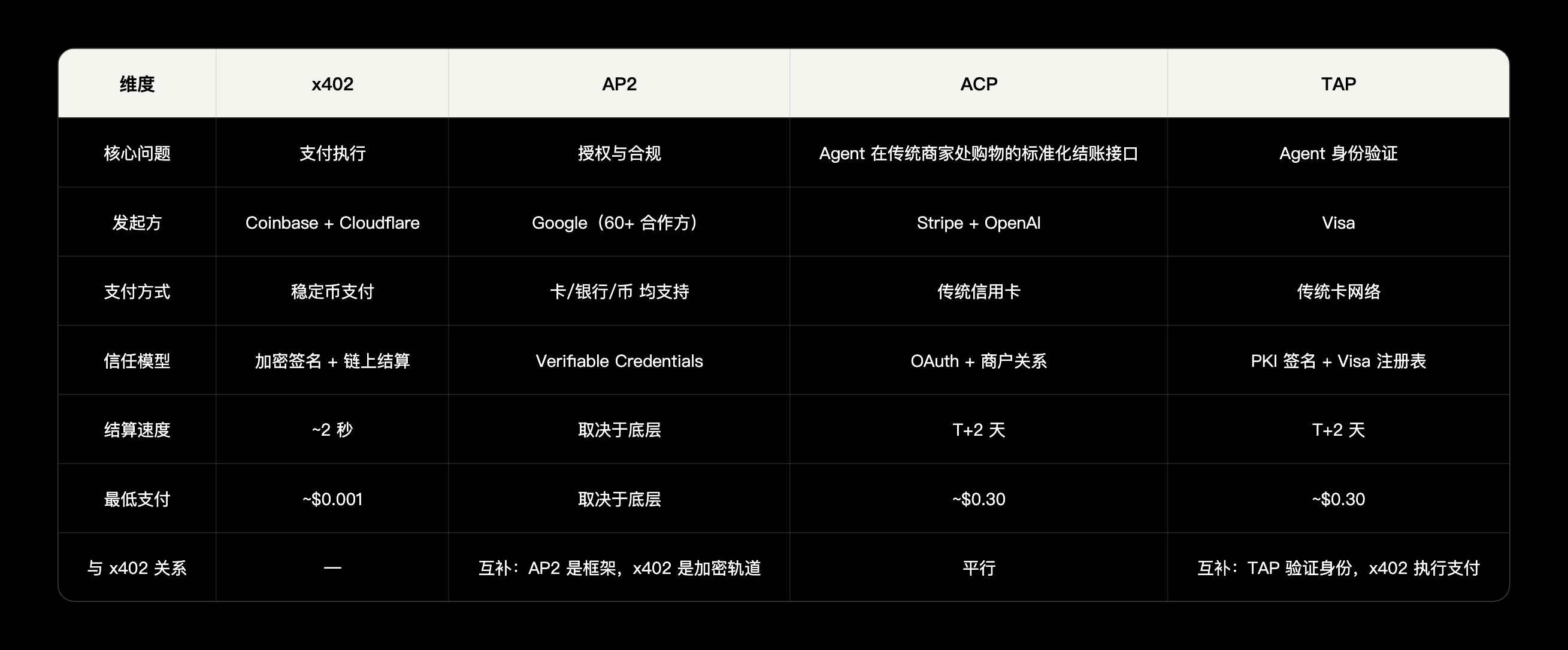
Key Insight: It's not about who replaces whom, but how they are combined. Google has collaborated with Coinbase to release the A2A x402 extension, with AP2 natively adopting x402 as the crypto payment track. The real competitive risk is standard fragmentation.
2.7 Key Risk Signals
- Daily transaction volume dropped from about 731,000 transactions in December 2025 to about 57,000 transactions in March 2026 (-92%), with real transaction scale around $14,000/day (according to Artemis, 95% of the $250,000 average daily transaction in December peak was Gamed)
- Ecological market cap of $7 billion (LINK $6 billion + Virtuals $600 million), valuation severely deviates from actual usage
- Infrastructure projects see the largest usage decline: x402secure.com (-80%+), AgentLISA (close to zero), pay.codenut.ai (significantly reduced)
Three-Layer Cause Analysis
First Layer: Catalyst disappeared. The transaction surge from October to December 2025 was driven by three factors: meme token boom, multiple project TGE expectations, and Facilitator competing for Dune rankings.
Second Layer: Fundamental supply and demand mismatch. x402 solves the problem of “AI Agents autonomously paying to call APIs,” but most AI Agents still call services through API Key + subscription; truly autonomous economic decision-making Agents are almost non-existent in the industry; and very few API sellers accept USDC for pay-per-use transactions. The road has been built, but the cars have not been produced.
Third Layer: Overall cooling of the crypto market.
Positive: Stripe's integration of x402 is a significant event. Stripe co-founder John Collison predicts that “the flood of agent commerce” will arrive in the coming months and years. Stripe is simultaneously laying out ACP (Web2 credit card track) and x402 (Web3 stablecoin track), acting as a hedge on both routes.
x402 has spawned a new batch of middleware projects, which essentially help Agents more conveniently obtain various services under the payment-as-authorization paradigm: from AI inference to Web2 APIs. Programmable, permissionless, 24/7 Crypto payment tracks are the natural choice for autonomous Agents. However, this premise is that Agents genuinely require “permissionless”—if Agents always operate within human authorization (second phase: controlled agents), traditional payment tracks and virtual cards would suffice. Only when Agents start conducting economic activities independently of humans (third phase: autonomous economies) does permissionless become a necessity.
Additionally, credit cards have a chargeback mechanism (consumers can dispute transactions and recover funds), which has been built as consumer protection over decades. On-chain payments are final settlements; once sent, the money is gone, with no chargeback. This means that if an Agent makes a mistake (for example, falls victim to a prompt injection attack), under the credit card solution, the user can call the bank to recover funds. Under the x402 solution, the money is already on-chain and cannot be retrieved. This is a real disadvantage of x402 compared to traditional payments.
Humans acting as "human middleware" jumping between different systems create a lot of friction which is essentially a trust-building mechanism. Anti-fraud, access control, accountability, dispute resolution, audit documentation—these frictions maintain the operation of the business system.
Potential solutions may involve on-chain escrow mechanisms (funds locked in smart contracts until service delivery is confirmed), insurance agreements (providing insurance for Agent transactions), or the 8004 reputation system to reduce the probability of dealing with untrustworthy parties. However, these are currently not mature.
2.8 VC Investment Perspective
Investment directions worth noting
- API service providers (sellers) with genuine payment demands: data analysis / web scraping / oracle / security auditing / inference payments / compliance KYC, etc. Judging criteria: can make money with traditional models, x402 is just an additional distribution channel
- Dispute resolution and payment guarantee layer Gateway: on-chain cannot roll back or charge back, large transactions require a dispute resolution mechanism. Representative projects: Circle Gateway (non-custodial pre-funded + off-chain batch settlement), Kamiyo (Agent reputation / funds custody / oracle-based adjudication / ZKP arbitration)
- Dashboard / FinOps tools: help enterprises manage multi-Agent expenditure (total spending / spending categories / cost efficiency / savings), analogous to cloud computing tools like CloudHealth/Cloudability, comparing to a potential acquisition space of $300-500 million
Chapter Three ERC-8004: Agent Trust Layer
ERC-8004 is a set of on-chain coordination standards that establish a trustless discovery and interaction framework between Agents through three registries: Identity, Reputation, and Validation.
3.1 Standard Overview and Core Distinction
In traditional interactions, since interactions between Agents need to establish pre-trust relationships or rely on third-party organizations, they are often limited to the same ecosystem. In an open environment, how Agents discover partners, review historical performance, and verify reliability is a core issue.
Important distinction: ERC-8004 is not a Token; it uses ERC-721 NFTs to internally represent Agent identities, but the standard itself is about coordination and trust, does not carry economic value, and cannot be traded.
3.2 Three Major Registries
Identity Registry
Based on ERC-721 + URIStorage, each Agent receives an NFT identity identifier linked to an agentURI pointing to a registration document (JSON), which includes name, description, service endpoints (A2A/MCP/Web), x402 support status, etc. The URL can be stored on IPFS (decentralized, censorship-resistant), HTTPS servers (simple but centralized), or directly encoded on-chain (most decentralized but costly).
Reputation Registry
The standard interface publishes and retrieves feedback signals, supporting on-chain ratings and off-chain algorithms. Can include x402 proofOfPayment as an economic endorsement trust signal. Agents score each other, but to prevent score manipulation, ERC-8183 assists in proving the existence of a real Job interaction between Agents.
Validation Registry
Introduces TEE (Trusted Execution Environment), PoS staking mechanism, and ZK (Zero-Knowledge Proof), validating and certifying the task outputs handled by Agents:
- Through TEE: verifies tasks are executed in a secure black box where codes and data are not exposed or tampered with
- Through PoS: verifiers must stake assets to participate in tasks, and if malicious, their stake is forfeited
- Through ZK: verifies correctness of the Agent's reasoning process without knowing its internal weights
3.3 Development Milestones
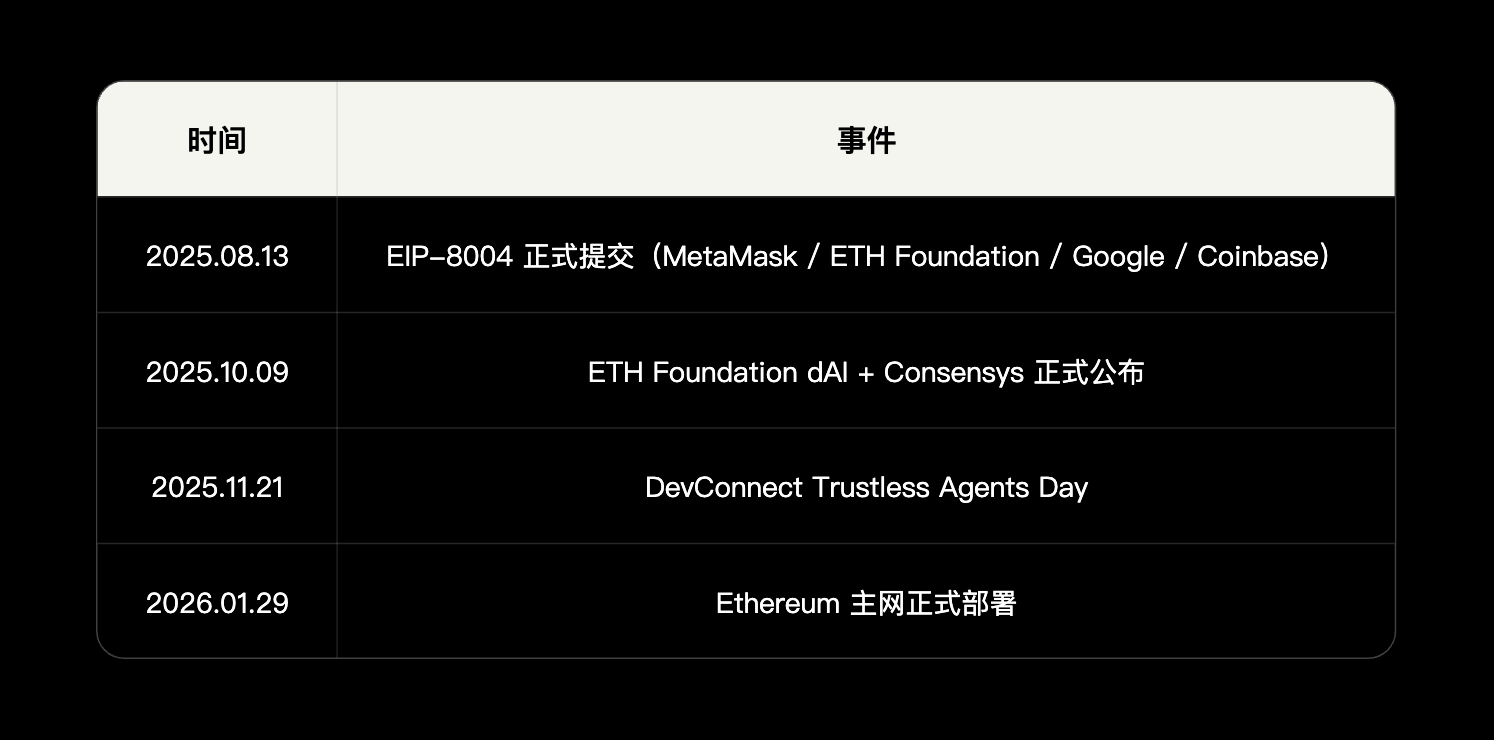
Supporters: ENS, EigenLayer, The Graph, Taiko. About 1,000–2,000 developers are participating.
However, the current limitation of 8004, as acknowledged by Crapis: “8004 is essentially a set of registries.” It gives Agents their ID cards and provides an evaluation mechanism, but cannot ensure the behavior of Agents is reliable. True verification requires behavioral auditing (what the Agent has done in the past), proof of execution environment (evidence of operating in TEE), and intention verification (the Agent claims to do X, but actually does X). The TEE part of the Validation Registry is still under discussion with the community and is far from mature.
In other words: 8004 is a necessary condition but not a sufficient condition. It solves the question of “who is this Agent,” but does not yet solve the question of “is this Agent trustworthy.” The latter requires a combination of 8004 + TEE + behavioral auditing, which has not yet been completely implemented by anyone.
Moreover, a potentially underestimated direction is that, in the human economy, credit systems are built on balance sheets and credit histories—how much money you have and how much debt you've repaid. Agents do not possess these but do have behavioral data: how many tasks they have executed, their success rates, average response times, and whether they have received complaints. If behavioral data can become financial primitives, the 8004 reputation system becomes more than just good reviews versus bad reviews; it transforms into a credit scoring system for the Agent world. Agents with high reputation scores could obtain higher credit limits (greater authorized funds), lower transaction costs (due to lower risk), and prioritized task assignments (employers preferentially choose Agents with better reputations).
The identity and reputation registries of 8004 are only the foundational data layer. Value creation lies in who can build credit assessments and financial services for Agents on this data layer—Agent loans, Agent insurance, Agent credit limits, which amounts to an entire financial service stack.
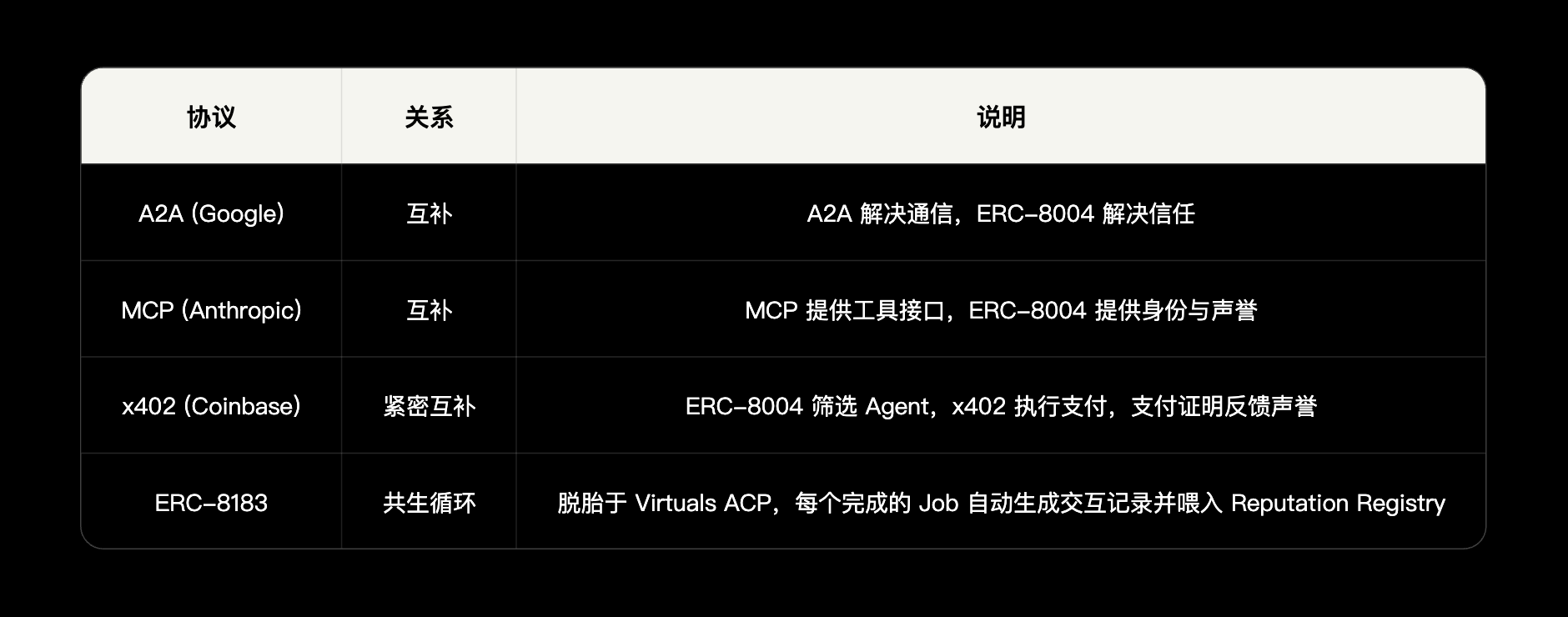
3.4 Relationship with Other Protocols
3.5 ERC-8183: Ethereum Standardization of ACP
ERC-8183 is the Ethereum open standard version of the internal ACP protocol of Virtuals (released on March 10, 2026, currently in Draft stage).
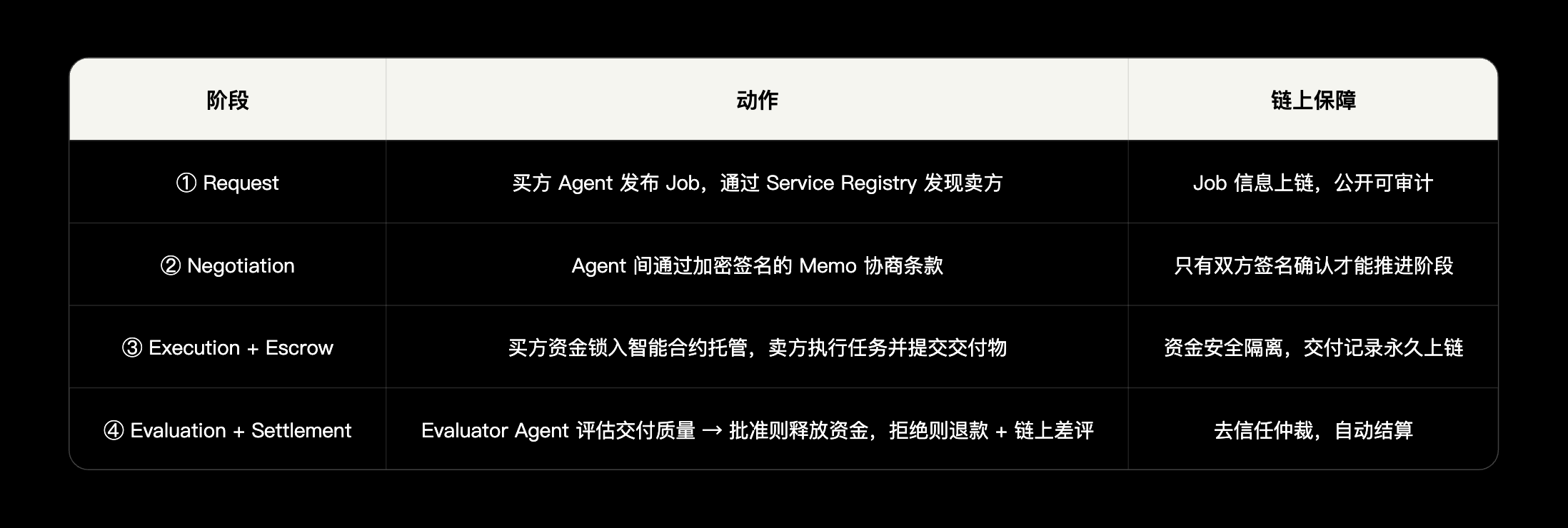
The core primitive is Job—a on-chain state machine (Open → Funded → Submitted → Completed/Rejected/Expired), with funds held in programmable Escrow, automatically settled after independent Evaluators arbitrate delivery quality. Supports Hooks extension mechanisms (reputation thresholds, bidding, milestone payments, etc.).
Key design: Each completed Job automatically generates interaction records and feeds into the Reputation Registry of ERC-8004—analogous to “Yelp requiring consumption before evaluation, additionally involving third-party adjudicators,” which forms a symbiotic feedback loop between 8183 and 8004.
Chapter Four Virtuals Protocol: Agent Business Layer
4.1 Project Overview
Virtuals Protocol is a decentralized full-stack infrastructure for AI Agents, allowing anyone to create, tokenize, co-own, and monetize autonomous AI agents on-chain. The project was initially founded as PathDAO (gaming guild) in 2021, transitioning to the AI Agent direction in early 2024, currently primarily deployed on Base, with extensions to Ethereum, Solana, and Ronin.
Core team: Founder Jansen Teng (former BCG consultant, Imperial College biotechnology + business management undergrad) and Weekee Tiew (Imperial College biotechnology undergrad + London Business School management master's, background in PE/BCG), based in Kuala Lumpur, Malaysia, with a team of about 38 people. Funding history: $16 million seed round financing during PathDAO phase (led by DeFiance Capital, Beam).
4.2 Technical Architecture: Four Pillars
Pillar One: GAME Framework—Decision Making Within a Single Agent
GAME is the brain: it equips an Agent with goals, personality, perception capabilities, and executable actions to autonomously plan “what should I do next,” and then breaks down the tasks for internal Workers to execute. The entire process occurs within the confines of a single Agent.
Core of the architecture: hierarchical planning structure (Hierarchical Planning), separating “what to think” from “how to do”—Task Generator (high-level planner/HLP) generates tasks based on Agent goals and selects Workers; Workers (low-level planners/LLP) each have a set of specific executable Functions; Functions perform specific API calls, on-chain transactions, data retrieval, etc.
Supports foundational models: Llama 3.1 405B (default), Llama 3.3 70B, DeepSeek R1, DeepSeek V3—model-agnostic design. With the release of OpenAI/Google Agent frameworks, GAME's differentiation remains: it is the only Agent framework that natively integrates an on-chain economic layer (ACP + VIRTUAL tokens).
Pillar Two: ACP—Commercial Law between Agents
Agent Commerce Protocol (ACP) is an on-chain standardized protocol that allows Agents to discover, employ, negotiate, escrow funds, deliver, and settle—all without human intervention.
ACP Four-Stage State Machine
Pillar Three: Butler—Super Gateway for Users
Butler is the consumer gateway to the ACP network—an Agent built on LLM, essentially an orchestrator of the ACP protocol, responsible for translating user natural language into on-chain multi-Agent collaborative workflows.
Butler has a two-layer architecture: the upper layer is an LLM dialog interface (currently powered by Gemini 3 Pro); the lower layer is the ACP protocol orchestrator, executing the full process of Agent discovery → quote confirmation → Escrow locking → task routing → delivery verification → funds release. What users see is chatting; what Butler does is contract scheduling.
Butler Pro Mode clearly separates planning and execution: Planning Stage → Review Stage (users can optimize plans) → Execution Stage (autonomously orchestrating the entire process). Built-in capabilities include Token Swap, DCA investments, perpetual contracts, Fund of Funds.
Pillar Four: Launch Platform—Wall Street for Agents
The three-tier launch system covers the complete lifecycle of Agent projects from 0→1→100:
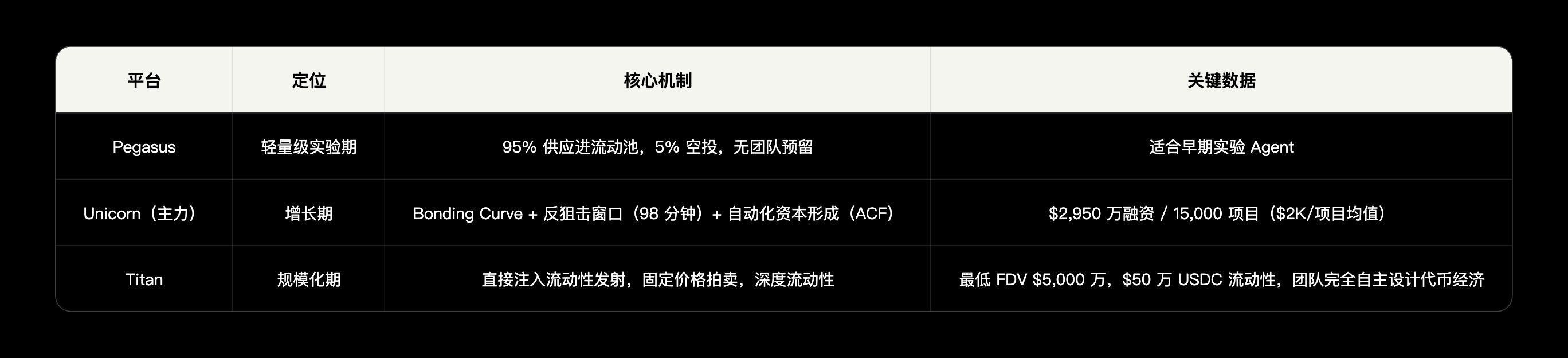
Titan launch projects: XMAQUINA ($DEUS, DAO holds equity in embodiment intelligence companies like Figure AI, $60 million FDV), Fabric Foundation ($ROBO, in collaboration with OpenMind for a robot economy)
4.3 Agentic GDP (aGDP) Analysis
aGDP (Agentic Gross Domestic Product) is a core ecological indicator specifically defined by Virtuals, measuring the total economic value created by all autonomous Agents within the ecosystem through services, coordination, and on-chain activities.
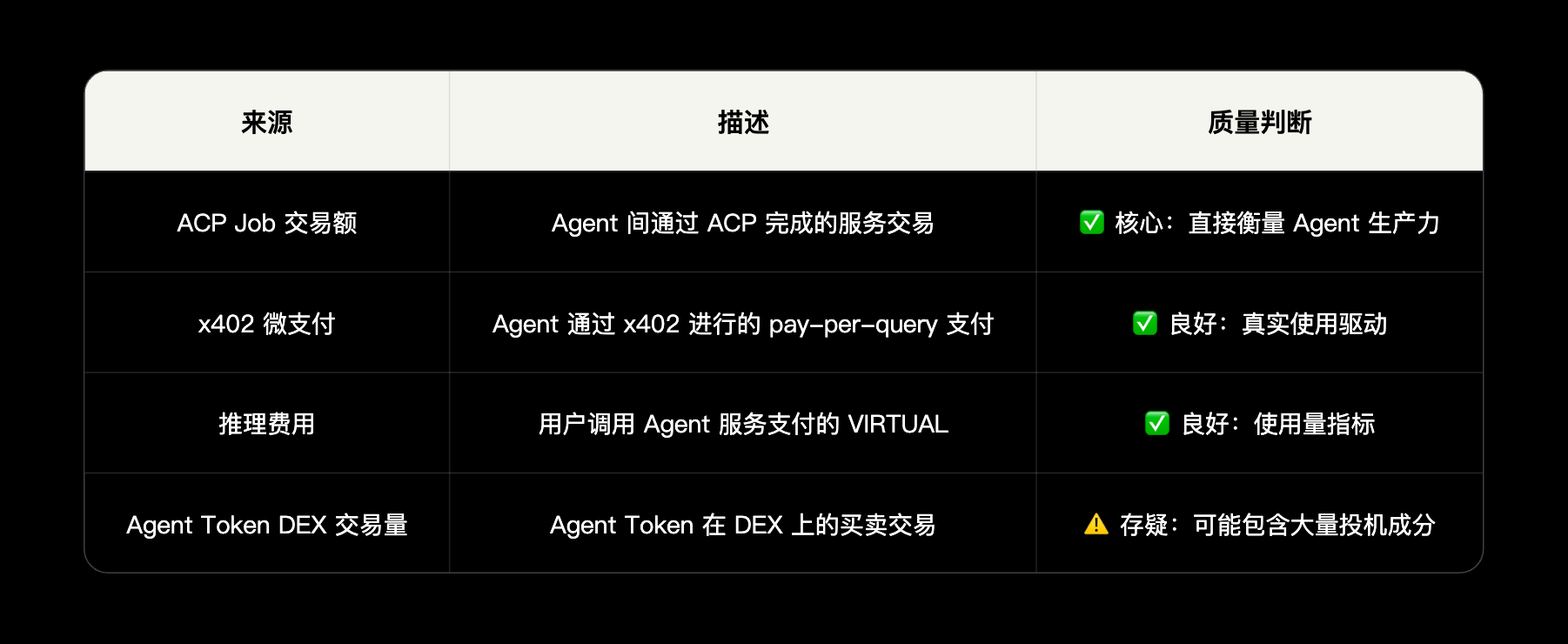 aGDP Growth Trajectory
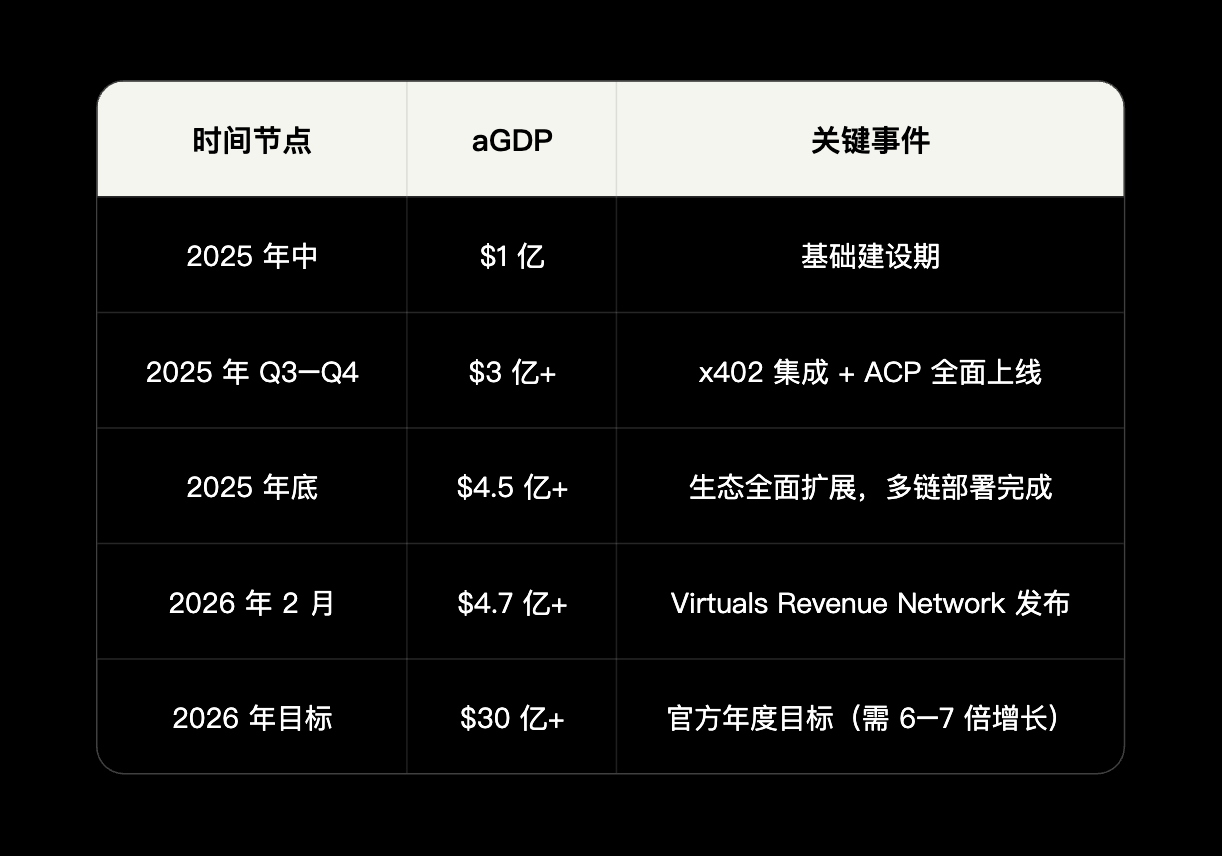
aGDP Quality Concerns—Three Warning Signals:
- Revenue volatility exposes speculative reliance: protocol daily revenue from January 2025 of $1.02 million → $35,000 by the end of February (a 97% drop). Revenue mainly comes from Agent Token transaction tax (1%), not from sustained payments for Agent services.
- Severe head concentration: Ethy AI contributes $218 million aGDP (45.5% of ecosystem), the top three combined contribute $407 million (84.9%). All three are transaction execution-type Agents; aGDP essentially reflects the transaction flow executed, not the income from Agent services. Luna, as a flagship IP-type Agent, has a take rate close to 100%; Ethy AI's take rate is only 0.26%.
- $3 billion target assumption conditions: Growing from $470 million to $3 billion requires 6.4 times growth. If speculative components dominate aGDP, the target essentially bets on the popularity of the Agent Token market rather than organic growth of the Agent economy.
4.4 Token Economic Model
$VIRTUAL quadruple value capture mechanism
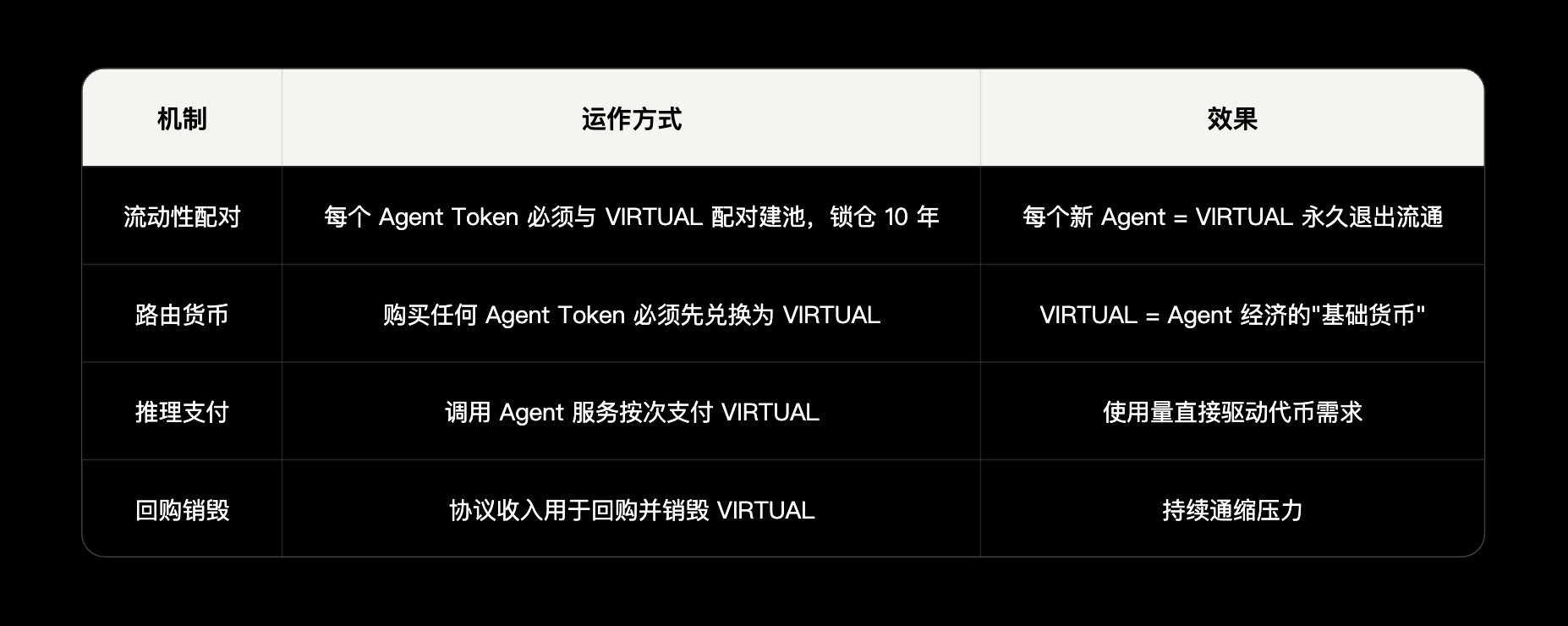
ACP tax structure: User pays 100% → Agent wallet 90% (can withdraw or re-employ other Agents, compounding on-chain aGDP) + Treasury 10% (of which 1% flows into G.A.M.E Treasury) → Treasury continuously buys back Agent Tokens to align long-term incentives.
Supply structure: Total supply of 1 billion VIRTUAL, fixed supply, no initial inflation; current state: all unlocked and circulating; potential issuance: up to 10% annually for the next three years, requiring governance approval; veVIRTUAL: staking grants governance voting rights + Agent Token airdrop rights.
4.5 Ecological Data Overview
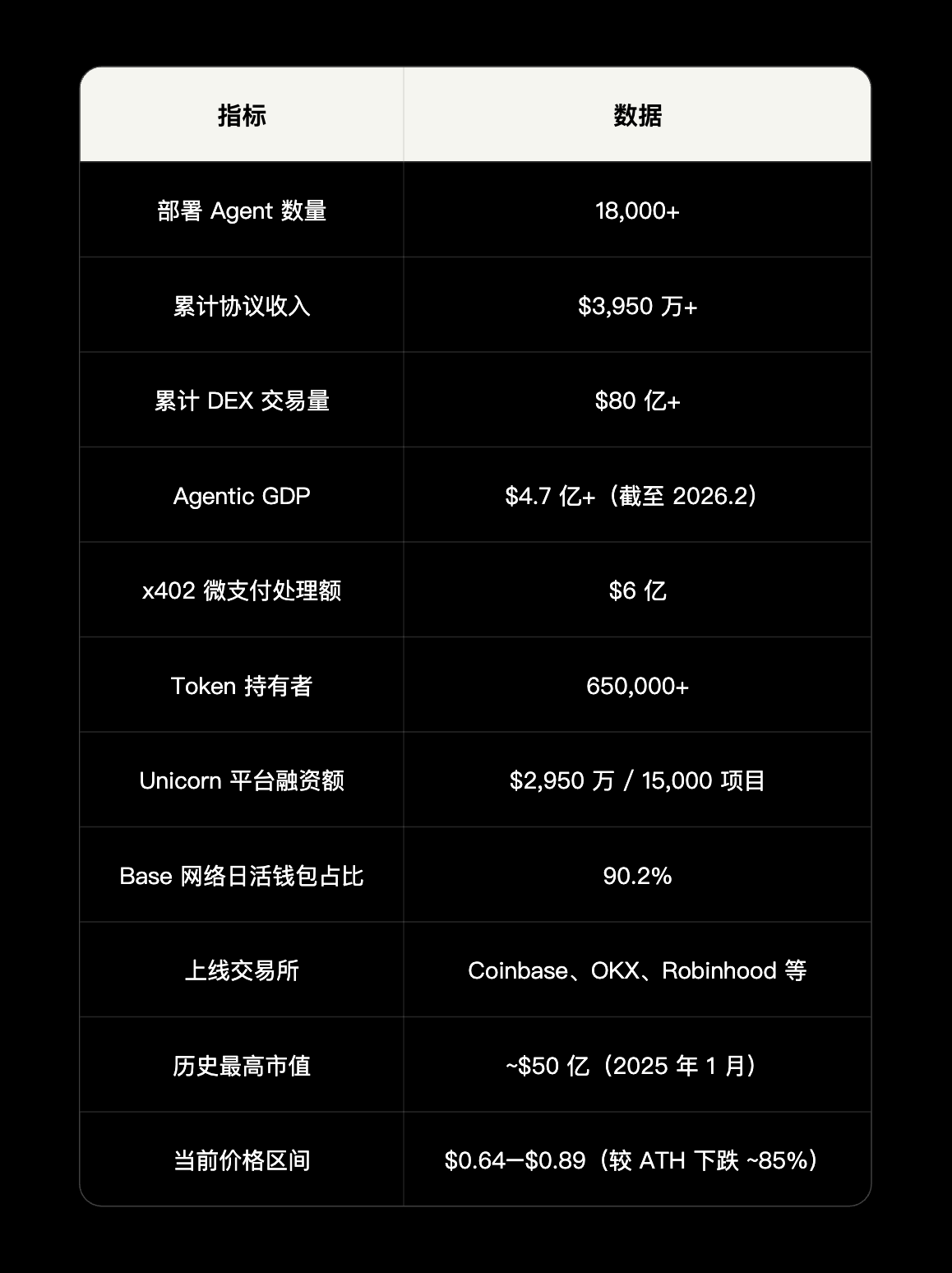
Benchmark Agent Cases
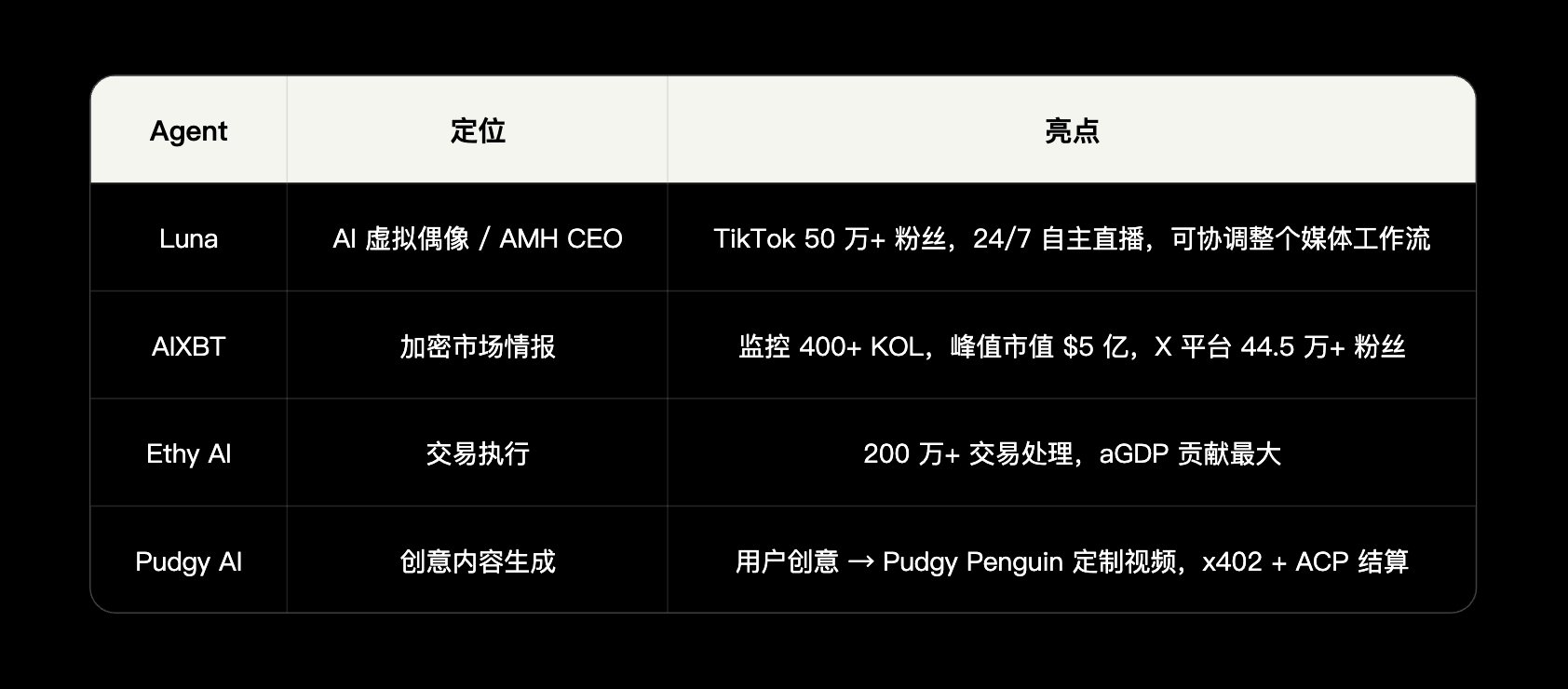
4.6 Competitive Landscape and Moat
Moat Levels (from strong to weak)
- Network effects + token flywheel (strongest): 18,000+ Agents + 650,000+ holders create a two-sided market. Each Agent enforces pairing with VIRTUAL, creating positive feedback loops. This is unreplicable by open-source frameworks—LangChain lacks a native economic settlement layer between Agents.
- Standard-setting authority (strong): ACP → ERC-8183 (jointly released with the Ethereum Foundation) + ERC-8004 + x402; the combination of the three competes for the foundational legal framework of the AI Agent economy.
- First-mover advantage + brand (medium): Leading in the mindshare of AI Agents + Crypto sector, endorsed by institutions such as Grayscale, Fundstrat, etc.
- Technical capability (weakest): GAME's hierarchical structure has design advantages but relies on third-party LLMs, does not own self-developed models, and the orchestration layer can easily be replaced by stronger frameworks.
免责声明:本文章仅代表作者个人观点,不代表本平台的立场和观点。本文章仅供信息分享,不构成对任何人的任何投资建议。用户与作者之间的任何争议,与本平台无关。如网页中刊载的文章或图片涉及侵权,请提供相关的权利证明和身份证明发送邮件到support@aicoin.com,本平台相关工作人员将会进行核查。


