Author: @BlazingKevin_, Blockbooster researcher
In the spring of 2026, the Intercontinental Exchange Group (ICE) completed a strategic investment in the cryptocurrency trading platform OKX with a valuation of $25 billion. As the parent company of the New York Stock Exchange (NYSE), ICE's transaction departs from the previous exploratory model of Wall Street relying solely on spot ETFs to establish a "funding channel." Analyzing the cooperation framework disclosed by both parties, the focus of the collaboration directly falls on the operational hub of financial markets, from the authorization of spot price data, establishment of joint ventures, to the joint distribution of tokenized stocks.
The authorization of spot data aims to create a regulated pricing anchor for traditional institutional funds to enter the market; the advancement of joint ventures and tokenized stocks attempts to physically stitch together the traditional fiat currency system and the native liquidity pools of cryptocurrencies. This systematic strategic bundling indicates that mainstream traditional capital has officially transitioned its strategy towards the cryptocurrency ecosystem from the peripheral "asset allocation" to the "incorporation" phase reliant on capital intervention in underlying infrastructure.
This is not merely a simple financial settlement but a top-down power restructuring by the existing financial system using capital leverage and compliance frameworks to reshape the emerging cryptocurrency market.
Power Restructuring: Surrender of Pricing Power and Mutual Erosion of Infrastructure
The core anchor of this deal lies in the foundational pillars of the financial system: pricing power and clearing infrastructure.
As an oligarch in the traditional market, ICE monopolizes pricing benchmarks from stock data on the New York Stock Exchange (NYSE) to core macro assets such as Brent crude oil and the US dollar index. This pricing power, based on legal trading hours and centralized clearing, constitutes the core of its business model. However, faced with a cryptocurrency asset network boasting a total market value of trillions of dollars, circulating 7x24 hours and highly decentralized in liquidity, ICE's original traditional price discovery mechanism exhibits significant structural fractures.
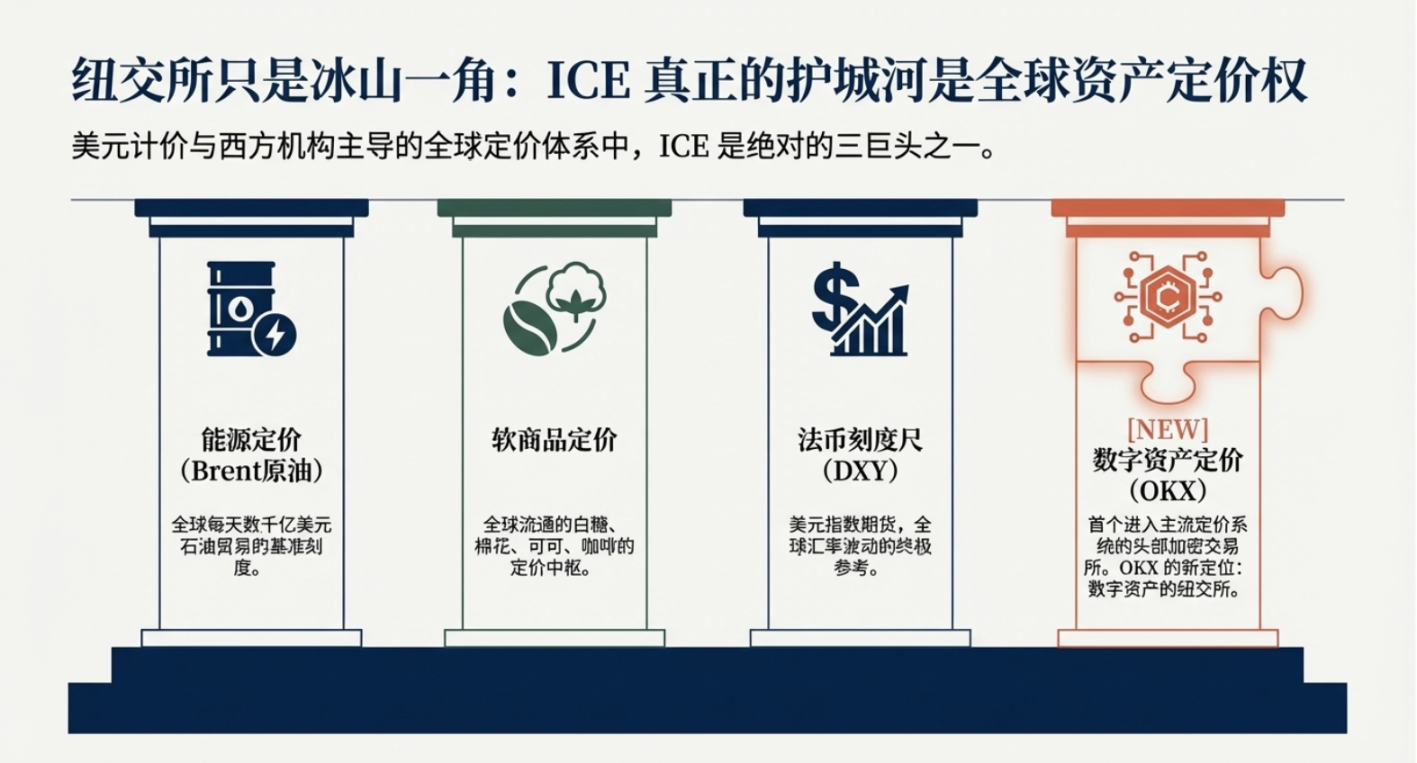
Acquiring the authorization for OKX's spot data is a substantive action by ICE to bridge this fracture. Currently, the Chicago Mercantile Exchange (CME) has established some pricing advantages in the institutional market through regulated Bitcoin futures. By deeply binding capital to top spot platforms, ICE can directly penetrate offshore markets and access first-hand underlying trading and depth data. This enables it to bypass a lengthy cold start and directly build a proprietary cryptocurrency derivatives product line compliant with US regulatory standards, aiming to reclaim the final interpretative power of cryptocurrency liquidity within Wall Street's traditional infrastructure.
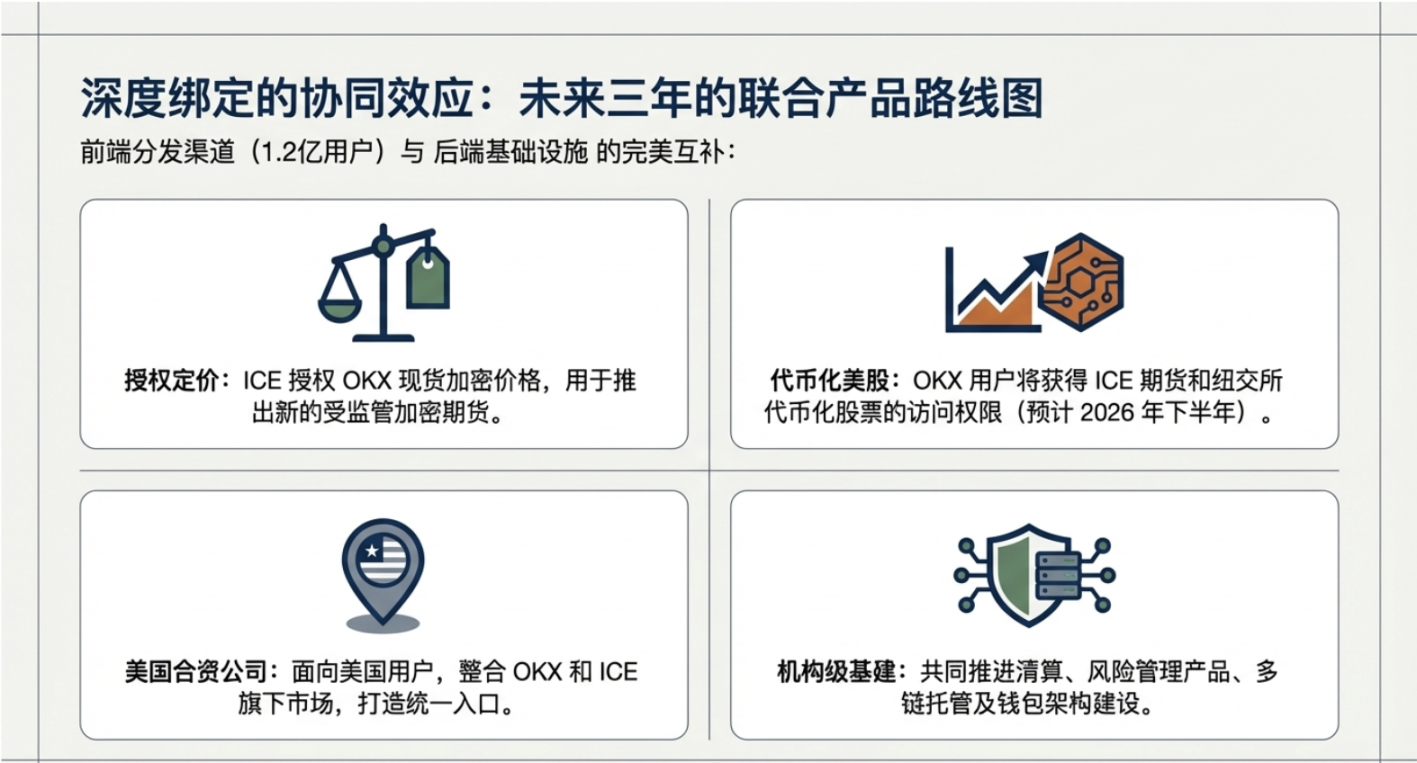
For OKX, surrendering core spot pricing data is a quid pro quo to break through existing business bottlenecks. At present, the competitive landscape for pure cryptocurrency asset trading platforms has intensified, with the user acquisition cost hitting a peak; relying solely on transaction fees from spot and perpetual contracts has reached a growth ceiling. By integrating into ICE's underlying compliance framework, OKX has effectively completed a transformation of its business model: from a single cryptocurrency asset matching engine to a bidirectional distribution network that connects 120 million native cryptocurrency liquidity to Wall Street’s compliant financial products.
Path Evolution
Looking back at ICE's expansion in the cryptocurrency domain, its business path has undergone a strategic correction based on real market feedback.
In 2018, ICE launched Bakkt, a Bitcoin futures platform focusing on physical delivery. Its early strategic logic was a typical "compliance infrastructure first": attempting to attract and regulate trading volume in the cryptocurrency market by establishing clearing and delivery channels that meet the highest regulatory standards of traditional institutions. However, Bakkt's subsequent prolonged business stagnation validated a structural rule: in the cryptocurrency market, compliance frameworks cannot spontaneously create liquidity. Traditional trading systems disconnected from the native retail network and cryptocurrency market-making ecosystem easily become "compliance islands" lacking genuine trading depth.
The setback Bakkt faced in its cold start prompted ICE's management to reevaluate its business logic. They realized that, in a bilateral trading market with strong network effects, the cost of re-establishing the trading habits of tens of millions of cryptocurrency users and reshaping underlying liquidity far exceeds building a set of institutional-grade clearing code. Rather than spending cycles on internal incubation, it was more effective to directly capture external capital.
Thereafter, ICE's resource allocation manifested a clear feature of node embedding. In 2025, ICE invested in the decentralized prediction market Polymarket, whose commercial essence is to secure a position in the data sources of on-chain event-driven data and pricing for non-standard assets. This heavy investment in OKX directly connects the radius of asset capture to the core of the cryptocurrency world— the bidirectional liquidity network of spot and derivatives.
From promoting Bakkt's "self-built closed loop" to now achieving "capital embedding" through equity stakes in Polymarket and OKX, ICE's evolution represents a prevalent consensus among current Wall Street giants: abandoning the heavy asset model of redefining cryptocurrency rules from scratch and instead using capital leverage as a "Trojan horse" to directly integrate scalable native cryptocurrency infrastructure into its extensive global clearing and distribution network.
The "Second Half" of Tokenized Assets
The mass on-chain integration of RWA (Real World Assets) constitutes the direct commercial impetus for this infrastructure convergence.
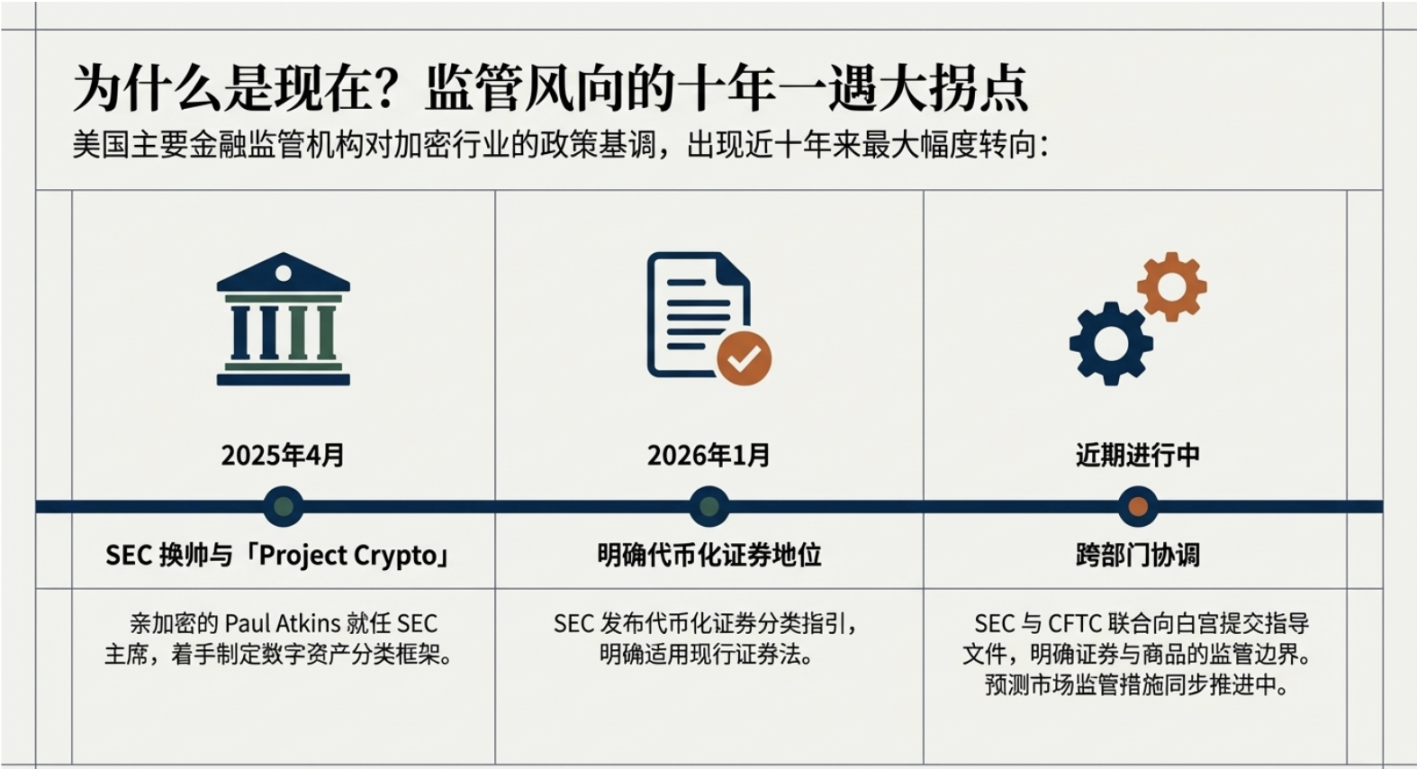
Entering the second half of 2025, along with the preliminary clarification of classification and ownership frameworks for tokenized securities by US regulators, the on-chain mapping scale of underlying stock assets has seen a structural leap. Faced with this incremental space capable of reshaping the traditional securities market's underlying settlement agreements, core Wall Street institutions are accelerating their competition for the issuance and circulation hubs of tokenized assets.
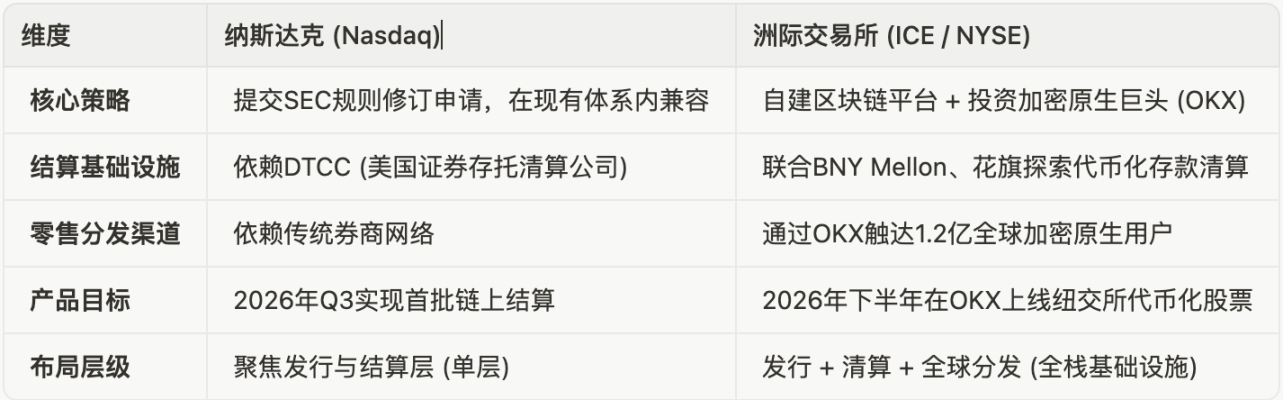
In the infrastructure deduction of asset tokenization, the market has differentiated into two distinctly different evolutionary paths. Nasdaq tends toward reformism, relying on traditional clearing centers like the DTCC (Depository Trust & Clearing Corporation) to complete the registration and circulation of tokenized assets within the existing compliance system. In contrast, ICE's strategic layout exhibits clear vertical integration characteristics, attempting to reconstruct a full-chain closed loop from asset packaging to terminal distribution:
On the supply side, the NYSE is promoting a tokenized securities engine that supports instant settlement (DVP) and 7x24-hour circulation; on the clearing side, ICE is trying to establish a tokenized deposit mechanism to eliminate settlement friction between fiat and digital assets; and on the distribution side, OKX's accumulation of over a hundred million native cryptocurrency accounts fills the liquidity outlet targeted at global retail terminals.
This "underlying licensed assets + on-chain native distribution" hybrid infrastructure structure poses a substantial threat to the traditional T+1 settlement cycle in terms of trading efficiency. From an industry mid-to-long-term perspective, the core barrier of the RWA track is shifting from a single "asset on-chain capability" to the "integration capability of compliance channels and global liquidity." After this systematic integration, small to medium-sized cryptocurrency platforms lacking quality fiat asset channels, as well as unilateral financial institutions constrained by traditional distribution channels, will face the risk of liquidity being siphoned away. Multifaceted infrastructures with cross-domain asset clearing and global network touch points will hold substantial dominion in the asset pricing of the next cycle.
Deep Gameplay
Returning from strategic deduction to the execution level, this infrastructure integration faces significant structural friction. The binding at the capital level has not directly eliminated the underlying misalignment between traditional fiat systems and cryptocurrency native ecosystems in regulatory pathways, clearing mechanisms, and governance structures.
First is the end of regulatory arbitrage and compliance costs of multi-jurisdictional oversight. After experiencing rough expansion in early offshore markets, OKX attempts to complete the compliance restructuring of the US market through the introduction of ICE's traditional licensing system. However, US regulation of cryptocurrencies and tokenized assets has long been in a split state between the SEC (focusing on securities attributes) and the CFTC (focusing on commodity attributes). The cross-domain characterization of tokenized stocks, the penetrative review of offshore liquidity, and the lengthy compliance processes that joint ventures must endure under a multilateral regulatory system will substantially increase operational expenses. Whether ICE can leverage traditional lobbying on Capitol Hill to translate substantial licensing benefits for OKX in the still-evolving legislative game of cryptocurrencies remains highly uncertain.
Second is the liquidity mismatch risk induced by asynchronous clearing mechanisms. Although the cooperation framework involves joint development of tokenized deposits, at this stage, traditional banks are limited by the fiat settlement cycle of business days and legal trading hours, creating unavoidable physical time differences with the high-frequency matching of the cryptocurrency network operating 7x24 hours. In the face of extreme volatility events such as macro data releases or on-chain black swan events, the closure or delay of fiat channels can easily trigger liquidity fractures on the cryptocurrency side. How to build market-making and buffering mechanisms capable of withstanding extreme prices between asynchronous clearing networks is the core technical resistance in the fusion of underlying systems.
Finally, there is a substantive mutual exclusion between governance structures and risk appetites. The governance bottom line of traditional regulated financial institutions is extreme risk aversion and absolute compliance; while the business drive of cryptocurrency native platforms is essentially built on agile iteration and embracing high volatility exposure. When the compliance committee of traditional capital substantially intervenes in the product release stream and asset listing rights of cryptocurrency platforms, it inevitably prolongs the decision-making chain. This tug-of-war between risk tolerance and business expansion efficiency will cause long-term governance erosion at the board level of the joint venture company and may weaken the platform's competitive edge in the purely cryptocurrency native track.
Full Asset Circulation under a "Frenemy" Framework
Horizontally considering the current macro financial cycle, the collaboration between ICE and OKX constitutes a symbolic node of the "TradFi and Crypto Infrastructure Alignment."
This systemic alignment is accelerating replication throughout the industry: from BlackRock establishing Coinbase as its core custodian and prime broker for its spot ETF, to traditional market-making giant Citadel Securities penetrating order flow to platforms like Kraken, and JPMorgan pushing for institutional-level intraday repurchase clearing based on the Onyx chain— the physical isolation between fiat capital networks and decentralized protocols is being systematically broken down.
In this process, the market is evolving into an "asymmetrical symbiotic" pattern based on factor interchange. Traditional Wall Street oligarchs no longer seek to build cryptocurrency trading engines from scratch, but rather accurately capture high-frequency, global, and low-compliance-friction retail trading flows in the cryptocurrency market through capital injection and channel authorization; while native cryptocurrency infrastructure exchanges part of their equity and underlying data sovereignty for traditional financial support of balance sheets, fiat clearing white lists, and institutional moats against extreme compliance risks. This asset reconfiguration based on comparative advantages is substantially peeling away the early "anti-establishment" label of the cryptocurrency ecosystem, thoroughly weaving it into the operational轨道 of global financial capital.
Following this path of infrastructure fusion, the asset shapes and circulation boundaries of global capital markets are tending to dissolve. The ultimate endgame of next-generation financial infrastructure points to a universal asset clearing network featuring "unified ledger" properties. Under this architecture, the issuance carriers of heterogeneous assets— whether native proof-of-work Bitcoin, tokenized US stocks encapsulated by smart contracts, or RWA assets reflecting real yield rights— will break away from traditional settlement islands and, within a shared global liquidity pool, achieve all-weather instant settlement and cross-asset cross-margin circulation based on atomic settlements. This is not only a structural release of settlement efficiency but also a complete reconfiguration of the global liquidity pricing paradigm.
Conclusion
With ICE's stake in OKX as a marker, the capacity cleansing in the cryptocurrency asset trading track has entered its final phase. In the foreseeable macro cycle, as traditional regulatory frameworks such as Basel Accord substantially cover cryptocurrency asset exposure and the high compliance costs continue to squeeze the platforms' profit margins, global cryptocurrency liquidity will irreversibly concentrate toward a few oligarch nodes possessing "traditional licensing + native infrastructure."
In this evolving pattern, tail-end trading platforms lacking quality fiat clearing channels, without core regulatory licenses, and unable to tap into mainstream institutional order flows will face severe liquidity exhaustion. In the stock game of bilateral markets, they may be passively cleared due to an inability to bear exponentially rising compliance expenses or become discounted acquisition assets in traditional capital's completion of the full-chain infrastructure puzzle.
For leading native platforms that have completed capital binding, their business model has fundamentally shifted: in exchange for acquiring traditional finance's trillions of dollars in balance sheets and compliant distribution channels, they must fully internalize Wall Street's stringent KYC/AML standards, anti-manipulation monitoring systems, and capital adequacy requirements. Pure "technological neutrality" is no longer applicable; instead, it is replaced by a highly privileged and access-controlled financial intermediation model.
Penetrating the underlying logic of this infrastructure reconstruction, it is not a simple zero-sum game but a balance sheet swap across cycles. Traditional financial oligarchs leverage capital to capture the next generation of distributed ledgers and 7x24-hour clearing networks at low costs; while the cryptocurrency native industry substantially surrenders early "decentralization and anti-censorship" principles in exchange for perpetual licenses to access the main arteries of global fiat currency liquidity.
免责声明:本文章仅代表作者个人观点,不代表本平台的立场和观点。本文章仅供信息分享,不构成对任何人的任何投资建议。用户与作者之间的任何争议,与本平台无关。如网页中刊载的文章或图片涉及侵权,请提供相关的权利证明和身份证明发送邮件到support@aicoin.com,本平台相关工作人员将会进行核查。


