BTC, ETH, SOL, XRP, DOGE, SHIB.
These names have been included in SEC regulatory documents for the first time, and with a few additional words added after them: not securities.
On the evening of March 17, 2026, the SEC and CFTC jointly released a 68-page explanatory document, officially characterizing the securities attributes of crypto assets. This marks the first time at the federal level in the United States that specific tokens are named individually and classified with formal regulatory interpretation. The document also replaces the SEC's previous "Investment Contract Analysis Framework" issued in 2019, which was the main reference for industry compliance judgments.
There is a clear timeline for the release of this document.
In January 2025, SEC Acting Chair Mark T. Uyeda established the Crypto Task Force to clarify the applicable boundaries of securities laws on crypto assets. In July of the same year, the President's Working Group on Financial Markets released a report recommending that the SEC and CFTC use their existing powers to provide regulatory clarity for the industry.
SEC Chair Paul S. Atkins subsequently launched Project Crypto, which was upgraded to a SEC-CFTC joint project in January 2026. During this period, the Crypto Task Force received over 300 public comments from issuers, investors, law firms, auditing agencies, and various other parties.
In other words, this document represents a "unified answer" provided by the two federal regulatory agencies after more than a year of industry negotiations and policy coordination.
Five Lines to Draw the Whole Map
The SEC categorizes crypto assets into five categories in this document. The core judgment criteria are the four elements of the Howey test.
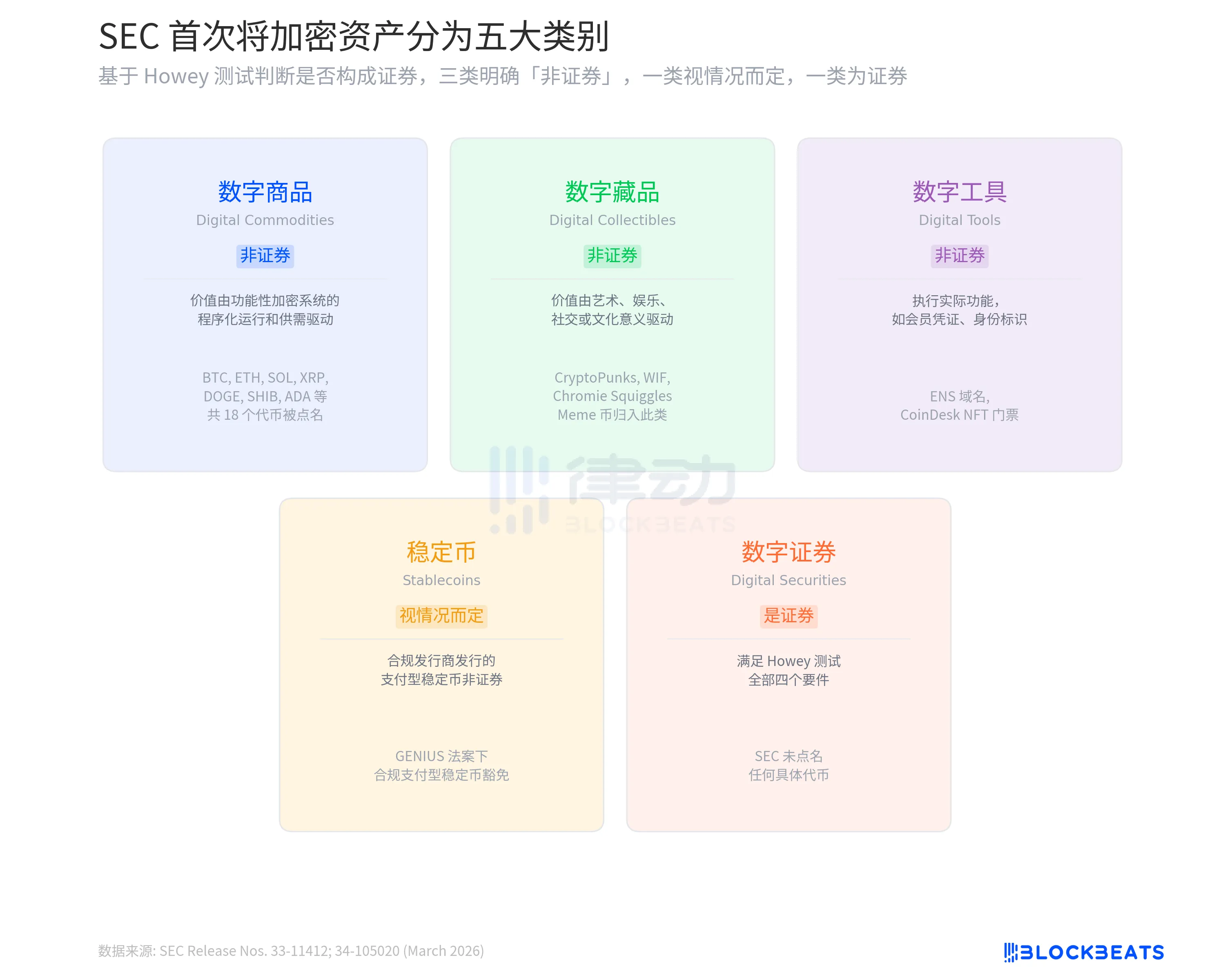
The first category is "Digital Commodities". This is the most attention-grabbing part of the entire document, as the SEC provides a specific named list. BTC, ETH, SOL, XRP, ADA, AVAX, DOGE, SHIB, LINK, DOT, LTC, BCH, HBAR, XLM, XTZ, APT, totaling 16 tokens, are clearly listed in the main text. The footnotes also mention that Algorand (ALGO) and LBRY Credits (LBC) belong to this category.
The SEC's reasoning is that the value of these tokens is intrinsically related to the programmatic operation of the functional crypto systems they are part of, driven by supply and demand, rather than by profit expectations from others' managerial efforts.
The second category is "Digital Collectibles." CryptoPunks, Chromie Squiggles, WIF (dogwifhat), and VCOIN are specifically named. Meme coins find their place here, as the SEC believes their value is driven by "artistic, entertainment, social, or cultural significance," similar to physical collectibles, and does not constitute securities.
The third category is "Digital Tools." ENS domain names and CoinDesk’s Microcosms NFT tickets are listed as examples. The characteristics of these assets are that they perform actual functions, such as membership credentials, identity verification, and property rights certificates, many of which are soul-bound and non-transferable.
The fourth category is "Stablecoins." According to the enacted "GENIUS Act," compliant issuers' "payment stablecoins" are explicitly excluded from the definition of securities by law. However, the SEC also retains jurisdiction over stablecoins that do not meet the standards of this act.
The fifth category is "Digital Securities." This is the only category explicitly identified as securities. However, the SEC did not name any specific tokens belonging to this category in the document.
The boundaries between these five categories are not absolute. The SEC itself acknowledges the existence of hybrid assets that cross categories, as well as crypto assets that do not belong to any category. But the significance of this classification framework is that it pulls the debate of "what is a security, what is not" from court argumentation to the level of regulatory enforcement.
Four Types of On-Chain Behavior, Unified Characterization
Beyond token classification, another significant contribution of this document is the unified characterization of four core on-chain behaviors: mining, staking, wrapping, and airdrops.
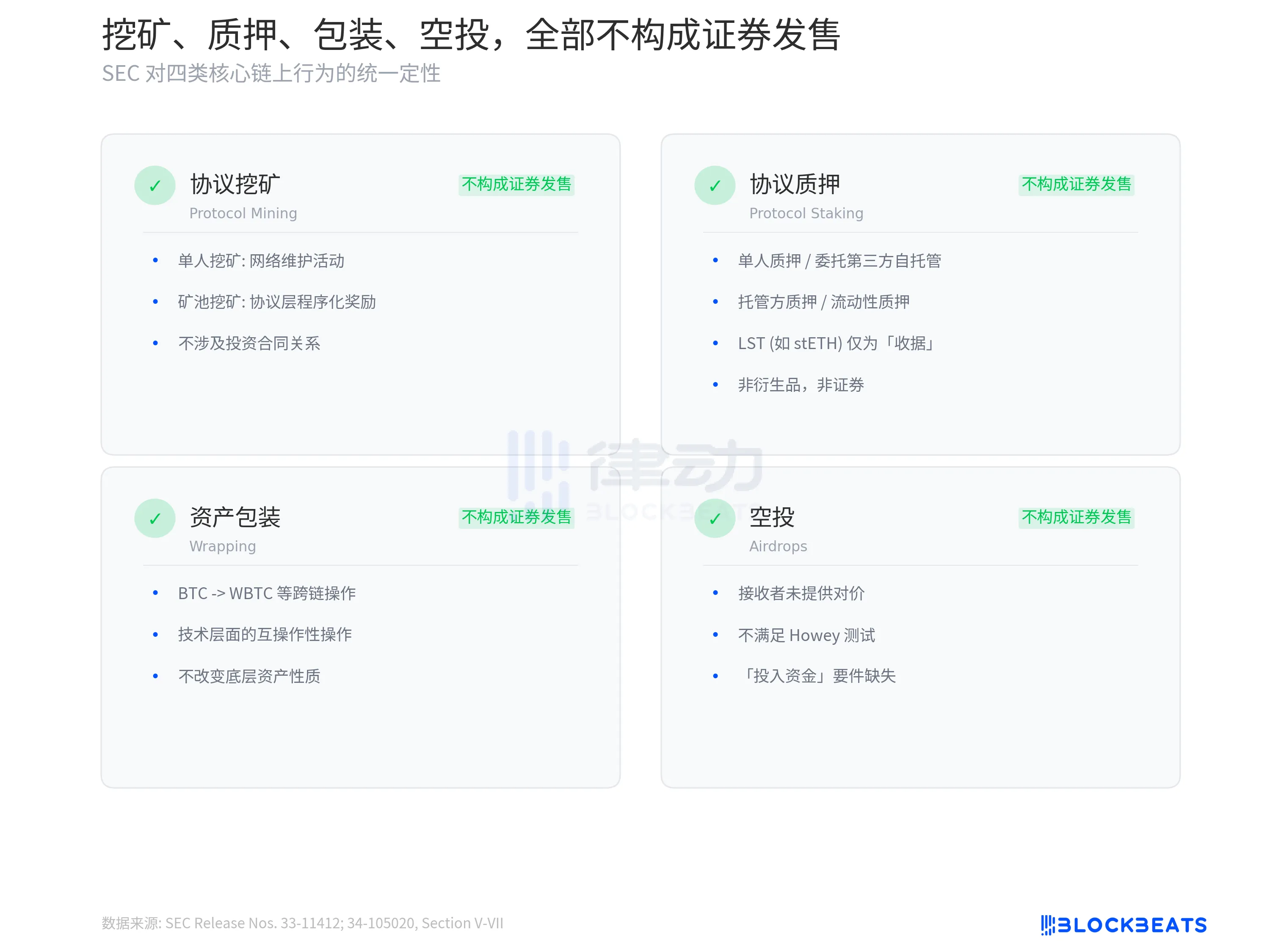
Protocol Mining does not constitute a securities offering. Whether mining alone or joining a mining pool, the act of mining itself is a network maintenance activity, and the newly generated tokens are programmatic rewards at the protocol level, unrelated to investment contract relationships.
Protocol Staking does not constitute a securities offering. This judgment covers four scenarios: solo staking, delegated to a third party but retaining custody of the keys, delegated to a custodian for staking, and liquid staking. The SEC clarifies in the document that staking rewards come from the programmatic distribution predetermined by the protocol, not from the operational efforts of a management team. For liquid staking generated LSTs (like stETH), the SEC deems them to be merely "receipts" of the underlying staked assets, not derivatives, and do not constitute securities.
Asset Wrapping does not constitute a securities offering. Wrapping BTC into WBTC for use on Ethereum is merely a technical interoperability operation that does not change the nature of the underlying asset.
Airdrops do not constitute a securities offering. As long as the recipients do not provide funds, goods, or services as consideration, the free distribution of tokens does not meet the "investment of money" requirement in the Howey test.
The direct impact of these judgments on the industry is that the core mechanisms of DeFi protocols, staking, wrapping, and airdrops, have all been removed from the reach of securities laws. Every project operator that has offered staking services or conducted airdrops over the past three years had been worried about this issue, but now there is a unified answer from a federal regulatory agency.
Securities Status is Not a Permanent Label
The most noteworthy part of this document might be the SEC's explanation of the "Separation" mechanism. The document clearly states that a crypto asset that is not inherently a security can be subjected to securities regulation due to its issuance method (e.g., through investment contract offerings). However, when the conditions of the investment contract no longer hold, the asset can be "separated" from its securities status.
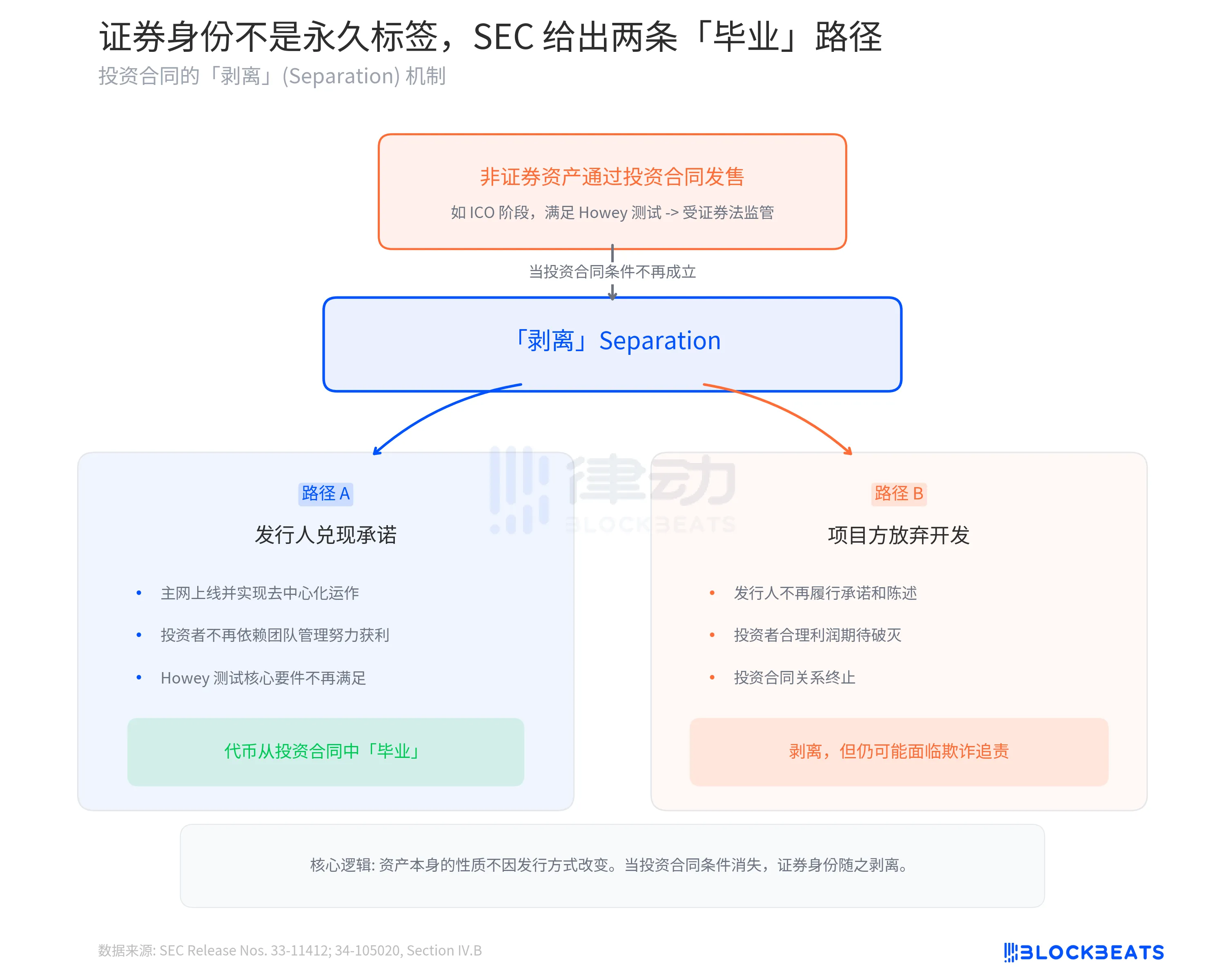
The SEC provides two scenarios of separation. The first scenario is when the issuer fulfills its promises. For example, if a project promises during an ICO to develop a decentralized network, and the network is genuinely launched and operates in a decentralized manner, investors no longer need to rely on the issuer team’s management efforts to profit; the core criteria of the Howey test are no longer met, and the token "graduates" from the investment contract.
The second scenario is more interesting, which is when the project parties "abandon" the efforts. If the issuer no longer fulfills its promises and representations made in the investment contract, the investors’ reasonable expectations of "profits from the efforts of others" also dissipate, leading to the termination of the investment contract relationship. However, the SEC emphasizes that this does not mean the issuer can escape responsibility; they may still face accusations of fraud.
The real significance of this "separation" mechanism lies in that it provides a compliance path for crypto projects. From ICO to mainnet launch to full decentralization, it is no longer a risky venture in a legal gray area but a regulatory tunnel with a clear endpoint. Once completed, the project comes out.
68 pages. Nine chapters. 18 explicitly named tokens, 6 types of characterized on-chain behaviors, 2 "graduation" paths. The SEC took over a year to gather more than 300 comments and ultimately delivered this answer in collaboration with the CFTC. It is not perfect; the boundaries of stablecoins still have ambiguous areas, no specific examples were given under the "digital securities" category, and the judgment standards for hybrid assets were left open.
But for an agency that has been criticized for "substituting enforcement for regulation," this document at least accomplishes one thing: it puts the rules down on paper, rather than in pleadings.
免责声明:本文章仅代表作者个人观点,不代表本平台的立场和观点。本文章仅供信息分享,不构成对任何人的任何投资建议。用户与作者之间的任何争议,与本平台无关。如网页中刊载的文章或图片涉及侵权,请提供相关的权利证明和身份证明发送邮件到support@aicoin.com,本平台相关工作人员将会进行核查。


