Original Title: "From Abandoned Asset to Sky-High Target, Mastercard Swallows BVNK for 1.8 Billion Dollars"
Original Author: Sanqing, Foresight News
On March 17, global payment giant Mastercard announced the acquisition of stablecoin infrastructure provider BVNK. The transaction value could reach up to 1.8 billion dollars, including 300 million dollars in contingent payment terms. Mastercard expects to complete the transaction by the end of this year, thereby expanding its end-to-end support capabilities in the digital asset and cross-currency value transfer sectors.
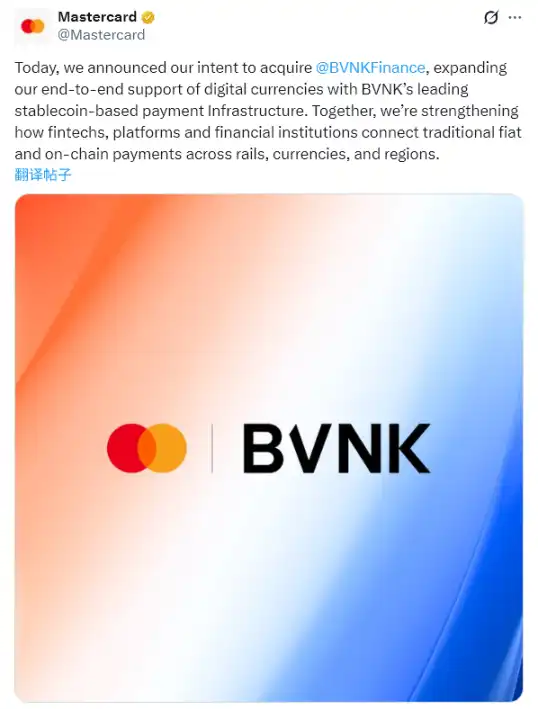
Image Source: Mastercard Tweet
The Value of Abandonment, Coinbase's Hesitation and Mastercard's Decisiveness
BVNK was established in 2021 and is headquartered in London. In May 2022, BVNK completed a 40 million dollar Series A financing, achieving a post-financing valuation of 340 million dollars. Two years later in December 2024, it completed another Series B round financing of 50 million dollars, raising its valuation to about 750 million dollars.
BVNK is led by three South African founders, including CEO Jesse Hemson-Struthers (a serial entrepreneur who previously founded e-commerce and gaming companies acquired by Naspers and Sportradar, respectively), CTO Donald Jackson (a blockchain and enterprise systems expert), and CBO Chris Harmse (a CFA holder and former macro/crypto fund partner focused on forex and cross-border payments).
This startup has quietly woven together a vast settlement network for crypto assets.
Currently, the platform processes annual stablecoin payment transaction volumes of about 25 to 30 billion dollars. It provides businesses with a seamless gateway to connect fiat currency and stablecoins, supporting payment activities across major blockchain networks in over 130 countries and regions worldwide.
However, prior to Mastercard's intervention, the true potential buyer of BVNK was in fact the crypto giant Coinbase.
In November 2025, acquisition negotiations between Coinbase and BVNK, worth as much as 2 billion dollars, had entered the due diligence phase, and both parties even signed an exclusivity agreement at one point.
Coinbase was an investor in its Series B round funding, and if this deal had gone through, it would have marked a significant event for a crypto-native company expanding into the core area of global payment infrastructure. However, both parties ultimately announced the cancellation of the transaction that month and did not disclose any substantive reasons for the fallout.
As Coinbase stepped back, Mastercard quickly filled the gap.
For a startup with an annual revenue of only about 40 million dollars, the 1.8 billion dollar deal appears extremely costly in financial terms. But this sky-high funding has never been about current profit margins; instead, it is a monopoly ticket to the next generation of settlement networks.
Defensive Counterattack, Buying the Possibility to "Bypass Card Organizations"
Mastercard's actions are, in fact, a strategic counterattack with a strong defensive color.
Stablecoins are visibly eroding the market share of traditional cross-border settlements at an alarming rate. With around-the-clock operation, low friction costs, and extremely fast clearing speeds, blockchain-based digital dollars are starting to shine in B2B payments and cross-border remittance scenarios.
Within the global financial network, traditional credit card organizations are among the payment channels most threatened by the disruption of stablecoins. If multinational corporations and commercial institutions become accustomed to point-to-point on-chain settlements, the centralized fiat routing networks that Mastercard relies on could face the risk of being completely marginalized.
If you can't compete, decisively buy it.
Mastercard's Chief Product Officer Jorn Lambert did not shy away from this. He stated in the acquisition announcement that it is expected that most financial institutions and fintech companies will offer digital currency services in the future.
Mastercard's plan is quite clear, aiming to directly integrate BVNK's ready-made stablecoin pathway and compliance engine into its vast global fiat network. Stablecoins will no longer be competitors of card organizations, but instead forcibly incorporated as a highly complementary subset of its underlying network.
Traditional giants are building high walls with insurmountable capital barriers.
Claiming Turf, There Are No New Players at Wall Street's Payment Table
This is by no means an isolated action by Mastercard; the entire traditional financial sector is frantically vying for entry into on-chain infrastructure.
Before this acquisition came to fruition, BVNK had already gathered a luxurious lineup of capital from Wall Street. In May 2025, Mastercard's biggest rival Visa strategically invested in BVNK through its venture capital arm, Visa Ventures.
In October, Citigroup's venture capital department, Citi Ventures, also invested real money, although Citigroup refused to disclose the specific investment amount and BVNK's valuation, the company stated in an interview that its valuation is higher than the 750 million dollars of the Series B round.
Even two months before Mastercard announced its acquisition, Visa boldly announced the integration of BVNK’s stablecoin settlement capabilities into its core Visa Direct platform, intended to support the cross-border fund distribution of global digital wallets.
This is not only a technological hard stitching but also a tacit collusion of capital.
Looking across the entire payment industry, the Silicon Valley darling Stripe had previously spent 1.1 billion dollars to acquire the stablecoin startup Bridge. Moreover, before finalizing BVNK, Mastercard was also reported to be in high-stakes acquisition negotiations with another crypto infrastructure startup Zerohash (founded in 2017, headquartered in Chicago) for up to 1.5 to 2 billion dollars.
Traditional payment giants are intensively and crazily merging to reclaim the originally decentralized and fragmented liquidity of stablecoins back into their extremely familiar business frameworks and regulatory channels.
At this highly lucrative table, the ones ultimately sitting down are still the old rulers holding substantial amounts of capital.
免责声明:本文章仅代表作者个人观点,不代表本平台的立场和观点。本文章仅供信息分享,不构成对任何人的任何投资建议。用户与作者之间的任何争议,与本平台无关。如网页中刊载的文章或图片涉及侵权,请提供相关的权利证明和身份证明发送邮件到support@aicoin.com,本平台相关工作人员将会进行核查。