Text | Lin Wanwan
In 2014, there was an intern at Baidu Research Institute, a PhD from the Institute of Automation at the Chinese Academy of Sciences, coming from a county city in Henan. He had calculated for himself: the most ideal place after graduation would be IBM, writing Java, with an annual salary of 280,000.
During the Spring Festival of 2026, a tool called OpenClaw, an Agent, became a global sensation; developers needed large underlying models to support lobster development. There was a model that was both fast and cheap, consuming 14.4 trillion tokens on OpenRouter in a week, topping all platforms.
This model is called M2.5, and the company is called MiniMax.
Within two months of going public, the stock price soared from 165 HKD to 1300 HKD, with a market value exceeding 300 billion, while it was still a company with an annual revenue of less than 80 million dollars.
The person who created MiniMax is none other than that intern from twelve years ago, Yan Junjie.
Betting More Than a Year in Advance
During the Spring Festival of 2021, Yan Junjie returned to his hometown in Henan for the New Year and visited his grandfather.
His grandfather told him he wanted to write a memoir to record his 80 years of life. However, he couldn’t type and couldn’t organize the stories well, and after a few discussions, he set it aside.
Yan Junjie had been in the AI industry for more than a decade. At that moment, he suddenly realized that, despite everything he had created already being implemented in the industry, helping numerous companies, it had no value to an old man wanting to write a memoir.
This detail was later referenced multiple times, taking on a bit of an inspirational story flavor. But it genuinely explained one thing: his motivation for doing AI was very simple, to really allow ordinary people to use it. This persistence later drove a series of counterintuitive decisions.
At the end of 2021, he left SenseTime.
The timing was critical. SenseTime was preparing for a listing in Hong Kong at the time; he was vice president, deputy director of the research institute, and CTO of the smart city business group. When he left, it was one of the most valuable times for the company. He didn’t wait for the IPO or for the wealth to materialize; he just left.
ChatGPT was only released in November 2022.
MiniMax was established in December 2021.
This time difference became the foundation for everything that followed. Yan Junjie later stated that if he hadn’t started early, in the later fundraising environment where "star researchers and major AI backgrounds were more popular," MiniMax would have had no chance against others.
Both of his parents are ordinary people. He attended high school in a county city, later got into Southeast University’s Mathematics Department, then obtained his doctorate at the Institute of Automation at the Chinese Academy of Sciences, postdoctoral at Tsinghua University, and then joined SenseTime, progressing step by step without any overseas background or prominent connections from the start.
During his internship at Baidu, he had some interaction with Yu Kai of Horizon Robotics. Later, Yu Kai said that while academic ability can be trained, those who can engineer AI technology into the real world are rare. Yan Junjie is one of them.
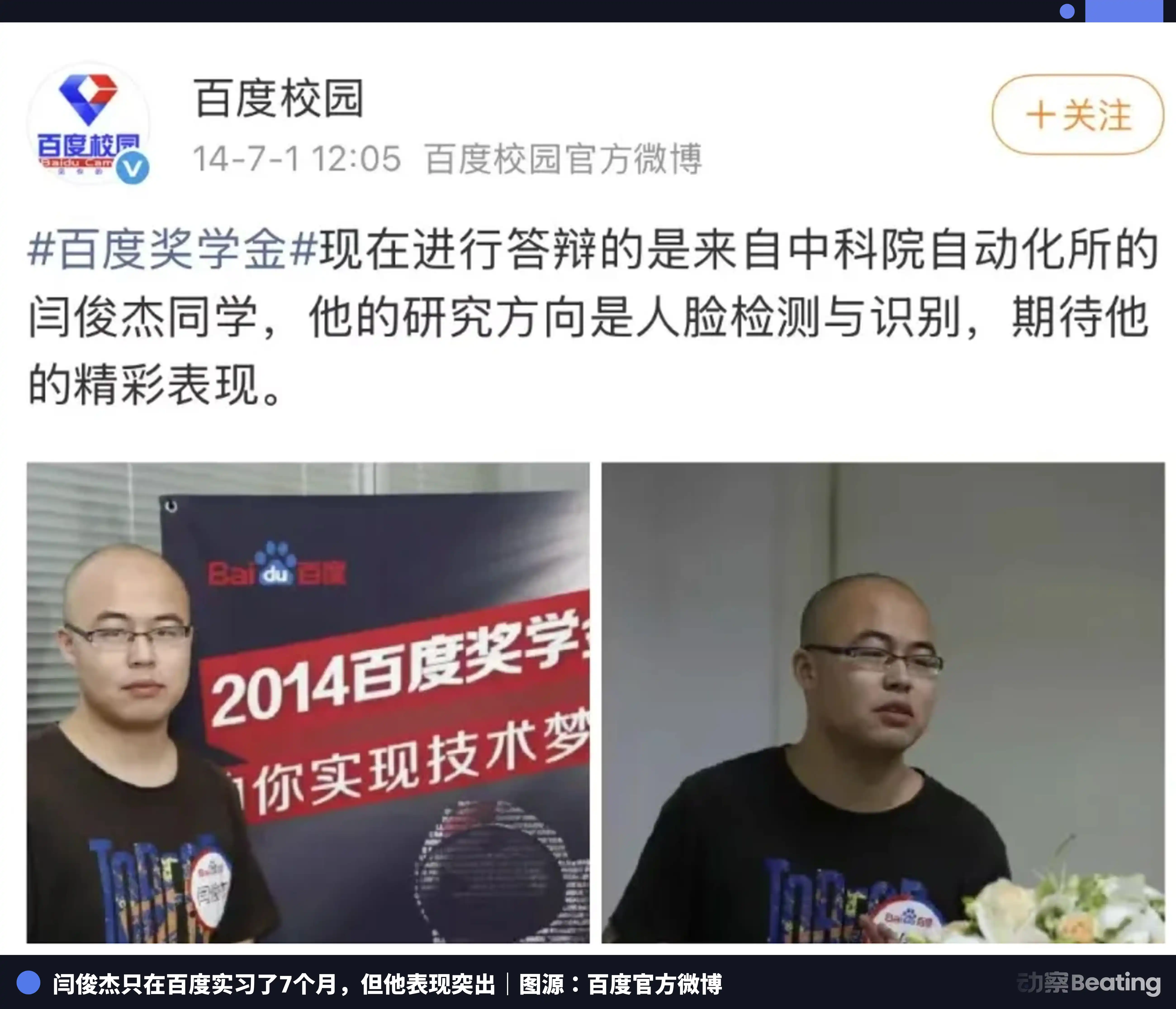
After joining SenseTime, he rose from intern to vice president in seven years. In 2018, with insufficient manpower, he led a team to create an "All for One" model algorithm, overtaking Megvii and Yitu in the bidding process to claim the industry’s top spot. Some commented that he "reads papers incredibly quickly, disregarding clichés and focusing only on essentials." This efficiency later became part of MiniMax's corporate culture.
He named the company MiniMax, derived from von Neumann's minimax algorithm in game theory.
His explanation was that when making decisions, one must first guard against the worst risks and then choose the relatively optimal solution.
A Unique Shareholder List
In December 2021, MiniMax completed its angel round with 31 million dollars, at a pre-money valuation of 170 million dollars. Investors included miHoYo, IDG, Hillhouse, and Yunqi.
The investment from miHoYo was somewhat special. Yan Junjie had a good personal relationship with miHoYo's chairman, Liu Wei, who invested in the angel round and is still on MiniMax’s board as a non-executive director.
MiHoYo itself is also a client of MiniMax, using their models for NPC dialogues and plot generation in games.
After the angel round, the story encountered a small twist.
In March 2023, Silicon Valley Bank announced its bankruptcy. At that time, all of MiniMax's funds were in that bank. This was the most perilous moment in the early days of the startup; the money was gone, and the financing environment was chaotic. But they got through it, and two months later secured A round funding of 257 million dollars, with a valuation of 1.157 billion dollars.
The subsequent list of investors became increasingly remarkable. Alibaba invested, Tencent joined in, and Sequoia followed. By the time of the IPO, there had been seven rounds of funding, totaling nearly 1.5 billion dollars, with a valuation of 4.2 billion dollars. After the IPO, Alibaba owned 12.52%, becoming the largest external shareholder.
Yan Junjie had a habit in early-stage financing: he only spoke with the top executives of investment institutions. He met with Shen Nanpeng from Sequoia and Zhang Lei from Hillhouse.
But there is one person on this shareholder list who deserves special mention: Yuan Yeyi.
Born in 1994, she studied electronic engineering at Johns Hopkins University, minoring in economics and mathematics. She entered SenseTime immediately after graduating in 2017, working in financing and strategic investment, and a year later was promoted to administrative assistant and strategic department director for CEO Xu Li. She was deeply involved in SenseTime’s journey from early days to the Hong Kong listing.
In 2021, she co-founded the startup with Yan Junjie.
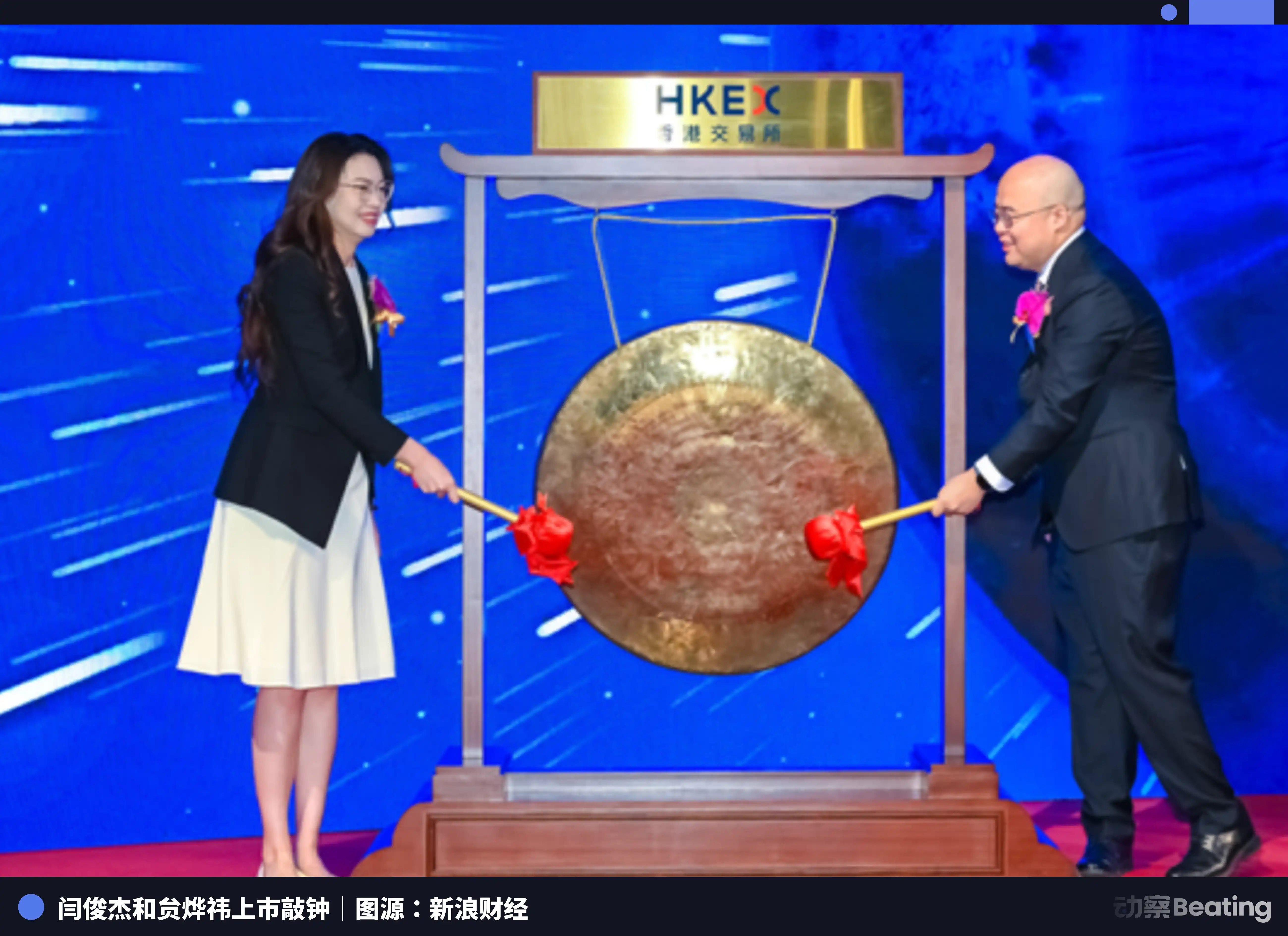
Investors have described her as "capable, commanding, with strong execution and a maturity that surpasses her age." Her division of labor with Yan Junjie is very clear: one defines the technical vision, while the other turns the vision into money and resources. Yan Junjie can immerse himself in technology; it doesn’t matter if he shaves his head, but the market, capital, and globalization are Yuan Yeyi’s battlefield.
On the day of the IPO bell-ringing, the two stood on the same platform. Yuan Yeyi was 31 years old, with a net worth of over 4 billion HKD.
385 People and 1% of the Money
When MiniMax went public, the company had 385 employees, with an average age of 29.
From its establishment until September 2025, the company spent about 500 million dollars. OpenAI spent between 40 billion and 55 billion dollars during the same period.
This comparison is somewhat absurd. With less than 1% of the competitor's spending, they built a world-leading company in all modalities. Saving money was just a result. The real reason was that they pushed AI to its limits. 80% of the company's code was completed by AI, which they referred to internally as "interns", endowed with permissions high enough to directly access the codebase and modify the online environment—they could chat with it in Feishu and have it review and go live directly.
This efficiency made MiniMax's per capita output exceedingly high.
In terms of products, they adopted an all-modal route from the beginning: language, video, speech, music, advancing in four directions simultaneously. While others were busy learning to have dialogues like ChatGPT, Yan Junjie bet on multi-modal integration. His judgment was that multi-modality is the fundamental premise for continuously enhancing intelligence; without an all-modal approach, the next generation of models would have no opportunity.
In the summer of 2023, he made an even bolder decision.
He allocated 80% of computational power and R&D resources entirely to MoE (Mixture of Experts systems).
At that time, the domestic mainstream was still iterating dense models, and MoE was seen as "cutting-edge but immature" technology. Yan Junjie’s logic was straightforward: to serve tens of millions or even hundreds of millions of users, generating tokens at low cost and latency cannot be supported by dense models. Without MoE, scaling up is impossible, making everything futile.
In early 2024, MiniMax released the first domestic MoE large model.
In terms of products, they also did not engage in fierce competition within the domestic market. The C-end produced Xingye and Talkie, one in domestic and one overseas, creating AI companions; Hailuo AI focused on video generation, achieving the highest monthly active users for global video generation applications for six consecutive months in the latter half of 2024.
Current numbers show: 236 million users covering 200 countries and regions, with overseas revenue accounting for 73%. The B-end has 214,000 enterprise clients and developers, with Google Vertex AI, Microsoft Azure, and AWS all having deployed MiniMax’s models; Notion's first open-source model choice was also MiniMax.
February’s ARR surpassed 150 million dollars, with the M2 series’ daily token consumption being six times that of last December, with programming-related growth exceeding tenfold.
This is the reason the market is willing to give a 200x sales ratio.
But there is a set of numbers that need to be unpacked.
In the annual report, the C-end gross profit margin was 4.7%, while the B-end gross profit margin was 69.4%. 67% of the company’s revenue came from the C-end, which contributed almost no gross profit. By the fourth quarter’s rough calculations, the C-end gross profit margin had already dropped to around 2.1%. The overall gross profit margin increased from 12.2% to 25.4%, primarily due to the rapid increase in B-end revenue proportion in the fourth quarter, raising the overall numbers.
This is an unsolved problem.
The Mountain Can Be Surmounted
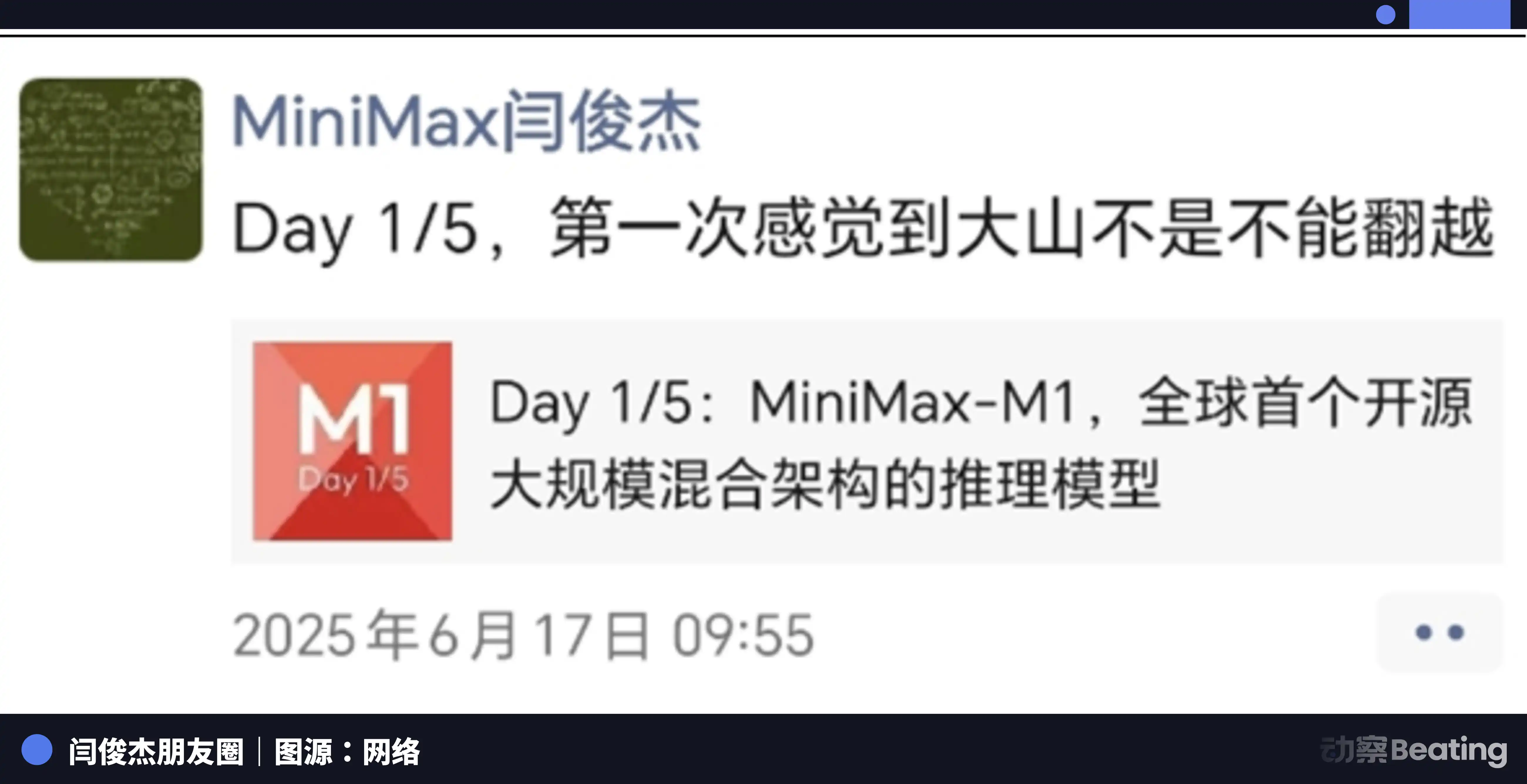
In June 2025, MiniMax released the M1 model.
Yan Junjie posted a line on his social network:
"For the first time, I feel that the mountain can be surmounted."
The reality behind this statement is that the technical capabilities of leading models in China and the US might only differ by 5%, but this 5% allows foreign companies to occupy scenarios valued at ten times higher and charge prices ten times higher, ultimately resulting in a commercial gap of nearly a hundred times. OpenAI’s latest valuation exceeded 700 billion dollars. MiniMax went public with a valuation of 80 billion HKD, less than 10 billion dollars.
He made a judgment that in the future, there would be five top AGI companies globally, with at least two coming from China, and even one could reach first place.
After going public on January 9, he immediately appeared at an expert entrepreneur symposium hosted by the Prime Minister on January 19, becoming the second AI large model founder to attend after Liang Wenfeng from DeepSeek.
Then on March 2, the first annual report was released, leading to a surge in Hong Kong stocks that day.
At the earnings conference, Yan Junjie spent a long time discussing one thing: MiniMax wants to transform from a "large model company" into a "platform company in the AI era."
He provided a formula for platform value: intelligence density × token throughput. The platform in the internet era was a traffic gateway, while the platform in the AI era is a company capable of defining intelligent boundaries and simultaneously reaping commercial benefits. Google is doing this, OpenAI is doing this, and they must do it too.
The opponents he faced are dozens of times larger than him.
Going public on the Hong Kong stock exchange merely pushed him into another battlefield. Quarterly reports, analysts, market capitalization pressure—these elements are entirely different from writing code. The second market does not believe in sentiment; it only looks at numbers. Can the C-end story be converted into gross profit? Can B-end growth be maintained? When will M3 be released? These questions will need to be addressed every quarter moving forward.
But if we look at the broader picture, the story of MiniMax is not just the story of one company.
The US has been tightening its grip on chips in recent years. A100 sales are limited, H100 sales are limited, and H800 is also restricted. The logic is straightforward: by choking off computing power, the AI's throat is grabbed.
On the Chinese side, they have been forced to take a completely different path.
DeepSeek achieved results close to H100 using the H800. MiniMax accomplished in 500 million dollars what OpenAI needed hundreds of billions to achieve. Yan Junjie’s gamble on MoE in 2023 resulted because the limited resources he had could not support the reasoning volume needed for hundreds of millions of users. M2.5 costs one dollar for an hour of continuous work, which is one-twentieth of GPT-5. Mixed attention architecture, linear attention, CISPO algorithms—innovations that were forced out due to necessity.
The intention behind the chip blockade was to widen the gap, but the actual effect forced Chinese AI companies into a path of low computational power and high efficiency evolution.
With limited money, limited cards, and few people, they instead produced extreme engineering capabilities and architectural innovations.
This follows the same logic as Huawei making chips: if you block one capability, I will compensate in other dimensions, and in the process of compensation, I may grow something you do not have.
OpenAI currently has more than 4,000 employees and plans to burn 8 billion dollars in cash in 2025 while planning to spend 600 billion dollars on computing power by 2030. MiniMax has 385 employees and has spent a total of 500 million dollars.
Who will win is still unknown. But at least for now, the number of people betting that MiniMax will fail is decreasing.
The Henan PhD student who interned at Baidu in 2014 probably never imagined that twelve years later, he would be positioned here, linked to an entire national-scale technological competition.
He chooses to keep running.
免责声明:本文章仅代表作者个人观点,不代表本平台的立场和观点。本文章仅供信息分享,不构成对任何人的任何投资建议。用户与作者之间的任何争议,与本平台无关。如网页中刊载的文章或图片涉及侵权,请提供相关的权利证明和身份证明发送邮件到support@aicoin.com,本平台相关工作人员将会进行核查。