Original | Odaily Planet Daily (@OdailyChina)
Author | Ethan (@ethanzhang_web3)
The "lobster craze" has reached crypto exchanges, becoming one of the most interesting scenes in the OpenClaw frenzy. In recent days, OKX, Binance, Gate, and Bitget have almost sequentially launched Skills, MCP, CLI, Agent Hub, and Wallet Skill.
This time, the exchanges are not just chasing trends; they are transforming their capabilities embedded within Apps, web pages, and APIs into an interface layer that Agents can understand, call, and execute. In the past, the competition was about liquidity, transaction fees, and listing speeds; now they are vying for a more preemptive position: who will be the first platform called when users delegate research, filtering, and order preparation to Agents.
This is also the truly critical aspect of this round of changes.
First, let’s see what these exchanges have updated in recent days
The update rhythm among the exchanges in this round of actions has been very tight.
OKX's actions are actually split into two steps. On March 3, Odaily quoted official news stating that OKX OnchainOS has opened AI-related capabilities through three methods: AI Skills, MCP, and Open API, allowing Agents to execute trades on-chain, gain market insights, perform address analysis, and conduct on-chain payments. According to the OnchainOS official documentation, this system already covers essential capabilities such as wallets, trading, market insights, and payments, with a scope covering over 130 major public chains and aggregating over 500 DEX routes on the trading side. By March 10, OKX Agent Trade Kit took a step further by pushing forward the okx-trade-mcp and okx-trade-cli access paths, along with four pluggable Skills. What is truly noteworthy is not the label of AI trading, but its detailed description: AI can perform spot, perpetual, and conditional order operations through a single MCP interface; the keys are saved only in local configurations, and signatures are completed locally; if the API Key does not have trading permissions, the corresponding ordering tool will not even be registered in the toolbox. The official figure is 82 tools and 7 modules, also mentioning the live options market and simulation mode. Looking at OnchainOS and Agent Trade Kit together, it is clear that OKX is not just trying to be a trading assistant but is also leaning towards integrating on-chain capabilities and trading capabilities into the Agent infrastructure.
Binance's rhythm is a bit earlier and involves continuous forward pushes. On March 3, the first batch of 7 AI Agent Skills were introduced, followed by the Skills Hub showcasing these capabilities, publicly listing modules such as crypto-market-rank, meme-rush, query-address-info, query-token-audit, query-token-info, spot, and trading-signal. The next day, MPC wallet and DeFi wealth management were disclosed to be entering the auditing stage; by March 12, 4 new AI Agent Skills expanded the capabilities directly to Alpha market data, USDT margin contracts trading, leveraged trading, and asset management. In other words, Binance's offerings have expanded from the initial 7 informational Skills to derivatives, leverage, and account management in a very short time. One of the most interesting statements on the page is not a functional introduction, but that all Skills will undergo review before going live. This indicates that Binance is not just after traffic entry points but also includes the capability distribution rules in the Agent era.
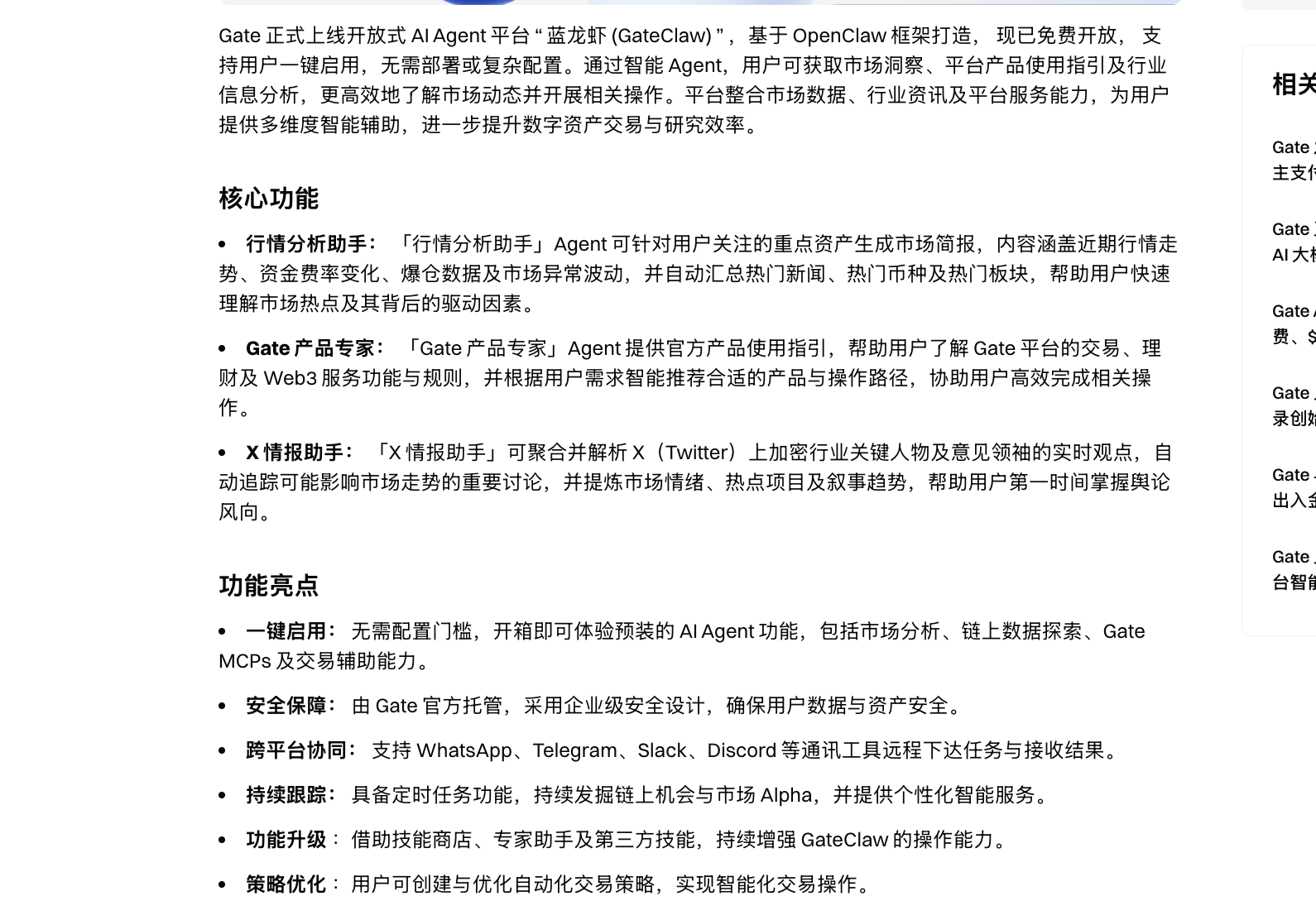
Gate's updates feel more like a series of rapid releases. On March 5, Blue Lobster was first released, lowering the barrier for ordinary users to experience GateClaw; on March 7, the DEX MCP was launched; on March 10, CEX MCP followed, at this point Gate has integrated both on-chain and centralized trading capabilities into the Agent scenario. Then, on March 11, it released Skills Hub, the new Blue Lobster, Gate CLI, Blue Lobster User Guide, and 20 AI Agent Skill updates in succession. In other words, Gate is not just putting up a Gate for AI page but has expanded the experience entry points, DEX/CEX MCP, CLI, Skills Hub, and Agent Skills within a few days. Looking back at Gate for AI architecture, with application layer, capability layer, protocol layer, and infrastructure layer, along with the five core modules of Exchange, DEX, Wallet, News, and Info, it becomes easier to understand: it aims to create not just a standalone tool but to package CEX, DEX, wallets, information, and on-chain data into a complete Agent infrastructure.
Bitget's moves have formed a very complete line as well. The earliest was on February 27, when the Bitget Wallet Skill beta was released, focusing on allowing large models and automation tools to access on-chain data and trading infrastructure using natural language, while trades still require user confirmation; then on March 2, Bitget Wallet initiated Agent scenario capability exploration and launched Skills beta, fully bringing the Wallet line to the forefront. By March 9, Bitget Agent Hub underwent significant upgrades, connecting the Skills and CLI modules with last month's launched MCP and API to form a complete call system, with an official count of 9 major modules and 58 tools, enabling access to OpenClaw in 3 minutes; on the same day, Bitget Wallet announced integration with Paydify, incorporating consumption payment scenarios into the Agent ecosystem; then by March 12, Bitget Wallet MCP has opened testing for users, further advancing on-chain wallet capabilities into the callable interface layer. Looking further, the March monthly report presents another set of figures: a net inflow of approximately 205.95 million USD in February, ranking third globally among CEX, with BTC reserves rising to 36,700 coins. Connecting these actions, Bitget is clearly not just riding the lobster craze temporarily but is integrating Wallet, payments, Agent Hub, and MCP into its infrastructure narrative as platform growth, fund inflows, and brand expansion occur simultaneously.
Looking at the timeline of recent days, a noticeable change emerges: this wave is no longer a collective round of AI public relations from the exchanges, but several leading platforms are sequentially repackaging capabilities—originally scattered across pages and APIs—such as market insights, addresses, audits, wallets, order placements, and risk controls, into callable modules for Agents.
In summary, the difference lies in: while most products before simply made AI more articulate, this round of leading exchanges has started to enable AI to truly invoke actions.
Over the past year, the industry has indeed talked about AI trading. Automated copy trading, signal bots, strategy generation, report summarization—everyone has discussed these. The problem is, many of those products merely added a layer of smarter frontend to the existing trading process. AI analyzes on one side, trading executes on the other, and the user still has to cut pages, copy parameters, and click to confirm in between. Essentially, they still help you observe instead of connecting the system for you.
This round is different. It is no longer satisfied with stopping research and advice at the dialogue box, but has begun to move towards system calls, permission boundaries, and execution links. Because of this, what the exchanges are currently releasing is not merely an enhancement of the dialogue layer but is beginning to touch real system interfaces.
Comparing several exchanges, the gap is no longer about "whether there are", but "how far have they gone"
From my own hands-on experience, if we were to put all four exchanges into a table, spot and conditional orders are no longer rare capabilities. The difference mainly lies deeper. (Notes at the end include tutorials for each Agent, here I only share my experiential feelings)
First, let's discuss the most basic spot trading scenario. Buying a piece of ETH while placing take profit and stop loss orders—this action is now supported by all three exchanges. Binance's Spot Skill supports OCO (One Cancels Other), OKX’s spot module can handle take profit and stop loss, and Bitget's spot conditional orders have also been released. At this stage, the difference does not lie in whether it can be done but in who can execute it more smoothly, and who has better intent recognition by the Agent.
The futures level begins to reveal the tiers. Both OKX and Bitget can directly accept open, stop loss, and take profit instructions. Binance has not yet put futures front and center during the initial Skills phase, so that version seems more like a research and spot execution entry. Later, although it supplemented with USDT-based futures, leverage, and asset management, based on the current public product completion, the most straightforward aspect remains the informational level and standardized spot scenarios.
Looking further, Bitget has expanded its boundaries wider. Modules for copy trading, wealth management, and account management are already publicly presented. Trader selection, automatic copy trading, wealth product inquiries and subscriptions—these no longer remain just slogans. OKX and Binance have not yet placed this aspect at the same depth. Therefore, Bitget gives a more direct impression: it has not only created a few more Agent tools; it is moving the entire trading environment into the dialogue box.
Binance has its own strengths as well. Among several public hands-on experiences, address queries, hot token analysis, token audits, and spot trading chains are the smoothest. Especially in the layer before placing orders, wallet address insights, token security audits, and market rankings are very suitable to be delegated to the Agent. However, its boundaries are also clear; for example, wallet inquiries currently only support BSC, Base, and Solana chains; many capabilities are still about setting up the entry point first before gradually deepening.
OKX, on the other hand, appears to focus its efforts on the execution layer. It has combined spot, perpetual, conditional orders, options, local signatures, and simulation environments together, clearly prioritizing solving a more challenging task: when the Agent interacts with the order system, how permissions are controlled, risk management maintained, and simulation conducted—OKX clearly aims to think further ahead.
Gate, for now, struggles to use a few singular scenes to overshadow others. Compared with the previous three exchanges, it currently has not published many visible third-party hands-on scenarios, making it difficult to claim it has outperformed anyone in any particular trading action; however, from the recent pushes of DEX/CEX MCP, CLI, Skills Hub, and 20 Agent Skills, it is clear that Gate is not merely supplementing a function, but is laying a foundational layer. In the short term, it may not be who uses it the most vigorously; in the medium term, it aims to hold a more critical platform position. Beyond functionality, there's a very intuitive sense: as exchanges adopt increasingly similar naming conventions, with the heat rising, their distinctiveness has not completely kept pace.
Adding Bybit as a comparison makes the differences more apparent. Until March 13, 2026, its most noticeable public action remains an AI vs. Human 1v1 Trading Competition type of narrative, which can draw traffic, but in contrast to the previous exchanges pushing Skills, MCP, CLI, and modular interfaces forward, it’s clearly a different product pace.
Thus, looking at these exchanges together, the conclusion is already quite clear: Binance has first occupied the information and Skill distribution entry, OKX is the closest to closing the trading execution loop, Bitget currently reveals the deepest business depth, Gate seems to be building a platform foundation, while Bybit remains at the activity and promotion layer, temporarily not entering into this round of real product competition.
Why are exchanges the first to charge ahead?
This question is actually more crucial than who is currently doing it more comprehensively. Exchanges are precisely the group of companies that are least likely to slow down in this matter.
Market data, depth, accounts, orders, wallets, risk control—these elements are already the most mature, structured, and modularizable capabilities in the daily operations of exchanges. For large models, the challenge has never been "understanding a human sentence," but whether there are reliable external systems that can connect post-understanding. Exchanges happen to hold all these ready-made systems.
A more realistic layer is that exchanges fear losing entry points more than other projects. Previously, users first opened the App, then checked market data, and then placed orders; later, users began to enter through wallets, quantitative tools, Telegram groups, or on-chain dashboards. Now, Agents have generated a new layer of entry. Users may eventually not first open the trading page, but instead might first say in Claude, OpenClaw, ChatGPT, or terminals: "Help me check which coins are moving significantly today; if the risks are controllable, give me a phased buying plan." If the first touchpoint becomes a dialogue box, and the exchanges do not actively position themselves as the default calling capability layer for Agents, they risk degenerating into mere liquidity backends.
The current heat surrounding OpenClaw has also somewhat pushed this forward. Terms like Skills, MCP, and CLI were previously developer-centric, but now exchanges, media, and KOLs can weave stories around them. For exchanges, this is not just about having more new terminology, but a new layer of distribution channels has suddenly formed. Whoever gets in first stands a chance to secure a spot before standards are solidified. (Recommended reading: "Key 11 Questions about Lobsters: The Most Understandable Breakdown of OpenClaw Principles")
Thus, this round for exchanges is not merely a sudden love for AI, but a judgment on a matter: if, in the future, a portion of users' first trading interface is no longer a candlestick chart but rather a dialogue box, will they simply retreat to the background, becoming a liquidity provider subject to comparison and switching, or take a proactive step forward, transforming themselves into the financial foundation that Agents first call upon?
What truly should be alarming in this round is not exchanges doing AI, but the market starting to talk about interface upgrades as revolutions
However, it is now also the moment when it is easiest to easily phrase things, as if the moment exchanges implement Skills and MCP, the next generation of trading interfaces has already shifted from Apps to dialogue boxes. It is premature to reach this conclusion now.
Today, what is truly running smoothly mainly revolves around research, filtering, reminders, and condition judgments as preliminary actions. When it comes to the execution layer, there remain numerous problems: how to set permissions, how to implement secondary confirmations, how to roll back failures, how to express risk warnings, and who bears ultimate responsibility. Anyone who has seriously engaged with trading systems knows that there are no shortcuts here. Thus, in this round of competition, it’s likely that the initial focus will not be on fully automated trading. More practically, whoever can make that pre-order preparation layer seamless will be more likely to be the default called by the Agent. Research, filtering, information, reminders, and pre-order preparations may not sound explosive but are the most likely to turn into real use first.
Because of this, what’s worth watching is not just that exchanges are chasing another AI trend, but they are beginning to compete for the same new position: who can first organize their trading capabilities into callable modules, who can design permissions and security to a level that inspires trust, and who can secure the default entry in these new interfaces like Claude, OpenClaw, ChatGPT.
As for whether this competition will genuinely rewrite the industry's landscape, it is still too early to conclude. Interfaces can go live first, but trust cannot be built overnight; pages can be made compatible first, but user habits won’t migrate immediately; products can be discussed as closed loops, but real usage must undergo rounds of trial and error.
However, at least by today, one thing is clear: when exchanges begin to seriously transform their interfaces, permissions, and capability modules, the industry should not see it as just another wave of AI trends, but rather as a more concrete question surfacing: after AI Agents gradually take over part of the pre-trading process, who will become the default invoked crypto financial operating system?
Related Agent Tutorials
Binance AI Agent Skills Official Tutorial
OKX Agent Trade Kit Build BTC Regular Investment System (Openclaw Combined Version)
Bitget GetClaw Official Minimal Video Tutorial
Gate GateClaw Official Building Tutorial
免责声明:本文章仅代表作者个人观点,不代表本平台的立场和观点。本文章仅供信息分享,不构成对任何人的任何投资建议。用户与作者之间的任何争议,与本平台无关。如网页中刊载的文章或图片涉及侵权,请提供相关的权利证明和身份证明发送邮件到support@aicoin.com,本平台相关工作人员将会进行核查。


