Original Title: "The Chronicles of Cryptography in the Middle East"
Original Author: Hazel, Zhi Wubu Yan
In the early hours of June 18, 2025, while tens of millions of Chinese stayed up late to buy discounted goods, Iran's largest cryptocurrency trading platform Nobitex was also "liquidated".
A hacker organization called Gonjeshke Darande, meaning "The Plundering Sparrow" in Persian, posted on X, claiming to have hacked into Nobitex's hot wallet and stolen over 90 million dollars. Just a day earlier, this organization had attacked one of Iran's largest state-owned banks, Bank Sepah.
Then they did something rarely seen in the history of hacking.
They transferred the entire 90 million dollars to eight "black hole addresses" for destruction. These wallets, without private keys, once deposited, the funds would be forever unrecoverable. Ironically, these addresses were all embedded with phrases like "FuckIRGCTerrorists," with IRGC being the abbreviation for the Iranian Revolutionary Guard Corps.
Not taking a single dollar from 90 million, but going through all this trouble to stage such a satire, was clearly not motivated by financial reasons.
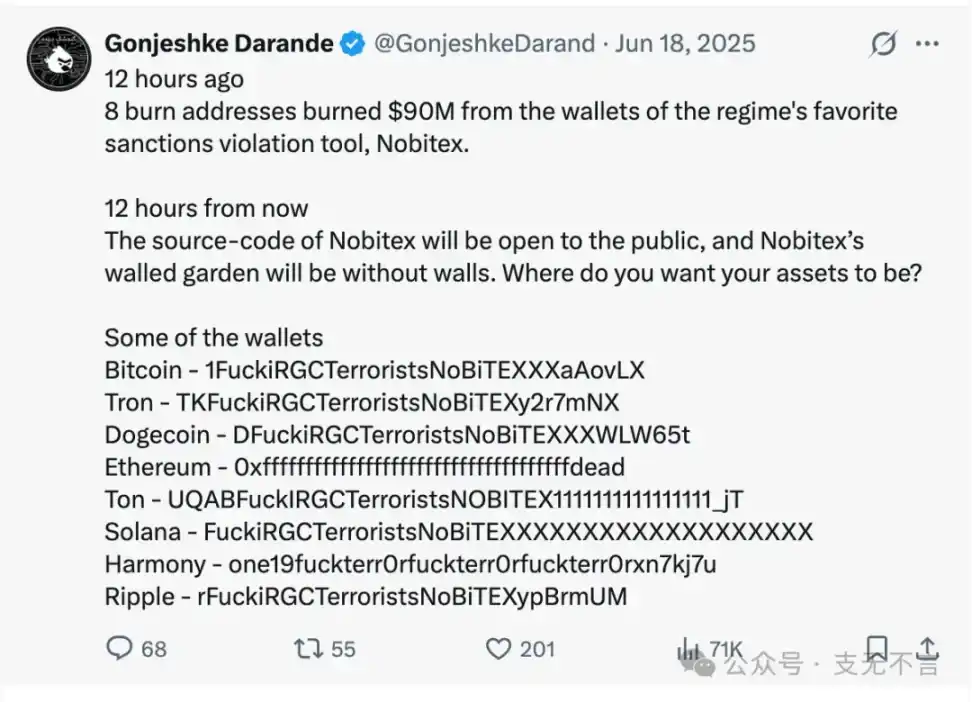
12 hours later, Nobitex’s source code and internal documents were fully revealed.
Independent investigator Nariman Gharib analyzed these documents and found that the 90 million dollars destroyed almost perfectly matched the IRGC-associated funds that had flowed into Nobitex via specific wallets in the preceding months.
Therefore, rather than theft, it could be said that this was a politically motivated targeted purging operation on the blockchain.
When it comes to cryptocurrency in the Middle East, what often comes to mind is Dubai licenses, the Token 2049 conference, and After Parties on Palm Island, but there is a more hidden, intricate world that exists outside our complete understanding.
Few can clearly articulate: what trading platforms do Iranians use? Why is there a nationwide cryptocurrency craze in Turkey? Why is Kuwait the country with the strictest crackdown on mining in the Middle East?
The story of Nobitex might be a key to unlocking this world.
From Chemical Engineer to "Zhao Changpeng" of Iran
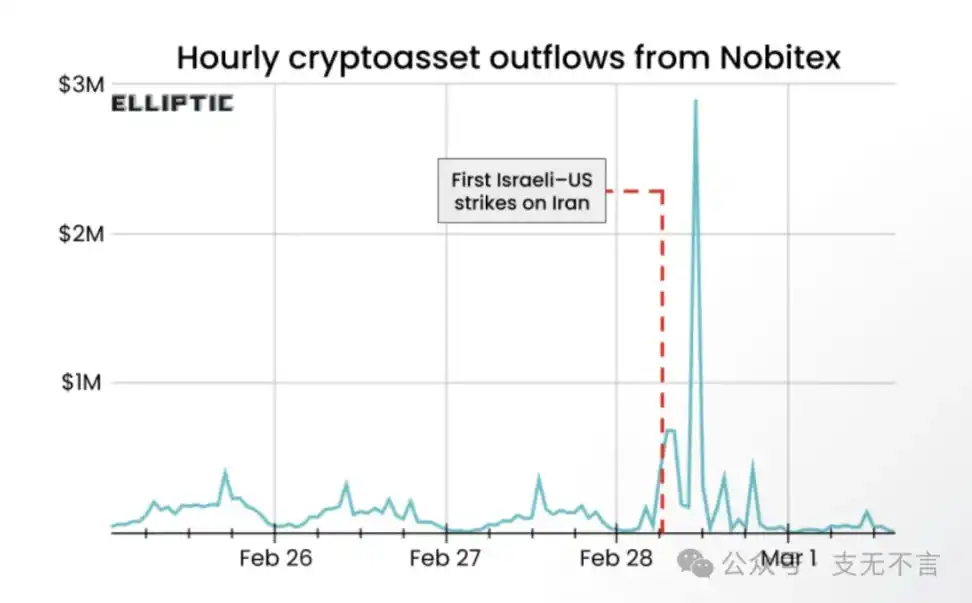
After the United States began its war with Iran, a piece of news brought Nobitex into the public eye: within minutes of the airstrikes commencing, the platform's cash withdrawal volume surged by 873%.
Nobitex's founder is Amir Rad. He does not come from a financial background, but is an engineer who graduated from Sharif University of Technology with a major in Chemical Engineering, and before starting his business, he worked in process safety and risk assessment in the petrochemical field.
Last year, he appeared on a popular Iranian business podcast called Karnakon Podcast — interestingly, the program's title roughly translates to: "Don’t Be a Wage Worker!" This was also the first time he publicly accepted an in-depth interview after the hacking incident.
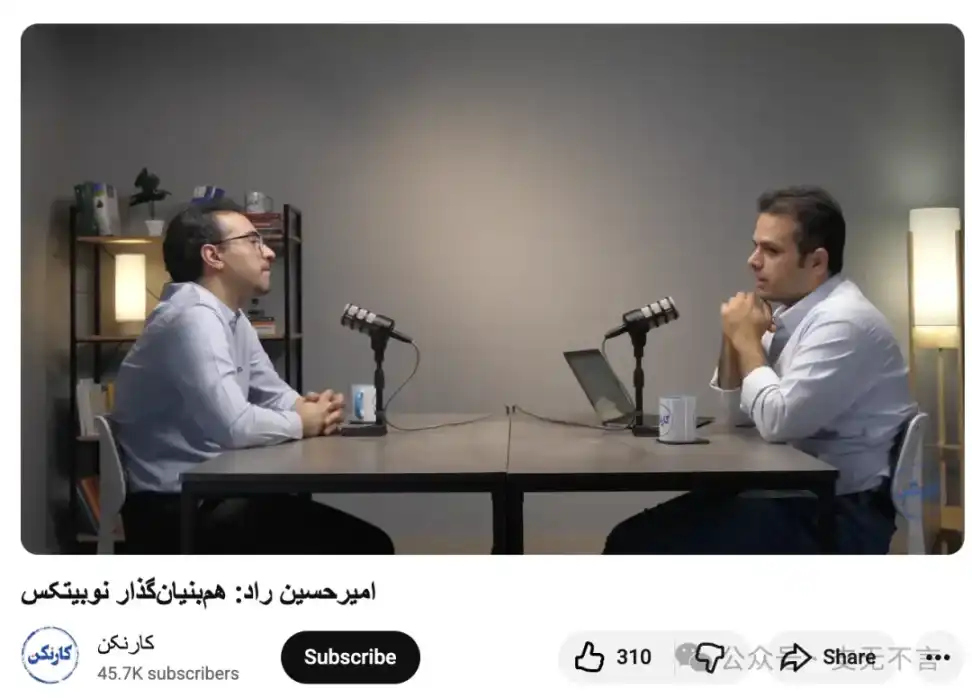
According to Rad, in 2017, as a retail investor in cryptocurrency, he co-founded Nobitex with three friends. The idea at the time was quite simple: to allow Iranian users to recharge with rials and place buy and sell orders for digital assets. And that was it.
But the results were far better than they had anticipated. Just a few months after its launch in 2018, hostility from Iranian regulators toward cryptocurrency led to Nobitex enduring a year-long comprehensive blockade. But it was so popular that even during the blockade, the platform maintained an organic growth rate of 20% monthly.
As of today, Nobitex has 11 million registered users, with total inflows exceeding 11 billion dollars, surpassing the total of the next ten Iranian trading platforms combined.
What does 11 million mean? With Iran's total population at 89 million, one in every eight individuals has registered on Nobitex. Excluding minors and elderly persons, the actual penetration rate is even higher. This number is roughly equivalent to that of the long-established, compliant American trading platform Kraken.

A chemical engineer, in eight years, created a trading platform that covers an eighth of the country's population. If the story ended here, it would be a rather impressive entrepreneurial legend.
The Wandering Financial Ghost
But the story does not end here.
Starting in 2024, there have been successive open-source intelligence reports indicating that the primary shareholders of Nobitex included relatives of Supreme Leader Khamenei, as well as business partners of Mohsen Rezaee, the founder of the Revolutionary Guard.
Chain analysis by Elliptic shows that Nobitex had financial interactions with sanctioned Russian trading platform Garantex, Hamas, and Houthi-associated wallets.
How did a private enterprise transform into the white glove of the highest echelons of power? The intricacies remain unclear to us. But in Iran, this script is not unfamiliar.
After Digikala (the Iranian version of Amazon) and Snapp (the Iranian version of Didi) grew larger, they both accepted "strategic investments" from shell companies associated with the Revolutionary Guard or the state telecom group. In this country, once private businesses grow to a certain size, someone will come to "help" you.
Only, what Nobitex carries is far more sensitive than e-commerce and ride-hailing.
In the internal documents revealed by "The Plundering Sparrow," Gharib traced a special account. This account was responsible for coordinating tens of millions of dollars flowing from the financial network of the Revolutionary Guard into Nobitex. However, unlike the other 11 million users on the platform, it was completely exempt from KYC verification.
Everyone else had to undergo identity verification, but the account handling Revolutionary Guard funds did not.
TRM Labs’ analysis of the leaked source code indicates that this account was not registered under any officer’s name. It appeared more like an invisible channel within the system, affiliated with a certain shell import-export company under the Revolutionary Guard's Quds Force, specifically serving a VIP whitelist of politically exposed individuals.
But overseas, the person connecting with this ghost account is no longer a secret. His name is Babak Zanjani.
Cat and Mouse Game
Zanjani's biography reads like a spy novel: sanctioned by OFAC in 2013, sentenced to death in Iran in 2016 (for embezzling billions of dollars from the national oil company), having his sentence reduced in 2024, and being released in 2025.
The U.S. Treasury's statement is: he was released in order to continue laundering money for the regime.

In May 2021, a company called Zedxion Exchange Ltd was registered in the UK. Five months later, a person named Babak Motazaa was listed as its director and actual controller.
The U.S. Treasury later confirmed: this person is indeed Babak Motazaa Zanjani.
In July 2022, Zanjani disappeared from company records. A few days later, Zedcex Exchange Ltd was registered at the same London address, under the same succeeding director.

Both companies claim to be in a "dormant" state. On paper, there are only nominal directors and virtual office addresses.
But on-chain data tells a completely different story. TRM Labs’ analysis shows that Zedcex has processed over 94 billion dollars in transactions since its registration. The two trading platforms together handled approximately 1 billion dollars for the Revolutionary Guard, peaking at 87% of the total platform volume in 2024.
Funds flowed in USDT on the TRON chain, shuttling between Revolutionary Guard wallets, offshore nodes, and Nobitex.
OCCRP (Organized Crime and Corruption Reporting Project) uncovered more details. The registered address of both trading platforms, at 71-75 Shelton Street, Covent Garden, London, is a mass-registered virtual office address, with dozens of companies registered under the same address, including at least six sanctioned entities.
Both trading platforms feature a person named "Elizabeth Newman" as an "executive director" in their official videos. OCCRP discovered that this person does not actually exist. The female figure in the video originates from stock imagery websites, tagged as "Pretty Black woman talking to camera."
Fictitious characters, ghost companies, astronomical on-chain flows. But OCCRP initially had only indirect clues. Although Zanjani's name had appeared in Zedxion's director records and white paper metadata, he had long distanced himself from all public documents.
The real breakthrough came from a cat.
In May 2024, Zedxion's official Telegram channel posted a photo of a gray and white striped cat, wearing an eye-catching purple bell around its neck. A few months later, a cat with the same coloring, pattern, and purple bell appeared on the Facebook page of Zanjani's girlfriend, Solmaz Bani.
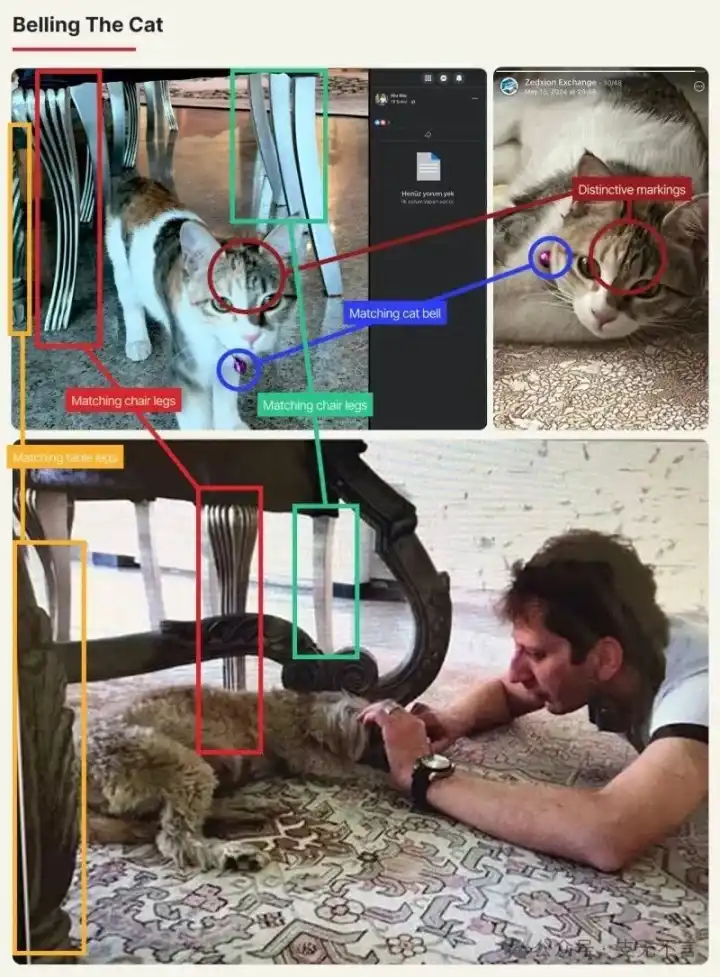
Tracing this line back to Bani, reporters discovered she was the registrant of the Zedxion electronic newsletter domain, and her name also appeared in Zedcex's email login information. Furthermore, in Zedxion's official YouTube tutorial video, two names briefly flashed in the autofill fields: Solmaz and Babak.
Before the cat, even the money laundering network of the Revolutionary Guard had nowhere to hide.
"We Endure Darkness, They Are Mining Bitcoin"
Do you remember the 90 million dollars that Nobitex was burned?
It later proved to likely be the Revolutionary Guard's money. But from the outside, it appeared as if a major trading platform had a 90 million dollar hole on its books. If not handled timely, a bank run could happen at any moment.
Nobitex's choice was to cover the loss itself.
TRM Labs found that after the hacking incident, Nobitex quickly consolidated about 2.7 million dollars from over 100 long-dormant wallets to alleviate the liquidity crisis. These wallets accumulated mining rewards in 2021 and 2022 and had never previously transferred funds, tracing upstream to two global mining pools: EMCD and ViaBTC.
We cannot confirm whether this money was from external infusion or Nobitex's own mining treasury. But this incident gave us a glimpse into Iran's massive mining industry.
Cryptocurrency mining in Iran was legalized starting in 2019. Licensed miners were allowed to mine Bitcoin using subsidized electricity and sell everything to the central bank, which would then use it for imports, bypassing the dollar system.
The government set the industrial electricity price at 0.5 cents per kilowatt-hour, with the cost of producing a single Bitcoin around 1320 dollars. Even if the price of Bitcoin has dropped to the sixty or seventy thousand dollar range, the profit margin remains astonishing.
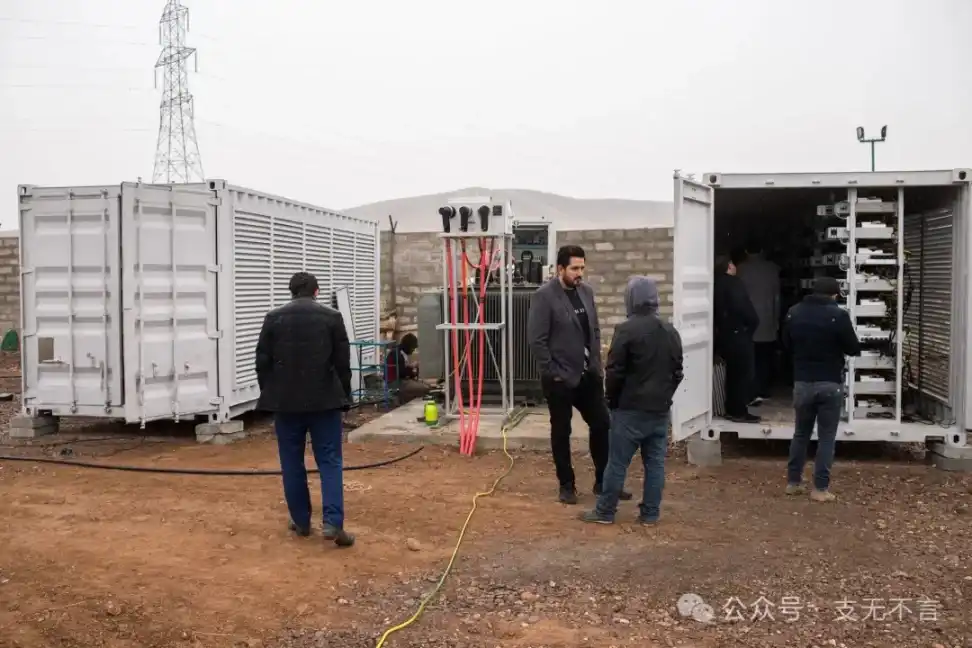
This profit margin explains everything that followed.
In 2022, the parliament passed a bill allowing the military to build private power plants. The Revolutionary Guard directly acquired electricity originally supplied to cities. Mining sites were established in military bases and special economic zones. Large religious foundations directly controlled by the Supreme Leader, such as Astan Quds Razavi, were deeply involved, forming a de facto "mining cartel".
As of 2023, of about 180,000 mining machines in Iran, 100,000 belonged to state or Revolutionary Guard-associated enterprises.
Yet Iran is a country severely lacking in electricity; rolling blackouts during extreme weather are not uncommon. Not only are residents' lives affected, enduring sweltering heat or bitter cold, frequent factory shutdowns also lead to unemployment among industrial workers, and small businesses struggle due to unstable power supply. This has sparked protest slogans like "We endure darkness while they mine Bitcoin."
Where are the mining machines hidden? A widely circulated rumor suggests mosques. In Iran, mosques legally enjoy free electricity. The 2025 budget bill exempted all Revolutionary Guard bases, Basij centers, and mosques from electricity charges, while the electricity charge for ordinary citizens increased by 38% that same year.
In 2019, an Iranian researcher photographed about 100 mining machines spread across different rooms in a mosque, fueling this rumor.
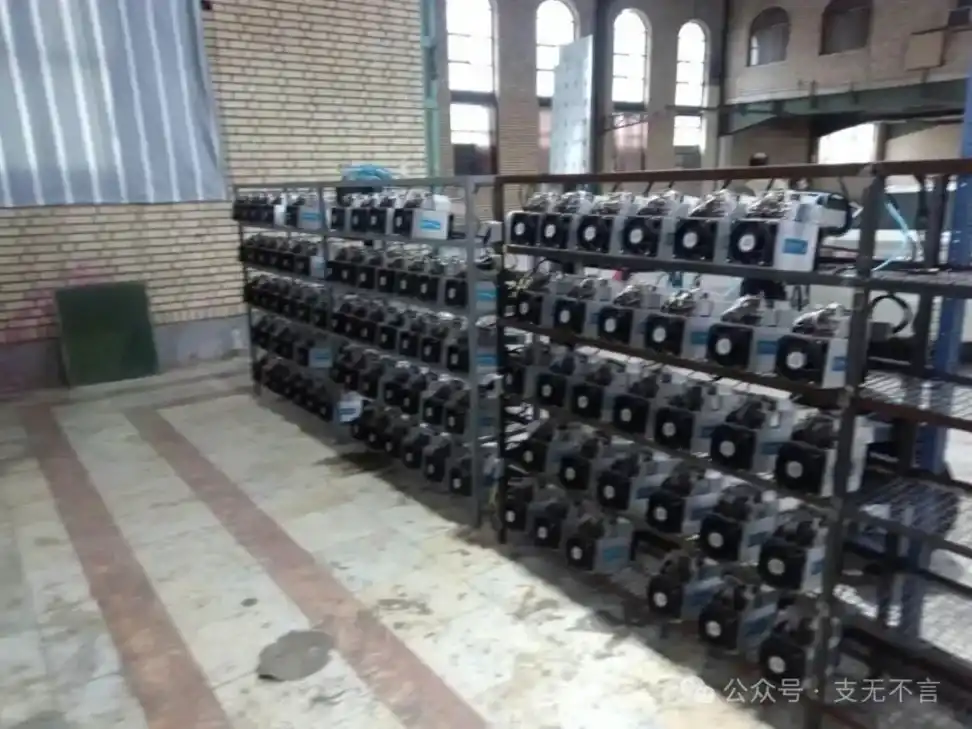
However, some practitioners hold an opposing view. Urban transformers have load limits, and large-scale mining can lead to system overloads or even explosions. If the government wants to mine, they certainly have more concealed sites.
No matter where the mining machines are, one number cannot be ignored: the scale of illegal mining power is about 400 times that of legal mining. The National Power Company Tavanir, under the Iranian Ministry of Energy, can only offer rewards to the public to capture miners, initially rewarding 1 million toman (about 24 dollars) for each illegal mining machine reported, which later rose to 200 million toman (about 2300 dollars).
The lower-class public reports each other for 24 dollars, bearing the burden of rising electricity costs. Meanwhile, mining operations under military protection flourish. In 2021, when the Ministry of Energy attempted to shut down a mining site, Revolutionary Guard armed personnel showed up and physically obstructed the raid.
This is the underlying theme of cryptocurrency in Iran: one country, two sets of rules.
The Other Side of the Gulf
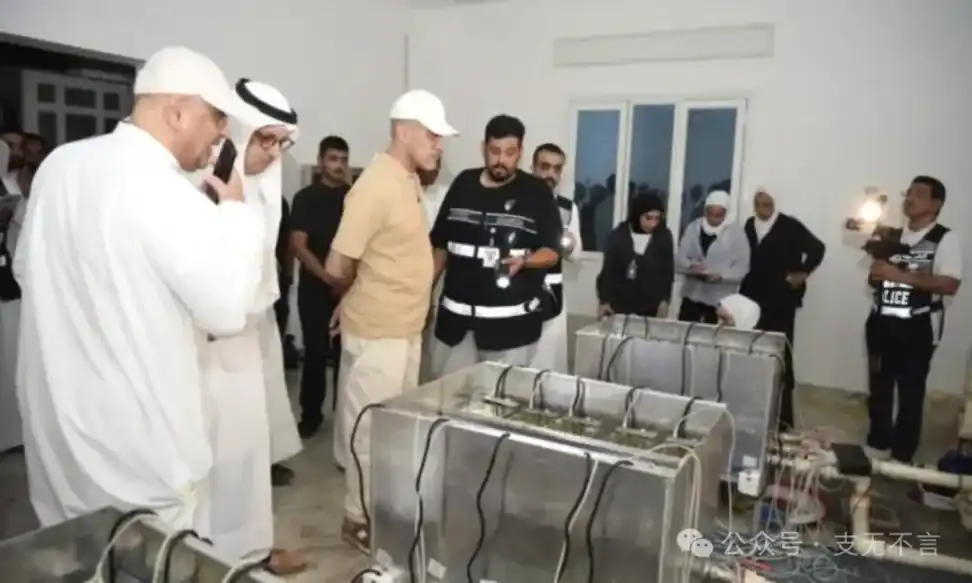
Earlier, it was written that the cost of producing a single Bitcoin in Iran is about 1320 dollars. Across the Gulf in Kuwait, this number is 1400 dollars. Under heavy interest rates, there will inevitably be those willing to take risks, but Kuwaitis choose to mine in their own bedrooms. To avoid arousing official suspicion, miners even turn off their air conditioning at home to disguise the electricity consumption of their mining machines.
In 2023, Kuwait comprehensively banned cryptocurrency activities, but the ban did not stop profits. In April 2025, the Ministry of Interior conducted a raid, discovering over 100 illegal mining sites, with electricity consumption in the southern Wafra region dropping by 55% within a week.
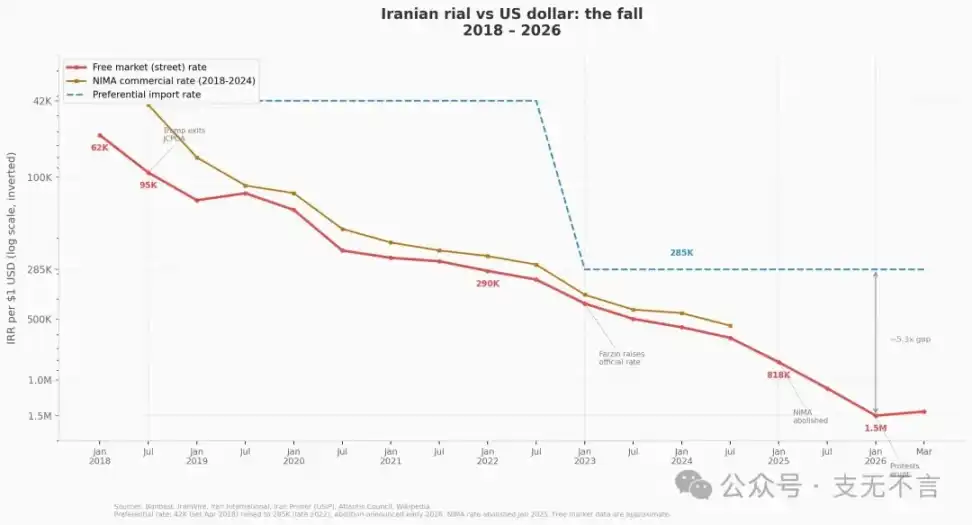
Mining stories vary by country, as do the stories of currency devaluation. Why did Nobitex grow so rapidly during those years? Because it happened to be when the rial crashed the hardest, at one point in 2018 reaching 92,000 to 1 dollar, and now it has fallen below 1.5 million.
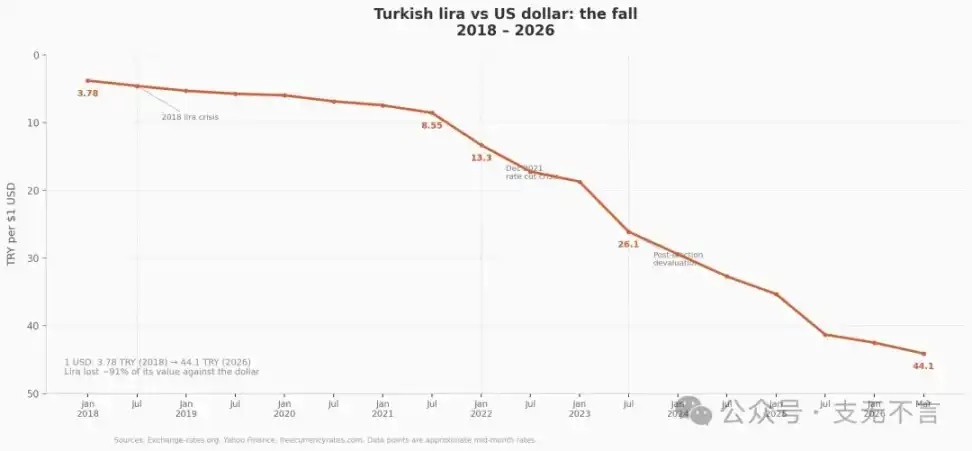
Turkey's lira is also on a similar path, with inflation consistently above 30%. The annual trading volume of USDT/lira on Binance exceeds 22 billion dollars, larger than any Bitcoin trading pair. Between 2024 and 2025, Turkey received nearly 200 billion dollars in cryptocurrency assets, with over half of adults holding crypto assets; those who do not trust their local currency can only believe in on-chain dollars, even if many do not particularly like the United States. This is happening every day in Tehran and Istanbul.
And while some struggle to maintain their purchasing power, more countries in the Persian Gulf are already discussing the next era. The UAE has written cryptocurrency into the blueprint for its national financial infrastructure, with Dubai and Abu Dhabi each establishing regulatory agencies for virtual assets; the Dirham stablecoin has been approved for launch, with annual cryptocurrency inflows of 53 billion dollars. The same technology serves as a lifeline on one side of the Gulf and a calling card for attracting investment on the other side.
However, ironically, middle eastern cryptocurrency brand activities originally scheduled for late April, such as Token2049 in Dubai, have been postponed until next year due to the ongoing events in Iran.

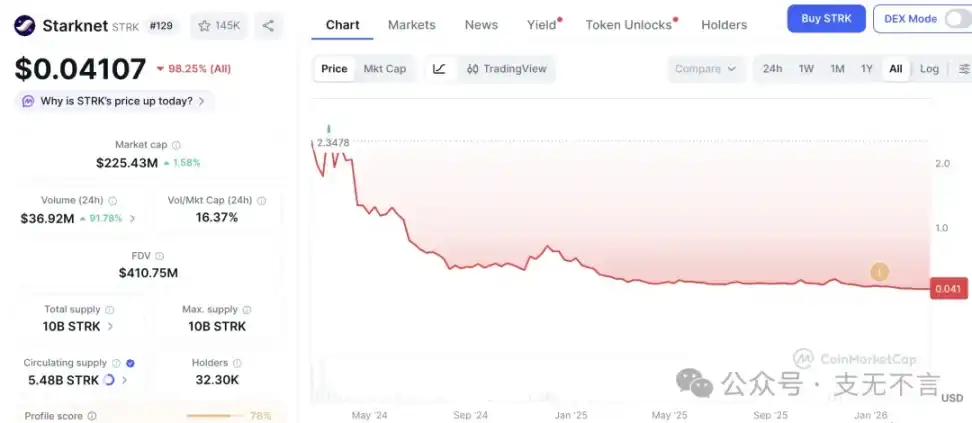
In the crypto sphere, Israel—the arch-rival launching strikes against Iran—plays a much cooler role. This country has no cheap electricity and does not need to use cryptocurrency to bypass sanctions, but it has the highest density of blockchain startups globally. Several core projects in the zero-knowledge proof field come from Israeli teams, with StarkWare reaching an estimated valuation of 8 billion dollars in 2025. Even though its token STRK dropped ninefold after launch, becoming a poster child for failed projects, its ecosystem still sees little use.
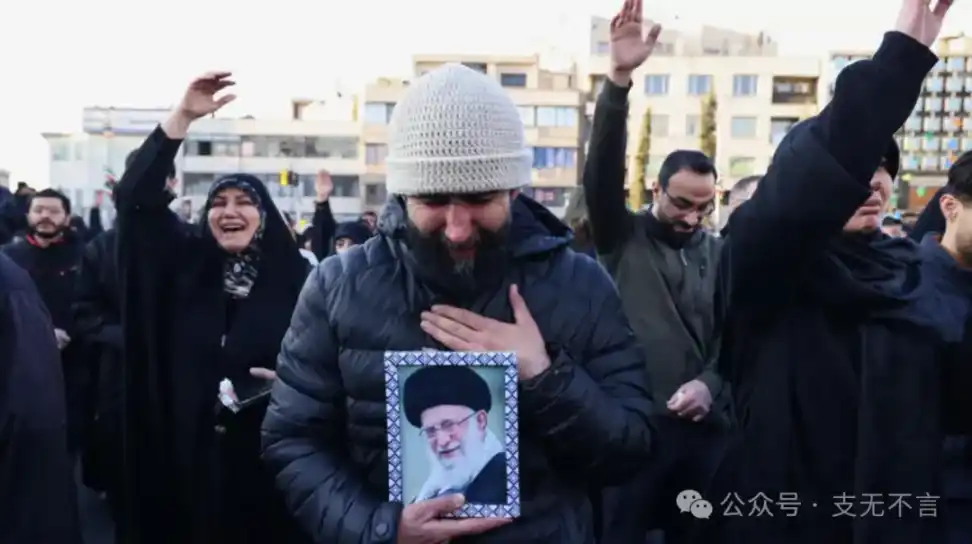
The same gulf, different worlds, yet they are all now caught up in the same war. By the time this article was finished, some of the names mentioned within it were no longer in existence. Khamenei died in an airstrike at the end of February 2026. Several high-ranking members of the Revolutionary Guard were eliminated in the joint strikes by the U.S. and Israel. The funds flowed through Nobitex via ghost accounts are still recorded on the blockchain, but perhaps the owners behind those addresses have changed time and again. Nine hundred years ago, the Persian poet Omar Khayyam wrote in "Rubaiyat":
In that palace where Jamshid raised his cup to drink
Now the doe gives birth, and the lion rests there
That Bahram, who hunted wild donkeys for a lifetime
Now has been captured by graves, sleeping long in the earth
Cryptocurrency in the Middle East has never been just one thing. It encompasses many things. It is the compliant licenses in Dubai's office buildings, the lifebuoy after the lira depreciated on the streets of Ankara, the suspected sound of fans coming from the basements of Isfahan mosques, the 94 billion dollars behind a virtual address in Covent Garden, and a cat wearing a purple bell.
Years later, when people look back on these cryptocurrency chronicles from the Middle East, they may be surprised by how it simultaneously contains the most advanced technologies of this era and the oldest conflicts. But for the ordinary Middle Eastern people who are still depositing their meager salaries into Nobitex to preserve value, this is not a matter of the past; it is their present.
免责声明:本文章仅代表作者个人观点,不代表本平台的立场和观点。本文章仅供信息分享,不构成对任何人的任何投资建议。用户与作者之间的任何争议,与本平台无关。如网页中刊载的文章或图片涉及侵权,请提供相关的权利证明和身份证明发送邮件到support@aicoin.com,本平台相关工作人员将会进行核查。