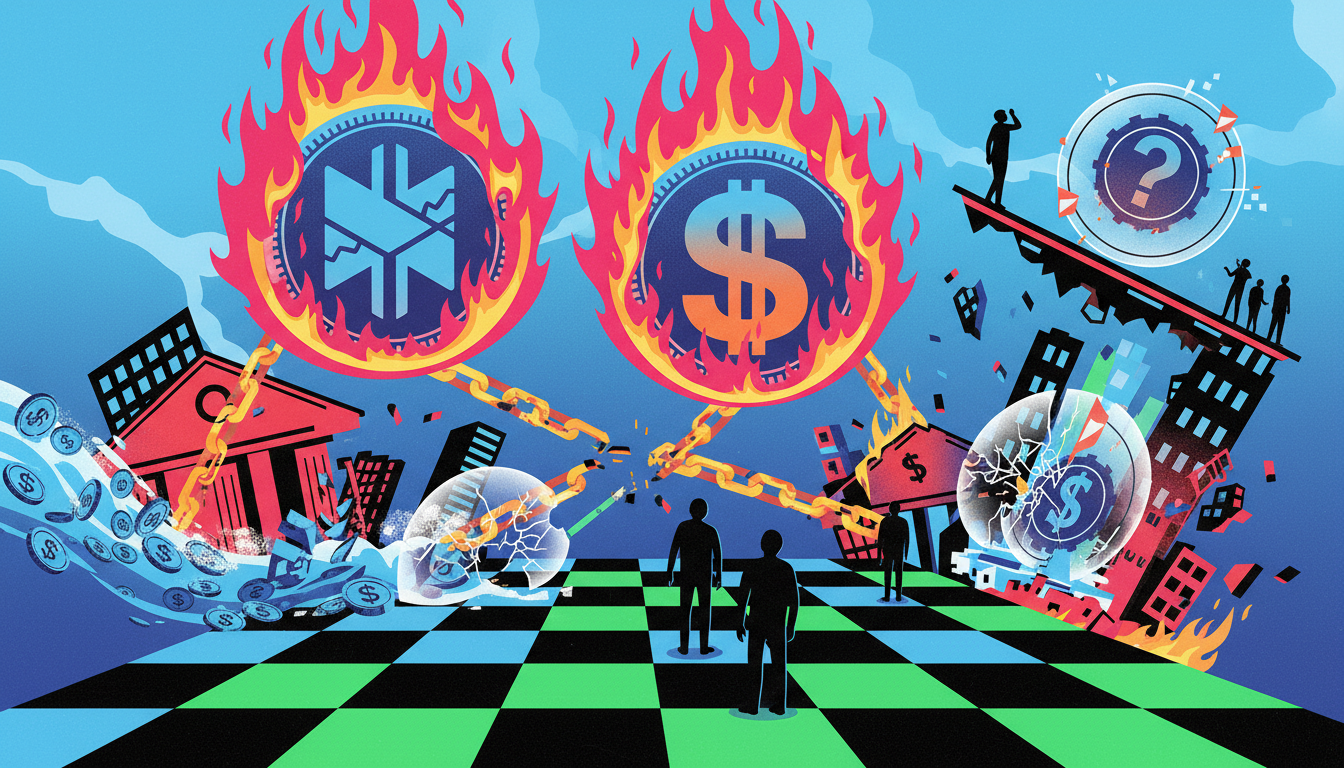
This week, under the East Eight Time Zone, the crypto market unfolds along three main lines: the Bitcoin options market experiences intense fluctuations around approximately $74,000 with a Gamma exposure of about $180 million, AI-based on-chain payments are highly concentrated in Base and Solana accounting for a total of 97% of transaction volume, and the crypto lending platform BlockFills has filed for bankruptcy protection, with liabilities in the range of $100 million to $500 million. Price fluctuations are amplified by the options structure, exposing risks of institutional defaults, and AI traffic clusters on a few chains. These phenomena combine to reshape the market landscape: on one side, volatility surges and business models, as well as technological trials, accelerate their advance; on the other side, regulation, risk control, and governance frameworks lag conspicuously behind, with the tension between Gamma exposure, bankruptcy shadows, and payment centralization reshaping the backdrop of this cycle.
Above $74,000: The Accelerator Effect of Options
● Gamma exposure amplifies short-term volatility: A $180 million Gamma exposure near Bitcoin's $74,000 mark means that the side selling a large number of options must adjust positions slightly along with changes in the underlying price to maintain Delta neutrality. Every time the price approaches or even pierces this critical area, the passive buying or selling of spot and futures by market makers gets magnified into an active price push, causing otherwise gradual fluctuations to transform rapidly into steep rises and falls, even creating a “mid-air refueling” effect of continuous impact.
● How hedge chains elevate or stomp on prices: As the price nears key execution ranges, market makers on one side need to quickly adjust their exposure through spot and perpetual contracts, leading to a dense build-up of chasing and panicking orders on the liquidity book. If the overall market is bullish, passive replenishment during an upward breakout pushes the market higher, and FOMO among bulls adds to a self-reinforcing “stair-step up”; conversely, if sentiment is weak and the price breaks down through support, Gamma sellers are forced to sell off, causing futures liquidations to stomp on spot selling pressure, rapidly amplifying a mild correction into a “waterfall” effect, as volatility continuously escalates in chain hedging.
● The role of leverage structures and the amplification of options excitement: Among current market participants, those trading high-leverage contracts and short-term options strategies are increasingly prevalent, leading to a more concentrated overall risk exposure amid an environment where volatility products and short-term OTM options are thriving. A significant amount of capital bets on short-term direction, making any price fluctuations in a single direction more likely to trigger forced liquidations, margin calls, and stop losses, forming a chain reaction of “options—futures—spot”, structurally biasing the market towards drastic swings rather than smooth price discovery.
AI Agents Dominating On-chain: Competition Between Base and Solana
● 97% of transaction volume highlights the dominance of two chains: Currently, on-chain payments related to AI agents are highly concentrated in Base and Solana, which together occupy approximately 97% of transaction volume, with other public chains only sharing a small portion of the tail-end traffic. This extreme concentration indicates that, in terms of micro-payments and high-frequency call scenarios for AI applications, the market has made an initial collective choice between performance and cost, with these two chains locking in the minds of developers and early users first through their fee and throughput advantages.
● Costs, performance, and ecosystem drive traffic aggregation: Compared to traditional public chains, Base leverages the Ethereum ecosystem and the lower-cost L2 architecture to provide a predictable fee ceiling for the frequent small calls of AI agents; Solana, on the other hand, relies on high throughput and block confirmation time advantages to offer an experience close to “second-level interaction” for real-time response AI scenarios. By combining the active development tools, funding support programs, and AI-related foundational components on both chains, a positive feedback loop of cost—performance—ecosystem has been formed, drawing in more experimental traffic into their orbit.
● Tencent’s “Lobster Assault Team” reflects the gap between users and technology: Tencent’s “Lobster Assault Team” noted, “The popularity of lobster-related products exceeds current capabilities, but its aim is to help ordinary people take the first step toward embracing AI,” reflecting the misalignment between current AI product narratives and actual capabilities. On one end is an AI imagination amplified by social and capital, while on the other, ordinary users are apprehensive about complex interactions and wallet thresholds. Although on-chain AI payments are at the forefront, there remains a significant gap between their actual usability and public expectations.
● Early experiments may reshape payment paths and chain choices: Despite discrepancies between capabilities and expectations, this round of experiments combining AI and crypto is quietly redrawing payment paths—from single large transactions toward high-frequency, small-scale, automated agent expenses—which also compels underlying chains to optimize in terms of cost models, settlement speeds, and development interfaces. The one that can first build a secure, low-latency, and composable payment environment for AI agents is more likely to occupy a core “settlement layer” position in the future multi-chain landscape, and currently, the 97% market share of Base and Solana is an early footnote in this evolutionary direction.
BlockFills Bankruptcy: Structural Hazards in Crypto Lending
● A warning sign with bankruptcy and liabilities of $100 million to $500 million: The crypto lending platform BlockFills has applied for bankruptcy protection, revealing a liability range of $100 million to $500 million, marking another iconic risk exposure event in this cycle. The numbers themselves are not unprecedented, but they expose that some institutions are unable to bear asset volatility and counterparty defaults, prematurely being pushed off the table, while prices remain high and liquidity has not yet entirely dried up, which sends an alarm to other highly leveraged participants.
● The common vulnerability of collateral management, liquidity mismatch, and counterparty risk: Many crypto lending platforms, during their expansion phases, concentrated collateral on highly volatile crypto assets, being poorly prepared for price shocks and markdown disposals; regarding maturity structures, they supported long-term exposure with short-term funds, leading to significant liquidity mismatches. Furthermore, counterparty risks are often simply outsourced to “well-known institutions” or “high-quality clients,” lacking penetration-level reviews. Once a rapid price withdrawal or liquidity exhaustion occurs, these three frail links can erupt in combination, amplifying localized losses and causing spillover effects.
● The long-term contradiction between expansion and inadequate risk investment: Institutions like BlockFills often lure in funds by raising leverage, loosening entry standards, and increasing yield promises during up cycles, quickly growing their scale but rarely increasing resources for risk control, compliance, and stress testing simultaneously. In the short term, this enhances the attractiveness of asset returns and growth narratives, but long-term, it signifies a lack of sufficient buffer during periods of amplified volatility or tightened liquidity, establishing a structural fate of “profiting fully in a bull market and concentrated explosions in a bear market.”
● The secondary blow to confidence and liquidity in high-volatility environments: Currently, the options Gamma exposure and leverage structures have already elevated overall volatility. If institutions like BlockFills falter at the edge of volatility, participants' trust in lending platforms and market makers will concurrently decline. Funds, out of self-preservation, will reduce authorizations and lending positions, further compressing market liquidity, causing prices to be pulled more easily on thinner order books, creating a negative cycle of “volatility—defaults—declining trust—liquidity retreat—greater volatility,” with risks not dissipating naturally as individual institutions are liquidated.
Foundation Dysfunction: a16z Questions the Old System
● a16z asserts that the traditional foundation model is no longer suitable: a16z crypto policy director Miles Jennings clearly stated, “The traditional foundation model is no longer suitable for the development of the crypto industry”, pointing out that many projects rely on foundations as a “legal and governance container” but lack supervision and accountability mechanisms that match their asset size and influence. As project funding pools scale from tens of millions to billions, the institutional benefits of this model have been overdrawn, exposing its flaws increasingly.
● The gray areas of governance, compliance, and fund usage amplify systemic risks: Many foundations claim to be responsible for ecological development and public goods funding, but in practice, they hold significant discretionary power in key aspects such as token unlocking schedules, secondary market sell-offs, and related party transactions, yet lack transparent disclosures and external audits. In terms of governance structure, the board overlaps significantly with project teams, and compliance responsibilities are unclear; regarding fund uses, broad interpretations of “ecological incentives” leave room for high-risk investments and short-term cash-outs. These gray areas are prone to turning into points of triggering sell-off tides and trust collapses when market pressures arise.
● How an “accountability-free capital pool” exacerbates regulatory and trust crises: On the side of crypto lending platforms, customer funds often enter assets controlled by project parties, market makers, or foundations through complex structures, with end decision-makers often obscured behind multiple entities and on-chain addresses. When risk events arise, accountability gets diluted into abstract concepts of technical errors, market fluctuations, or “decentralized governance.” The fragility of lending platforms and the ambiguity of accountability in foundations combine to leave a significant amount of capital in a de facto “accountability-free capital pool," which not only stimulates regulatory bodies to take stricter interventions but also weakens long-term investors' trust expectations across the sector.
Regulatory Gaps and Games: The Market’s Collective High Stakes
● The commonality of rule absence behind three phenomena: The drastic fluctuations of Bitcoin in high Gamma ranges, the extreme concentration of AI payments on a few chains, and BlockFills' bankruptcy revealing lending risks seem to stem from different tracks, but essentially point to the incompleteness of regulation and industry rules. The options market lacks unified hard constraints regarding leverage and concentration; the financial security and data usage boundaries in AI payment scenarios have not yet been incorporated into systematic regulation; lending and custody businesses still have vague bottom-line standards regarding capital adequacy ratios and information disclosure, leaving ample arbitrage and risk-laden space.
● A clear contrast with traditional financial constraints: In traditional financial systems, risk management, margin ratios, and concentrations for options sellers are clearly regulated; stress testing and disclosure requirements are relatively mature; lending institutions must meet capital adequacy ratios and liquidity coverage indicators, with strict custody and segregation protocols for customer funds; the uses of customer funds and exposure to underlying assets must fall within regulatory oversight. In the crypto field, similar constraints are often exempted by “innovation” and “decentralization,” leading the same business logic to operate under higher leverage and lower transparency, heightening yield ceilings while hollowing out risk floors.
● The psyche and strategies of participants between high yield and regulatory shadows: Faced with an incomplete regulatory framework, market participants generally weigh between “earning a round first” and “contracting defensively in advance.” Some funds choose to bet on excessive returns during regulatory windows, preferring high-leverage derivatives, incompletely disclosed yield-bearing products, and high-risk on-chain strategies; while other funds are gradually migrating to assets and platforms with clearer compliance expectations and governance structures, seeking to avoid a “one-size-fits-all” approach during future regulatory tightening. This differentiated game results in a coexistence of apparent market heat and underlying risk aversion sentiments, where the price fluctuations are quietly redistributing the funding structure.
From Short-term Volatility to Long-term Order: A New Watershed in Crypto
The drastic volatility of Bitcoin under high Gamma exposure, the concentration of 97% of AI agent payments on Base and Solana, and the chain reaction of BlockFills' bankruptcy and liabilities between $100 million to $500 million reveal three major vulnerabilities in the industry today: price volatility is geometrically amplified by the options structure, excessive concentrations emerge in the early stages of technological innovation, and risk control and governance systems are lagging far behind the scale of funds. In the short term, these factors make the market resemble an amplifier, extreme-izing every fluctuation of emotion and liquidity; in the long term, they are compelling the industry to rethink the boundaries of order and constraints.
Moving forward, funds are more likely to make clearer reallocations between “high-risk high-reward” and “compliance, transparency, and sustainability.” Assets and platforms with clear governance structures, public disclosure mechanisms, and predictable regulatory paths will find it easier to attract long-term capital; while projects relying on high leverage, ambiguous responsibility subjects, and black box foundation models face marginalization or liquidation risks under the dual pressure of enlarged volatility and tightened regulation. The funds are not leaving crypto; rather, they are casting votes with their feet, reshaping the internal risk pricing and credit hierarchies of the industry.
At the intersection of AI and on-chain finance, whoever can first address the shortfalls in governance and compliance, and provide secure, transparent, and auditable financial infrastructure for AI agents, is more likely to become the main stage for the next round of narratives and capital flows. Whether it’s mainstream public chains dominating 97% of transactions, or institutions occupying significant positions in derivatives and lending businesses, real competition is no longer merely about performance or yield, but about whether they can build a long-term order recognized by both the market and regulation in today’s high-volatility context.
Join our community to discuss and grow stronger together!
Official Telegram community: https://t.me/aicoincn
AiCoin Chinese Twitter: https://x.com/AiCoinzh
OKX Welfare Group: https://aicoin.com/link/chat?cid=l61eM4owQ
Binance Welfare Group: https://aicoin.com/link/chat?cid=ynr7d1P6Z
免责声明:本文章仅代表作者个人观点,不代表本平台的立场和观点。本文章仅供信息分享,不构成对任何人的任何投资建议。用户与作者之间的任何争议,与本平台无关。如网页中刊载的文章或图片涉及侵权,请提供相关的权利证明和身份证明发送邮件到support@aicoin.com,本平台相关工作人员将会进行核查。