Symbiosis of Algorithms and Ledger: A Major Shift in the Global Technological Paradigm
In the third decade of the 21st century, the combination of artificial intelligence (AI) and cryptocurrency (Crypto) is no longer just the overlap of two buzzwords; it is a profound revolution in the technological paradigm. As the global cryptocurrency market capitalization officially surpasses $4 trillion in 2025, the industry has transitioned from an experimental niche market to an essential component of the modern economy.
One of the core driving forces behind this transformation is the deep confluence between AI, as an extremely powerful layer for decision-making and processing, and blockchain, as a transparent and immutable layer for execution and settlement. This combination is addressing each side's pain points: AI is at a critical juncture in transitioning from a monopolistic centralized giant to a decentralized and transparent "open intelligence;" while the cryptocurrency industry, following the gradual improvement of its infrastructure, urgently needs AI to solve issues of complex on-chain interactions, fragile security, and insufficient application utility.
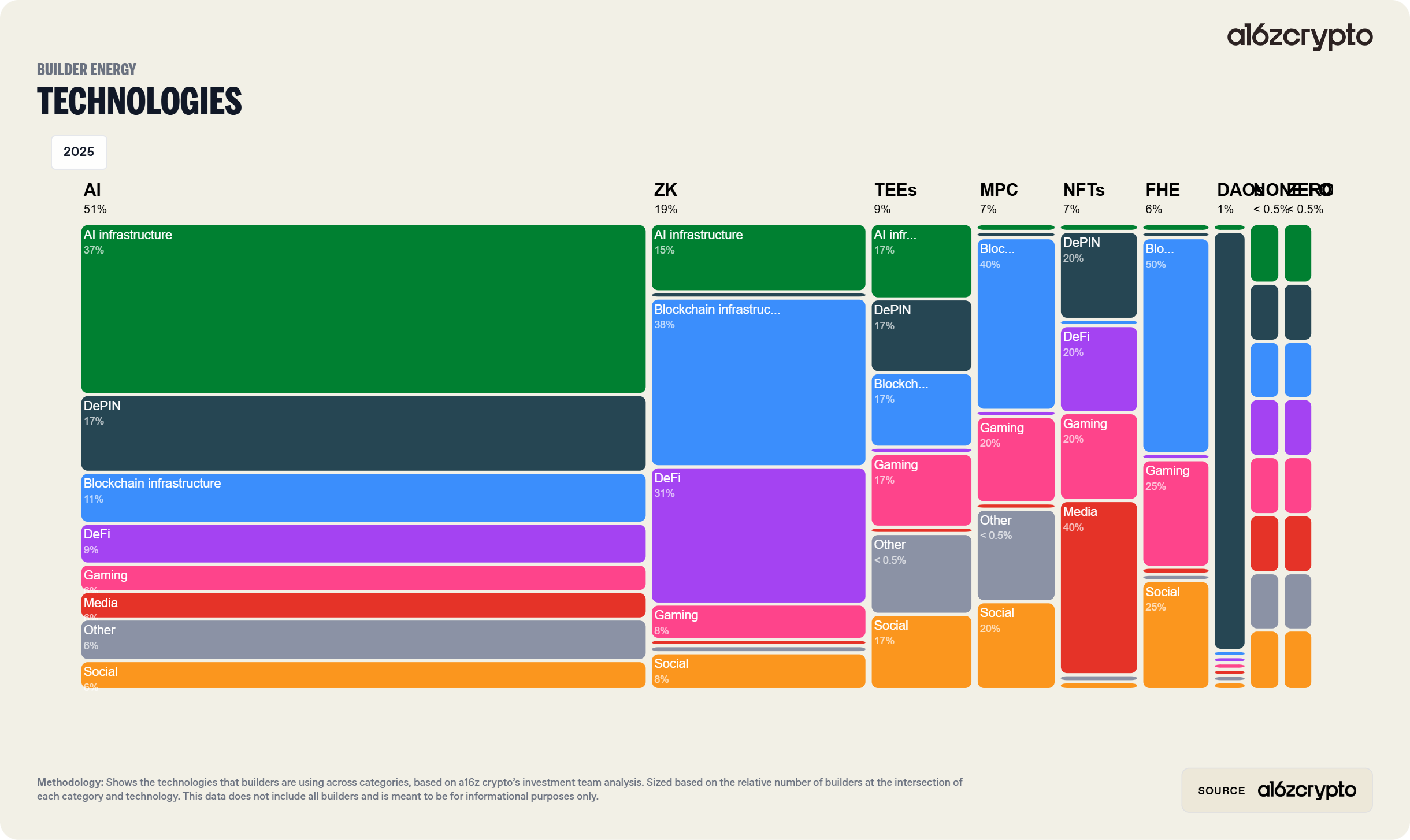
From the perspective of capital flow, the strategic divergence of top venture capital firms also confirms this trend. a16z Crypto completed its fifth round of fundraising at $2 billion in 2025, firmly positioning the intersection of AI and Crypto as a core long-term strategy, believing that blockchain is a necessary infrastructure to prevent AI censorship and control.
Meanwhile, institutions like Paradigm are attempting to capture the cross-industry dividends brought about by technological integration by broadening investment boundaries to include robotics and general AI. According to OECD data, by 2025, venture capital in the global AI sector will account for 51% of total global investment, while the financing share of AI-related projects in the Web3 sector is also steadily rising, reflecting the market's strong recognition of the narrative of "decentralized intelligence."
1. Infrastructure Reconstruction: Decentralized Computing Power and Computing Integrity
The insatiable craving for graphical processing units (GPUs) by artificial intelligence and the current fragility of the global supply chain present a natural contradiction. From 2024 to 2025, GPU shortages have become the norm, providing fertile ground for decentralized physical infrastructure networks (DePIN).
1.1 Dual Evolution of the Decentralized Computing Market
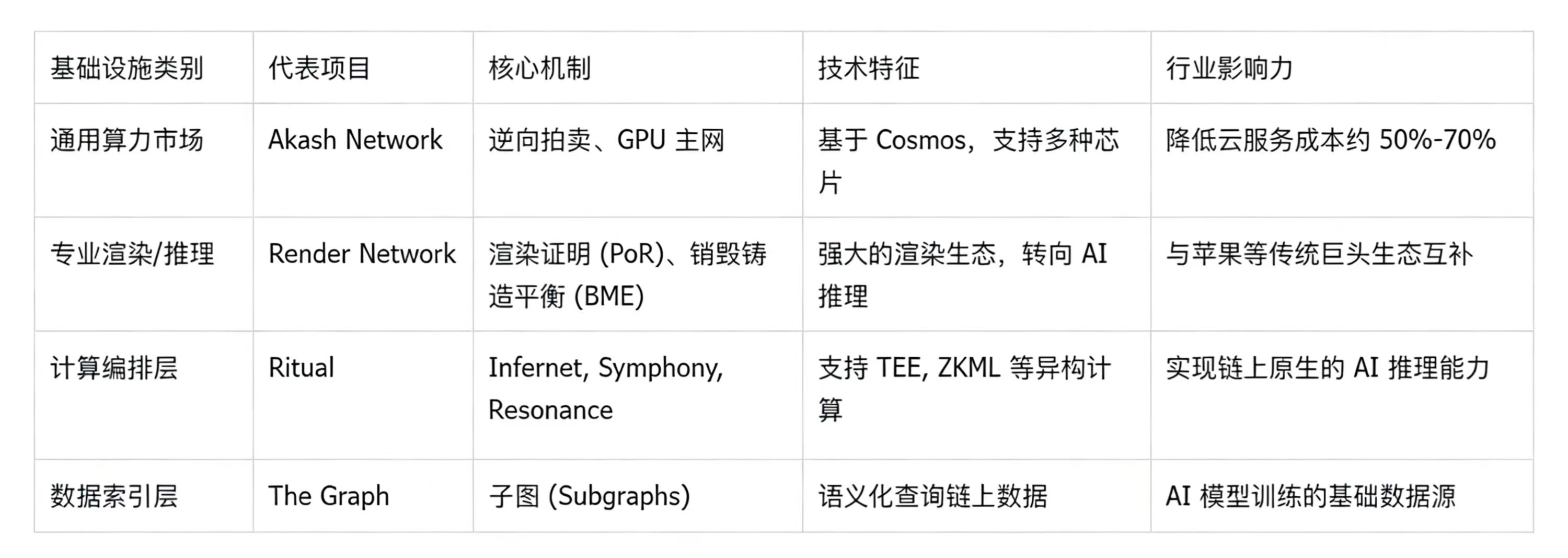
The current decentralized computing platforms can mainly be divided into two camps. The first type is represented by Render Network (RNDR) and Akash Network (AKT), which aggregate idle global GPU power by building decentralized bilateral markets. Render Network has become the benchmark for distributed GPU rendering, not only reducing the costs of 3D creation but also supporting AI inference tasks through blockchain coordination features, enabling creators to acquire high-performance computing power at lower prices. Akash has made significant strides since 2023 through its GPU mainnet (Akash ML), allowing developers to lease high-spec chips for large-scale model training and inference.
The second type represents a new computational orchestration layer typified by Ritual. Ritual's uniqueness lies in its approach—it does not attempt to directly replace existing cloud services, but rather serves as an open, modular sovereign execution layer that embeds AI models directly into the blockchain's execution environment. Its Infernet product allows smart contracts to seamlessly call upon AI inference results, addressing the long-standing technical bottleneck of "on-chain applications being unable to natively run AI."
1.2 Breakthroughs in Computing Integrity and Verification Technology
In decentralized networks, validating "whether the computation has been executed correctly" is a core challenge. Technological advancements in 2025 have primarily focused on the fusion applications of zero-knowledge machine learning (ZKML) and trusted execution environments (TEE).
The Ritual architecture employs proof-system agnostic design, allowing nodes to choose TEE code execution or ZK proofs based on task requirements. This flexibility ensures that even in a highly decentralized environment, every inference result generated by AI models is traceable, auditable, and has integrity guarantees.
2. Democratization of Intelligence: The Rise of Bittensor and Commodity Markets
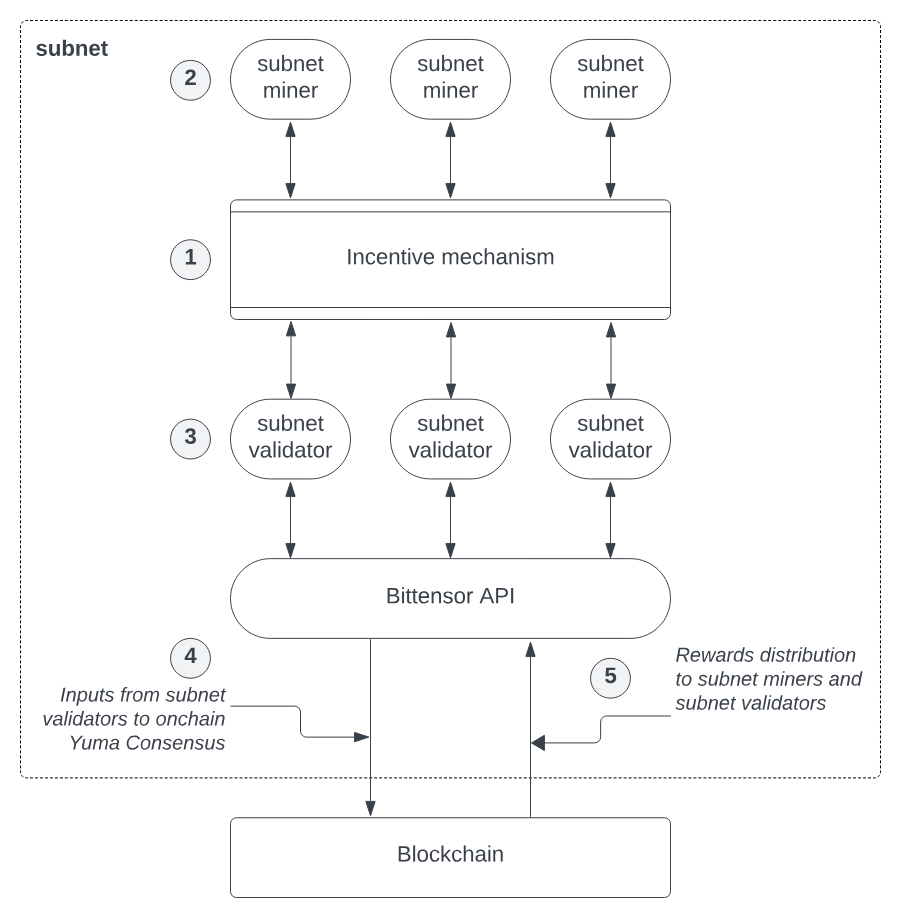
The emergence of Bittensor (TAO) marks a new phase in the marketization of machine intelligence through the combination of AI and Crypto. Unlike traditional single computing power platforms, Bittensor aims to create an incentive mechanism that allows various machine learning models globally to interconnect, learn from each other, and compete for rewards.
2.1 Yuma Consensus: From Linguistics to Consensus Algorithm
The core of Bittensor is the Yuma consensus (YC), which is a subjective utility consensus mechanism inspired by Grice's pragmatics.
The operational logic of YC assumes: an efficient collaborator tends to produce true, relevant, and informative answers, as this is the optimal strategy for obtaining the highest rewards in the incentive landscape. At a technical level, YC calculates token emissions based on validators' weight evaluations of miners' performances. Its core logic can be illustrated by the following LaTeX formula representing the distribution of emission shares:
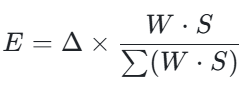
Where E is the emission reward, Δ is the daily total supply increment, W is the matrix of validator evaluation weights, and S is the corresponding staking weight. To prevent malicious collusion or bias, YC introduces a Clipping mechanism, which reduces weights exceeding the consensus benchmark, ensuring the system's robustness.
2.2 Subnet Economy and Dynamic TAO Paradigm
By 2025, Bittensor has evolved into a multi-layered architecture. The foundational layer is the Subtensor ledger managed by the Opentensor foundation, while the upper layer consists of dozens of vertical segmented subnets, each focusing on specific tasks such as text generation, audio prediction, image recognition, etc.
The introduced "dynamic TAO" mechanism creates independent value reserve pools for each subnet through automated market makers (AMM), with prices determined by the ratio of TAO to Alpha tokens:
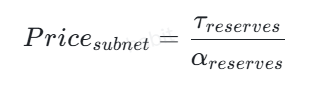
This mechanism achieves automatic allocation of resources: subnets with high demand and high output quality will attract more staking, thereby obtaining a higher proportion of daily TAO emissions. This competitive market structure is vividly compared to an "intelligent Olympic competition," naturally selecting out inefficient models.
3. The Rise of the Agent Economy: AI Agents as Primary Entities in Web3
During the 2024 to 2025 cycle, AI agents (AI Agents) are undergoing a significant transformation from "auxiliary tools" to "on-chain native entities." This evolution is reflected not only in the complexity of technological architecture but also in the fundamental expansion of their roles and permissions within the decentralized finance (DeFi) ecosystem.
Below is an in-depth analysis of this trend:
3.1 Agent Architecture: A Closed Loop from Data to Execution
The current chain-based AI agents are no longer mere scripts but rather mature systems constructed on three complex logical layers:
- Data Input Layer: The agent captures on-chain data in real-time such as liquidity pools and transaction volumes through blockchain nodes or APIs (like Ethers.js), and introduces off-chain information such as social media sentiment and centralized exchange prices by integrating oracles (like Chainlink).
- AI/ML Decision Layer: The agent analyzes price trends using long short-term memory networks (LSTM) or iteratively develops optimal strategies through reinforcement learning in complex market games. The integration of large language models (LLM) also gives agents the ability to understand human ambiguous intentions.
- Blockchain Interaction Layer: This is key to realizing "financial autonomy." Agents can now manage non-custodial wallets, automatically calculate optimal gas fees, handle random numbers (Nonces), and even integrate MEV protection tools (like Jito Labs) to prevent being front-run in transactions.
3.2 Financial Tracks and Agent-to-Agent Transactions
a16z's 2025 report particularly highlights the financial pillar of AI agents—x402 protocol and similar micropayment standards. These standards enable agents to pay API fees or purchase services from other agents without human intervention. For example, the Olas (formerly Autonolas) ecosystem has processed over 2 million automated transactions between agents monthly, covering a variety of tasks from DeFi swaps to content creation.
Agent economy components
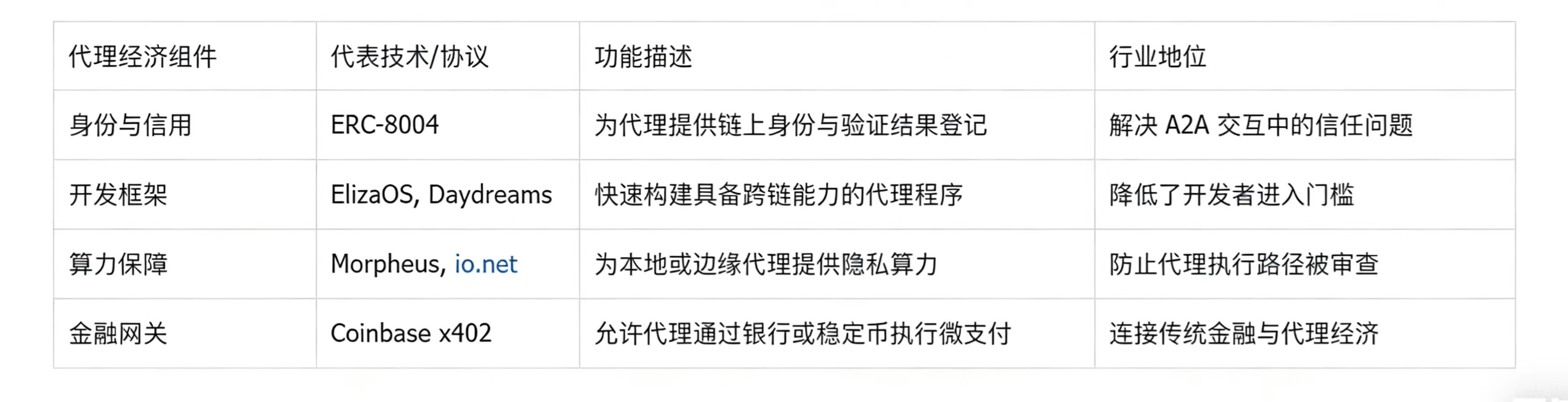
This trend is now reflected in market data. From a growth perspective, the AI agent market is on the brink of an explosion. According to research from MarketsandMarkets, the global AI agent market is expected to grow from $7.84 billion in 2025 to $52.62 billion by 2030, with a compound annual growth rate (CAGR) of 46.3%. Additionally, Grand View Research has provided similar long-term forecasts, predicting the market size will reach $50.31 billion by 2030.
Meanwhile, standard tools at the development layer are also beginning to take shape. The ElizaOS framework, promoted by a16z, has become the infrastructure for AI agents, akin to "Next.js" in front-end development. It allows developers to easily deploy AI agents with full financial capabilities on mainstream social platforms like X, Discord, and Telegram. By early 2025, the total market capitalization of Web3 projects built on this framework has surpassed $20 billion.
4. Privacy Computing and Confidentiality: The Game of FHE, TEE, and ZKML
Privacy is one of the most challenging issues in the integration of AI and Crypto. When companies operate AI strategies on public blockchains, they do not wish to expose private data nor disclose their core model parameters. Currently, the industry has formed three main technical paths: Fully Homomorphic Encryption (FHE), Trusted Execution Environments (TEE), and Zero-Knowledge Machine Learning (ZKML).
4.1 Zama and the Industrialization Journey of FHE
Zama, as a leading unicorn in this field, has developed fhEVM, which has become the standard for achieving "end-to-end encrypted computation." FHE allows computers to perform mathematical operations on encrypted data without decrypting it, with results matching plaintext calculations upon decryption.
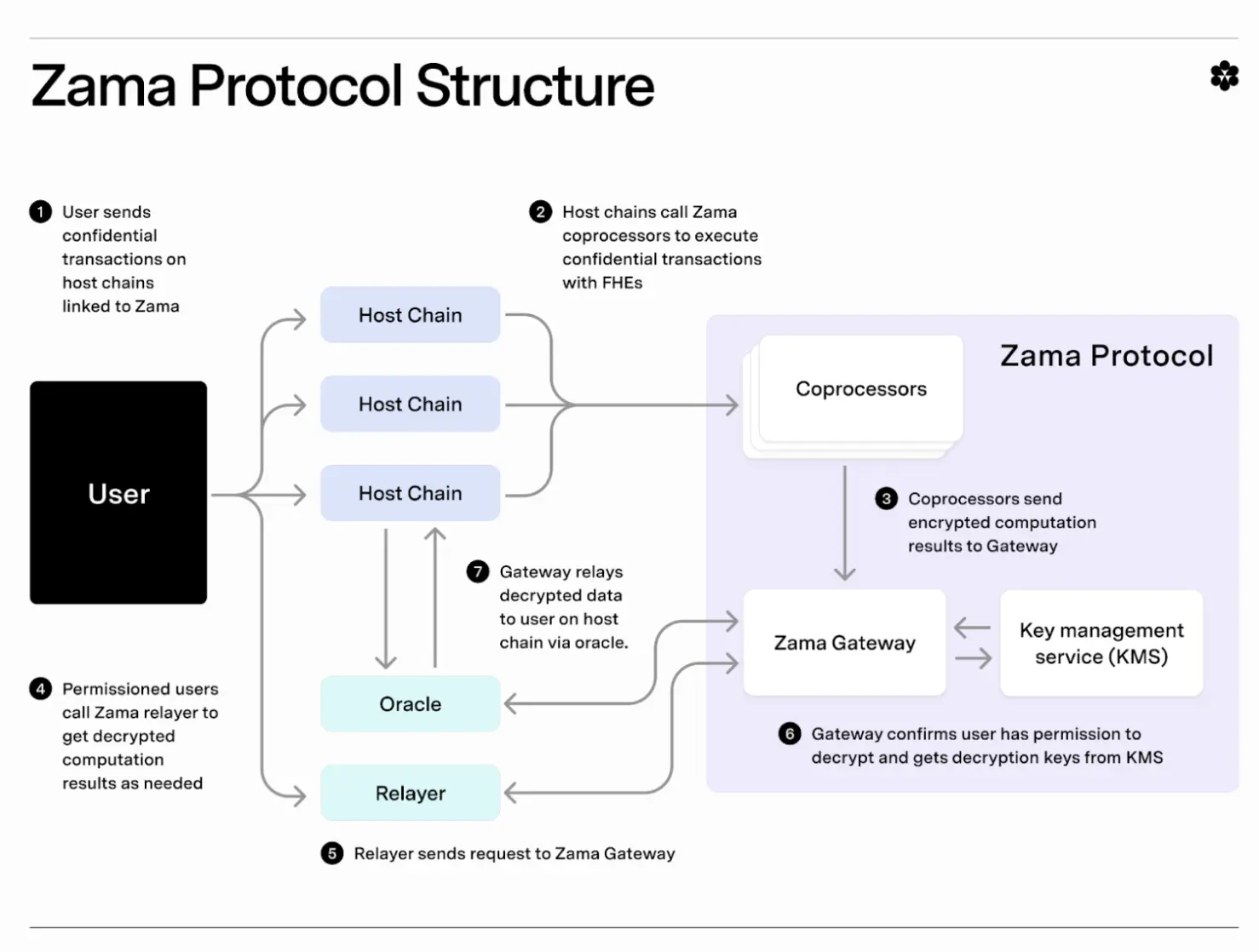
By 2025, Zama's tech stack had achieved significant performance leaps: for a 20-layer convolutional neural network (CNN), the computation speed improved by 21 times, while for a 50-layer CNN, the speed increased by 14 times. This progress has made "privacy stablecoins" (trade amounts encrypted from the outside while the protocol still verifies legality) and "sealed-bid auctions" possible on mainstream chains like Ethereum.
4.2 ZKML's Verification Efficiency and the Integration with LLM
Zero-Knowledge Machine Learning (ZKML) emphasizes "verification" over "calculation." It allows one party to prove that they have correctly operated a complex neural network model without exposing input data or model weights. The latest zkLLM protocol has achieved end-to-end inference verification for a model with 13 billion parameters, reducing proof generation time to under 15 minutes, with proof size only 200 KB. This technology is crucial for high-value financial audits and medical diagnostics.
4.3 The Synergy of TEE and GPU: The Power of Hopper H100
Compared to FHE and ZKML, TEE (Trusted Execution Environment) provides execution speeds close to native performance. NVIDIA's H100 GPU introduces confidential computing capabilities, isolating memory through hardware-based firewalls, with inference overhead typically below 7%. Protocols like Ritual are extensively adopting TEE based on GPUs to support AI agent applications requiring low latency and high throughput.
Privacy computing technology has officially transitioned from the idealism of laboratory conceptions into a new era of "production-grade industrialization." Fully Homomorphic Encryption (FHE), Zero-Knowledge Machine Learning (ZKML), and Trusted Execution Environment (TEE) are no longer isolated technical tracks but together constitute the "modular confidential stack" of decentralized artificial intelligence.
This fusion is fundamentally rewriting the underlying logic of Web3 and draws the following three core conclusions:
- FHE is the underlying standard of Web3 "HTTPS": As unicorns like Zama enhance computational performance by orders of magnitude, FHE is achieving a qualitative change from "everything public" to "default encryption." It resolves the privacy challenges in on-chain state processing, enabling privacy stablecoins and fully MEV-resistant trading systems to shift from theory to large-scale compliant applications.
- ZKML is the mathematical endpoint of algorithmic accountability: The "ZKML singularity" arriving in the second half of 2025 signifies a dramatic decrease in verification costs. By compressing the inference proof of a 13 billion parameter (13B) model to under 15 minutes, ZKML provides "mathematical-level consistency" guarantees for high-value financial audits and credit ratings, ensuring that AI is no longer an untrustworthy black box.
- TEE is the performance foundation of the agent economy: Compared with software solutions, TEE based on hardware like NVIDIA H100 offers nearly native execution speeds with overhead below 7%. It is currently the only economical solution capable of supporting hundreds of millions of AI agents for 24/7 real-time decisions, ensuring the agents securely hold private keys and execute complex strategies within a hardware-level firewall.
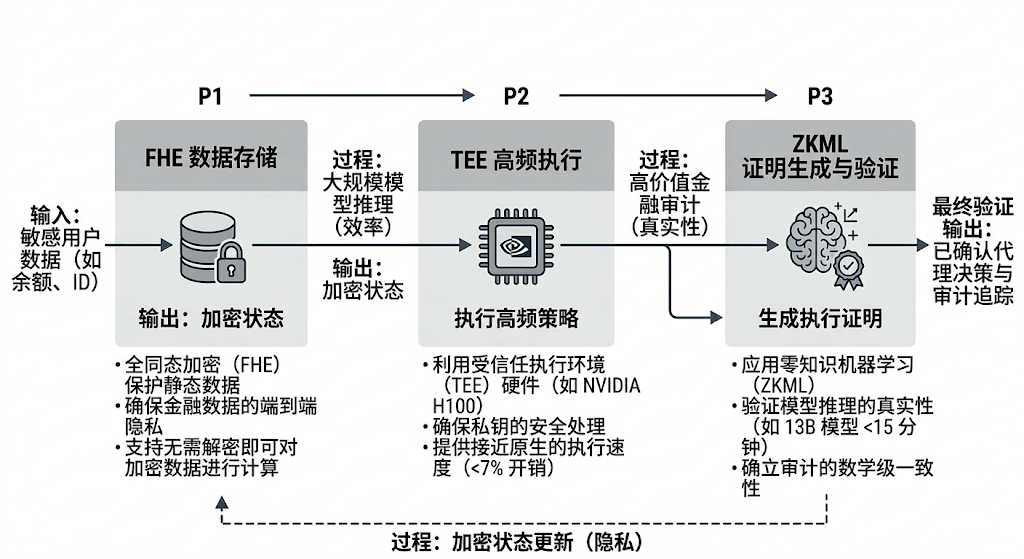
The future technological trend is not a victory of a single path but rather the comprehensive adoption of "hybrid confidential computing." In a complete AI business flow: use TEE for large-scale, high-frequency model inference to ensure efficiency; generate execution proofs through ZKML at key nodes to ensure authenticity; sensitive financial states (such as account balances and private IDs) will be encrypted with FHE.
This "trinitarian" fusion is transforming the cryptocurrency industry from “public transparent ledgers” to “intelligent systems with sovereign privacy,” truly ushering in an era of automated agent economy worth trillions of dollars.
5. Industry Security and Automated Audits: AI as Web3's "Immune System"
The cryptocurrency industry has long been plagued by substantial losses due to smart contract vulnerabilities. The introduction of AI is changing this passive defense landscape, shifting it from expensive manual audits to real-time AI monitoring.
5.1 Innovations in Static and Dynamic Audit Tools
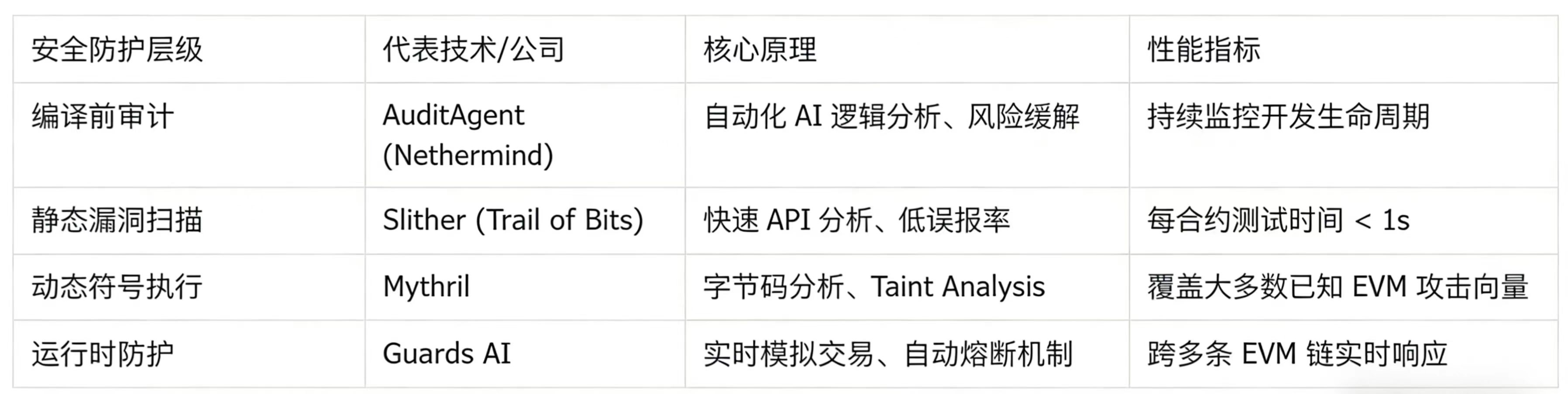
Tools like Slither and Mythril have deeply integrated machine learning models in 2025, capable of scanning Solidity contracts for reentrancy attacks, suicidal functions, or gas consumption anomalies at sub-second speeds. Furthermore, fuzz testing tools like Foundry and Echidna utilize AI to generate extreme input data to uncover deeply hidden logical vulnerabilities.
5.2 Real-time Threat Prevention Systems
In addition to pre-deployment audits, real-time defenses have also made significant strides. Systems like Guardrail's Guards AI and CUBE3.AI can monitor all pending transactions (Mempool) across chains. Upon detecting malicious attack signals (such as governance attacks or oracle manipulation), they can automatically trigger contract pauses or intercept malicious transactions. This "proactive immunity" significantly reduces hackers' risks to DeFi protocols.
Practical Roadmap for Developing Crypto with AI
In the future digital landscape, the integration of AI and Crypto is no longer a technological experiment but a profound revolution concerning "productivity efficiency" and "wealth distribution rights." This combination not only gives AI a "wallet" that it can independently control but also grants Crypto a "brain" capable of thinking independently, jointly opening the era of autonomous agent economy worth trillions of dollars.
Here are the core benefits and practical roadmap of this integration at both business and individual levels:
1. Enterprise Level: From “Cost Reduction and Efficiency Increase” to “Expansion of Business Boundaries”
For enterprises, the combination of AI and Crypto primarily addresses the structural contradictions between high computing costs, fragile system security, and data privacy protection.
- Dramatic Decrease in Infrastructure Costs (DePIN Effect): With distributed computing networks (like Akash or Render), enterprises are no longer constrained by the expensive procurement of NVIDIA H100 clusters. Real-world data shows that renting globally idle GPUs can reduce costs by 39% to 86% compared to traditional cloud service providers. This "freedom of computing power" allows startups to afford the fine-tuning and training of large-scale models.
- Automation and Cost Reduction of Security Barriers: Traditional contract audit cycles are long and costly. Now, by deploying AI security agents driven by neural networks, such as AuditAgent, enterprises can achieve "sentinel monitoring" across the entire development lifecycle. They can identify logical vulnerabilities like reentrancy attacks at the moment of code submission and, upon detecting hacker commands, can automatically trigger contract fail-safes at the mempool level to protect protocol assets from losses.
- “Encrypted Computation” of Core Business Secrets: Utilizing fully homomorphic encryption (FHE) and "blind computation" networks like Nillion, enterprises can run AI strategies on public chains without revealing core model parameters and private customer data. This not only establishes data sovereignty but also allows financial and medical data, typically constrained by compliance risks, to enter decentralized collaborative networks.
2. Individual Level: From “Financial Blind Spots” to “Intelligent Sovereign Economy”
For individual users, the integration of AI and Crypto heralds the complete disappearance of technical barriers and the opening of new income channels.
- Intent-driven “Private Banker”: In the future, users will no longer need to understand what gas fees or cross-chain bridges are. AI agents built on frameworks like ElizaOS will achieve “radical abstraction”—you only need to say: “Help me deposit this 1000 into the place with the highest and safest interest,” and AI will autonomously monitor global APYs, automatically closing positions during risk fluctuations. Ordinary individuals will thus enjoy asset management at a level comparable to top hedge funds.
- Assetization of Personal Data (Data Yield Farming): Your digital footprint will no longer be exploited by giants for free. Through platforms like Synesis One, users can participate in “Train2Earn,” providing labeled data for AI training and directly obtaining token rewards. They may even receive passive dividends by holding Kanon NFTs each time AI calls upon a specific knowledge entry, truly realizing that “data is an asset.”
- Ultimate Protection of Privacy and Identity: By utilizing Worldcoin or cryptographic identity protocols, you can prove you are human rather than an AI, while employing privacy computing networks to protect sensitive information such as your personal schedule and home address from being disclosed to AI service providers. This “blind interaction” mode ensures that while you enjoy the conveniences of AI, you still retain the highest level of interpretive rights over digital sovereignty.
This bidirectional structural evolution is transferring "trust" to blockchain while assigning "efficiency" to AI. It not only reconstructs the enterprise's competitive moat but also builds a ladder for every ordinary person to rise into the intelligent sovereign economy.
Evolution Prediction: Moving Towards a New Era of “Intelligent Ledgers”
In summary, how can AI better integrate with Crypto? The answer lies in shifting from “simple tool overlay” to “deeper architectural coupling.”
First, blockchain must evolve into a platform capable of supporting large-scale computations. Efforts by protocols like Ritual and Starknet are making ZKML as simple to call as standard libraries. Secondly, AI agents must become legitimate entities in economic life. With the proliferation of identity standards like ERC-8004, we will witness the emergence of an “intelligent network” composed of hundreds of millions of agents, engaging in on-chain resource games and value exchanges 24/7.
Finally, this integration will reshape human financial sovereignty. Privacy payments realized through FHE, fair creator distributions enabled by provenance protocols, and algorithm democratization through markets like Bittensor will jointly construct a blueprint for a more fair, efficient, and decentralized future digital economy.
In this technological marathon, the cryptocurrency industry offers not just capital but also a philosophical framework concerning “transparency” and “trust;” while AI provides the “brain” that makes these frameworks truly operational. As we approach 2026, this confluence will extend beyond the tech circle, reaching billions of ordinary users through more intuitive AI interaction interfaces.
免责声明:本文章仅代表作者个人观点,不代表本平台的立场和观点。本文章仅供信息分享,不构成对任何人的任何投资建议。用户与作者之间的任何争议,与本平台无关。如网页中刊载的文章或图片涉及侵权,请提供相关的权利证明和身份证明发送邮件到support@aicoin.com,本平台相关工作人员将会进行核查。


