Source: Geek Park
Written by: Tang Yitao
After OpenClaw became popular, an interesting phenomenon occurred: a large number of developers flocked to Feishu to "raise lobsters." In the community, Feishu-related tutorials and code contributions significantly outnumbered those on other platforms; benchmark users like Fu Sheng and Li Zhifei have successfully implemented lobster practices on Feishu. "Raising lobsters on Feishu" is becoming a community consensus.
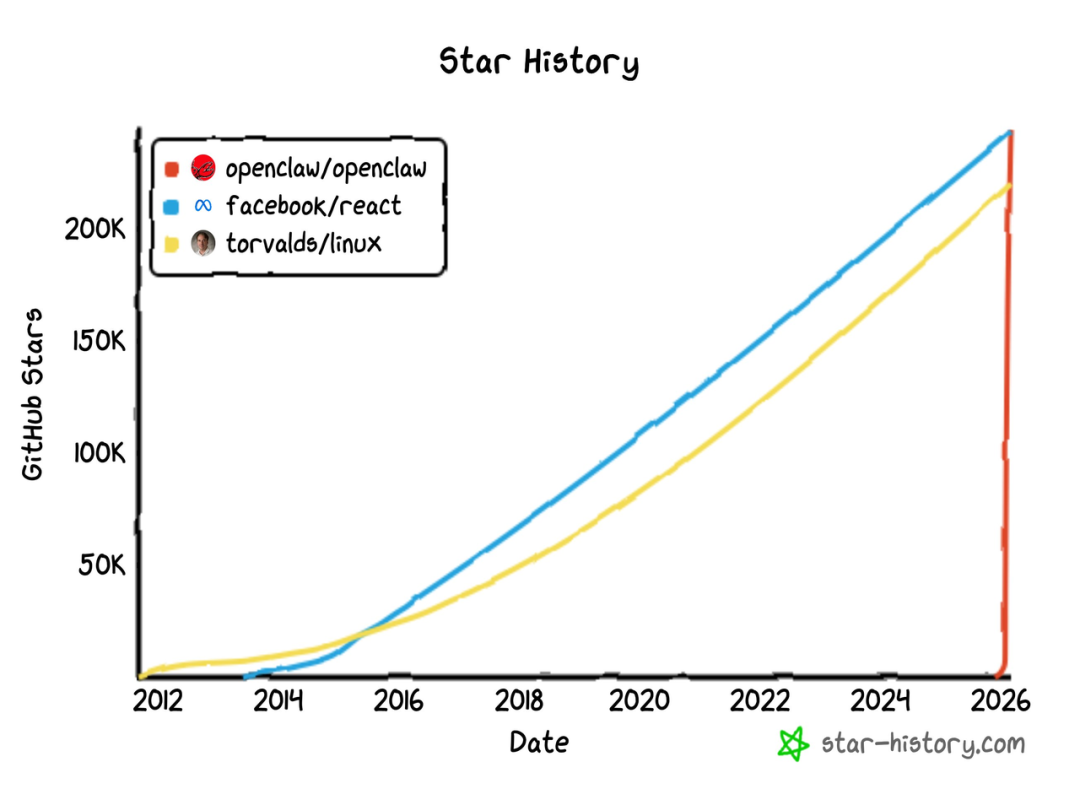
Why did the popularity of an AI Agent framework unexpectedly make a collaboration platform go viral?
Recently, Jensen Huang published a lengthy article, making a rather radical judgment: in the coming years, traditional software and app forms may gradually disappear, and AI Agents will become mainstream. If this judgment holds, the first question for Agents entering enterprises is where they will reside.
After all, Agents do not exist in isolation; their actual operation relies on the business soil composed of data, processes, and organizational relationships. And these elements are precisely what enterprises have already accumulated over many years on All-in-One platforms like Feishu.
This to some extent explains why developers in the OpenClaw community spontaneously gather on Feishu. Competitors can buy the same model, can deploy the same Agent framework, but they cannot take away the data, business, and experience you have cultivated in Feishu for three years.
01 Agents in Dry Land
The concept of Agents has been popular for over a year, but there are very few cases running within enterprises.
The reasons have been cited many times: data silos, permission fragmentation, security concerns. But these are surface symptoms; underneath is a deeper ailment that enterprise digitalization has not cured for twenty years.
All system issues, at their core, boil down to human issues. ERP governs processes, CRM manages customer relationships, OA oversees approvals.But there is one type of element that all systems have not touched: implicit experience. Veteran salespeople know when to push for orders, seasoned customer service representatives understand what phrases can soothe complaints, and experienced experts know how to communicate the same issue differently to various clients. This sense of nuance is never found in any knowledge base; it entirely relies on mentors training apprentices and seniors guiding newcomers.
Knowledge bases, SOP manuals—these methods have all been tried by businesses, but the reason for their failure is that the core characteristic of implicit experience is context-dependency. "Only push for the order after the client asks for the price for the third time" and "only provide a proposal when the other party's tone softens" cannot be recorded as static entries because the triggering conditions themselves are dynamic. A knowledge base can contain a "Top 50 FAQs," but it cannot respond to the contexts in which deviations from standard answers should occur.
Past intelligent agents have also failed to solve this problem. You can inform them of company background, business logic, your management style in the prompt, but do they really execute according to that? Uncertain. Large models are essentially functions whose output quality is controlled by the model vendors. Input should ideally be defined by the enterprise itself, but previous frameworks didn't provide enterprises with this degree of freedom. Agents are more like black boxes: you give tasks, they provide results, and you have no idea what happens in between, nor can you intervene.
OpenClaw is breaking this deadlock. Previous Agent frameworks also did module segmentation; LangChain has memory, Dify has workflow orchestration, but OpenClaw has lowered the threshold to a new level: configurations can be written in Markdown, enabling non-technical personnel to get started. It disassembles the Agent into soul (persona), user (user profile), memory (memory), and tool (tools), allowing enterprises to precisely define what Agents say in what scenarios and how to handle boundaries.
Implicit experience has, for the first time, transformed into digital assets.
02 The "Big Lobster" Raised
White box architecture hands the power to "define Agents" over to enterprises, but this power comes at a cost.
During the Spring Festival, Fu Sheng injured his leg and was bedridden for 14 days. He spent these 14 days raising a team of 8 Agents, accumulating 1157 messages and 220,000 words of dialogue, operating automatically 7×24 hours.
This may currently be the most complete personal lobster-raising sample, but the process was far from as smooth as it appears. For the first two days, Fu Sheng's 30000 couldn't even check contacts, forcing him to manually dictate executive information into the phone one by one. Then came leaks and misuse. 30000 inadvertently disclosed work arrangements to colleagues, and almost missed a flight due to reminders being stored in contextual rather than timed mechanisms.
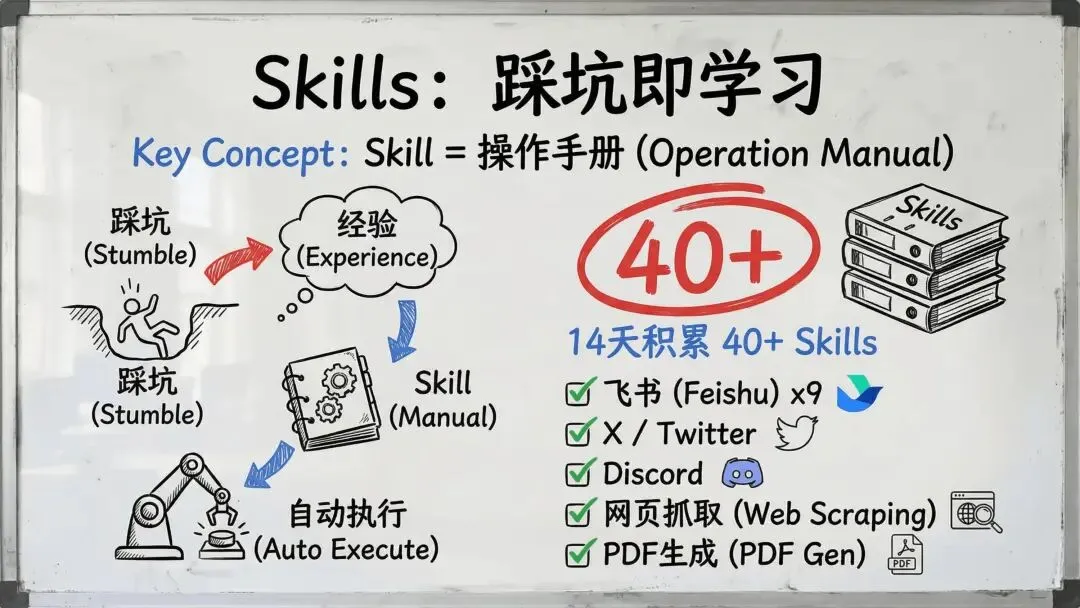
From this experience, Fu Sheng grasped a realization: Agents cannot be treated with a tool mindset. Tools are purchased for immediate use; Agents are more like new employees, requiring rules to be established, boundaries drawn, and immediate feedback on mistakes. He turned every instance of failure into Skill documents, accumulating over 40 in 14 days, the vast majority originating from missteps. The turning point came on the 12th day: the reading volume of selected WeChat public account topics by 30000 exceeded Fu Sheng's expectations. The Agent started displaying a certain "editorial instinct."
More than 40 Skill documents essentially involved repeatedly redefining the knowledge boundaries of the Agent using the white box architecture. This process is completely different from traditional digitalization: previously, one would buy a set of software, conduct one round of training, and then deliver; now, it involves repeatedly calibrating in real scenarios, and one mistake takes longer to rectify.
In business scenarios, OpenClaw has already begun to be used as a true production tool. During the "Lobster Conference" live broadcast held by Feishu yesterday, senior manager Wen Wei shared his experiences using OpenClaw: he views OpenClaw as a smart new employee—growing quickly but knowing nothing about the business, requiring experience to be fed. He fed factory data through two pathways: business system data is regularly synchronized to Feishu forms, and frontline management experiences are maintained in a knowledge base by employees. Together, the two sources enable the lobster to have a thorough understanding of the entire factory.
As for security policies, Wen Wei does not allow the lobster to connect directly to the factory's business system. After enterprise data governance, the data is synchronized to Feishu forms, and the lobster can only read from the Feishu forms. "It doesn’t even have the password to our system," Wen Wei says, "under a minimum permission policy, it is safe and controllable."
His lobster, "Super Xiao Fu," exists in various business groups as an AI colleague, providing daily report analysis, task follow-ups, and safety inspections. Previously, to have AI regularly check camera footage for anyone not wearing a safety helmet required configurations on the safety monitoring system and writing algorithms, taking at least two to three days to complete. Now, the user simply says in the group: "Help me set up a scheduled task to regularly check for safety risks in the final assembly workshop." Seconds later, the task is created, and the AI begins working.
During the Spring Festival, he allowed the lobster to monitor factory cameras online, directly reporting problems in the Feishu group and contacting on-site personnel for resolution.
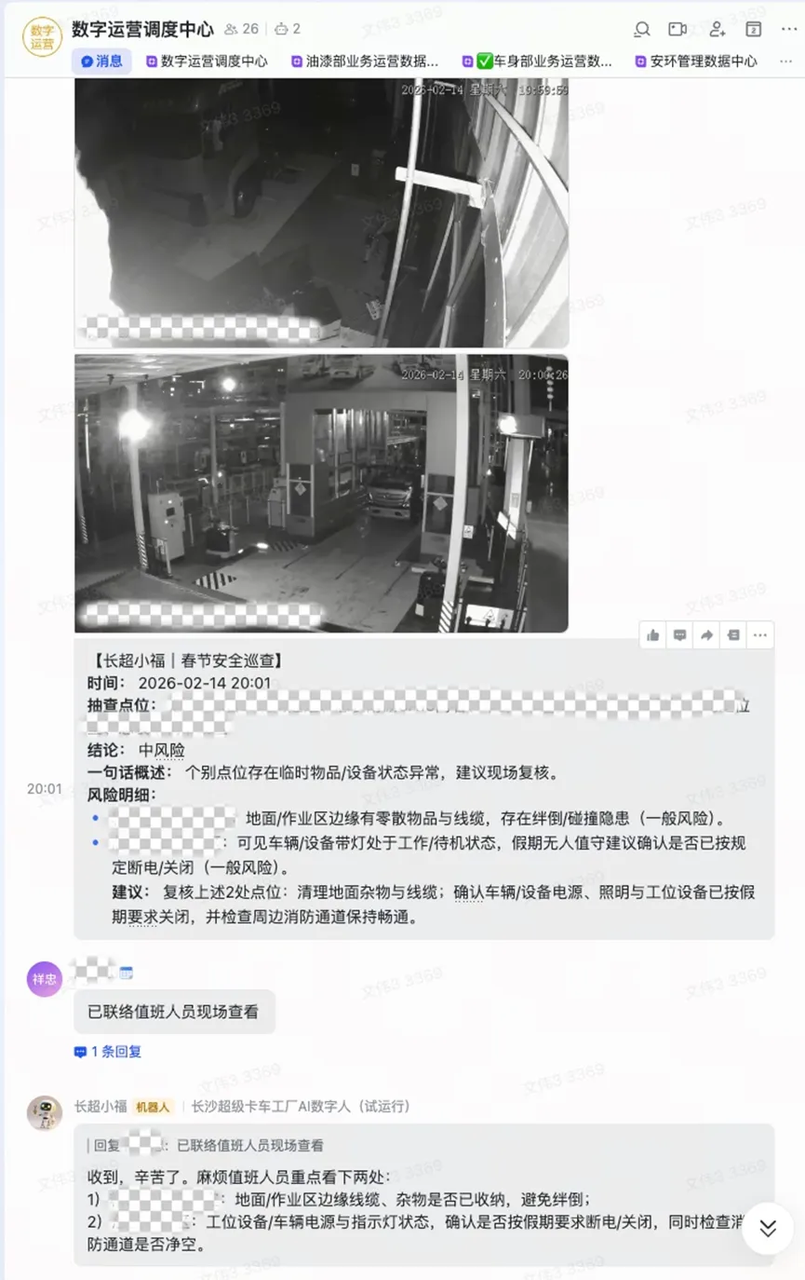
This reveals another layer of transformation that white box architecture brings to enterprise digitalization: the way business and IT collaborate is being reshaped. For the past two decades, business departments have known where the problems lie, but implementation relied on IT scheduling, resulting in the original demands often being compromised. Now, business personnel can define Agent behaviors, delineate knowledge boundaries, and configure workflows using natural language.
03 The Pond Determines the Limit of the Lobster
Fu Sheng's 40+ Skill documents and Wen Wei's dual data feeding share a common premise: Agent cultivation requires an environment capable of long-term operation. For experience to sediment, there must be a place to store it; for permissions to be controllable, there must be a unified framework; for context to continuously grow, daily employee behaviors must constantly feed in. If any one of these three elements is lacking, the Agent can only remain at the periphery, performing tasks like writing weekly reports or making summaries.
Theoretically, OpenClaw can connect to any IM, but the most vibrant developer community has voted with their feet for Feishu, as it happens to be a pond that has already raised sufficient water.
First is the data. Agents need context to work; where does the context come from? Those enterprises that have accumulated sales scripts, promotional reviews, and project documents early on in Feishu have essentially prepared the "feed" for Agents.
Next is permissions. In Feishu, the permission system runs through all modules including communication, documents, forms, and approvals. Agents need only to be authorized once to work across the entire ecosystem, but they can only operate within the scope of authorization.
Moreover, employees' daily habits of collaborating on Feishu, organizing notes, and managing multi-dimensional forms constitute the continuous context sources available to Agents.
Data, permissions, habits—these three things are interlinked. Agents can come in without having to clear the ground, taking over directly.
Feishu CEO Xie Xin recently posted on social media: "Individuals use Agents for exploration; enterprises use Agents out of responsibility. If something goes wrong in a personal scenario, it’s just a matter of starting over; if something goes wrong in an enterprise scenario, it could mean lost files or data breaches. The upper limit of Agent capabilities is exciting, but the lower limit of security determines whether they can genuinely enter working scenarios."
Trust and security are questions all collaboration platforms need to answer. Much of the security complexity of various Agents doesn't come from the models themselves but from the fragmentation of enterprise tool stacks. If chat occurs in Slack, documents in Notion, and data is in custom systems, every time an Agent executes a single task, it has to cross system boundaries, quickly complicating permission reading, writing permissions, and API call chains. Just configuring permissions can be an engineering disaster.
From this perspective, Feishu's "all-in-one" architecture provides it with a structural advantage: permissions don’t need to be pieced together across systems, they can form a closed loop within one platform.
Feishu is also proactively raising the pond's water level. In March, the official OpenClaw plugin was launched, allowing lobsters to directly read and write cloud documents, check calendar schedules, and search group chat contexts as users after receiving user authorization, transforming from mere chat plugins into actual working members of an organization. The monthly API call limit for the free version was also raised from 10,000 to 1,000,000.
This also brings new security tensions. The core feature of the lobster is its high degree of autonomous execution; once user authorization is completed, its specific operations and actions cannot be fully predicted and controlled. The official recommendation is: for important operations involving sending, modifying, or writing, be sure to "preview first, then confirm," and never let the AI enter a completely detached "fully automated" state.
After connecting to the lobster, Feishu actually faces an identity crisis, as it does not control the model layer. The lobster can connect freely to any large model, whether it be Doubao, Qianwen, or DeepSeek; it doesn't face limitations, and the token consumption is deducted from the model vendor's account, which Feishu cannot intercept.
So where is Feishu's core value? Context.
Feishu's chief AI expert Fu Qiang fed nearly 500,000 words of all weekly meeting documents, comments, and transcripts from the past two years into the lobster, refining his management style and code of conduct. Last week, for the first time, he had the lobster review weekly meeting materials and leave comments in the document, with the lobster selecting topics for discussion that overlapped with his concerns by about 70-80%.
He has a fixed segment in his customer demonstrations: first asking clients to spend a minute writing a prompt that describes their management style, then showing them the version extracted from hundreds of thousands of words from meeting records. Not a single client could produce an equally high-quality description in a minute, and he understood on the spot why Feishu is the best context container in the AI era.
For the past twenty years, the logic of enterprise digitalization has been procurement: buying systems, tools, and solutions. The logic of the Agent era is cultivation: feeding, calibrating, and solidifying skills. This process has no shortcuts, but it is precisely because there are no shortcuts that enterprises that cultivate early will possess assets that latecomers cannot purchase.
Every action taken by enterprises on Feishu today essentially represents an investment in their future AI execution capability. The earlier they start, the deeper the pond, and the harder it is for others to catch up.
The emergence of OpenClaw is accelerating the evolution of digital employees, and Feishu is the best pond for nurturing them.
免责声明:本文章仅代表作者个人观点,不代表本平台的立场和观点。本文章仅供信息分享,不构成对任何人的任何投资建议。用户与作者之间的任何争议,与本平台无关。如网页中刊载的文章或图片涉及侵权,请提供相关的权利证明和身份证明发送邮件到support@aicoin.com,本平台相关工作人员将会进行核查。


