Original Author /Stacy Muur
Translation / Odaily Planet Daily Golem(@web 3_golem)
Every month, Green Dots conducts research on KOL promotional activities on the X platform to understand the strategies of other Web3 marketing teams and track which strategies and post styles are truly effective. However, due to the new paid partnership policy introduced by X, the marketing landscape on the X platform has changed (Related reading:Elon Musk casually overturns crypto KOL's meal ticket), which means most Web3 projects' promotional strategies are no longer suitable. In this article, Stacy Muur reveals common issues present in many recent Web3 promotional activities, using Starknet as the case study.
The author clarifies: This is not directed at Starknet; their technical strength remains strong. Despite many doubts and skepticism from the outside after the airdrop and TGE, the team continues to publish and develop products, which is commendable. However, this article focuses solely on one aspect: marketing strategy. Starknet's recent product promotion is just a typical example.
How does Starknet conduct advertising promotions?
Starknet recently launched strkBTC [₿] and invited some content creators on the X platform to promote the event. They followed a very classic promotional model:
- First, release an announcement with a promotional video;
- Within 12-48 hours of the announcement, KOLs will post collaborative promotional posts;
- Subsequently, publish articles specifically explaining the advantages of the product.
Even though this promotion took place in late February, to comply with X's paid partnership policy, some creators included paid partnership identifiers when posting related content. However, the main focus of this article is not on paid disclosure but on the effectiveness of this promotional strategy itself.
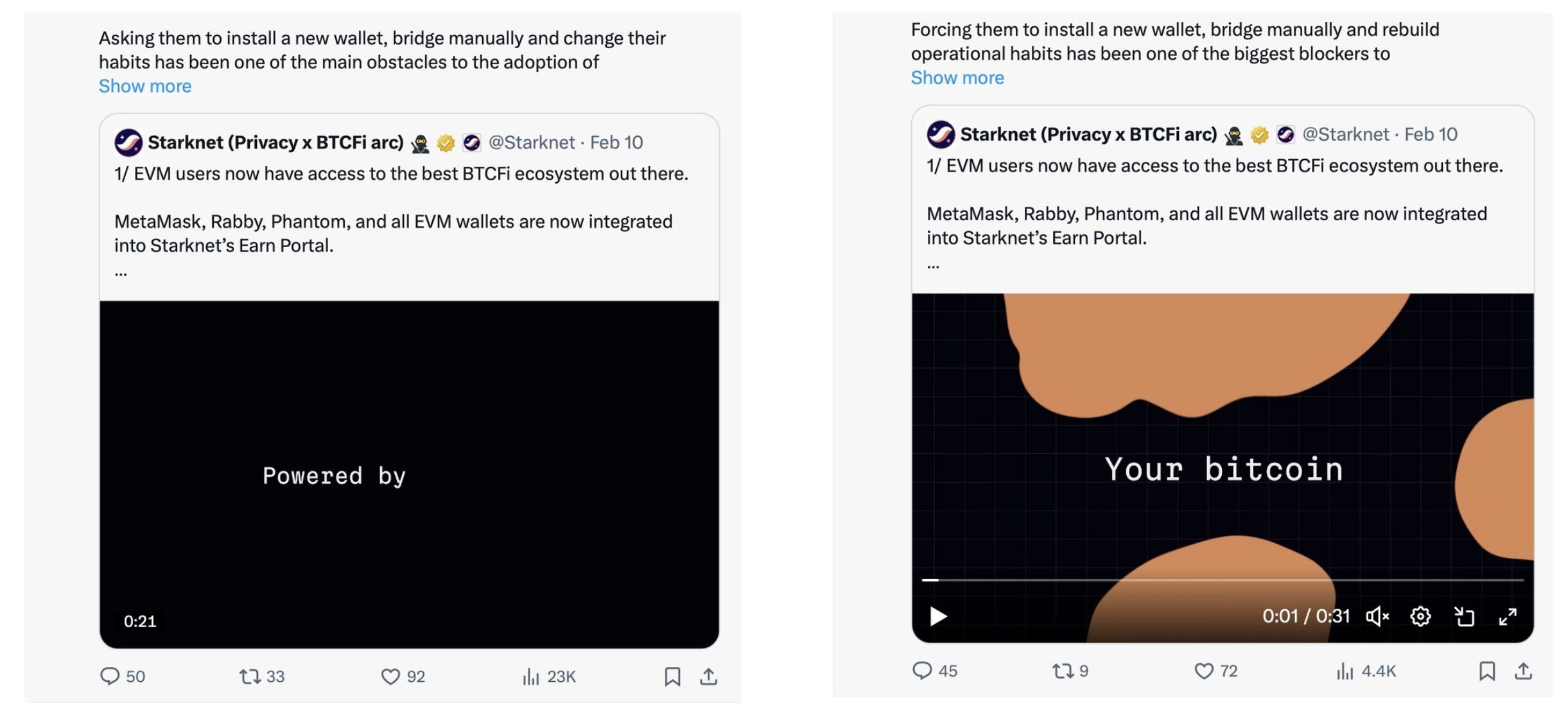
On February 10, surrounding another announcement from Starknet, its marketing team again conducted a KOL promotion. The same routine was repeated, first releasing a video announcement and then promoting it through KOLs.
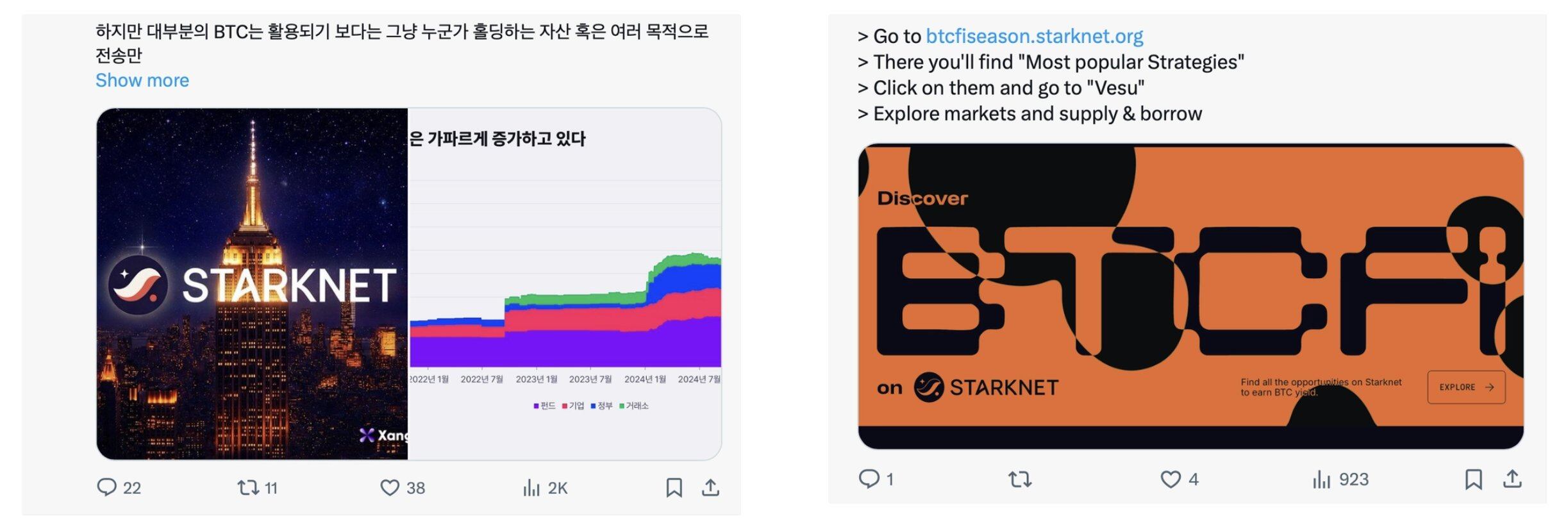
Of course, Starknet also has other promotional methods, such as publishing several long articles and conducting some promotional activities in Korean-speaking areas.
As a preliminary note, I do not know who is in charge of managing this activity or whether there is an agency involved; I am merely providing some thoughts from the perspective of a marketer as an outsider.
One evident issue throughout the promotional process is the weak selection criteria for participating creators.
X is essentially a perception layer. Ideally, creators promoting on X should lead to:
- More discussions about the brand
- Increased posts from independent creators on their own
- More community-generated content
- A more robust ecosystem activation
But is this what we see? Far from it.
If you simply filter by conditions on X and look at the popular posts mentioning Starknet in February, the results are obvious.
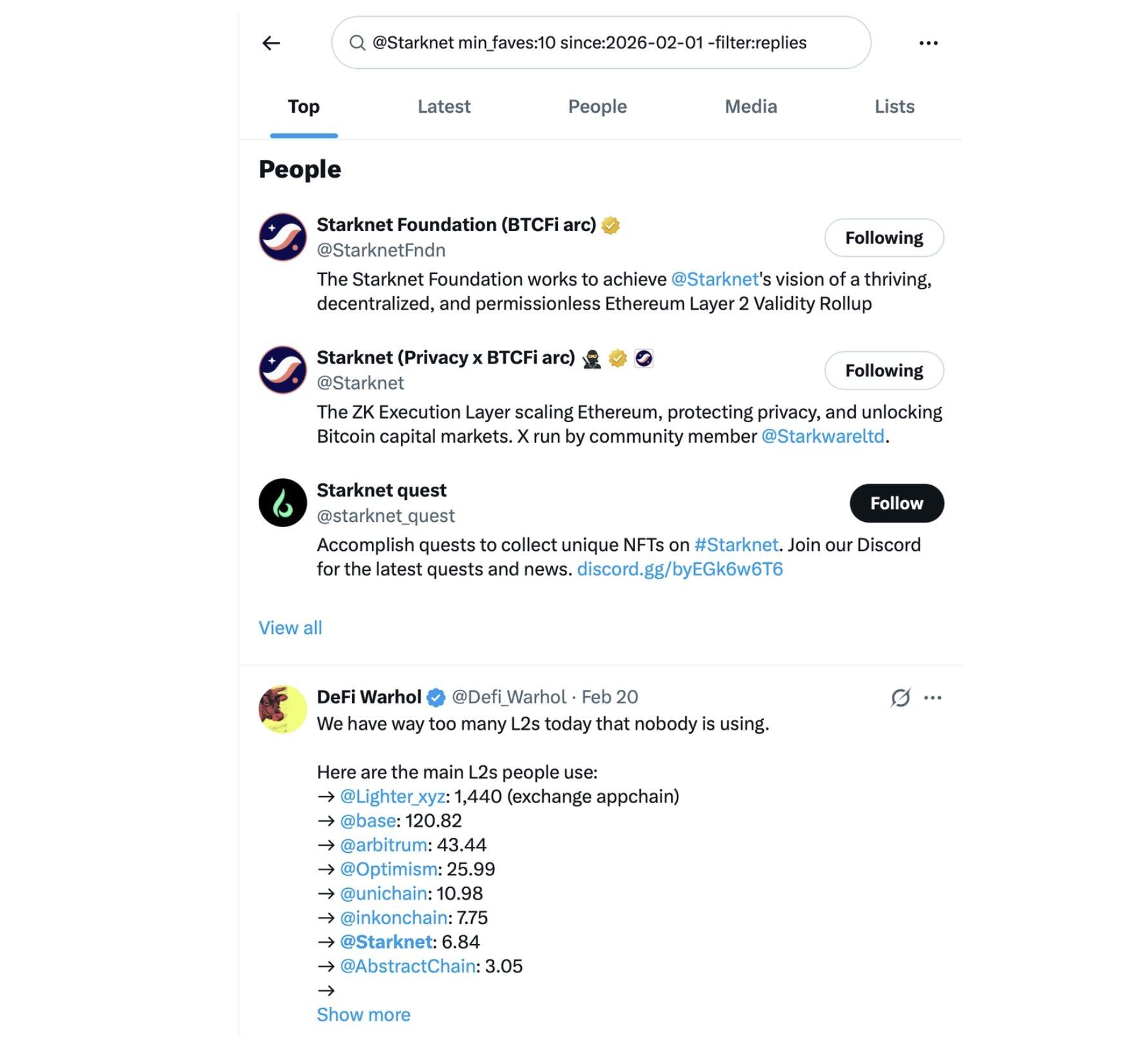
The most mentioned post is actually Warhol's post. Overall, in February, only a little over 100 independent posts mentioning Starknet received more than 10 likes. For a well-known L2 ecosystem, this number is not significant.
Some naturally popular posts mentioning Starknet include:
- Mookie's post about token unlocks (around 10k views)
- Warhol's post about the best internship brands in the cryptocurrency industry (around 16k views)
- Warhol's L2 ranking list (around 30k views)
- santiment's post ranking L2s based on developer activity (around 50k views)
- mztacat's post about the "big four" (around 82k views)
This roughly represents Starknet's mention volume on the X platform in February. This leads to a more significant question, not only concerning Starknet but also about why traditional Web3 marketing strategies are gradually failing on the X platform.
Why have classic Web3 advertising and promotional strategies failed?
For years, the default model for Web3 marketing has been: publish announcements—KOL promotion—community discussion.
In a time when the X timeline was less crowded, narrative-driven, and most promotional activities were not easily identifiable as paid promotions, this classic model was effective. However, this model has become ineffective after the following changes occurred.
Paid disclosures have stifled implicit communication
Once creators start adding paid disclosure information, this promotional model becomes obvious to fans.
First, users see an announcement, then within the next 24 hours, 5-10 similar promotional posts appear, and all the post content is largely the same, making it easy for users to identify this structure. It does not spark community discussion; instead, it sends the signal that "this is an advertising campaign."
In the environment of crypto Twitter, advertisements rarely initiate community discussions; they are usually scrolled past by users.
KOL behavior is now very easy to recognize
Crypto Twitter has matured, and people understand how KOL marketing works.
When the same group of creators quotes the same announcement with slightly different wording, it is easily interpreted as a coordinated promotional activity. Once the content posted by KOLs is clearly identified as a promotion, user interaction rates decline because the audience switches from curiosity mode to advertisement filtering mode.
X rewards topic engagement, not announcements
X is not a distribution channel; it is a narrative space. Unless Web3 project's announcements can spark the following situations, they rarely become hot topics:
- Arguments and debates
- Meme coins
- Popular opinions
- Competition between KOLs
Without these dynamic factors, dissemination can only lead to short-lived user outreach without actually winning users' minds. Therefore, to gain genuine topic engagement, Web3 projects should alter the sequence of marketing activities.
The old promotional process followed the pattern: announcement—KOL promotion—community discussion, while the new promotional structure should be: first build a topic—trigger creator debate—generate community content—finally release an announcement; thus, the announcement becomes the final confirmation moment instead of the starting point.
If the project team skips the narrative stage, promotion becomes impossible to discuss.
How to redesign a promotional campaign for Starknet
Let's return to reality; Starknet carries a heavy burden. The previous airdrop stage caused widespread panic, uncertainty, and skepticism, and merely explaining and using promotional videos won't solve this problem; the project team needs to control the dialogue to address issues. Different goals require different marketing strategies.
If the goal is to win users' minds
The strategy should actively engage in controversy rather than attempting to suppress critics, designing topics that can provoke debate.
For example:
- "Which L2 is more suited for developing BTCFi?"
- "Ethereum L2 vs Bitcoin L2"
- "The top five ecosystems for BTCFi developers"
Then sponsor posts listing rankings, posts comparing Starknet with other projects, and posts that engage in debate. Perhaps half of the timeline will support Starknet, while the other half will attack Starknet, but both sides increase visibility. Creating drama is not bad marketing; indifferent marketing is what’s terrible.
If the goal is to dominate public opinion
Then stop publishing lengthy PR articles; very few people will read them. Instead, release visual infographics, ecosystem maps, competitor comparisons, and short frameworks that KOLs can reuse. Give creators the space to remix content, which is far more powerful than content they can only quote.
The goal of dominating public opinion is not a single good article but dozens of derivative articles; that is how narrative dissemination works.
If the goal is to attract developers
Then remember that acquiring developers operates on a B2B model. Publishing announcements on X will not effectively guide developers. What the project team should do is:
- Build topic momentum
- Create ecosystem prestige
- Showcase successes already achieved by developers there
Once this trend is established, guiding developers becomes much easier because developers also chase hotspots.
Conclusion
The traditional promotional model in Web3 (release announcement → KOL promotion) is gradually declining on X. The new model is more akin to: design topics → stimulate creator interest → spark discussions → let the community continue its engagement.
The project's announcements remain important, but they should no longer be the beginning of the promotional activities; instead, they should be the endpoint.
免责声明:本文章仅代表作者个人观点,不代表本平台的立场和观点。本文章仅供信息分享,不构成对任何人的任何投资建议。用户与作者之间的任何争议,与本平台无关。如网页中刊载的文章或图片涉及侵权,请提供相关的权利证明和身份证明发送邮件到support@aicoin.com,本平台相关工作人员将会进行核查。


