This week in Eastern Eight Time Zone, as geopolitical tensions escalate in multiple regions and oil and gas prices soar again, global risk appetite has generally cooled, putting pressure on traditional assets. However, in this risk-averse and contractionary macro environment, Bitcoin has not only withstood the dual pressures of energy shocks and declining sentiment but has also periodically outperformed gold and the Nasdaq 100 index, with prices rising back to around 74,000 USD. This abnormal structure brings an old question back to the forefront: In the turbulent cycle intertwined with the shadow of war and soaring oil prices, is Bitcoin being reshaped into a new "macro hedge asset," or is it still just a high-beta risk asset that amplifies volatility?
Bitcoin Price Turns Up Under the Shadow of War
● The simultaneous rise in geopolitical tensions and oil and gas prices has directly increased market concerns about the economy and corporate profits, putting traditional assets under pressure amidst a mix of risk aversion and reduction in positions. Stock indices gave back gains, and commodity markets showed structural divergence; while gold saw inflows, it was also constrained by profit-taking and fluctuating interest rate expectations, making it difficult to form a unilateral trend overall. Global assets appear to be passively responding in an environment of "forced contraction."
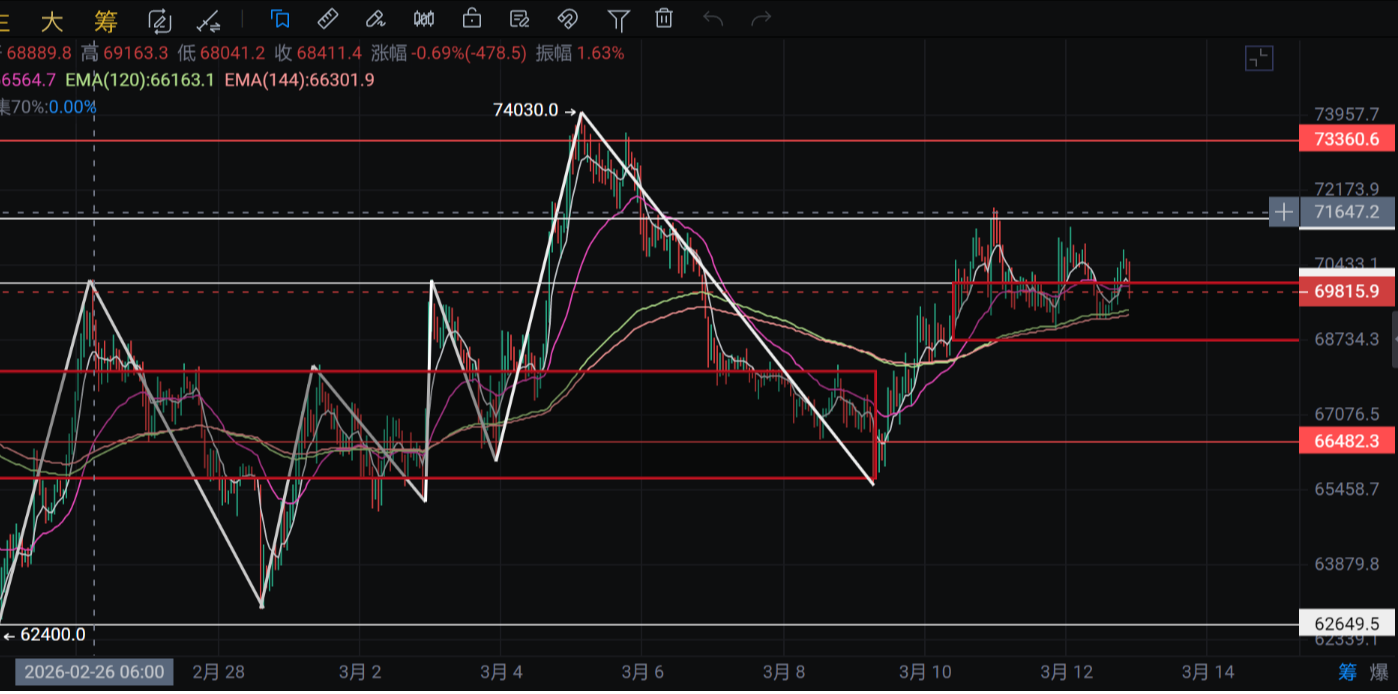
● Against this backdrop, Bitcoin first traded sideways in the 62,000-72,000 USD range, with frequent turnover near the center, before starting to surge and rising back to around 74,000 USD. This rhythm indicates that the market did not initially view Bitcoin as a direct safe-haven tool, but rather, after a period of hesitation, turnover, and repricing amidst considerations of geopolitical risk, energy costs, and liquidity, gradually formed a consensus for an upward price action.
● In contrast, gold experienced about a 2% pullback during the same period, and the Nasdaq 100 index fell about 0.5%; amidst the overarching backdrop of surging oil prices and geopolitical uncertainty, both traditional safe-haven and growth assets saw some retreat. Bitcoin, however, re-approached historic highs after the fluctuations, with its relative strength reflected not only in absolute gains but also in its independent rise amid the dual onslaught of "gold losing luster and tech under pressure," providing quantifiable data support for the narrative of "leading against the trend."
Gold Loses Luster, Tech Under Pressure, Bitcoin Leads Against the Trend
● Since February 28, Bitcoin has cumulatively risen about 7%, experiencing sharp pullbacks and rapid rebounds along the way, with volatility consistently remaining high. This trend not only continues the asset's high volatility legacy but also shows that after each pullback, buying interest swiftly re-emerges to push prices higher, indicating that during times of amplified macro noise, there remains a group of investors willing to chase this main narrative with a higher risk tolerance.
● In stark contrast to the climbing pace of Bitcoin, gold has dropped about 2% since the same point, and the Nasdaq 100 index has retreated approximately 0.5%, exhibiting a typical scenario of "risk assets cooling while safe-haven assets are not robust." This structure suggests that Bitcoin's 7% increase is not merely a simple market fluctuation, but resembles a character on a stage where others are pulling the curtains, managing to maintain a bright spotlight and thus amplifying its topic of discussion in asset allocation dialogues.
● In a phase where traditional safe-haven assets are under pressure and growth stocks are squeezed by valuation and macro expectations, some investors have begun to consider Bitcoin as an "alternative safe-haven position": on one hand, it is not directly constrained by a single sovereign credit or regional risk; on the other hand, its high volatility and global liquidity allow capital to move in and out quickly to hedge against emotional fluctuations. This motivation may not stem from long-term faith but appears particularly attractive during the current window of intense macro noise.
Hayes' Judgment: Bitcoin...
● The public viewpoint of former BitMEX CEO Arthur Hayes has become an important amplifier of this discussion. He emphasizes that amid the surge in oil and gas prices and compounded geopolitical tension, Bitcoin's performance has exceeded that of traditional assets like gold and the Nasdaq 100, suggesting that this round of Bitcoin’s rise is not merely the result of warming risk appetite, but a “parallel bet” against the fiat currency system and energy shock risks, potentially demonstrating more resilience than traditional safe havens and equity markets in extreme environments.
● Around Hayes’s statements, the market has begun to rethink Bitcoin's asset attributes: is it transitioning slowly from a typical high-risk growth asset to a “macro hedge asset”? Supporters believe that Bitcoin has shown price logic independent of a single economy throughout multiple crises, gradually being viewed as an option to hedge against fiat currency devaluation and geopolitical risks; skeptics caution that this performance may be more likely driven by liquidity and speculative sentiment, with its "hedging function" lacking sufficient verification from long cycles and multiple crises.
● In the social media and market opinion arena, debates surrounding this positioning have intensified. Bulls highlight that amidst gold pullbacks and Nasdaq 100 pressures, Bitcoin still records about a 7% increase; this fact alone suggests that its macro sensitivity and capital recognition are improving. Bears counter that Bitcoin has also experienced sharp declines during multiple extreme risk events, making it difficult to simply classify it as a “safe haven.” More often, it serves as an amplifier during extreme risk preference, and this strong performance may merely reflect an amplification of a high-leverage cycle.
Derivatives Buying Returns, Bulls Use Real Gold...
● Data shows that net buying of Bitcoin derivatives continues to be positive, meaning that in the contract market, larger-scale buyers are choosing to actively buy out limit sell orders, with active buying clearly suppressing passive selling. This structure is often interpreted as "someone is actively chasing the price up," rather than just relying on spot slowly lifting prices, reflecting that behind each price pullback, there is a pool of capital willing to incur higher shock costs to buy in.
● Meanwhile, demand for long positions in the futures and other contract markets has rebounded, creating a significant leveraged amplification effect on spot prices. When capital increases bullish bets through contract instruments, even if spot buying intensity is limited, prices may be pushed to higher ranges, prompting more chasing sentiment to enter the market. The transition of Bitcoin from the 62,000-72,000 USD range to the rise around 74,000 USD is hard to understand without considering the emotions and directional betting aids from the derivatives market.
● It is essential to emphasize that establishing a direct causal chain between soaring oil and gas prices and the return of derivatives buying remains a matter to be verified. Some on-chain and derivatives data analysts suggest that rising energy prices could elevate inflation and currency depreciation expectations, thereby driving speculative and hedging money into Bitcoin via derivatives; however, related models and arguments have not been fully disclosed in this briefing. Without more robust evidence, a more prudent approach is to view the two as potentially related parallel phenomena rather than as proven causal relationships.
74,000 is Not the Endpoint, Key Resistance Zone...
● The currently widely watched key range around 78,000-80,000 USD reflects a technical analysis consensus from various third-party institutions and traders, rather than any binding "official conclusion." These views are mostly based on historical transaction density zones, prior high positions, and capital cost distributions, but the briefing also clearly reminds that such sources still require further verification, thus it is more suitable as a reference anchor for market sentiment and expectations rather than as a definitive resistance zone that will necessarily be effective.
● If Bitcoin cannot effectively break through and stabilize above 78,000-80,000 USD, the current movement from the 62,000-72,000 range to around 74,000 USD may still be defined by some participants as a sharp rebound within a bearish structure rather than a true starting point for a new bull market. This perception will directly influence the willingness to leverage funds, the holding cycles of long and short positions, as well as the tolerance for pullback amplitudes, thereby creating a self-reinforcing cycle of volatility in price.
● Surrounding this critical range, bulls and bears have already constructed opposing narratives. Bulls bet on a "strong breakout," believing that geopolitical conflicts and soaring energy prices provide a substantial macro narrative, coupled with derivatives buying support, offering a chance to break through prior highs in the short term; bears choose to amplify concerns about macro uncertainty, emphasizing that if geopolitical risks worsen or policy expectations reverse, Bitcoin could still repeat past occurrences of significant downturns, establishing more aggressive short positions around this key area.
Safe Haven Myth or High Leverage Fantasy...
In the current backdrop of overlapping geopolitical conflict and rising energy prices, Bitcoin's staged outperformance of gold and the Nasdaq 100 index has been validated at a data level: it has risen about 7% since February 28, contrasting with gold's 2% drop and the Nasdaq 100's 0.5% decline, creating clear relative returns. Its rise from the 62,000-72,000 USD range back to about 74,000 USD certainly reflects different price rhythms from traditional assets. However, simply labeling this performance as the "safe haven myth" while ignoring its fundamental traits of high volatility, high leverage, and strong emotional drive also constitutes an overly simplified narrative.
Whether Bitcoin can be regarded as a genuine safe-haven asset still requires more historical testing across multiple cycles and different types of crises; simply likening it to gold will obscure its unique risk-return structure. In the coming months, the evolution of geopolitical situations, whether energy prices continue to rise, and whether Bitcoin can effectively break through and stabilize within the widely focused range of 78,000-80,000 USD will jointly shape the flow of capital and the direction of narratives. If prices repeatedly falter before the critical resistance zone, the voices of "high leverage fantasy" will be resurrected; if a breakthrough can be achieved amidst macro noise, the discourse on "macro hedge assets" will further strengthen. For participants, maintaining caution toward narratives and clarity regarding risks while enjoying relative returns and severe volatility may be more critical than simply seeking a binary conclusion of "hedge or not."
Join our community, let’s discuss and grow stronger together!
Official Telegram community: https://t.me/aicoincn
AiCoin Chinese Twitter: https://x.com/AiCoinzh
OKX Benefits Group: https://aicoin.com/link/chat?cid=l61eM4owQ
Binance Benefits Group: https://aicoin.com/link/chat?cid=ynr7d1P6Z
免责声明:本文章仅代表作者个人观点,不代表本平台的立场和观点。本文章仅供信息分享,不构成对任何人的任何投资建议。用户与作者之间的任何争议,与本平台无关。如网页中刊载的文章或图片涉及侵权,请提供相关的权利证明和身份证明发送邮件到support@aicoin.com,本平台相关工作人员将会进行核查。