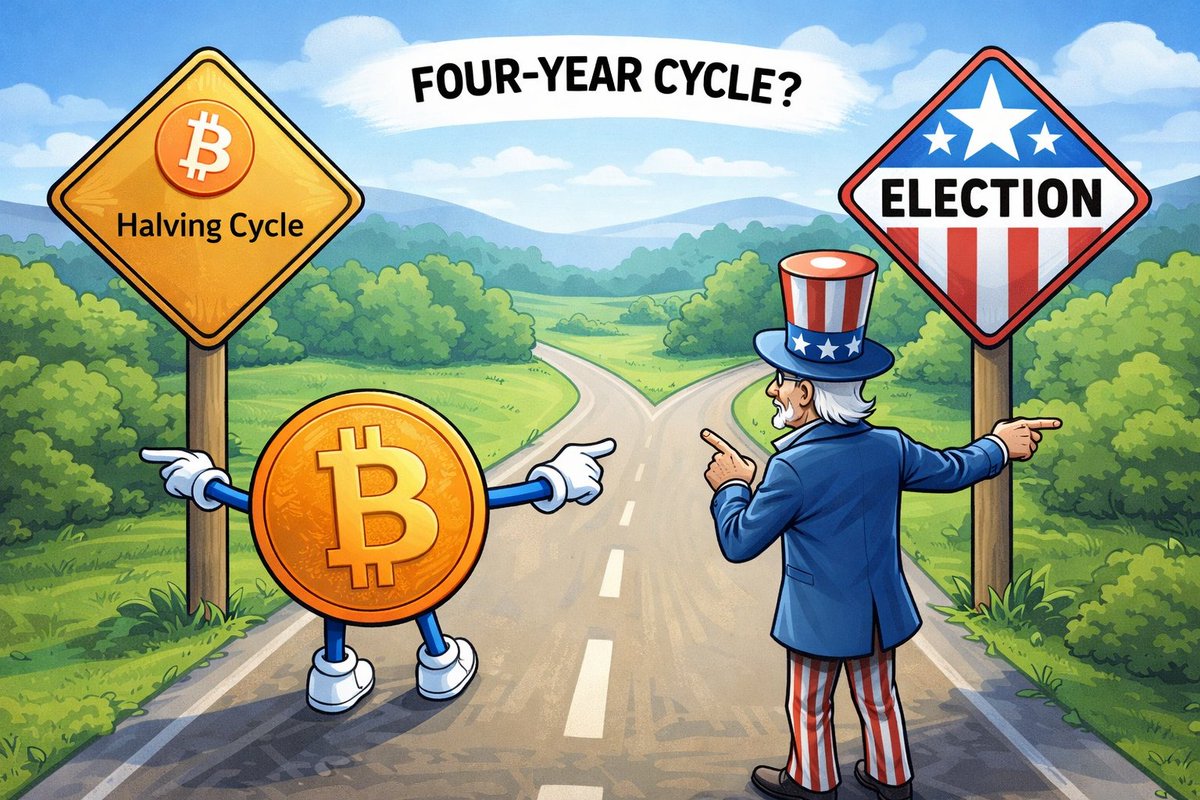
Does the four-year halving cycle of Bitcoin still exist?
In my personal view, the impact of halving on $BTC is weakening, as the total supply approaches its limit, and the anti-dumping effect brought about by each halving is no longer as strong as it used to be.
Moreover, looking back at the past few cycles, when Bitcoin truly enters an emotional peak, it often overlaps with the U.S. election cycle. Therefore, my consistent view is that the four-year cycle is likely still present, but what drives it is not only the halving itself, but also the combined results of halving, elections, liquidity expectations, and risk appetite.
The elections themselves will not directly determine the price of Bitcoin, but elections often influence fiscal policy, regulatory expectations, and market perceptions of future liquidity, which are precisely what risk assets value the most.
In addition, the lifecycle of BTC is still too short, and many event combinations have either never occurred before or have just recently emerged. For example, this halving cycle corresponding to the Federal Reserve's high interest rates and balance sheet reduction is the first time, and Bitcoin has yet to truly face a prolonged economic recession.
Therefore, when many friends directly apply past experiences to the future, there will inherently be biases. Past history can only tell us how Bitcoin might perform under certain environments, but it cannot prove that the same path will be repeated under completely different macro combinations in the future.
Moreover, the biggest difference between now and the past is not only that the impact of halving is declining, but more importantly, Bitcoin has increasingly penetrated the global financial system. Previously, factors affecting $BTC were more about narratives within the cryptocurrency community, miners, halving, exchanges, and retail sentiment, but now ETFs, institutional allocations, U.S. dollar liquidity, U.S. Treasury yields, Federal Reserve paths, regulatory attitudes, and even geopolitical conflicts and energy prices have a more direct impact on Bitcoin.
In layman's terms, Bitcoin used to be more like a small market with its own rhythm; now it resembles being pulled into the global macro asset pricing system, making it difficult to explain all issues solely based on halving narratives.
Therefore, I believe the four-year cycle is likely still present, but it does not mean there will definitely be a significant price increase every four years. In the future, it is more likely that there will be a market sentiment boost during the election phase, but if there isn't a genuine improvement in liquidity, once the heat passes, the market will again fall silent.
Of course, there is another possibility, that as institutions fully enter, Bitcoin gradually resembles gold, no longer strongly relying on the halving cycle, but pricing itself more according to global liquidity, interest rates, and safe-haven demand.
End
免责声明:本文章仅代表作者个人观点,不代表本平台的立场和观点。本文章仅供信息分享,不构成对任何人的任何投资建议。用户与作者之间的任何争议,与本平台无关。如网页中刊载的文章或图片涉及侵权,请提供相关的权利证明和身份证明发送邮件到support@aicoin.com,本平台相关工作人员将会进行核查。


