Written by: Ye Kai
Many people think OpenClaw is just another AI Agent, but I prefer to see it as the first digital production line of the computing power era.
What it rewrites is not a certain function, but rather the organizational forms, means of production, settlement methods, and asset logic of the next five years.
The real question is not whether it can work, but who will manage it once it starts working, who will keep its accounts, and who will be responsible for its uncontrollable behavior.
Introduction
Brother Kai is still holding onto Web 2.5, yet Web 4.0 has arrived.
If you still think of OpenClaw as a smarter AI assistant, then you're likely underestimating it. Its real danger and true value lie not in "being able to chat," but in "being able to execute."
This marks a watershed.
A system that only answers questions is, at most, an assistant. A system that can adjust devices, connect channels, run skills, and execute tasks across various tools is, in essence, no longer just an assistant.
It begins to resemble a workshop, like an assembly line. It's like a digital factory that never turns off its lights.
Many people are still using it for demonstrations. The truly smart individuals are already using it to rewrite their production functions.
Why do I say this?
Because the current wave of interest in OpenClaw appears to be just a new favorite within the AI circle, but at its core, it actually signals the emergence of digital economics.
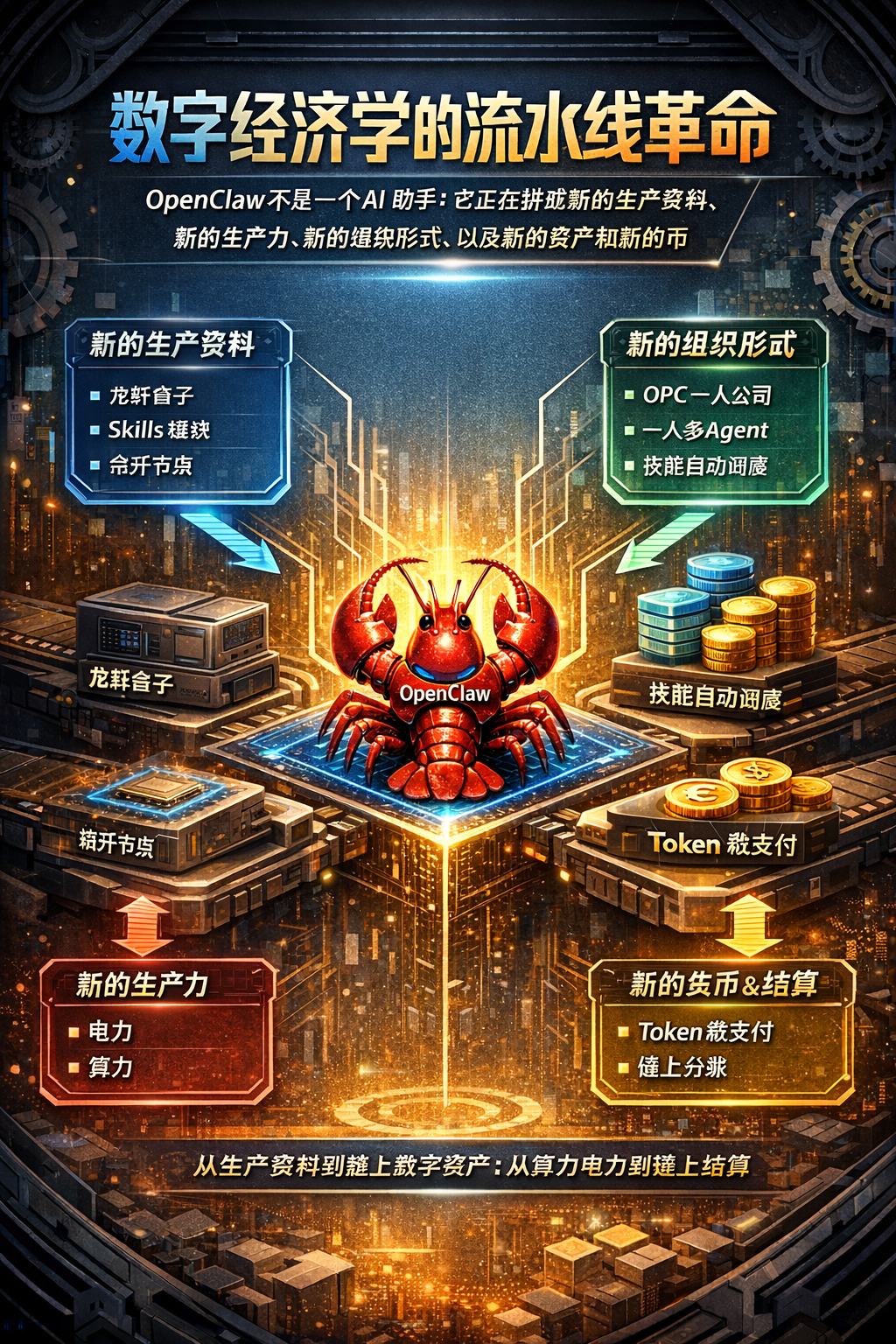
Productivity is changing, means of production are changing, organizational forms are changing, assets are changing, and even currencies and settlement methods are beginning to change.
Lobsters are not toys; lobsters are signals.
Main Text
Lobsters are not tools; lobsters are digital factories
Let me place the most critical point upfront. OpenClaw is not a product upgrade; it is more like an upgrade in the mode of production.
In the past, the software logic was quite simple. People operated the software, switched pages, ran processes, made connections, and were the “interface” switching windows within the process.
Now, this logic is starting to fracture. Once systems like OpenClaw mature, they no longer just help you write some things, search for some data, or reply to a few messages. They will start to take on tasks for you, break down tasks, call skills, connect channels, operate devices, and then return the results.
Don’t underestimate this change. This is not just about a productivity tool doing a bit more work. It’s the first time digital labor is being truly streamlined.
To put it even more plainly, in the past you operated software; in the future, it seems like software will operate itself for you.
Once this change takes hold, the value chains of many industries will be reshaped.
The first to be consumed: not physical labor but switching costs
Many people love to ask whether AI will replace humans. I increasingly feel this question is misbegotten.
The real question should be, what form of human value will AI first replace?
My answer is straightforward: what will be devoured first is not necessarily "people," but rather their switching costs.
Consider this: much of today’s office labor essentially involves what? Checking emails, copying data, formatting documents, passing information, following processes, switching between Feishu and Slack, changing spreadsheets, navigating websites, and then organizing it all to send to the next person.
The reason many positions still exist is not because of how wise their judgments are, but rather because systems have not yet been interconnected, processes are still fragmented, and organizations require multiple layers of people to transport, translate, and coordinate.
However, once systems like OpenClaw mature, they will first swallow up this portion of "digital manual labor."
When a message comes in, it will receive it first; when a task needs to be broken down, it will do that first; when tools need switching, it will run that first; when processes need linking, it will connect them first; and when results need feedback, it will respond with them. What does this mean? It means that in the future, those who first lose bargaining power will not necessarily be the most visible high-paid positions, nor necessarily the programmers themselves. The first to be squeezed will likely be a large number of middle-level white-collar workers and functional intermediaries.
Those who rely on following up, coordinating, transporting, connecting, or "I know which buttons to click in which system" for their livelihood—previously these actions provided a sense of job security, but now, that security is starting to wane.
The sharpest cut of OpenClaw: it targets not positions, but the "intermediary layer"
Many people have yet to realize that the real danger is not that a certain job type is replaced but rather that the entire intermediary layer is being thinned out.
What is meant by the intermediary layer? It is not in the literal sense of a broker, but rather all value layers that exist based on “information not flowing automatically.”
Those in SaaS making money from interface friction, those in organizations relying on manual forwarding and hand-synchronized work, service providers charging for “connecting A to B,” teams sustaining their presence through process transport—these layers previously benefited from non-connectivity; in the future, they will be among the first to bleed.
Because OpenClaw is not just doing a single point function; it is competing for the rights to manage processes. Whoever controls the rights to manage, begins to control the distribution of value. On the surface, what you see is an Agent. At its core, it resembles a new control console.
This is where many people fail to see the bigger picture. An Agent capable of executing tasks across channels, devices, tools, and processes is fundamentally no longer just a tool. It begins to morph into a new layer of infrastructure. Once this infrastructure grows, business models built on friction and breaking points will be revalued.
This is not an AI story; this is a new story in digital economics
That’s why I always say, you cannot view OpenClaw solely from an AI perspective. Because if you do, you will at most see it as a new generation of assistants. Yet, once you shift to a digital economics perspective, you'll realize the variables it encounters are of an entirely different level.
First, let’s look at productivity. The hardest productivity today is increasingly not traditional labor, but electricity and computing power. If electricity supply is unstable, machines do not operate; if computing power management is insufficient, Agents won’t function. So in this era, electricity and computing power are not just background conditions; they have become core variables within the production function.
Next, examine means of production. The means of production in the industrial era were machines and workshops; in the internet age, they were servers and software. In the Agent era, the means of production have evolved again. Lobster boxes are means of production, permanently active nodes are means of production, Skills are means of production, permission systems, model interfaces, automated processes, logs are all beginning to be regarded as means of production.
This change is crucial.
Because it means that in the future, what is most valuable is no longer merely “can I use tools,” but rather “do I have my own digital factory.”
Many are still discussing whether they should learn prompt engineering.
The real lethal question is whether you have begun building your own system of means of production. Without this system, no matter how smart you are, you remain merely an advanced manual craftsman. With this system, you can transform from an individual into a small organization.
OPC why it suddenly emerged
In recent years, everyone has been talking about OPC, one-person companies, one-person organizations, super individuals.
To be honest, I don’t really trust many of these discourses. They seem too light and more like slogans. How could one person truly operate like a company? You are always limited by time, attention, channels, and execution radius.
But with systems like OpenClaw emerging, things suddenly start to appear a bit different.
An individual, a set of Agents, a group of Skills, a lobster box, a set of permanent nodes, plus a budget, permissions, and a calling system. Notice how an individual at this point is no longer just “one person,” but a small organization that possesses a digital assembly line. This is the moment OPC truly takes shape. It is not merely about inspirational stories or personas being realized, but about organizational capability being established.
In the past, when talking about a one-person company, it was often about one individual working hard until they reached their limit. The truly mature OPC of the future will not see one person working harder, but rather one person beginning to possess an entire organized digital labor force.
It sounds exciting, but it raises bigger issues. Because once you possess not just tools, but digital labor, the management challenges will shift from addition to multiplication.
The most terrifying thing is not its intelligence, but the fact that it begins to acquire power
This part is the most important.
Many people focus on "is OpenClaw user-friendly," "is it intelligent," "can it write content," "can it automate office tasks." None of these are the real big issues.
The real issue is that it is beginning to gain power. A system that can only answer questions carries limited risk. But once a system can adjust files, connect devices, run scripts, access channels, adjust tools, and trigger actions, its essence changes. It transforms from a language system into a high-privilege action body.
What does this concept mean?
This means it’s not just about speaking; it can also move. Once it can move, it brings the possibility of operational errors and potential manipulation. More importantly, once the permission design is flawed, its errors will no longer just be about saying the wrong words, but directly impact business operations, systems, customers, and assets.
Many people think that governance is the last step; I believe quite the opposite. In the Agent era, governance is not the last step. Governance is the first step: permission matrices, audit logs, skill signatures, node isolation, budget melt-downs, high-risk operation approvals, and one-click shutdown capabilities—these are not mere decorations in a corporate safety report. They are the dividing line that determines whether OpenClaw can actually transform from a “demo tool” into “infrastructure for real business operations.”
To be even more blunt. Without governance, the more popular OpenClaw becomes, the more dangerous it is. Without boundaries, the stronger the productivity, the bigger the risk radius.
Skills look great, but they are more like supply chain bombs
Many are excited about Skills. The imagination around Skills is vast; they resemble plugins, workflow templates, components of digital labor, and prefabricated workstations that anyone can deploy.
But I must pour cold water on this enthusiasm.
If you really regard OpenClaw as a production line, you will find Skills are not as simple as "a plugin marketplace"; they are more like an industrial parts supply chain.
You are not just installing a small feature; you are connecting to an external production logic. If there are issues with the logic, permissions, signatures, or sources, what you are integrating may not be efficiency but rather accidents.
Thus, the more prosperous Skills become, the more governance must be prioritized. Who develops them, who signs off, who reviews, who rates, who takes responsibility, what can be accessed, whether there is a sandbox, and whether problems can be rolled back must all be implemented up-front. Otherwise, at first glance, it looks like an ecological boom; at its core, it could merely be accumulating risks of the supply chain. You may think you’re installing plugins, but in reality, you are attaching unfamiliar components to your factory.
Once you understand this, you will realize the next competitive focus of OpenClaw should not merely be "who has more Skills," but rather "who has reliable Skills."
Why is the lobster box important? Because it is not hardware; it is the factory
I have always thought the term “lobster box” is clever.
Many people's first reaction is that it is merely a small device running Agents. In reality, it’s much more than that.
If OpenClaw truly aims to move towards a production line, the lobster box is essentially not just a terminal but a small digital factory.
Why? Because it is responsible for constant operation, scheduling, connectivity, traceability, permission boundaries, budgets, and operational stability.
It quietly sits there, but it may be connected to your messages, documents, browser, models, payment interfaces, and workflows. When you view it now, you won’t see it as a toy. It functions like a machine cabinet in a factory, an electrical room in an office, or a micro production station in the computing power era.
This also means that the future of "selling lobster boxes," if it is just about selling a box that can run Agent, lacks significance. What is truly valuable is turning it into a standardized digital factory terminal with key isolation, hierarchical authorization, signature verification, call logs, remote auditing, and budget melt-down capabilities.
Selling devices is not valuable. Selling well-governed means of production is what holds the value.
Where will it ultimately lead? Towards new currencies and new assets
To delve even deeper.
As systems like OpenClaw advance, they will inevitably encounter two questions. One is currency, the other is assets.
First, talking about currency. Today, many still believe that the costs associated with Agents are mainly API expenses, subscription fees, and model invocation fees. This is certainly the first layer, but it won't stop there. Once the digital production line matures, costs will transition from "one person buys one account" to "billing by action," "billing by invocation," "billing by task flow," and "billing by collaboration."
At this point, the ways of settlement will start to change. Who invokes whom, who pays, who shares accounts, who manages authorizations, and who handles settlements.
The traditional subscription model will increasingly become insufficient. Micropayment settlements will gain importance. And as micropayment settlements advance, token micro-payments, on-chain revenue sharing, and machine-to-machine payments — concepts that once seemed too futuristic — will suddenly become very real.
Next, let’s discuss assets. Many highly valuable outputs in the future may not be specific instances but rather the processes, skills, logs, collaborative credibility, and verifiable results that have been accumulated.
A mature Skill is not just a script; it could be an asset;
A long-term stable node network is not just equipment; it could be an asset;
A traceable, auditable, reusable workflow is not just an efficiency tool; it too might qualify as an asset.
This is why I say that the phenomenon of OpenClaw is ultimately not just a story within the AI industry. It will gradually align with the logic of RWA, digital assets, on-chain settlements, and micropayments.
Today, you see a lobster; tomorrow, you may witness a new set of digital capital equipment.
Who should truly be concerned: those still interpreting new productivity through old organizational methods
As I write this, I wish to bring the message home more directly.
What truly makes people uneasy about OpenClaw is not whether it can create a PowerPoint, whether it can reply to WeChat messages, or whether it can automatically code.
What is truly unsettling is that it reminds us of one thing: the old organization methods have begun to fail to accommodate new productivity.
You are still trying to understand digital labor by adhering to traditional positions, but digital labor has already started being streamlined.
You still think of efficiency in terms of "people plus tools," but the new world appears more like "people plus scheduling layers plus digital labor."
You still interpret software based on subscription fees, but the settlement logic has begun to shift towards micropayments and invocation revenue sharing.
You still define capability as "completion of tasks," while in the future, what will be more valuable is the ability to "accumulate tasks into means of production and assets."
Thus, in essence, OpenClaw is not merely to offer you another tool option. It aims to compel you to upgrade your cognitive framework. Anyone who continues to regard it as just an assistant will find themselves falling behind.
Those who understand it as a production line, a scheduling layer, a means of production, a micropayment entry, or the organizational foundation of OPC will truly stand at the starting point of the next wave of digital economics.
Conclusion
To sum it up, don’t keep treating OpenClaw like a pet.
It is not just a lobster that keeps you company during conversations; it is more like the first digital production line emerging in the age of computing power. Once this production line is operational, what will vanish first will not be the name of a specific position but an entire layer of the old order that thrived on friction, breaking points, and manual transportation.
However, equally, if this production line lacks a governance framework, permission boundaries, cost melt-downs, reliable Skills, and standardized lobster boxes, it will not autonomously lead to a new world. It will only magnify risks, decentralize complexity, and shift responsibilities onto every ordinary person who believes they “mastered AI.”
Therefore, the real opportunity lies not in the noise but in the structure.
First, there must be electricity and computing power, then means of production, followed by organizational forms, and finally, asset accumulation will generate new currencies and new settlement methods.
This is the most profound aspect of the OpenClaw phenomenon.
It is not about creating a product; it is attempting to grow the foundational apparatus of a new era.
You may think you are nurturing lobsters, but in reality, you are powering the digital factories of the future.
Brother Kai's Quotes
OpenClaw is not an AI assistant; it is the first digital production line of the computing power era.
The first to be consumed by AI may not be jobs; it is more likely to be the switching costs of humans.
Lobsters are not toys; lobster boxes are the factory for digital factories.
Productivity without governance is not liberation; it is merely amplifying risk.
Skills appear like a plugin marketplace, but they are fundamentally more like an industrial parts supply chain.
OPC is not about one person working hard but about one person leading an organized digital labor force into battle.
The new currency will not necessarily first look like currency; it is more likely to first resemble a micropayment settlement system.
You may think you are improving efficiency with Agents, but you are actually standing at the threshold of the next organizational revolution.
免责声明:本文章仅代表作者个人观点,不代表本平台的立场和观点。本文章仅供信息分享,不构成对任何人的任何投资建议。用户与作者之间的任何争议,与本平台无关。如网页中刊载的文章或图片涉及侵权,请提供相关的权利证明和身份证明发送邮件到support@aicoin.com,本平台相关工作人员将会进行核查。