Written by: Nancy, PANews
In March, the air is filled not only with the breath of spring but also with the scent of lobsters from the AI industry.
As the public begins to "raise lobsters," the open-source framework OpenClaw is stepping out from the screens into reality and is starting to permeate and reconstruct the hardware world. Meanwhile, a movement to set up lobster installations is rapidly spreading in China, stirring the landscape of domestic large models.
Agents step out of the screen, building hardware like LEGO
Like LEGO blocks, more and more hardware products are being combined with OpenClaw to create various forms of smart devices.
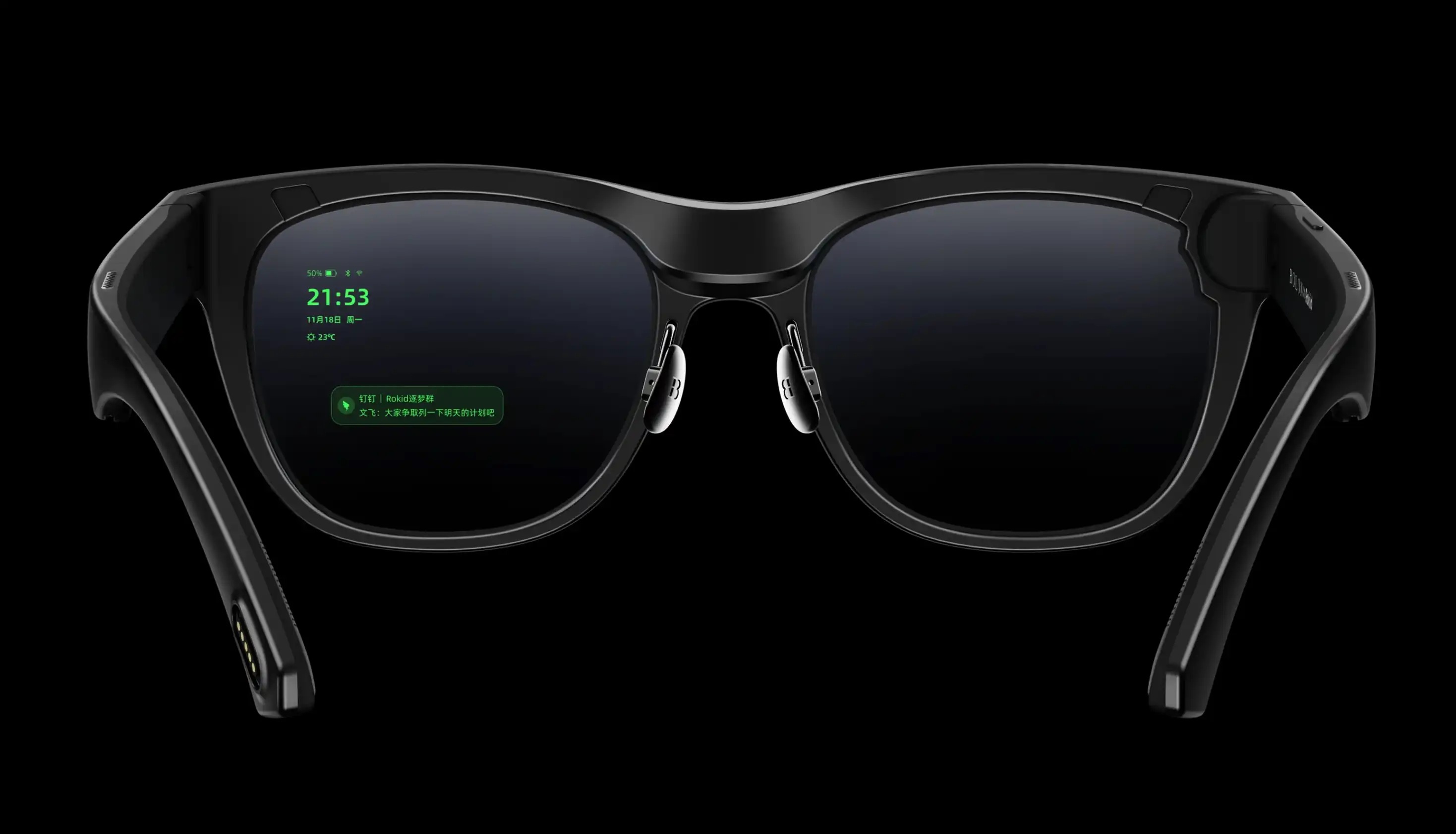
The Rokid Glasses are AI glasses with display capabilities that recently launched an imaginative feature, customizable agents. Through a standard SSE interface, users can connect the glasses to any backend system, such as OpenClaw. In other words, these glasses have become a programmable device capable of integrating various AI capabilities.
The Apple Watch, after connecting to OpenClaw, transformed into an AI control terminal that can be used anytime, allowing users to directly view their inbox, receive notifications, approve/deny actions, send quick replies, and even issue commands without continually relying on their mobile phones.
The wearable tech company WHOOP, after integrating OpenClaw, enables AI to automatically read crucial data such as sleep scores, recovery rate, and HRV, and based on these metrics, daily push personalized exercise suggestions and scheduling recommendations, upgrading from a recording tool to a health decision assistant.
If wearable technology is just the beginning, the field of robotics holds even more imagination.
After connecting to OpenClaw, the seven-axis robotic arm NERO from Songling Robotics allows users to issue commands using natural language without needing to write complex control programs, such as instructing the robotic arm to move an object to a specified location; OpenClaw automatically parses the semantics, plans the movement path, generates control scripts, and executes them.
Some companies are making more radical attempts, such as the AI company DeepMirror, which integrates OpenClaw into its core physics AI products and connects it to robotics software middleware from Yushu Technology, enabling robots to understand spatial and temporal contexts. The system can recognize people, remember object positions, and record the sequence of events, thus forming a kind of world memory. This means AI not only understands language but continuously comprehends changes in the current world.
In addition to hardware manufacturers, some individual developers and enthusiasts are also using OpenClaw to modify various hardware devices.
For instance, a recently popular open-source project, VisionClaw, combines the Ray-Ban Meta smart glasses launched jointly by Meta and Ray-Ban with OpenClaw. Users only need to tap the glasses or say a command, and the system can understand, explore, and even execute tasks based on what the camera sees, becoming a visual AI Agent.
After connecting to OpenClaw, the Vbot super-powered robotic dog is no longer limited to preset programs. Previous robotic dogs acted more like automated devices executing fixed actions, but after connecting to the Agent, it can autonomously plan actions based on tasks, such as patrolling indoors, searching for targets, or providing feedback on environmental conditions.

Furthermore, on platforms like GitHub, X, and Xiaohongshu, OpenClaw is constantly "transforming," with some putting OpenClaw into second-hand phones, some integrating it into smartwatches, and others fully controlling smart homes. These attempts are breaking the existing boundaries of smart hardware and opening up more possibilities and imaginative spaces.
The continuous exploration of these OpenClaw-based smart hardware will promote the public adoption of Agents, but the security risks posed by system permissions and the ongoing costs of model usage are real challenges that need to be addressed in the future.
Lobsters "on land," domestic Tokens accelerating "going abroad"
Currently, the OpenClaw trend is rapidly sweeping across China, not only triggering major companies to stake their claims but also pushing for policy reinforcement, with player enthusiasm also soaring.
In Shenzhen, this fervor has transformed into a cityscape phenomenon. A booth for "free lobster installation" was set up at the entrance of Tencent Building, drawing queues of over a thousand people, including elementary school students and elderly individuals; related photos have gone viral on social media; various lobster-themed gatherings are also frequently held, with many events filled to capacity and even requiring additional seating; and the local government is planning new policies to support "raising lobsters."
Even the world-famous "hardware silicon valley" Huaqiangbei has jumped into the OpenClaw business, with various modified lobster boxes becoming new popular products.
The OpenClaw storm that is currently brewing in China unexpectedly brings a new growth curve for domestic large model manufacturers, accelerating the international emergence of Chinese Tokens.
According to the latest data from OpenRouter, the world's largest API aggregation platform, the global consumption of Tokens from the top ten models this week is approaching 85 trillion, with Chinese models already accounting for half of the global actual utilization. On the list, several Chinese models occupy core positions, especially MiniMax M2.5, which ranks first, with a usage volume approaching 20 trillion and a growth rate of 21%.

As the usage volume explodes, MiniMax has also become one of the hot lobster-themed stocks, with its share price skyrocketing over 200% this year. Dramatically, just two months after listing, MiniMax's market value surpassed that of Baidu, whose founder and CEO Yan Junjie once interned at Baidu and received the second Baidu scholarship. Recently, its stock price surged due to its appearance on the PinchBench rankings and being shared on social media by the father of OpenClaw, Peter Steinberger. According to MiniMax's first financial report, while still in a loss state, its revenue structure has significantly improved, with contributions from international markets exceeding seventy percent.

It is also worth noting that OpenClaw is the largest single application on OpenRouter. This month, its usage volume surged to first place globally, more than double that of the second-ranked Kilo Code, and it is a key driver for domestic large models going abroad.
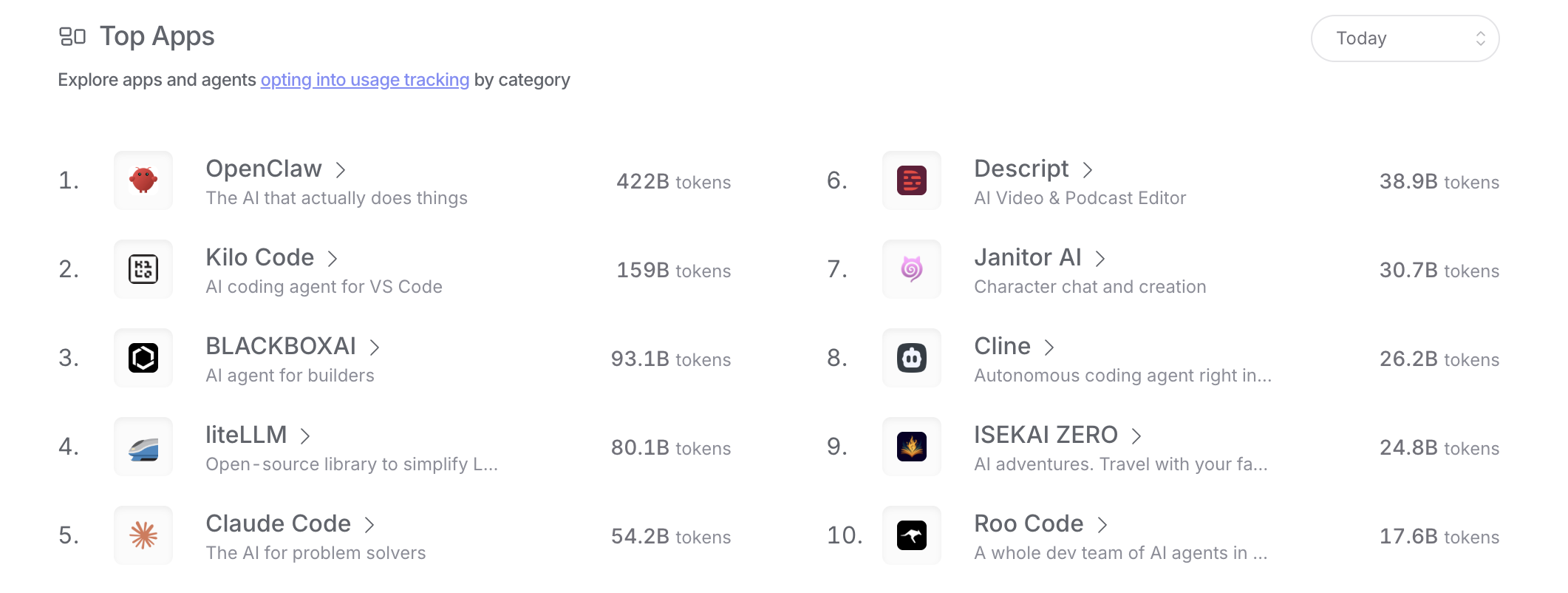
Among the top five models on OpenClaw, three are from domestic large models. Notably, Kimi2.5 is exceptionally leading, as OpenClaw announced last month it would designate it as the first official free main model, further boosting its usage scale. In the past two months, Kimi's paid user orders have significantly increased, directly driving the revenue curve to rise vertically, with revenue in just the past 20 days exceeding the entire revenue projected for 2025, and overseas revenue surpassing domestic for the first time.
It is particularly noteworthy that OpenRouter's data does not encompass all authentic global usage. Due to its integration convenience and low-cost model access capabilities, it is highly favored among developers, and OpenRouter has garnered attention from Peter Steinberger multiple times. Nevertheless, OpenRouter's user base has exceeded 5 million, mainly concentrated overseas, making these data more valuable as a reference and, to some extent, reflecting the "push" of Chinese large models in overseas markets.
In this new race for Agents, the boundaries between various roles are being redefined. Hardware manufacturers, developers, and large model companies are all being drawn into the same ecosystem.
免责声明:本文章仅代表作者个人观点,不代表本平台的立场和观点。本文章仅供信息分享,不构成对任何人的任何投资建议。用户与作者之间的任何争议,与本平台无关。如网页中刊载的文章或图片涉及侵权,请提供相关的权利证明和身份证明发送邮件到support@aicoin.com,本平台相关工作人员将会进行核查。


