In the past few days, while browsing materials, I was struck hard by a set of numbers.
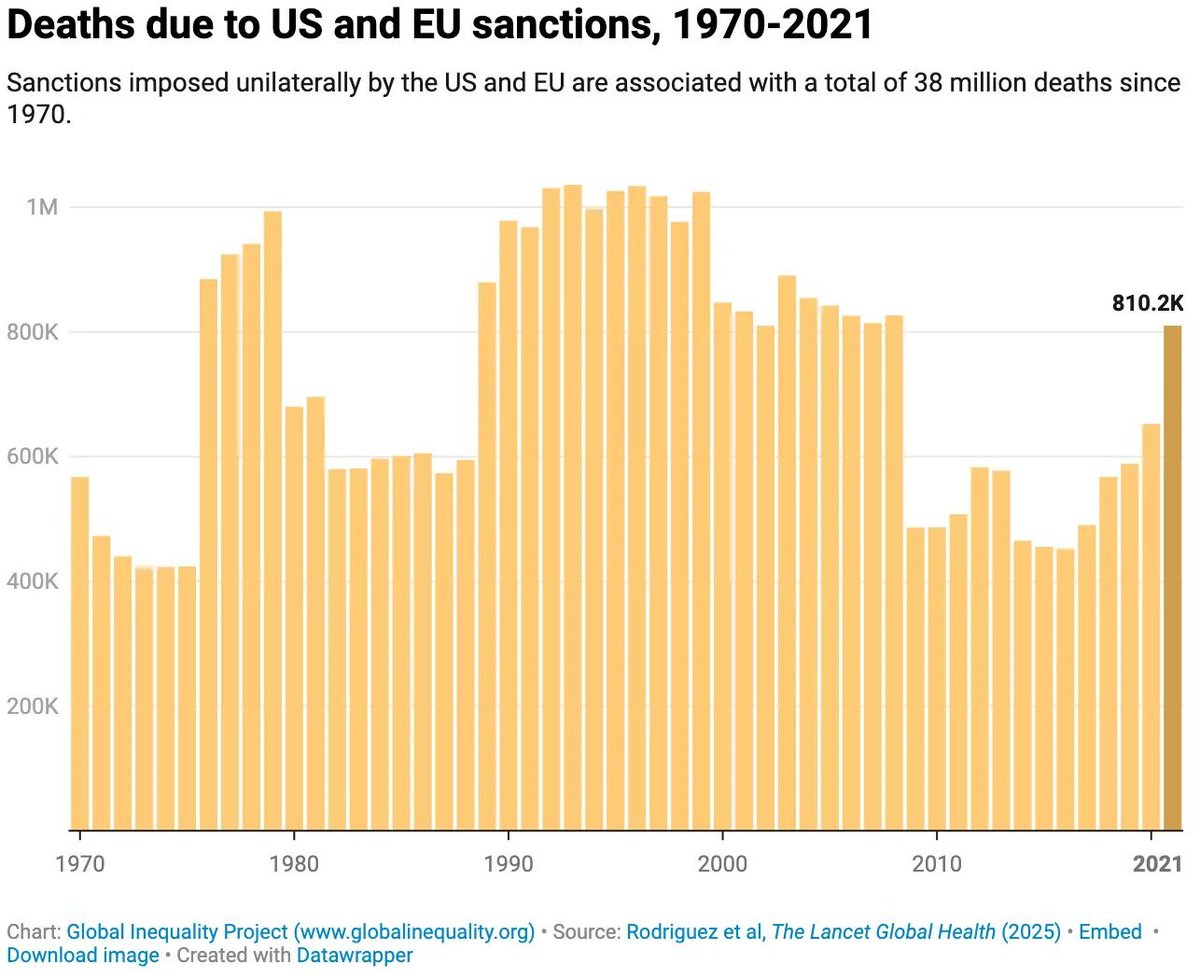
A study from the medical journal The Lancet gives a startling conclusion:
Since 1970, U.S.-led economic sanctions may be associated with the deaths of around 38 million people, averaging between 400,000 and 1 million people per year.
To be honest, I was stunned when I first saw this number. When we usually talk about "sanctions," we typically think of trade wars, chip bans, and entity lists, imagining officials in suits negotiating at the table, as if it's a cold economic game.
But this research actually reminds us of something: sanctions are often not just an economic issue, but a matter of life and death.
Let me explain some of the logic behind it 👇
1️⃣ Sanctions seem "civilized," but their lethal impact is very real
Many people might wonder:
Isn't it just about not selling things to you or not letting you use U.S. dollars?
How can that lead to death? The key lies in a cruel chain reaction.
The survival of modern society actually relies heavily on several basic systems: water, electricity
, healthcare, food supply.
When financial sanctions cut off a country's payment systems, trade settlements, and import capabilities, these fundamental systems gradually malfunction.
The study repeatedly mentions one case: Iraq, which was sanctioned in the 1990s.
At that time, oil exports were cut off, foreign exchange earnings disappeared, and a large number of equipment were banned from import.
The result was quite simple:
· Water treatment plants broke down, unable to purchase repair equipment
· Power plants halted, hospitals frequently experienced power outages
· Difficulty in importing medicines and vaccines
This led to a chain of problems: "cholera," "typhoid," "child infections"
"Newborn mortality rates soared"
For healthy adults, this may only result in a decline in quality of life.
But for children under 5, the elderly, and chronic illness patients, this is a matter of life and death.
Many deaths are not caused by bombings, but by a lack of antibiotics, interrupted vaccine supplies, and hospital power outages. This type of death is very quiet, yet the numbers are enormous.
2️⃣ The most uncomfortable question: Is this a side effect or a means?
The paragraph I found most chilling was one where the study quoted some historical documents.
During the Cold War, a memo regarding U.S. policy towards Cuba stated plainly:
"Since the government still has public support, economic pressure should be used to create poverty and despair, thereby triggering internal dissatisfaction."
In other words: By making ordinary people's lives unlivable, they are pushed to overthrow the government.
If viewed through this lens, many civilian casualties are no longer just "collateral damage," but part of a pressure mechanism.
This is also why many developing countries are particularly sensitive to sanctions.
Because they know that the target of sanctions appears to be the government, but the first to bear the brunt are always ordinary people.
3️⃣ Sanctions have transformed from a "surgical knife" to a "routine tool"
The study also mentions a turning point: the "International Emergency Economic Powers Act."
This law allows the U.S. president to directly freeze assets, restrict trade, and cut off financial channels during a "national emergency."
In the past, sanctions were more of an auxiliary tool during wartime.
Now, they have become a routine diplomatic weapon.
The executing agency is the Office of Foreign Assets Control (OFAC) under the U.S. Treasury Department.
In the financial system, as long as someone is on the list, it means: "Banks cannot open accounts for you," which effectively cuts off U.S. dollar settlements, making international trade extremely difficult.
In a sense, it means being "deleted" from the global financial system.
The research stats indicate that nearly one-third of countries worldwide have experienced or are experiencing different forms of sanctions. The scale has far exceeded that of the Cold War.
4️⃣ Another rarely discussed phenomenon: the sanctions industry
This is actually quite ironic. As sanctions increase, a new industry has formed around them.
In Washington, many people leave government agencies and enter private consulting firms, becoming "sanctions compliance advisors," "legal advisors," "risk consultants."
They assist businesses in studying:
· How to avoid sanctions
· How to legally circumvent risks
· How to deal with frozen assets
This is a very lucrative business. In other words, sanctions are not only a policy tool but have also slowly turned into a complete commercial ecosystem.
5️⃣ Why more and more countries are discussing "de-dollarization"
After reading these materials, I understood something better. Why in recent years, many countries are discussing "local currency settlement," "de-dollarization," "independent payment systems," and "local technology supply chains."
The reason is simple. If a country's "payment systems," "financial settlement," "medical supplies," and "technical equipment" are heavily dependent on external systems, then once sanctioned, the entire society will be impacted. What appears to be efficiency brought about by globalization.
But in extreme cases, these channels can also become places that choke the throat.
Finally, my personal feeling is that I used to think of sanctions as a relatively "gentle" tool in international politics. For example, the civilization of war, rational bombings.
But after reviewing this research, I began to realize: Many times, it merely moves violence from the battlefield to the supply chain and financial systems. Although there are no gunfires or explosions.
The impact still lands on the lives of ordinary people. This may also be why more and more countries are quietly preparing plan B.🧐
免责声明:本文章仅代表作者个人观点,不代表本平台的立场和观点。本文章仅供信息分享,不构成对任何人的任何投资建议。用户与作者之间的任何争议,与本平台无关。如网页中刊载的文章或图片涉及侵权,请提供相关的权利证明和身份证明发送邮件到support@aicoin.com,本平台相关工作人员将会进行核查。


