Recently, the United States and Iran have been fighting, and the market is changing rapidly. One moment a military base was bombed, the next the Strait of Hormuz was blocked. Every day, people are glued to news to watch the market, making it really easy to become mentally exhausted. Last week, I was woken up multiple times by my phone, #BTC has had many false breakouts. Rubbing my sore eyes, I stared at the numbers flickering on the screen, suddenly feeling a bit dazed: is this really the trading life I wanted?
The turning point came a bit unexpectedly. Due to the popularity of Openclaw🦞, major exchanges have recently launched AI Skills products. I actually compared and experienced the products from different companies, and #Bitget's Agent Hub is the one I used most comfortably, with comparatively generous permissions.
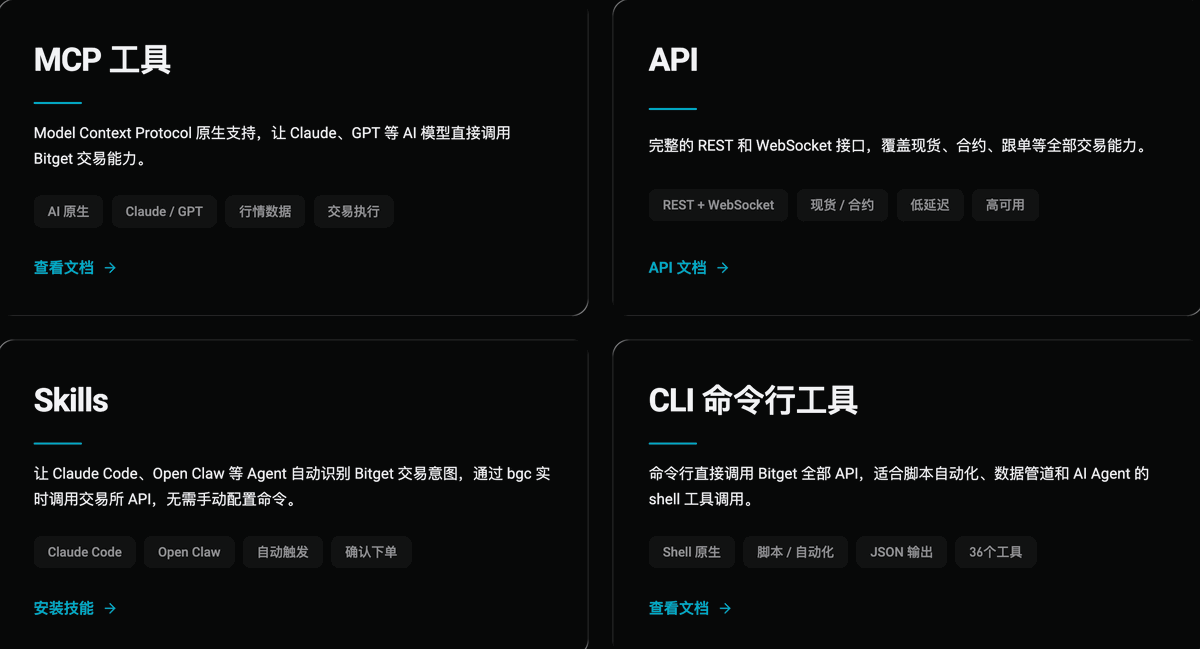
In the past, if we wanted AI to help us execute trades, we had to provide a bunch of API documents for it to understand how to call the interfaces. Now it's much simpler; it only takes three minutes to configure Bitget’s Skills in Claude or Openclaw, and the AI can directly call some tools from the exchange without us needing to write any strategy code. As long as we clearly express the trading logic, the AI can help me turn it into executable commands. I browsed through the list of tools, with about fifty modules available, including spot trading, contracts, following trades, and fund management.
To be honest, I was sweating in my palms during my first real trading experience. Before sleeping, I gave an instruction on my phone: “If #BTC falls more than 2% within the hour, use 5% USDT from the contract account to open a 5x long position with a 3% stop loss.”
After executing the operation, I even laughed at myself; what’s the difference from wishing into thin air? The next day, I opened my eyes and checked the operation records; the conditions were triggered, and the response was basically instantaneous. Theoretically, it should be faster than my manual operation, truly achieving a rhythm of making money just by talking.
Later, I slowly explored my own rhythm, transforming AI trading from "automation" to "intelligent" operation:
First, I used OpenClaw🦞 to let it monitor social media, on-chain data, and some anomalous signals. For example, things like Twitter, Discord, and large on-chain transfers. No need for me to pay attention the entire time, letting the AI help me "watch the market."
Next, on the decision-making level, I would feed this information into the AI model connected to the trading interface to make judgments. Finally, if the conditions are triggered, I would let the trading Agent execute some strategies, such as hedging, opening positions, or following trades.
Now my desktop is much cleaner. In the past, one person had to monitor many screens; now it has gradually changed to where a person only needs to give instructions. No need to have ten windows open simultaneously; I can finally enjoy a hot cup of coffee peacefully. #Bitget's Agent Hub has truly liberated me from mechanical labor, leaving things like tracking the market, setting orders, and fund transfers to it. My main focus is on pondering, "Why does the market react this way?" "How can I optimize the strategy next time?"
If you also often find yourself staring at the screen until your eyes turn red, you might want to give #Bitget's Agent Hub a try; the configuration link is in the comments. This article serves only as an AI learning note 📒, DYOR.🧐
免责声明:本文章仅代表作者个人观点,不代表本平台的立场和观点。本文章仅供信息分享,不构成对任何人的任何投资建议。用户与作者之间的任何争议,与本平台无关。如网页中刊载的文章或图片涉及侵权,请提供相关的权利证明和身份证明发送邮件到support@aicoin.com,本平台相关工作人员将会进行核查。


