Written by: Viee, Biteye Content Team
In November 2025, an independent developer from Austria, Peter Steinberger, quietly submitted a project on GitHub - Clawdbot (renamed OpenClaw).
At that time, no one cared, but everything spiraled out of control by the end of January 2026.
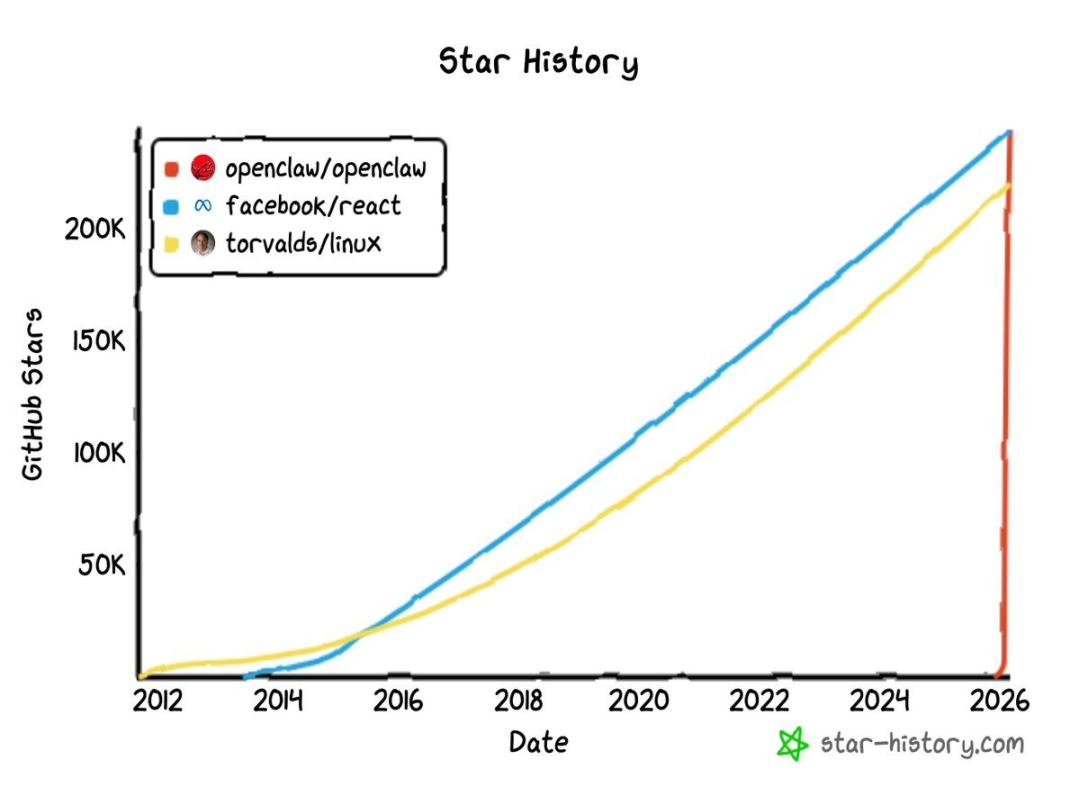
Between January 29 and 30, the project gained tens of thousands of GitHub Stars in a very short time, quickly surpassing 100,000. As of March 3, this number had swelled to nearly 250,000, topping the star leaderboard, surpassing Linux. For reference, star open source projects like React (one of the most popular front-end development frameworks in the world) and Linux (the operating system kernel that supports internet servers) typically take more than a decade to accumulate around 200,000 Stars, while OpenClaw's curve is almost a vertical line.
The initial name OpenClaw, Clawdbot, is a homophone for Claude; Anthropic sent a lawyer's letter on January 27 demanding a name change. The project was renamed Moltbot and eventually dubbed OpenClaw. However, the name change did nothing to slow its spread; instead, it created more discussion. On February 16, Sam Altman announced that Steinberger would be joining OpenAI and that OpenClaw would be transferred to an independent open-source foundation supported by OpenAI.
From an independent developer's project to a strategic piece for a tech giant, this little crayfish achieved this transformation in less than three months.
Everyone has witnessed how hot OpenClaw is in the tech circle; so where has this fire spread now? This article attempts to sort through the beneficial industrial chain behind OpenClaw's explosive rise from the perspective of the capital market, as well as the potentially revalued US companies.
1. What is OpenClaw? Why does it impact the US stock market?
Let’s talk essence first. OpenClaw is not just another chatbot; it is an open-source AI Agent framework.
What's the difference? A chatbot receives your question and returns a text response. In contrast, OpenClaw receives your commands and then gets to work. It can operate a browser, execute code, call APIs, manage file systems, and connect to more than 12 messaging platforms.
The differences in their operational modes can be summarized in a table:
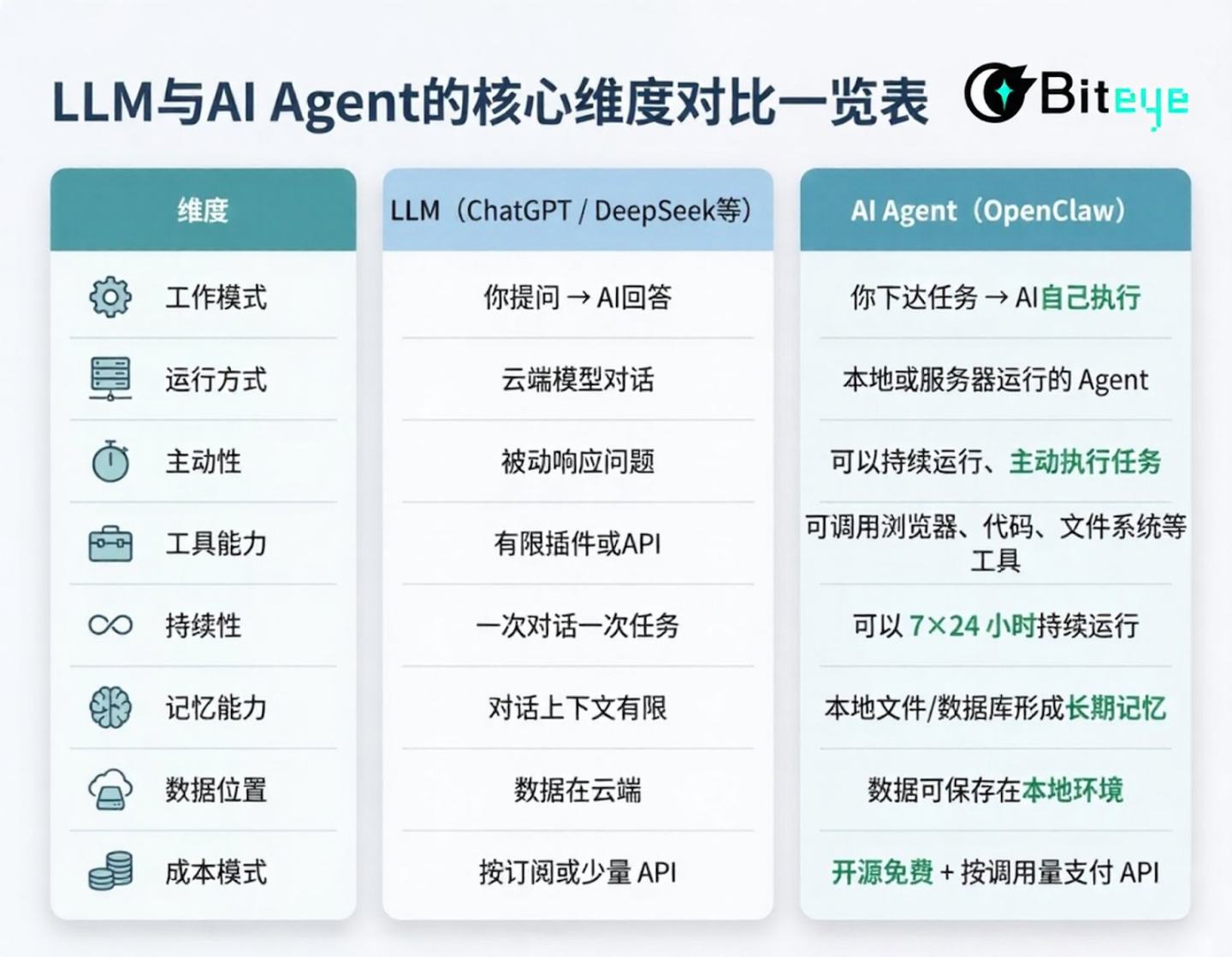
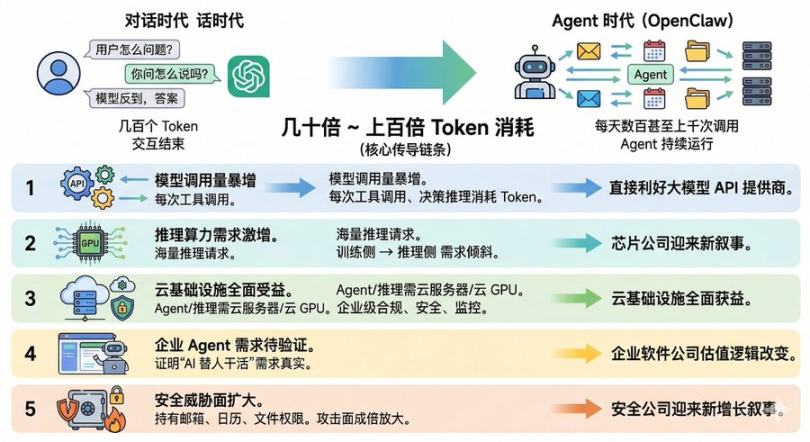
In short, to put it more plainly, it has evolved from a chatbot into a true digital employee, which also means that the business paradigm of AI is undergoing a qualitative change. In the conversational era, users pose a question to a large model, which returns an answer, consuming several hundred tokens, ending the interaction. But in the Agent era, an OpenClaw may initiate hundreds or even thousands of calls to the model every day. The token consumption generated by a single Agent user can even be tens or hundreds of times that of traditional chat users.
This consumption multiplier is the core conduit through which OpenClaw impacts the US stock market:
- Layer 1: Explosive increase in model calls. Every tool invocation and reasoning decision of the Agent consumes tokens, which directly benefits large model API providers.
- Layer 2: Surge in reasoning compute demand. A massive number of Agent calls means a massive number of reasoning requests, shifting GPU demand logic from the "training side" to the "inference side," thus offering chip companies a new narrative.
- Layer 3: Cloud infrastructure benefits comprehensively. Agents require cloud servers to operate, and model inference needs cloud GPUs to compute; enterprise-level Agents need compliant, secure, and monitored cloud infrastructure.
- Layer 4: Demand for enterprise Agents remains to be validated. OpenClaw has proven the genuine existence of the demand for "AI working for humans" in an open-source manner, and companies commercializing Agent capabilities may see their valuation logic change.
- Layer 5: Expanded security threat surface. When an Agent holds email, calendar, and file system permissions long-term, the attack surface is exponentially magnified, creating new growth narratives for security companies.
Next, we will trace this chain to systematically outline the benefiting US stocks.
2. Token Killer: The Super Flywheel of Large Model Service Providers
If Agents become the mainstream paradigm of AI interaction, the API revenue of large model vendors will experience exponential growth.
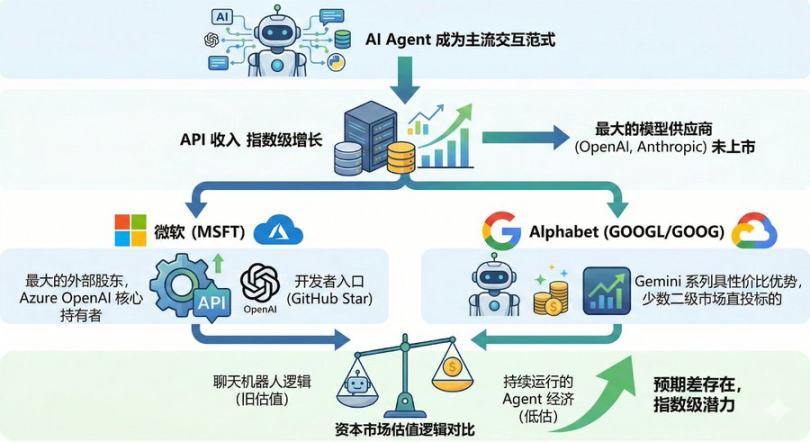
However, the two largest Agent model suppliers, OpenAI and Anthropic, have yet to go public. Thus, the most direct listed counterparts in the capital market correspond to MSFT and GOOGL.
Firstly, Microsoft, as the largest external shareholder of OpenAI, benefits from every API request made through Azure OpenAI Service calling GPT-4o or o1. The founder of OpenClaw joining OpenAI and transferring the project to a foundation supported by OpenAI means that the OpenClaw ecosystem will likely bind more closely with OpenAI models in the future. If OpenClaw’s default model recommendation list ranks OpenAI at the top, Microsoft effectively acquires an entrance into a developer community boasting 240,000 GitHub stars.
On the other hand, Alphabet is another beneficiary from a different angle, which is the listed company (stock codes GOOGL / GOOG) belonging to Google itself. Google’s Gemini series is one of the mainstream models supported by OpenClaw, and Gemini 2.0 Flash offers highly competitive inference cost-performance ratios. More importantly, among several leading model suppliers, Alphabet is one of the few AI model providers that can be directly invested in through the secondary market.
What’s more, it appears that the market has not fully priced the API consumption logic driven by Agents. Since the emergence of OpenClaw, GOOGL has not shown a significant rise, and MSFT has undergone a valuation pullback. In other words, the expectation gap still exists, meaning that the capital market continues to value model companies with the "chatbot" logic rather than the ongoing Agent economy.
3. Inference is Never Enough: New Narratives from Chip Companies
If token consumption is the gasoline of the Agent era, then GPU is the engine driving this machine, with the most direct beneficiaries still being GPU manufacturers NVIDIA and AMD.
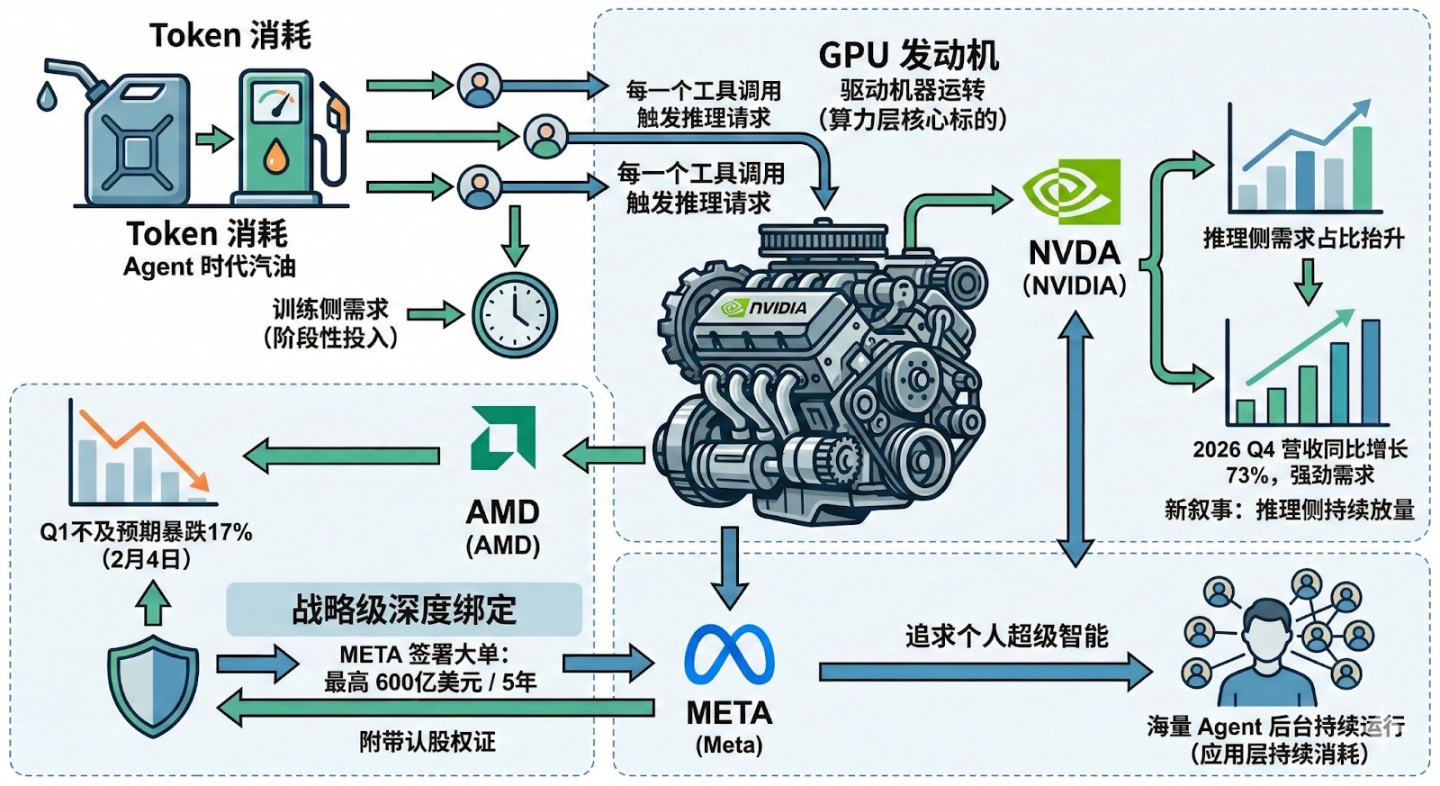
Over the past three years, the valuation logic for chip companies has mainly been based on the training side, as major manufacturers have competed to acquire GPUs to train larger foundational models. However, training feels more like a stage investment, while inference is a continuous consumption. For example, each tool invocation by an Agent constantly triggers new reasoning requests. As Agents transition from the laboratory to millions of users, the demand share for inference is likely to significantly increase.
This also explains NVIDIA's new narrative. If large training orders see marginal slowdowns, what else can sustain GPU demand? The answer provided by Agents is sustained growth in inference. NVIDIA's latest financial report shows a year-over-year revenue growth of 73% for Q4 2026, with the demand side remaining strong. The rise of the Agent paradigm offers a more sustainable foundational explanation for this strength.
Now let’s look at AMD. On February 4, AMD fell 17% due to disappointing Q1 financial results, creating panic in the market. Yet just 20 days later, Meta announced a strategic AI chip supply agreement with AMD worth up to $60 billion (over five years), accompanied by a warrant arrangement involving up to 160 million shares, or about 10% of the company.
Why does Meta need such extensive reasoning power? Because it is pursuing what it calls personal superintelligence, and realizing this vision relies on a multitude of Agents running continuously in the background. OpenClaw not only verifies a product direction but also highlights the demand logic for significant computing power for Agents.
Thus, the growth in inference demand driven by Agents will first be transmitted to the compute layer, with core targets being NVDA and AMD, while in the application layer, companies that continually consume computing resources, like META, may also become significant demand drivers.
4. The True Carrier of Agent Scaling: Cloud Computing
Earlier, it was mentioned that GPUs are the engines of the Agent era; thus, cloud computing platforms are the infrastructures where these Agents run long-term. From a capital market perspective, the core targets corresponding to this chain are the three major cloud platforms: AMZN, MSFT, and GOOGL. Moreover, at the upstream data center infrastructure level, EQIX and DLR could also become indirect beneficiaries.
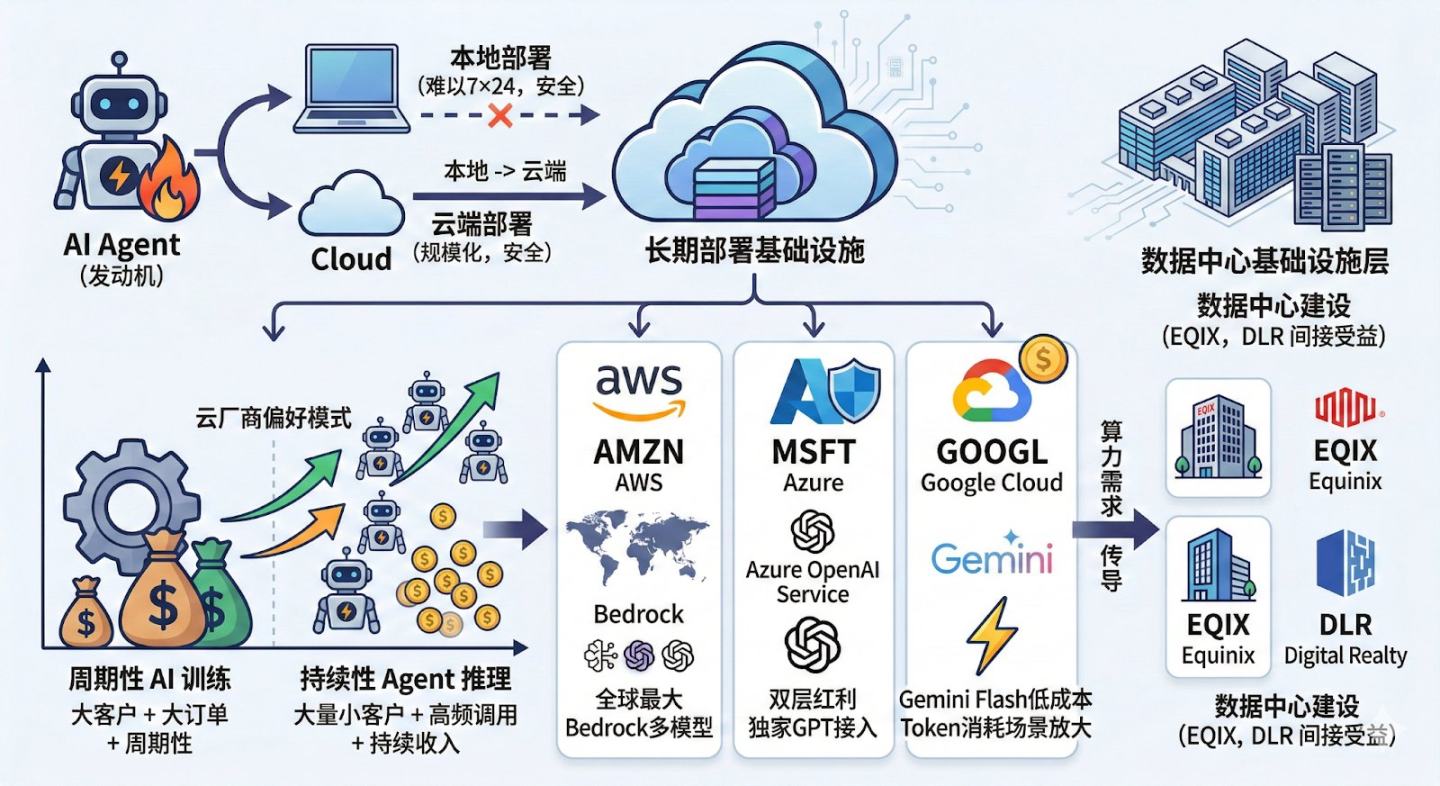
Although OpenClaw advocates local deployment, the reality is that due to security permission issues, most users will not run an AI Agent on their laptops 7×24 hours. Whether for individuals or enterprises, the endpoint of large-scale deployment is likely to be cloud deployment. Alibaba Cloud and Tencent Cloud have already launched one-click deployment services in the Chinese market, further validating the authenticity of the demand.
Furthermore, there’s a detail that’s easy to overlook: the value of Agents to the cloud is not only about computing power but also about long-tail inference traffic. This is because AI training orders are "large clients + large orders + periodic," while Agent inference is characterized by "numerous small clients + high-frequency calls + continuous revenue," which is a business model that cloud vendors prefer.
In the global market, the three major cloud vendors each hold unique advantages. AWS, as the world's largest cloud platform, has its Bedrock platform supporting multiple model API integrations; it has also become a common deployment environment for developers. Azure benefits from two layers of dividends: both model APIs and cloud infrastructure. The exclusive GPT access capability of Azure OpenAI Service is further amplified in the Agent scenario. Google Cloud's differentiation lies in its cost structure, as the inference prices of models like Gemini Flash are notably lower than many flagship models. In scenarios where Agents need to continuously run and consume tokens, such price differences will be quickly magnified.
Another point to note is, if Agents scale up, the computing power demands of cloud vendors will ultimately transmit to data center construction, meaning Equinix and Digital Realty could also become indirect beneficiaries.
5. The Logic of Enterprise Agents Remains to be Validated, Benefiting AI Native Companies
The popularity of OpenClaw verifies a trend: people are willing to let AI work for them rather than just chat. However, for traditional enterprise software domains, this is seen as the prologue to "SaaSpocalypse" (the doomsday of SaaS).
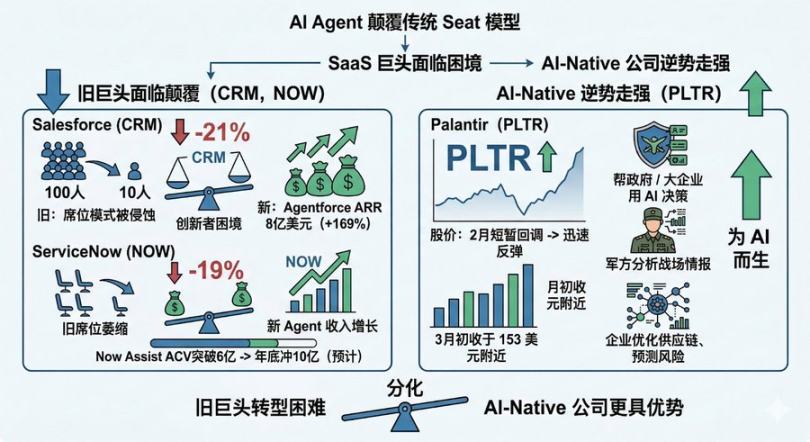
As 2026 begins, SaaS giants face collective pressure: Salesforce has dropped 21% since the beginning of the year, and ServiceNow has fallen 19%. The root of the panic lies in a structural game between Agents and software. In the past, we needed a software interface to command a system to perform tasks; now, Agents can call systems directly to accomplish work, diminishing the presence of software itself. This change brings two fundamental issues.
First, the impact of AI extends beyond just the "per-head charge" model; it affects the whole software value chain. For example, Adobe's stock price has fallen from a high of $699.54 to $264.04, a drop of 62%; the educational software company Chegg has plummeted from $115.21 to $0.44, nearly reaching zero; tax software giant Intuit also plummeted 16% in just one week in January 2026. The market is concerned not just about a specific pricing model being disrupted but about generative AI tools (such as those from Anthropic) automating core enterprise workflows, reducing reliance on traditional software features, thereby permanently compressing the revenue potential of entire SaaS platforms.
Secondly, as Agents become stronger, traditional business models become weaker. For instance, ServiceNow is facing erosion of its pricing power through Microsoft's "Agent 365" bundling strategy, slowing down the speed of acquiring new customers. A simple deduction is enough to make investors shiver: if one AI Agent can accomplish the work of 100 employees, does an enterprise still need to purchase 100 software licenses? The breakout of OpenClaw essentially accelerates the realization of this logic.
Of course, several giants haven’t sat idle. Salesforce’s AgentForce has achieved $800 million in ARR, growing 169% year-over-year; ServiceNow's Now Assist annual contract value has surpassed $600 million, with expectations to hit $1 billion by year-end. However, it is never easy for elephants to dance; they find themselves in the classic innovator's dilemma: new Agent revenues are growing, but existing licensing revenues are shrinking, and it remains unclear which curve will win out. For CRM and NOW, the core contradiction lies in - can the incremental revenue from Agents make up for the shortfall in the licensing model? The market has already cast its vote with its feet.
Meanwhile, Palantir has told a completely different story. This company focuses on helping governments and large enterprises make critical decisions using AI: the military uses it to analyze battlefield intelligence, and businesses use it to optimize supply chains and predict risks, deploying AI in the most complex and sensitive business scenarios. After a brief pullback in February, PLTR rebounded sharply, stabilizing around $153 in early March.
While the SaaS sector faces "SaaS doomsday," Palantir emerges strong against the trend. This differentiation may indicate that the winners of the Agent era might not be the old giants that transform the fastest but rather companies that were born to thrive in AI from the start.
6. Hidden Benefits for Security Companies
This is currently the most undervalued clue in the market.
Imagine you've configured OpenClaw with email, calendar, Slack, Google Drive, and GitHub; it needs these keys to help you work, but what if this Agent gets compromised? The OpenClaw community has already discussed related security risks multiple times, such as credential leaks, permission abuse, and even data theft.
This is precisely why security companies are positioning themselves early; within the current security industry, CrowdStrike (CRWD) and Palo Alto Networks (PANW) are two of the leading capable firms.
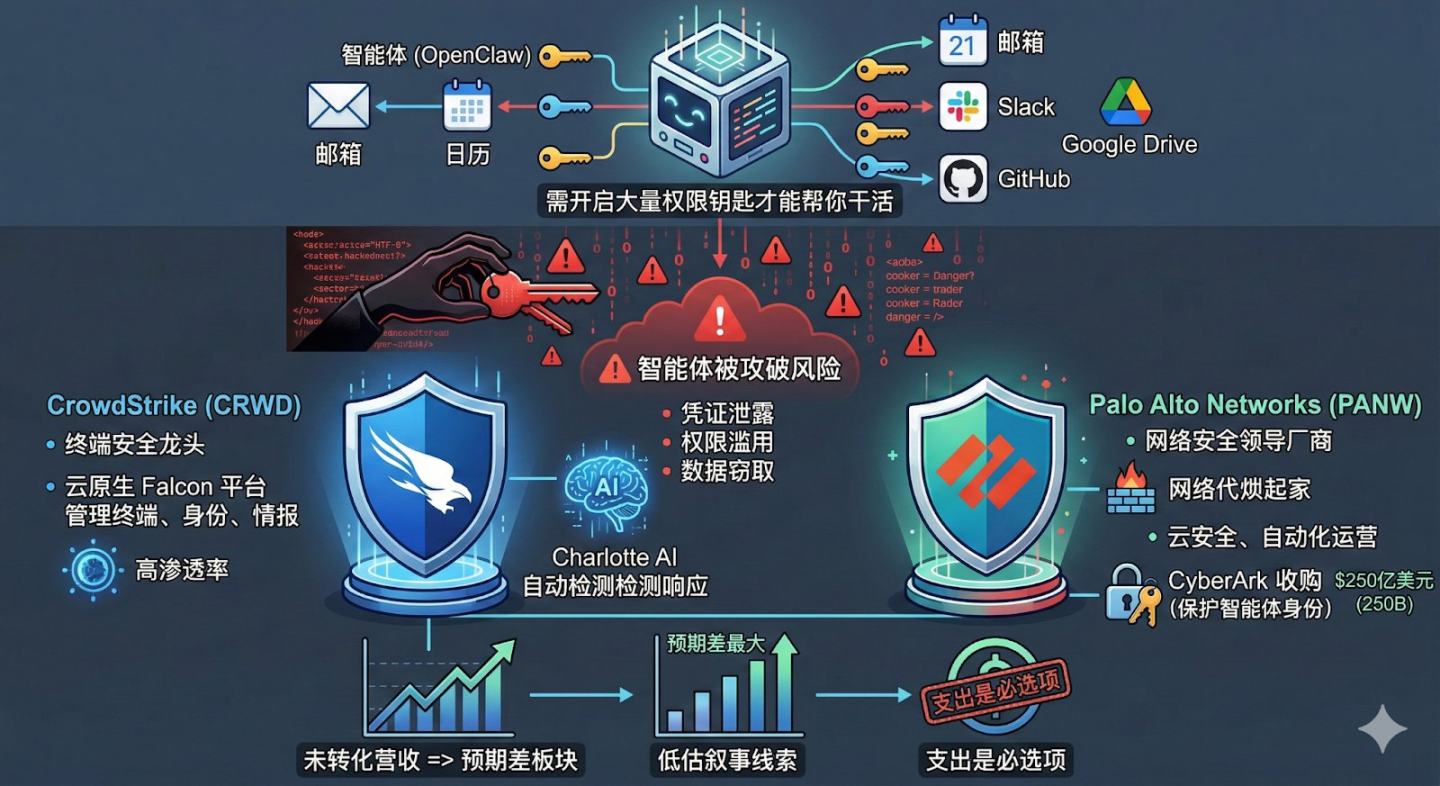
CrowdStrike is regarded as the leader in endpoint security, with its Falcon platform unifying the management of endpoints, identities, and threat intelligence through a cloud-native architecture, achieving a high penetration rate among large enterprises globally. In recent years, the company has continuously integrated AI into security operations, for example, Charlotte AI can automatically complete threat detection and response.
Palo Alto Networks is also a leading player in the global cybersecurity industry. Starting with next-generation firewalls, it has gradually expanded into cloud security, identity security, and automated security operations. In 2025, it acquired CyberArk for $25 billion, protecting intelligent agent identity security.
At the moment when OpenClaw has just exploded in popularity, security issues have yet to translate into revenue growth on a large scale; however, this precisely means that security companies could possess the greatest "expectation gap" in the entire Agent narrative. Moreover, security expenditure is a necessary option.
7. Conclusion: Short-Term Emotions, Mid-Term Inference, Long-Term Ecosystem
Returning to the initial question, what US stocks has OpenClaw really levered? We can explore reasoning along different timelines.
Currently (over the past month), judging from stock price performances, OpenClaw's direct impulse on individual stocks is quite limited. GOOGL and MSFT have not shown abnormal fluctuations driven by the Agent narrative since February. The only clear event-driven case came from AMD, with Meta's multi-billion dollar chip order boosting its single-day surge. Overall, the AI sector may be undergoing a valuation recalibration; the explosion of OpenClaw has not translated into immediate stock price catalysts.
In the short term (3 months), the market may continue to digest the squeezing of AI valuation bubbles, but the cognitive shock brought by OpenClaw could change buyers' cognitive anchors regarding the Agent sector. Such shifts in perception may not be immediately reflected in stock prices but could reshape analysts' expectation models.
In the mid-term (6-12 months), the key catalyst will be whether the demand for reasoning computational power from Agents can be validated in financial reports. If OpenClaw and subsequent Kimi Claw, MaxClaw, enterprise-level Agent solutions can bring observable increases in API call volumes and cloud resource consumption, the narratives concerning the reasoning sides of NVDA, AMD, and the three major cloud vendors may be confirmed.
In the long term (1-3 years), the real winners will be the companies that occupy strategic positions in the Agent ecosystem, such as CrowdStrike and Palo Alto Networks, which establish standards in the Agent security domain.
We also need to recognize that OpenClaw might not be the ultimate product; it has security vulnerabilities, high token costs, and uncertain business models. However, it has at least done one crucial thing: it has made the potential of AI Agents visible to the world. This is no mere product iteration; it’s a profound paradigm shift.
Once a paradigm shift occurs, it will not stop; we can only be fully prepared to wait for that day to arrive.
免责声明:本文章仅代表作者个人观点,不代表本平台的立场和观点。本文章仅供信息分享,不构成对任何人的任何投资建议。用户与作者之间的任何争议,与本平台无关。如网页中刊载的文章或图片涉及侵权,请提供相关的权利证明和身份证明发送邮件到support@aicoin.com,本平台相关工作人员将会进行核查。