Original | Odaily Planet Daily (@OdailyChina)
Author|jk
On March 8, local time, the Expert Assembly of Iran officially announced that 56-year-old Mojtaba Khamenei has been elected as the third Supreme Leader of the Islamic Republic of Iran. This appointment comes less than two weeks after his father, the former Supreme Leader Ali Khamenei, was killed in a joint airstrike by the U.S. and Israel on February 28, marking the first instance of familial succession of supreme power in Iranian history.
Taking Over in a Time of Crisis
On February 28, 2026, former Supreme Leader Khamenei was targeted in a joint airstrike by Israel and the United States at his residence in Tehran, resulting in the deaths of approximately 40 senior Iranian officials. Following the confirmation of Khamenei's assassination, Iran promptly established a temporary leadership committee based on Article 111 of the Constitution, led by President Pezeshkian, head of the judiciary Mohseni-Ejei, and constitutional council representative Ali Reza Alafi to jointly exercise temporary power.
On March 3, the office of the Expert Assembly in Qom reportedly came under bombardment, raising concerns about the election process being hindered. However, the Expert Assembly, composed of 88 clerics, eventually held a “decisive vote” on the 8th to elect Mojtaba Khamenei as the new Supreme Leader and issued a statement calling on all Iranians, “especially the elite intellectuals of seminaries and universities,” to pledge loyalty to the new leader and maintain national unity.
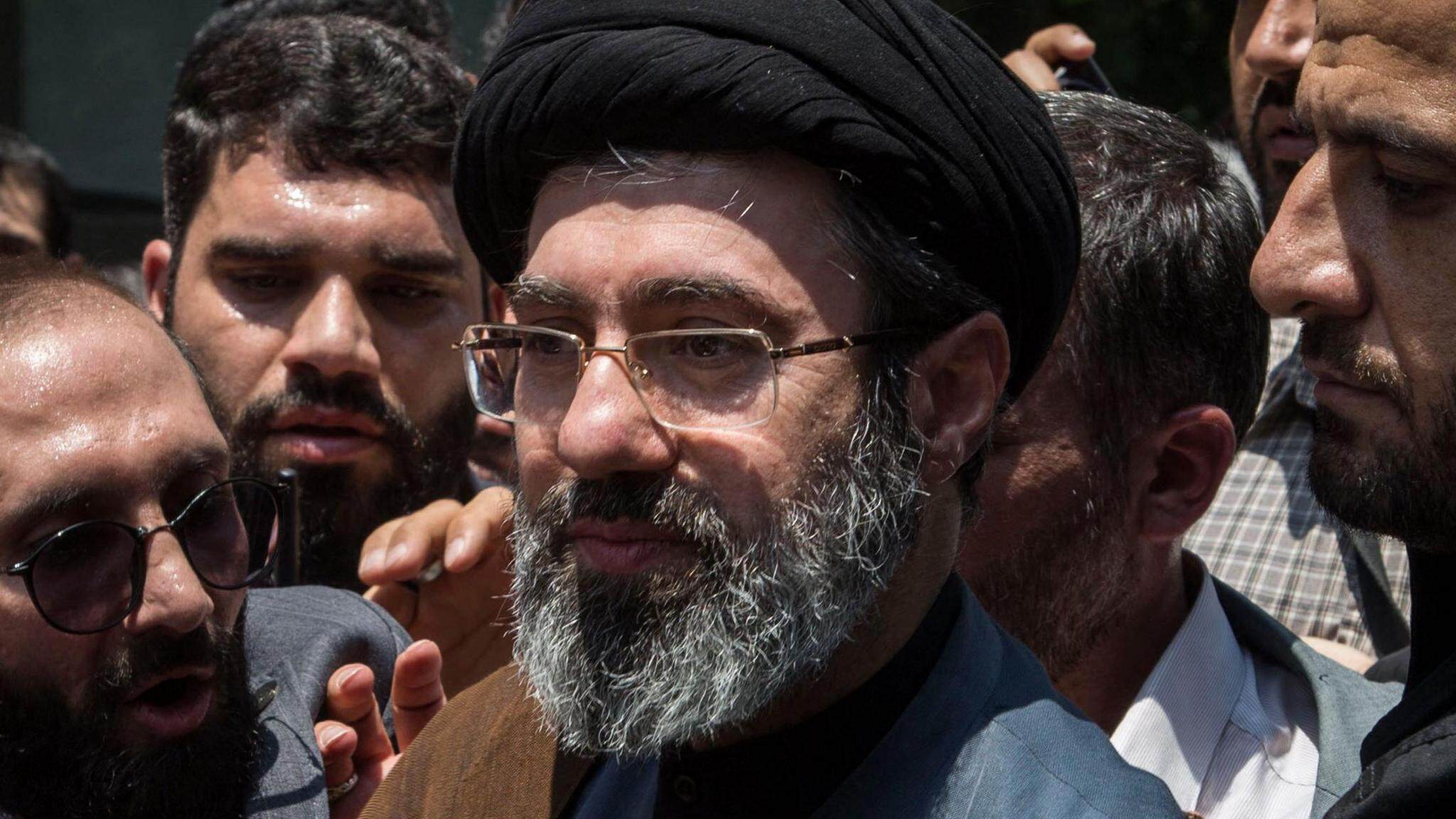
Mojtaba Khamenei, source: BBC
Who is Mojtaba Khamenei?
Mojtaba Khamenei was born in 1969 in the holy city of Mashhad, Iran, and is the second son of Ali Khamenei. His childhood coincided with a turbulent period as his father rose as a revolutionary figure opposing the Pahlavi dynasty, and the waves of the Islamic Revolution in 1979 profoundly shaped his political background. In terms of religious education, Mojtaba studied under the late Grand Ayatollah Mohammad Taqi Mesbah Yazdi, noted for advocating a hardline stance and who openly declared that “killing Iranian youths who promote Western moral corruption” is consistent with doctrine, being an extreme conservative theologian.
At 17, Mojtaba joined the Islamic Revolutionary Guard Corps, participating in the Habib battalion during the Iran-Iraq War. This battalion has been described by analysts as a “highly ideologically charged force,” commanded by one of the founders of Hezbollah. Many comrades from this battalion later became senior officials in Iran's security and intelligence system, laying an important network foundation for his subsequent power accumulation.
After his father assumed the role of Supreme Leader in 1989, Mojtaba became one of his most important aides. Over the years, he remained active in the core circle of the Supreme Leader’s office, and his influence significantly increased following the political turmoil of the 2009 Green Movement. U.S. diplomatic cables (released by WikiLeaks) referred to him as the “real power behind the robe.” In 2019, the U.S. Treasury sanctioned him for assisting in promoting his father's “ambitions that destabilize the region and domestic repression,” disclosing that the former Supreme Leader Khamenei had delegated some leadership responsibilities to him.
In stark contrast to his political status, Mojtaba has almost never appeared in public: he has never delivered a public speech, never presided over congregational prayers, and never made political statements, to the extent that many ordinary Iranians have never heard his voice. It has been reported that he has accumulated a vast network of economic interests spanning multiple countries, allegedly mobilizing billions of dollars through insiders and partners connected to the Iranian authorities.
Mojtaba is currently married and has at least one son and one daughter. His wife is the daughter of former Iranian parliamentary speaker Haddad-Adel.
Continuation of Hardline Policies, Polarized International Reactions
Mojtaba's election is widely interpreted as a signal that Iran's hardliners remain firmly in power under extreme pressure. Analysts point out that given his deep ties to the Revolutionary Guard and the security apparatus, the likelihood of Iran reaching a ceasefire agreement with the U.S. and Israel in the short term is very low. Rami Khouri, a public policy scholar at the American University of Beirut, stated that this appointment is a “contemptuous gesture,” signaling to the U.S. and Israel that attempts to dismantle the Iranian regime will not succeed.
Domestically, Iranian President Pezeshkian declared that this appointment heralds a “new era of national dignity and strength”; the Revolutionary Guard immediately issued a statement pledging allegiance to the new leader and expressing their readiness to fully obey his directives; Speaker of Parliament Qalibaf also stated that following the new leader is a “religious and national duty.”
On the international level, reactions are noticeably divided. Russian President Putin expressed strong support for Mojtaba's appointment, while China explicitly opposed any actions targeting the new Supreme Leader. U.S. President Trump publicly declared Mojtaba's appointment “unacceptable,” and during an interview with ABC, warned that if the new leader does not gain U.S. recognition, “he will not last long.” The Israel Defense Forces also issued a warning, stating that any successor to Khamenei would be considered a target.
Prediction Markets: Can Mojtaba Hold Onto the Leadership Position?
With Mojtaba Khamenei's formal inauguration, multiple trading markets related to the situation in Iran quickly emerged on the decentralized prediction market platform Polymarket, where traders are betting on the political fate of the new leader.
“Will the Iranian leadership change before the specified date?” This market opened on the evening of March 8, with total trading volume exceeding $530,000. Market data shows significant differences in traders' assessment of the probability of Mojtaba being “removed from the center of power” in the short term: on March 13, the “Yes” probability was only 11%; by March 31, it increased to 33%; and by April 30, the probability had reached 45%; if the timeline is extended to the end of the year (December 31), the “Yes” probability skyrockets to 69%. This means that more than two-thirds of market participants believe that Mojtaba will not remain in power as the actual ruler by the end of 2026.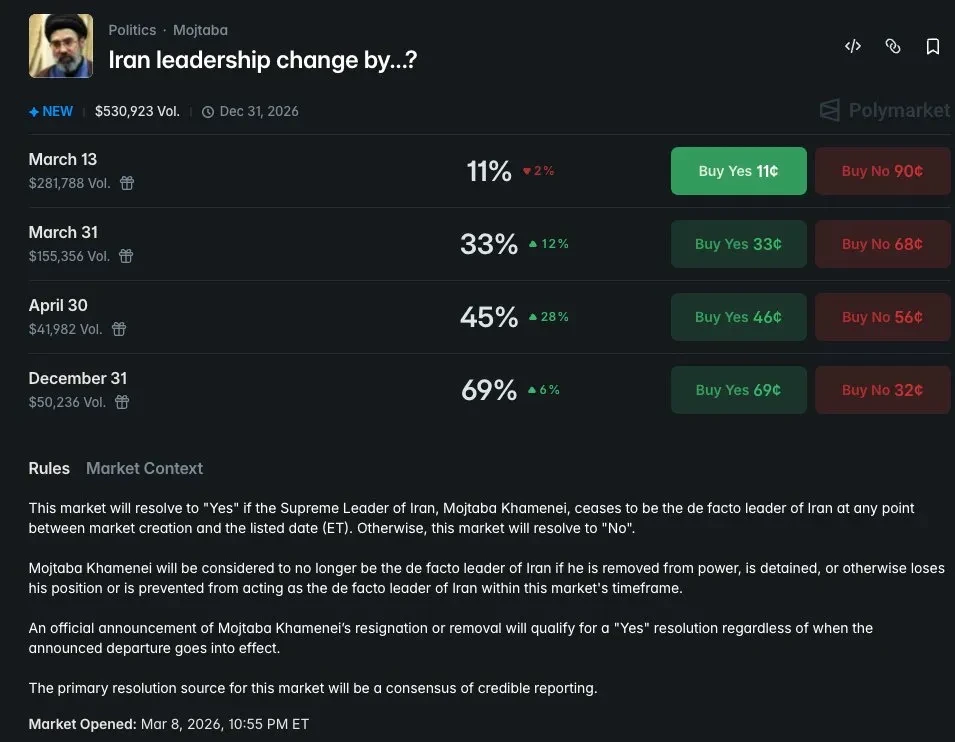
Will the Iranian leadership change before the specified date? Source: Polymarket
“Who will lead Iran at the end of 2026?” Another market has total trading volume surpassing $1.42 million, and among all candidates, Mojtaba Khamenei currently ranks first with a 32% probability, but this figure itself indicates that market confidence in his continuation in power is quite limited. Exiled Iranian Crown Prince Reza Pahlavi ranks second with 17%, while current President Pezeshkian is third with 10%, and the possibility of having “no head of state” (collapse of the regime or power vacuum) is also 5%.
“Can Reza Pahlavi lead Iran in 2026?” This market has a total trading volume close to $490,000, currently priced at 18%, a significant drop of more than 26 percentage points from previous highs.
免责声明:本文章仅代表作者个人观点,不代表本平台的立场和观点。本文章仅供信息分享,不构成对任何人的任何投资建议。用户与作者之间的任何争议,与本平台无关。如网页中刊载的文章或图片涉及侵权,请提供相关的权利证明和身份证明发送邮件到support@aicoin.com,本平台相关工作人员将会进行核查。