Original | Odaily Planet Daily (@OdailyChina)
Author|Azuma (@azuma_eth)

Under conventional understanding, time is linear, but there are "exceptions" in the crypto world.
Yesterday, at Eastern Time (ET), the switch from standard time to daylight saving time was completed as per usual (generally at 2:00 AM on the second Sunday in March), moving the clock forward by one hour, directly jumping from 2:00 on March 8 to 3:00. Time did not slip away without reason; rather, the Eastern region adjusts between standard time (EST) and daylight saving time (EDT) according to customs, with the intent of artificially adjusting the time scale to make better use of daylight (and save electricity).
For people's daily lives, this switch does not have a significant impact, but on the prediction market Polymarket, the time zone switch triggered unexpected controversy yesterday.
Polymarket Hits Timing Controversy
The controversy arose from the "Cryptocurrency Up or Down" prediction event on Polymarket.
Polymarket offers cryptocurrency up or down prediction events based on time ranges of year, month, week, day, 4 hours, 1 hour, 15 minutes, and 5 minutes, supporting mainstream tokens like BTC, ETH, SOL, and XRP. These events are automatically created and settled based on Eastern Time, and have become one of the important sources of trading volume on Polymarket.
At 1:00 AM on March 8 (still under Eastern Standard Time), Polymarket launched a new round of 1-hour up or down prediction events for BTC, ETH, SOL, and XRP. The relevant event links are as follows.
- BTC (final judgment result: up): https://polymarket.com/event/bitcoin-up-or-down-march-8-1am-et
- ETH (final judgment result: down): https://polymarket.com/event/ethereum-up-or-down-march-8-1am-et
- SOL (final judgment result: down): https://polymarket.com/event/solana-up-or-down-march-8-1am-et
- XRP (final judgment result: down): https://polymarket.com/event/xrp-up-or-down-march-8-1am-et
According to the event's judgment rules — comparing the opening and closing prices of the 1-hour candlestick chart in the Binance USDT trading pair from the start of the event — all four events have now been settled.
However, due to the end time of this batch of events coinciding with the switch to daylight saving time, when Eastern Time reached 2:00, it jumped directly to 3:00 (meaning the time period from 2:00 to 3:00 was skipped), causing some confusion in timing for this batch of events on the Polymarket platform.




As shown in the Polymarket front-end interface, either because 2:00 did not exist in yesterday's Eastern Time countdown, the currently displayed time periods for this batch of events show as "March 8, 1-1 AM ET" (i.e., March 8, 1:00 - 1:00), but under normal timing conditions, such events should display a 1-hour time period (for example, the same type of event the day before showed as "March 7, 1-2 AM ET", i.e., 1:00 - 2:00). Taking into account the impact of the switch to daylight saving time, a more reasonable time period for this batch of events should be "March 8, 1-3 AM ET" (i.e., 1:00 - 3:00, essentially still 1 hour).
Therefore, regardless of how one looks at it, the current display of "March 8, 1-1 AM ET" is quite strange.
A user from the Chinese region, "Little Z" (@richrichardoz), commented about this on Xpointing out that aside from the front end, Polymarket's API also reflected the "1-1 AM ET" time period, leading to automatic programs based on the API response "breaking", with estimated losses exceeding $100,000 due to this issue.
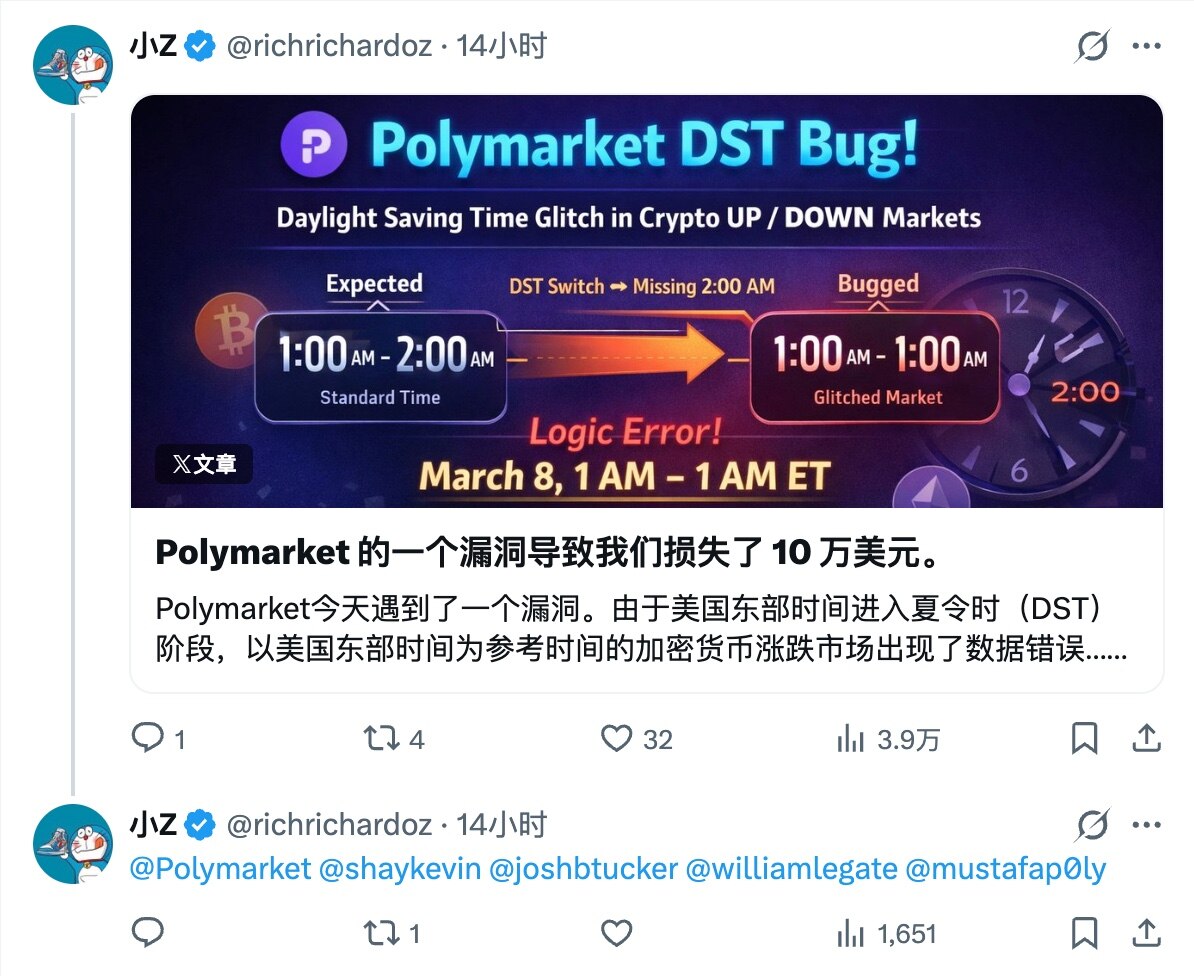
Little Z further explained that when the start and end times are the same, it indicates a logically impossible market state. Many automated trading systems rely on the end time to determine trading windows, and this error directly caused substantial losses for their programs. Therefore, it is recommended that Polymarket change the standardized time of relevant events to UTC and compensate users affected by the data issues.
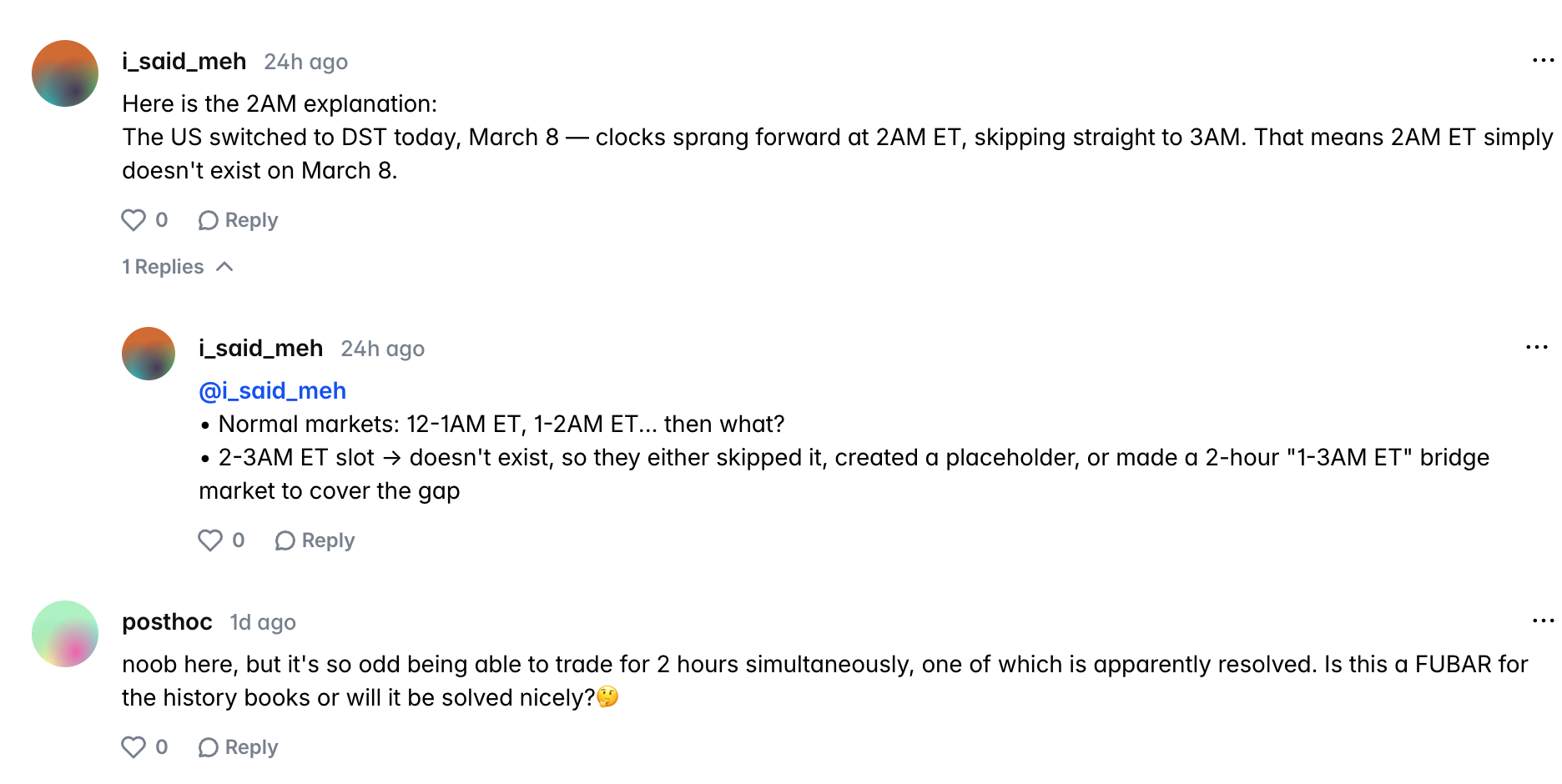
In addition to this user, many others online also expressed confusion in the comments below the relevant events, but as of the time of writing, Polymarket has not responded officially.
Time Standards in Traditional Financial Markets
Looking back at this controversy, while the scale of impact may not be significant, it has exposed a fundamental design flaw in Polymarket's "cryptocurrency up or down market" events.
Due to historical customs, economic status, and industry practices, Eastern Time is still widely used across various sectors. However, this is not friendly for financial systems because Eastern Time switches between standard and daylight saving time every year — meaning the clock is artificially adjusted forward or backward by one hour at specific times, causing "jumps" and "overlaps" in time.
In modern financial systems, UTC time has already become the de facto universal standard. In most financial infrastructures, internal systems typically use UTC timestamps as the sole standard time; while local times like Eastern Time are still in use, they often exist only in the user-facing presentation layer. This design is to avoid uncertainties in the time system and ensure that in financial transactions, settlements, and automation systems, time remains monotonic, unique, and globally consistent.
The key conflict in the Polymarket controversy lies in that the relevant events used Eastern Time as the timing standard but failed to fully consider the potential variables brought about by the switch to daylight saving time, ultimately leading to confusion between the front end and API data. Among the current prediction market user base, more and more participants are trading through APIs and automated programs. Some minor issues that formerly only affected front-end displays can easily be magnified into real monetary losses within automated systems.
From the outcome perspective, this controversy might not be regarded as a serious incident, theoretically occurring at most twice a year, but what it reveals is a more serious design problem — as prediction markets gradually evolve into financial infrastructure, they must also comply with the engineering standards adopted by financial infrastructures.
免责声明:本文章仅代表作者个人观点,不代表本平台的立场和观点。本文章仅供信息分享,不构成对任何人的任何投资建议。用户与作者之间的任何争议,与本平台无关。如网页中刊载的文章或图片涉及侵权,请提供相关的权利证明和身份证明发送邮件到support@aicoin.com,本平台相关工作人员将会进行核查。


