Original Title: "A valuation of 20 billion, does Kalshi and Polymarket start an arms race?"
Original Author: Ma He, Foresight News
Recently, according to the Wall Street Journal, the two leading prediction markets, Polymarket and Kalshi, have been in discussions with potential investors for investments, with valuations both around 20 billion dollars. In November 2025, news broke that Polymarket was then negotiating financing at a valuation of 12 billion dollars. In December of that year, Kalshi completed a financing round of 1 billion dollars, bringing its valuation to 11 billion dollars.
In just a few months, the estimate has likely doubled again.
According to public market data and industry reports, as of the end of February 2026, the global prediction market nominal transaction volume accumulated to 127.5 billion dollars, with Polymarket leading at 56.07 billion dollars and Kalshi at 44.71 billion dollars, together occupying 79% of the market share.
While leading in accumulated transaction volume, Kalshi's growth rate in 2025 was even more remarkable, not only achieving a market share reversal from a minority at the beginning of the year to over 60%, but also driving its monthly active users from 600,000 to over 5.1 million, demonstrating a faster scale expansion speed. In contrast, Polymarket maintained global event coverage and accumulated transaction advantages with its crypto-native edge, but user growth was relatively steady, with monthly active users peaking around 700,000. The two core metrics—transaction volume and monthly active users—clearly delineate Kalshi's explosive catch-up and Polymarket's continuous depth cultivation, forming a competitive landscape with both prediction market giants standing tall.
Specifically, in terms of transaction performance, Kalshi's growth trajectory shows a leap from a low base to high volume.
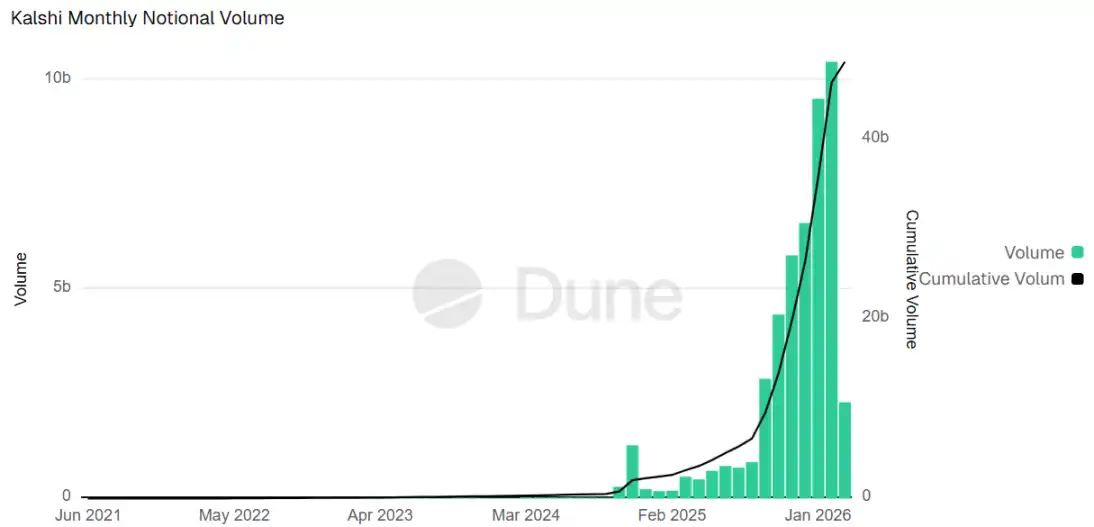
In 2024, Kalshi's total nominal transaction volume for the year was about 1.9 billion dollars, limited by early regulatory frameworks and market perception, primarily relying on a few driven events. By 2025, this figure skyrocketed to about 23.8 billion dollars, with a year-on-year growth rate exceeding 1100%. This explosion was directly reflected in monthly and weekly records: September's single month transaction reached 2.86 billion dollars, October further climbed to 4.39 billion, and December surged to 6.58 billion. The strong start in 2026 continued, with January's monthly transaction surpassing 10.4 billion dollars.
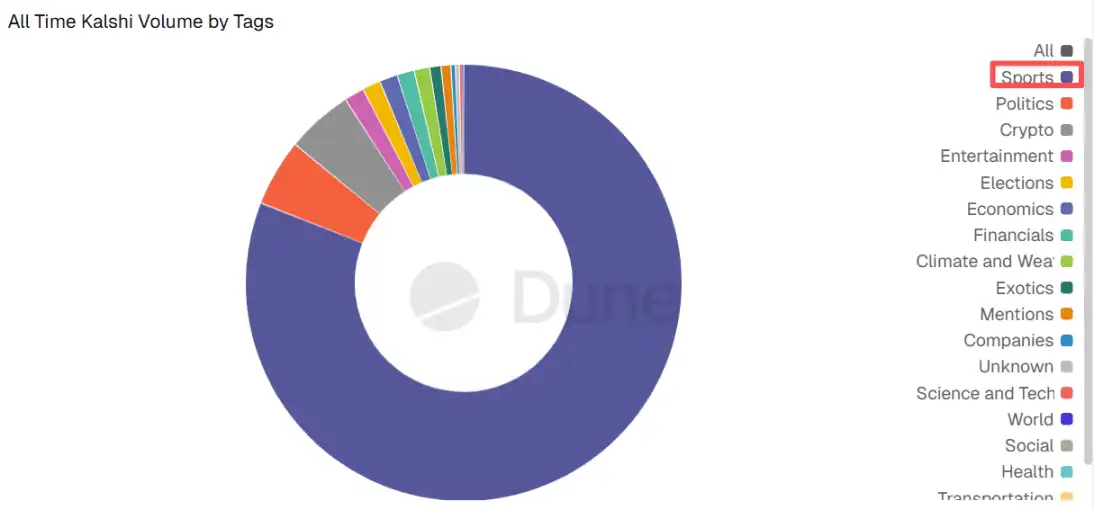
Contracts for sports events contributed about 81% of the total transaction volume.
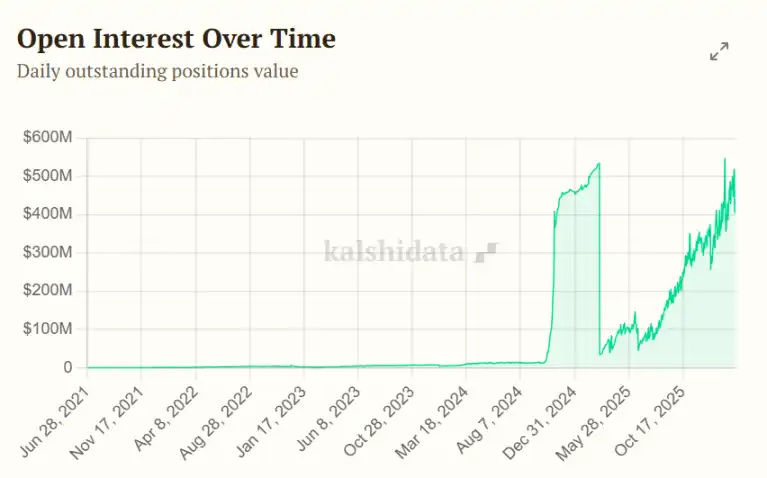
As of March 9, Kalshi's cumulative total transaction volume exceeded 48.6 billion dollars. Currently, its open contract volume hovers around 500 million dollars.
Polymarket's transaction volume reflects an earlier accumulation advantage and robust maintenance later. Dune data shows that in 2024, Polymarket's monthly nominal transaction volume experienced explosive growth, reaching 4.266 billion dollars in October 2024, setting a new record, with its cumulative transaction volume rising to 7.6 billion dollars.
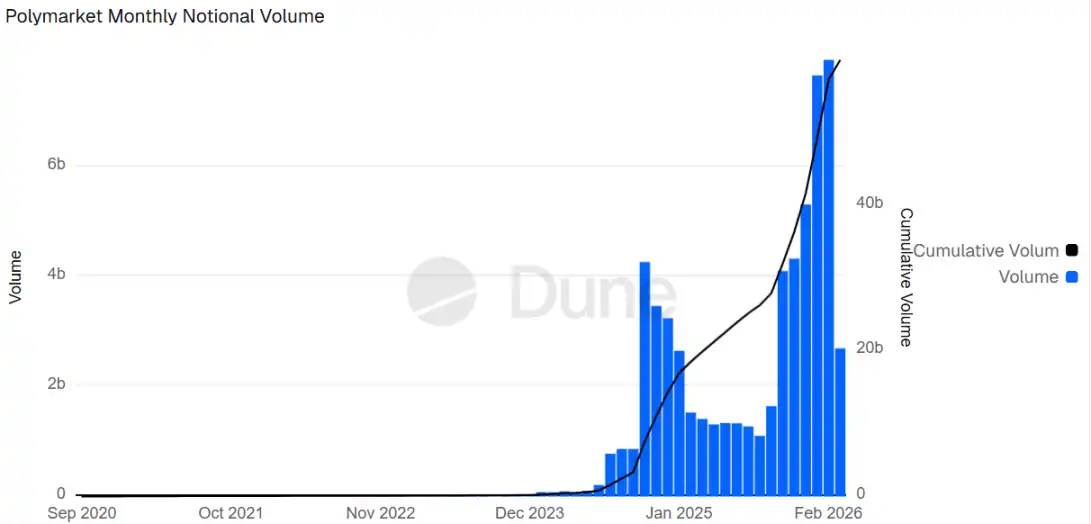
After that, while its monthly transaction volume gradually receded, it still maintained at a high level. A turning point occurred in September 2025, when Polymarket began its pulse-like surge in transaction volume.
October's single month transaction exceeded 4.1 billion dollars, and November exceeded 4.3 billion dollars.
As time reached 2026, in just January, its transaction volume surpassed 7.658 billion dollars, and in February it crossed 7.9 billion dollars, with its cumulative transaction volume exceeding 59.9 billion dollars as of March 9.
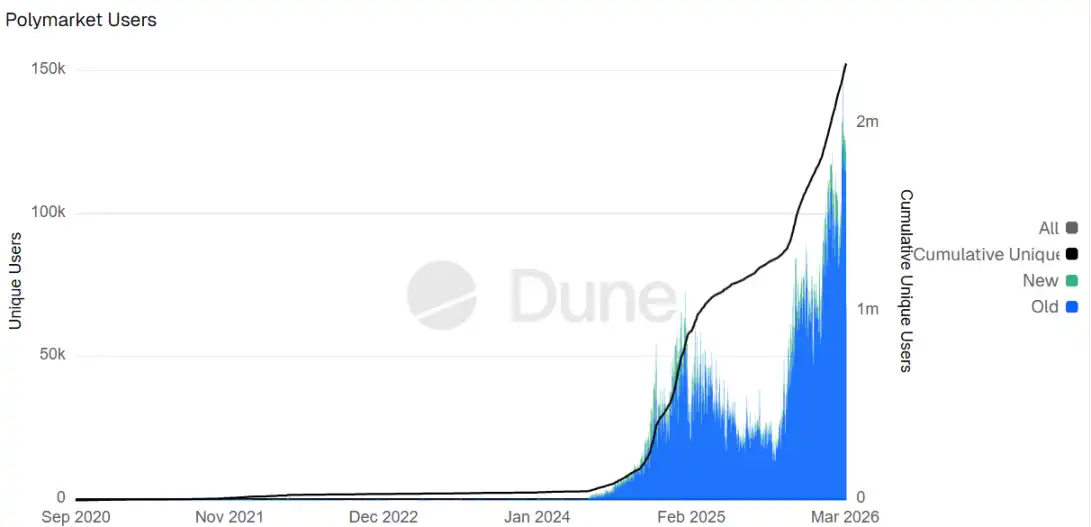
According to Dune statistics, its total user number has surged from 40,000 in 2024 to the current 2.31 million.
It is noteworthy that Polymarket still has an advantage in liquidity depth for political and crypto events, with some weekly transaction counts reaching as high as 57%, but its overall market share dropped from 95% to 35-40% in mid-2025, before gradually stabilizing.

The differentiation in transaction volume data between the two platforms fundamentally stems from differences in business focus and user access methods. As a CFTC-regulated entity, Kalshi focuses on compliant USD transactions, covering over 42 U.S. states, and has the upper hand dominated by sports, whereas Polymarket maintains a lead in politics and crypto, jointly driving the entire market's weekly nominal transaction volume to stabilize above several billion dollars.
In terms of ecosystem cooperation, both prediction markets have also been active, deeply binding mainstream institutions, media, and sports IP. The two not only opened offline grocery stores but also expanded rapidly online.
Kalshi relies heavily on compliance advantages, entering into a strategic partnership with Tradeweb and receiving minority equity investment, embedding real-time probability data into its institutional trading platform; Robinhood became the largest source of traffic, contributing over 50% of transaction volume in the second half of 2025; meanwhile, they formed an exclusive media partnership with CNBC and CNN, with data directly entering programs and reports.
Polymarket focuses on Wall Street data output and entertainment penetration. In June last year, Polymarket partnered with X to become its official prediction partner. They reached a strategic investment of up to 2 billion dollars with ICE, incorporating data into financial product flows. In November, Polymarket signed a multi-year exclusive agreement with TKO Group to become the official prediction market partner of UFC and Zuffa Boxing, with data integrated into broadcasts and live events.
In January 2026, Polymarket reached an exclusive cooperation with Dow Jones media to provide prediction market data to media outlets including Barron’s and the Wall Street Journal.
Interestingly, both are official prediction market partners of the NHL, and Google has integrated data from both into its search and financial platforms.
Overall, from the past two years of transaction volume and monthly active user data, both have jointly propelled the prediction market from a niche tool to a mainstream platform for information and risk management. This trend not only reshapes the valuation logic of the crypto industry but also provides real-time signal references for traditional finance. If financing lands in the future, combined with hot geopolitical events (U.S.-Iran conflict), the World Cup, and the eve of the U.S. elections, data from both platforms in 2026 is expected to break historical highs.
免责声明:本文章仅代表作者个人观点,不代表本平台的立场和观点。本文章仅供信息分享,不构成对任何人的任何投资建议。用户与作者之间的任何争议,与本平台无关。如网页中刊载的文章或图片涉及侵权,请提供相关的权利证明和身份证明发送邮件到support@aicoin.com,本平台相关工作人员将会进行核查。


