Author: Yokiiiya
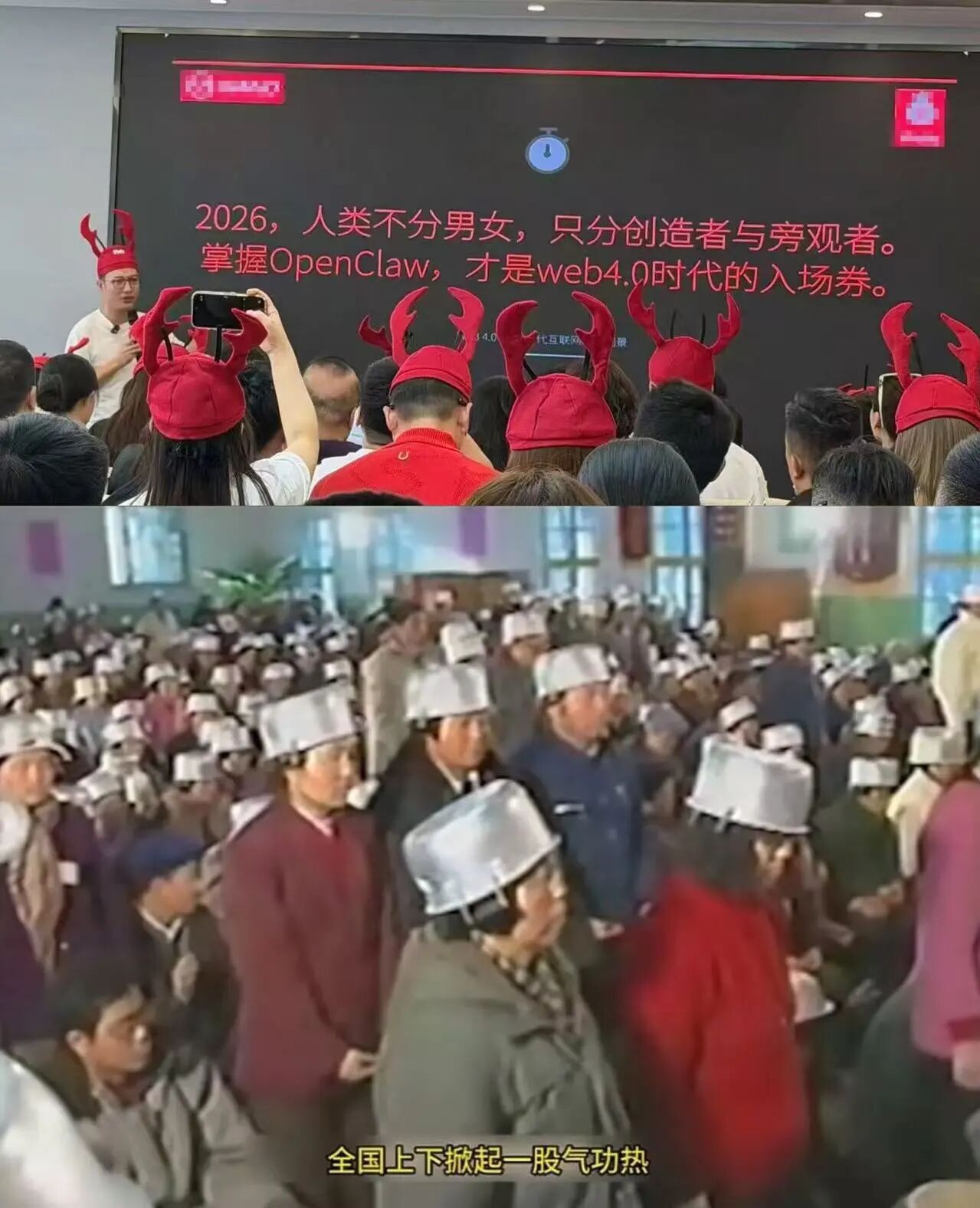
OpenClaw's current popularity has reached a rare level. On GitHub, this project has quickly garnered 280,000 stars and over 50,000 forks. New versions of the project are released almost daily. In China, on March 6, Tencent Cloud held a free OpenClaw installation event at the entrance of the Tencent Building in Shenzhen, where nearly a thousand people were seen queuing to install it. Related reports from Tencent Cloud also mentioned that the scale of "shrimp farmers" in the cloud has surpassed 100,000. Meanwhile, a community culture around OpenClaw is rapidly forming. Feishu is hosting a lobster conference. Longgang in Shenzhen has launched "Ten Lobster Rules." Suddenly, the entire internet is discussing one thing: shrimp farming.
When you open your social media, video accounts, or WeChat groups, you'll find similar messages almost everywhere. Some are sharing installation tutorials. Others are showcasing their "lobster army." Some are discussing how to earn money automatically using agents. When a technology begins to spread, the discussions often shift from: what problems it can solve, to: will I miss out on something if I don't participate. This sentiment has a name: FOMO (Fear Of Missing Out). And OpenClaw is very likely entering this phase.
High Popularity Does Not Mean True Implementation
The popularity of OpenClaw is indeed very high. However, the dissemination of technology and its practical implementation are usually not the same thing. From the current situation, the number of people discussing OpenClaw greatly exceeds those who have actually integrated it into a stable workflow. The reason is quite simple. The agent system itself is not easy to use well.
Although the installation process seems to take only a few minutes, in reality, users often need to handle many issues:
Model API integration
Prompt design
Workflow construction
Toolchain integration
Permission configuration
This resembles more of an engineering system rather than ordinary software. "Being able to install" and "being able to use it stably for the long term" are actually two completely different matters.
Observations from foreign communities provide similar signals. At the ClawCon developer event held in New York, hundreds of developers showcased various OpenClaw demos and tool packages. However, media reports noted that the most discussed topics at the event were not "how OpenClaw has changed workflows," but rather:
Agent reliability
Data security
Permission control
In other words: the tech community itself is still in the exploration stage. The actual experiences of developers also reflect this. Many people experience the most common outcomes after installing OpenClaw:
Can run demos
Can complete simple tasks
But find it difficult to construct stable automation processes
Once tasks become slightly complex, it requires a lot of debugging of prompts, modifying workflows, and even redesigning tool calling logic. This is also why many engineers say: The challenge of the agent is not "getting AI to do a task," but rather "getting AI to continuously and stably perform tasks well."
Security issues are another real concern. Agent systems often require very high permissions, such as: file system access, command execution, network calls, third-party tool control. Recently, there have been reports of security vulnerabilities and malicious plugins related to OpenClaw, such as gaining control of the agent system through weak passwords or malicious plugins. This indicates a simple fact: it is not a tool that ordinary users can simply "install and use."
There's also a frequently overlooked reality: The value of agent systems highly depends on the user's own capabilities. If someone is already good at automation, engineering processes, and system design, the agent can become a very powerful efficiency magnifier. But if such capabilities are lacking, the agent can instead turn into a complex and difficult-to-control system.
In other words: OpenClaw is more like a lever for experts, rather than a plug-and-play tool for the masses.
Therefore, a more accurate judgment might be: The number of installations and discussions around OpenClaw far exceeds the number of people who have formed a stable workflow. It is more like a widely disseminated agent entry point, rather than a mature product that has already achieved widespread adoption.
Why AI FOMO Appears
If we place the phenomenon of OpenClaw within the technology cycle, it's not surprising. Many waves of technology go through similar stages: technology emerges → profit stories → tool explosion → FOMO → true implementation. Right now, OpenClaw is very likely in the FOMO stage.
At this stage, the most discussed topics are not usually: what problems technology can solve. Rather, it’s: have others already started doing it? Technology at this point becomes a cultural symbol. The "shrimp farming" culture around OpenClaw is actually a typical example. These events are not entirely technical events, but more of a cultural dissemination phenomenon.
First is the narrative from model companies. In the AI industry, tech companies often need to constantly prove that their technology is changing the world. Therefore, the easiest narrative to spread is: "This is a revolution." For example:
AI is replacing a large number of jobs
AI will reshape the entire software industry
AI agents will become the new productivity infrastructure
This narrative itself is not necessarily wrong, but it naturally creates a sentiment: if I do not participate, will I be eliminated?
Second is the promotion by cloud vendors. For cloud vendors, agents serve as an excellent entry point. Because behind every agent system, it means: more computing power, more API calls, more cloud resources. Hence, we can see many cloud platforms actively promoting the deployment of agent tools. For instance: Tencent Cloud launched the OpenClaw free installation event, attracting a large number of developers for on-site experiences. This promotion is actually a very typical method of technology diffusion.
Third is the communication mechanism of content platforms. On content platforms, anxiety often spreads faster than rationality. For instance, the recent surge of content: "Those who cannot use AI will be eliminated," "One computer can raise an AI team," "Make 2.7 million dollars in 30 days using AI," the core of this content is not the technical details. Rather, it is: a sense of urgency.
Finally, there is the uncertainty in ordinary people's minds. When a technology cycle is just beginning, most people really do not know what will happen in the future. This uncertainty easily transforms into a psychological state: if everyone else is taking action, should I also do something?
Thus, various phenomena arise: queuing to install OpenClaw. Showcasing one's lobster army. Discussing how to earn money automatically with agents. These are indeed all expressions of FOMO.
Technological revolutions are never achieved through anxiety
AI is likely to change many industries. However, technological revolutions are never achieved through anxiety. Almost all significant technologies in history have emerged in this way: initially, only a few engineers experiment. Then, some companies start to use it internally. A few years later, it gradually enters wider applications.
This process often takes a long time, not just a few weeks. OpenClaw may be a valuable tool. It prompts many people to start seriously considering the potential of AI agents.
However, the large amount of discussion surrounding it now resembles more of an emotion. Few people will truly use OpenClaw effectively, yet many are discussing it. This is a very typical stage in the technology cycle. When everyone is talking about the tool, the truly important questions often have not been seriously discussed.
The truly worthwhile question is not:
"Which AI tool should I install?" but rather: "What problem am I actually trying to solve?" If the problem is clear, the tool will usually appear on its own. If the problem is unclear, people often end up doing something else: installing many tools. So instead of asking: "Should I start shrimp farming?" it's better to ask a simpler question: What tasks in my work are worth automating?
Because the way AI truly changes the world is never: Everyone starts using a tool at the same time. Instead, it is: A few people use the tool on real problems first. Then it spreads slowly.
Model companies sell imagination space, cloud vendors sell deployment entry points, content creators sell onboarding anxiety; but those who can truly turn agents into productivity still need strong capabilities in problem definition, process design, model scheduling, and security control.
免责声明:本文章仅代表作者个人观点,不代表本平台的立场和观点。本文章仅供信息分享,不构成对任何人的任何投资建议。用户与作者之间的任何争议,与本平台无关。如网页中刊载的文章或图片涉及侵权,请提供相关的权利证明和身份证明发送邮件到support@aicoin.com,本平台相关工作人员将会进行核查。


