Original author: angelilu, Foresight News
"Friends shorting crude oil are completely on fire."
On the morning of March 9, on-chain analyst Ai Yi tweeted this when WTI crude oil reached $108 per barrel. The top account on Hyperliquid's leaderboard was facing a floating loss nearing $3.4 million, with a liquidation price set at $120.76.
As of the time of writing, the WTI crude oil contract price peaked at $119.5 during intraday trading, currently reported at $114.5, which has accumulated a rise of more than 25% compared to last Friday's closing price.
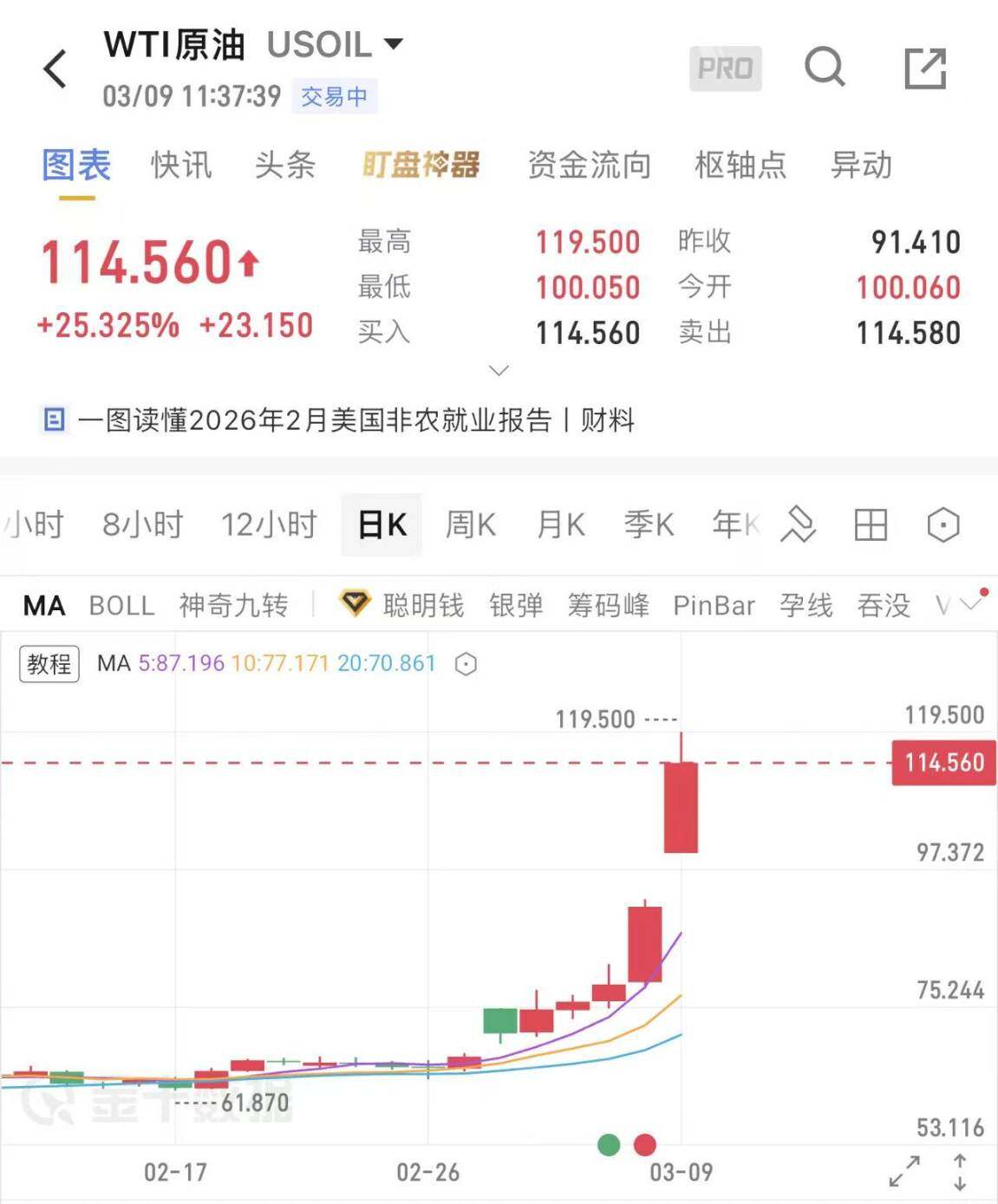
Due to a strait, crude oil surged over 40% in a week
The story begins with Iran's Strait of Hormuz.
As of March 9, the Strait of Hormuz had been in a nearly complete blockade for seven consecutive days. This vital passageway, carrying about 20% of the world's oil supply, stopped operating, causing a market shock. By March 9, WTI crude oil prices had skyrocketed in just a week, creating a rare volatility record in recent years, with an increase of more than 40% compared to pre-conflict levels.
The shockwaves spread rapidly. The Nikkei index fell 5.4% in a single day, marking the largest decline since the tariff crisis; South Korea's KOSPI plummeted 7%; Germany's DAX dropped over 3%. Bitcoin was also not spared, falling below $66,000, with a total market liquidation of $120 million within one hour. The crypto fear and greed index dropped to 12, indicating that the market had entered the "extreme fear" zone.
However, on Hyperliquid, another battle was brewing.
Three stories of shorting crude oil
In the on-chain circle, CBB (@Cbb0fe) is not an unfamiliar face. A few months ago, he publicly formed a team specifically to "hunt" another whale @qwatio. This time, it was his turn to become the prey.
https://x.com/lookonchain/status/2030817006107369727
According to Lookonchain monitoring, CBB shorted 127,175 xyz:CL (WTI crude oil mapping contracts) at an average price of $78.37, with a nominal value of approximately $13.78 million. As oil prices soared, his floating loss had reached $3.81 million, with a liquidation price hanging at $120.76.
There is still a few cents of space before reaching that number. But no one knows when the Iranian situation will cool down.
Another account, "2 frères 2 fauves", is in a similarly dangerous position. He entered short at $78.36 and currently holds 12,717 CL, with a nominal value of approximately $13.37 million, ranking first among CL contracts on Hyperliquid. Floating loss is $3.4 million, with a liquidation price also at $120.76.
More dramatically is the experience of whale 0x8Af7. He shorted 72,179 CL (around $7.8 million), and as oil prices rose, his short position was completely liquidated, resulting in a loss of over $1.55 million.
However, less than a few hours after the liquidation was completed, he immediately reopened a position—60,166 new short contracts, with a nominal value of $6.48 million.
Was it a misunderstanding or a gamble hard to change? Maybe both. But the choice itself has already indicated a certain temperament of high-leverage trading on-chain: liquidation is not the end, just the conclusion of the previous round.
There are also winners, another side of Sky's co-founder
In the same Hyperliquid, during the same period, Sky (formerly MakerDAO) co-founder Rune Christensen, however, watched the storm with a smile.
On-chain analyst EmberCN disclosed that RuneKek (Rune's on-chain account) had gone long on about $7.82 million of crude oil contracts, with costs around $93. As of today, when oil prices reached $109, his floating profit had exceeded $1.36 million.
More notably is his combination strategy: while going long on crude oil, he also shorted a portion of ETH and XYZ100 (U.S. stock index mapping contracts). This made his strategy more like a hedging logic against geopolitical conflict—crude oil benefits from war premiums, while stocks and cryptocurrencies are pressured by risk aversion, thus simultaneously laying out both sides to hedge the risks of unilateral bets.
Rune Christensen is a founder of a DeFi protocol who constructed a macro hedging portfolio using on-chain perpetual contracts. This matter itself is more worth noting than how much he earned.
On-chain commodities: new tools, old lessons
This round of crude oil pricing pushed a previously unnoticed topic to the forefront: on-chain commodity trading.
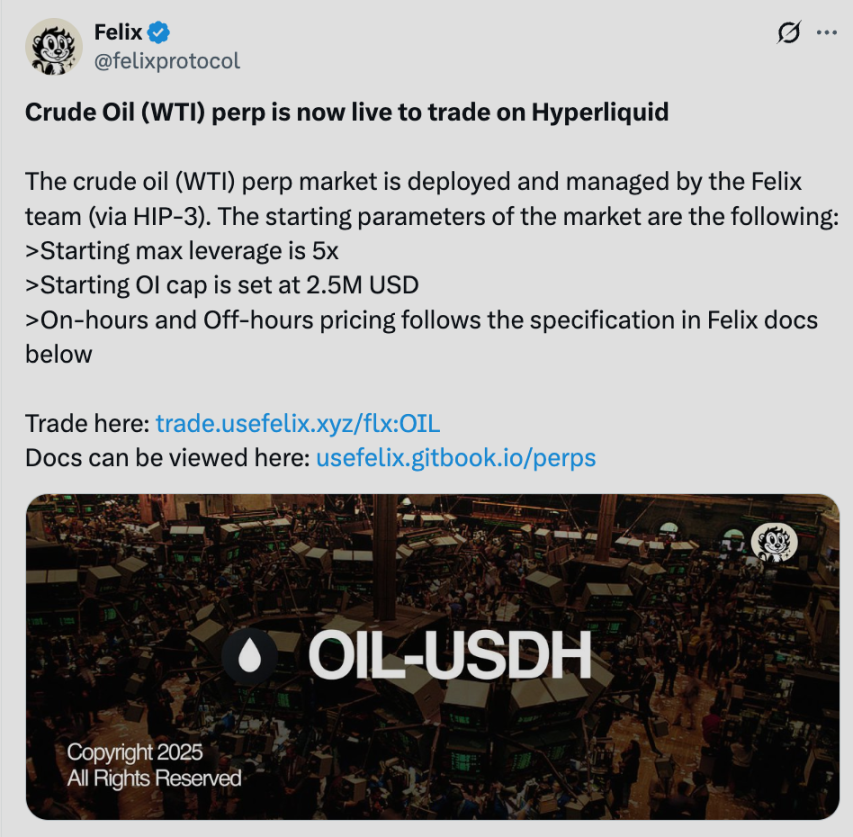
The crude oil on Hyperliquid was launched on January 9, 2026, by the Felix Protocol (the market deployer of HIP-3 on Hyperliquid), which was approximately two months ago. The initial parameters included a maximum leverage of 5 times and an unpaid balance limit of $2.5 million, belonging to an early small-scale launch, which only truly erupted in trading volume after the Iranian blockade of the strait.
Platforms like Phantom have also successively launched perpetual contracts for traditional commodities such as crude oil and gold. In theory, anyone just needs a wallet to trade crude oil futures like trading Bitcoin, without needing to open traditional futures accounts or use brokers.
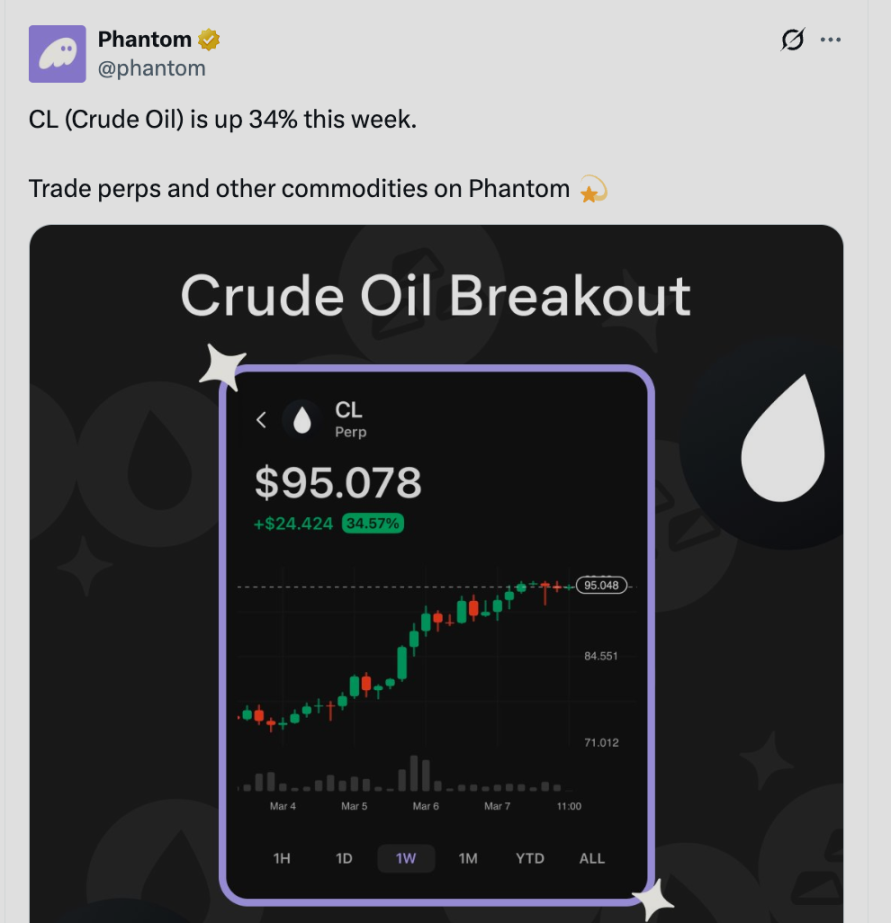
This is true financial democratization. But the other side of the coin is equally real.
The traditional commodity futures market has strict margin systems, circuit breakers, and position limits, with brokers’ risk control teams monitoring the market at all times. The rules of on-chain perpetual contracts are much simpler: when the position value drops to the liquidation line, the system automatically liquidates, with no phone alerts or manual intervention.
The liquidation prices for CBB and 2 frères 2 fauves were both pressed around $120.76—this number is not random, but calculated as a "margin of safety" when they initially built their positions. In normal oil price fluctuations, there was more than fifty dollars of space from the entry price of $78, which seemed quite ample.
But what they didn't anticipate was that a geopolitical crisis could lead to a 50% rise in crude oil prices within 72 hours.
This was not a mistake in strategy, but a black swan event. The problem is that there are no mechanisms on-chain to allow you to catch your breath when the black swan descends.
When DeFi meets Hormuz
The relationship between the crypto market and traditional geopolitical events is happening faster than anyone anticipated.
Hyperliquid users now need to keep an eye on the latest developments in Iran's Strait of Hormuz; meanwhile, DeFi OGs are using on-chain derivatives to hedge against war risks.
As the categories of on-chain commodities and on-chain U.S. stock mapping contracts continue to expand, the extent to which on-chain players are exposed to macro risks will only deepen. In the traditional financial world, this is called "global macro strategy," requiring professional teams and robust risk control systems to support it. On-chain, it’s called "one person's position."
免责声明:本文章仅代表作者个人观点,不代表本平台的立场和观点。本文章仅供信息分享,不构成对任何人的任何投资建议。用户与作者之间的任何争议,与本平台无关。如网页中刊载的文章或图片涉及侵权,请提供相关的权利证明和身份证明发送邮件到support@aicoin.com,本平台相关工作人员将会进行核查。


