Written by: Eric, Foresight News
On March 5, 2026, the renowned short-selling organization Culper Research released a short-selling report targeting Ethereum, pointing fingers at the Fusaka upgrade completed in December 2025. This technical upgrade aimed at improving network capacity not only failed to solidify Ethereum's position but pushed the network to the brink of a "death spiral" by undermining the basic economic structure of the tokens.
The report bluntly states, you may not believe me, but you have to believe Vitalik, who sold 3,000 more Ethereum; we are just following his lead.
At the end of January, Vitalik Buterin announced that the foundation would enter a "mild austerity period," then immediately turned around and sold 16,384 ETH for 19,326 ETH — a 16% increase over what was expected. It's like a boss saying at an all-hands meeting, "The company is tightening its belt," and then selling their monitor from the office on the second-hand market while also casually taking two potted plants from the reception desk.
Where does Ethereum's "death spiral" come from?
Before introducing Culper Research's views, it may be necessary to provide a brief introduction to Culper Research itself.
While not as famous as Muddy Waters, this organization, founded in 2019, was rated in 2021 by Activist Insight as one of the five most aggressive short-selling organizations on Wall Street, known for exposing misleading or fraudulent activities by publicly listed companies regarding operations, risk disclosures, and use of funds.
Though some investors believe that its published reports often carry subjective bias or opportunistic tones, Culper has a number of successful cases. In February 2025, Culper released a short-selling report against AppLovin, directly pointing out that it forcefully installed other apps on users' phones via an app backdoor to increase revenue. On the day the report was released, AppLovin's stock price fell 12.2%.
Returning to the topic of Ethereum, Culper attributes the issue of "Ethereum entering a death spiral" to a series of chain reactions caused by the Fusaka upgrade leading to an unexpected drop in gas fees:
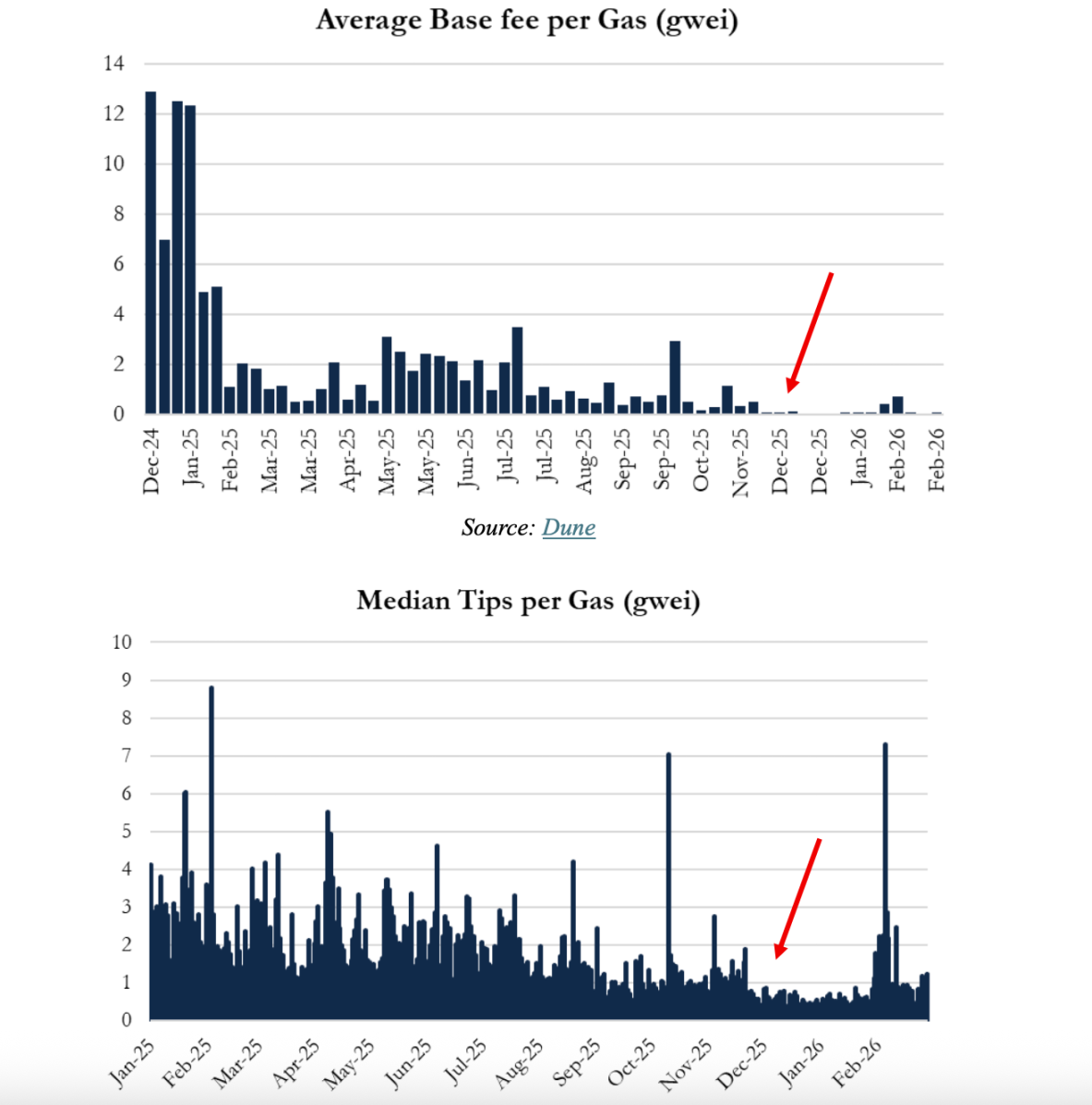
By raising Ethereum's gas limit from 45 million units to 60 million, the Ethereum Foundation originally hoped that the Fusaka upgrade would reduce transaction fees by 10% to 30% to stimulate L1 adoption and strengthen ETH's deflationary properties through increased fee burning. However, gas fees did not decline gently as expected but plummeted by about 90%, dropping from about 25 GWei before the upgrade to 0.5 GWei (currently, Ethereum's gas fee has fallen to 0.032 GWei).
The Ethereum Foundation intended to give the tires some air, but the 4S store directly took the tires off.
This collapse in fee structure triggered disastrous chain reactions. According to Culper's analysis based on entire chain trading data from January 2025 to February 2026, address poisoning attacks (such as sending 0.0001 USDT to your wallet, enticing you to copy the wrong address) saw explosive growth after the upgrade. The data showed that post-Fusaka upgrade, up to 22.5% of transactions on Ethereum's mainnet were actually address poisoning attacks; 95% of new wallet growth could be attributed to such fraudulent activities; in just the first two months of 2026, the annualized losses from these scams were estimated to reach $348 million, more than eight times the previous research estimates.
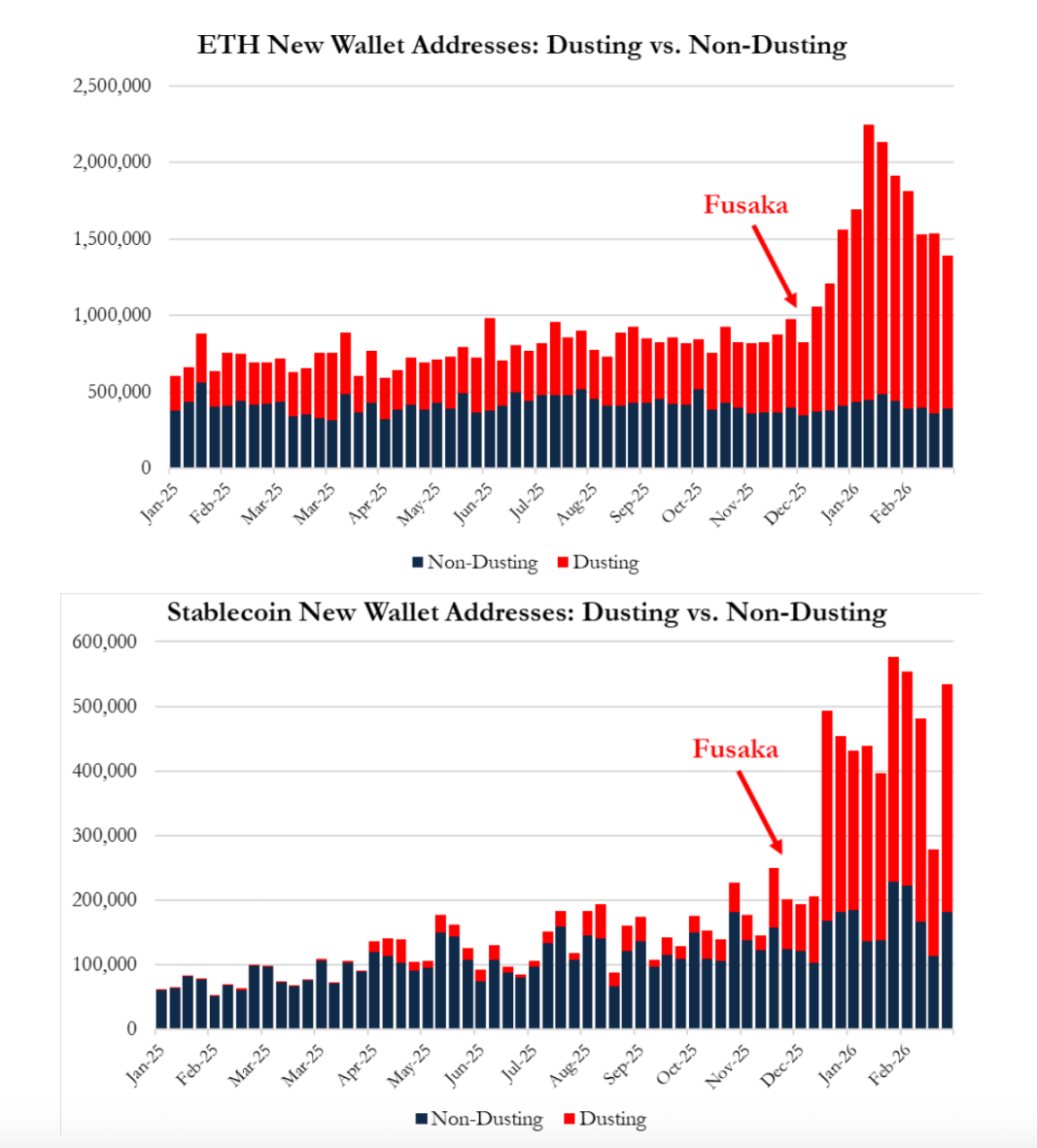
After on-site testing, two newly created addresses were attacked within just five minutes of transferring between each other.
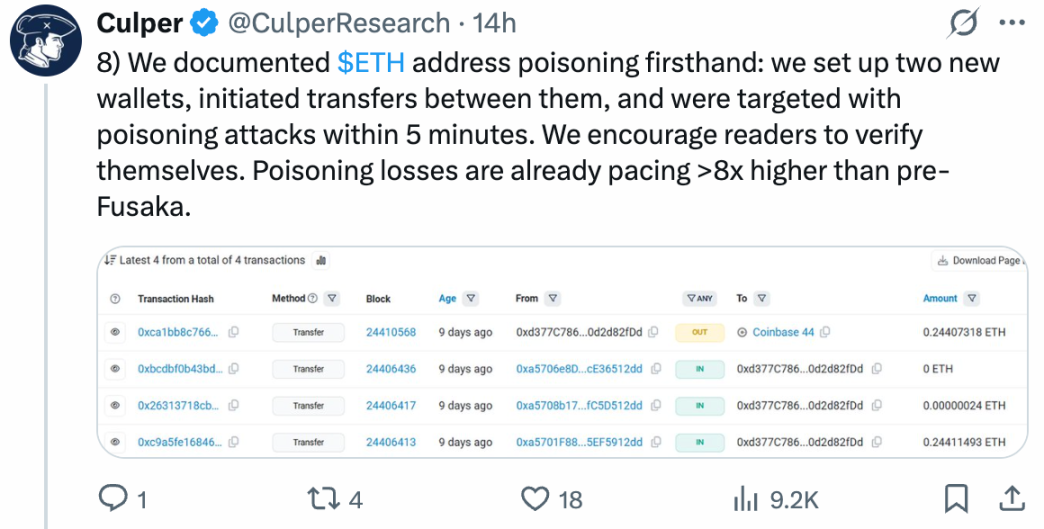
The report argues that the increase in active addresses and transaction volumes, which are viewed by bulls as "fundamentally strong," is, in fact, a manifestation of a systemic security crisis.
From deflation to inflation
The deep-seated crisis triggered by the Fusaka upgrade lies in its destruction of the validator economic model. In Ethereum's PoS mechanism, validators depend on transaction fees (priority fees) and profits from burned base fees to sustain operations. However, when blocks are filled with low-value garbage transactions and poisoning attacks, legitimate transactions can be packed without bidding, leading to a cliff-like drop in validator profits.
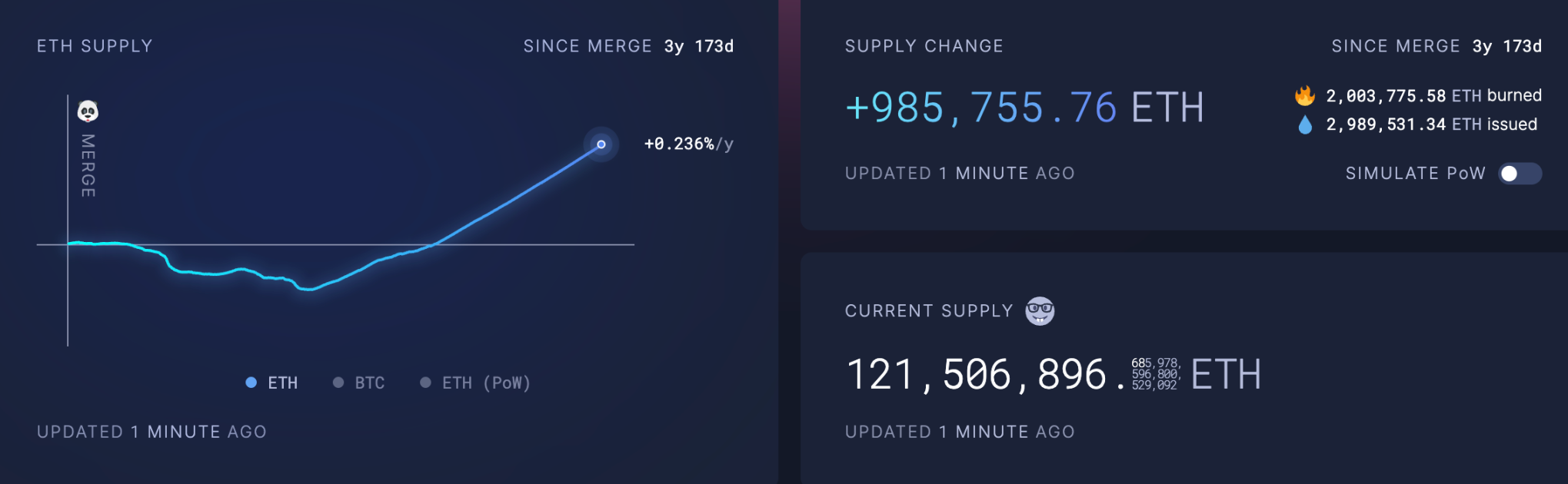
Currently, ETH staking returns are around 3%, while the yield on the U.S. 10-year Treasury bond is about 4.1%-4.2%. Meanwhile, Ethereum's annualized inflation rate over the past 30 days has already exceeded 0.8%, with circulating supply increasing from a low of more than 450,000 since the merger to nearly 1 million now. This data is not optimistic.
What’s more, in Ethereum's planned Glamsterdam upgrade, the gas limit is set to be further raised to 100 million or even 200 million, and this vicious cycle will continue to operate. According to Culper's view, as long as Ethereum cannot recreate the on-chain activity levels of the DeFi and NFT eras, the death spiral will be unavoidable.
High-level irony
Vitalik selling 3,000 more Ethereum is not a big deal; it may just be to prepare more funds for Ethereum's development. However, Culper interprets this inconsistency as: Although Vitalik talks about building Ethereum, his actions tell the truth.
Using Vitalik's extra sales of coins as a reason for their pessimism towards Ethereum is quite far-fetched; Culper might just be mocking Ethereum bulls like Tom Lee. In the report, Culper used "What Vitalik Knows, and Tom Lee Doesn't" as the title, which translates to: The founder knows this ship is going down, so he is looking for lifeboats; while the analyst is still playing "My Heart Will Go On" on the deck.
At the end of the report, Culper Research likened Ethereum to the former Netscape and Nokia — having once defined industry standards but possibly losing control of its economic model due to the failure of the token value capture mechanism. Furthermore, Ethereum's competitors are also performing remarkably well. In 2025, the number of developers on Solana grew by 29%, far exceeding Ethereum’s 6%; financial giants like Stripe, Visa, and Citigroup have successively chosen Solana as the infrastructure for stablecoin settlement and asset tokenization. Meanwhile, DEX trading volume on Solana has surpassed Ethereum's by more than double.
From Ethereum's price trends, Culper's short-selling report did not provoke a strong market reaction. Perhaps this issue has already been priced in, or perhaps everyone believes it is still controllable. From the comments on Culper's tweets, many are mocking Culper and think that this "outsider" FUD could very well be a signal for a bottom.
Good goods aren't cheap
Four years ago, when Yuga Labs announced it would develop games, I saw a very unique perspective on X: If BAYC is a limited edition luxury product representing identity, its value has no upper limit. However, if you forcibly add a GameFi narrative, its valuation certainly has an upper limit.
Culper applied this logic to Ethereum, believing that while the intention behind reducing gas fees was good, it seems they exerted too much effort.
Indeed, Ethereum's gas fees have become cheaper, sometimes even lower than L2, but this low cost has been targeted by hackers before attracting genuinely valuable applications. It's like subsidies from a platform failing to attract real users and instead attracting a large number of opportunists.
Vitalik and the Ethereum Foundation have high expectations for Ethereum, and they have never been stingy with funding in recent years to improve the performance of this pioneering public chain. However, they may have overlooked an important point: Ethereum is an organic economy, and massive construction that is not compatible with economic development levels may lead to the collapse of the entire local economy.
From my perspective, the issues described by Culper do exist. The ongoing low performance of Ethereum's price over the past two to three years is fundamentally due to the lack of high-quality applications leading to inactivity on-chain. The drastic decline in gas fees has indeed exacerbated the economic problems, which will continue to suppress Ethereum's price for a while.
But what Culper may not understand is that Web3 is not a rational market; as long as these issues do not affect the foundation of Ethereum, the explosion of any concept is enough to turn the situation around. Ethereum has also experienced despair when prices fell from 2000 to tens of dollars with on-chain activity stagnant; at worst, we will start again with a more complete infrastructure.
Culper laughs at our understanding of economics, while we laugh at Culper's lack of understanding of Web3.
免责声明:本文章仅代表作者个人观点,不代表本平台的立场和观点。本文章仅供信息分享,不构成对任何人的任何投资建议。用户与作者之间的任何争议,与本平台无关。如网页中刊载的文章或图片涉及侵权,请提供相关的权利证明和身份证明发送邮件到support@aicoin.com,本平台相关工作人员将会进行核查。


