What kind of Chinese families are more suitable for moving overseas?
I have always wanted to write about this topic, but I feel a lot of pressure. In the last two days, I happened to write a lot of related content, so I will give it a try. If there are any inaccuracies, I kindly ask everyone to bear with me.
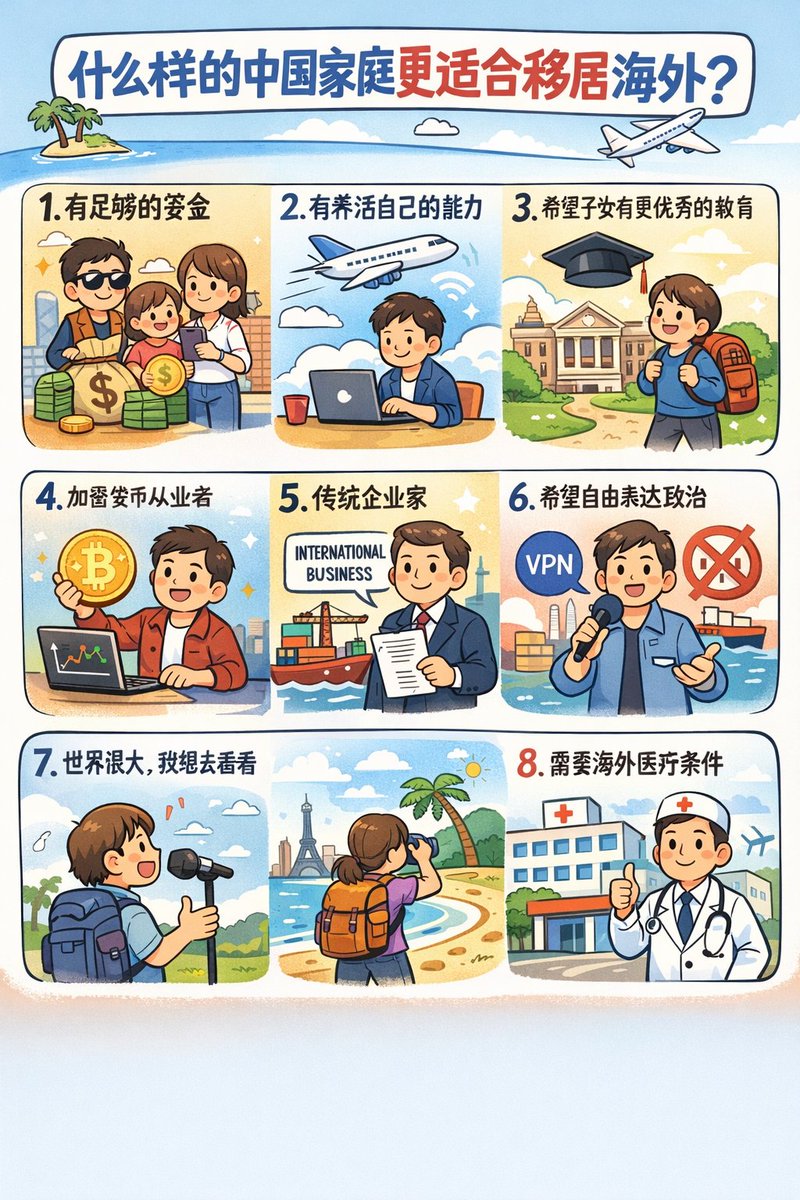
1. Have sufficient funds.
Moving overseas definitely comes with costs, and it is likely to be higher compared to one's comfort zone, especially in an unfamiliar country. Therefore, the primary requirement for moving is to have enough capital or a stable source of funds.
Many people who have achieved financial freedom come out for various reasons, intending to live a simpler life. "Simpler" is something I used to struggle to understand, but I am gradually starting to grasp it.
2. Have the ability to sustain oneself.
I often get asked how much money is needed to live in XX country’s XX city. Many people can’t move not because they don’t want to but because they can't legally earn money with the visa they currently hold in the local area. The most important thing before moving is not to ask about the cost of living but to clarify whether you are on a work visa, dependent visa, investment visa, or a remote work visa. For example, digital nomads, who have lower costs, find it very challenging to work legally in the local area. Therefore, if you don't have enough funds for living, it’s best to have a stable remote job.
From my personal experience, the cost of living in developed Asian countries (excluding Singapore) is about 10% higher compared to the rental groups in Beijing and Shanghai. This cost can be offset by lowering the quality of life. In the case of developing countries in Southeast Asia, basic living expenses are roughly equivalent to those in China’s second-tier cities.
For underdeveloped countries or prefecture-level cities in developing countries, the consumption is similar to that in China’s third-tier cities. Beyond that, I would not recommend it.
In fact, many people in trading face this situation. Although they do not receive a fixed salary, they can sustain themselves through trading. Particularly for those planning to create content on X or YouTube, moving abroad allows them to discover more topics to discuss.
3. Hope for better education for children or plan to take an international path.
Educational resources in China are relatively tight, especially the competitive atmosphere in public schools is quite intense. If you don’t want to study within China’s system, or plan for your child to study abroad in the future, based on my personal experience, the younger the child is when they go abroad, the better they adapt to the language environment and educational system.
In Singapore, if you arrive before the third grade of primary school, there is a chance to attend government public schools. After the third grade, the difficulty gradually increases. Generally, kindergarten is accessible to public schools, and there is a chance for direct admission to public schools. Especially for those starting with an English foundation, the sooner they come out, the better the language environment, and the lower the costs.
Of course, if you want to attend excellent universities in Singapore, Japan, South Korea, or even India, the competition is quite fierce. Singapore’s primary six exam, Japan and South Korea’s entrance exams, and India’s entrance exams are all highly competitive. Unless one plans to merely obtain a degree, if the goal is to climb to prestigious universities, the pressure exists everywhere. However, under the same competition, going abroad might be a bit easier.
For instance, the IELTS in Singapore is somewhat "easier" than in China. I have met many young friends who come to Singapore to take English tests.
Additionally, if a student doesn’t perform well in China’s college entrance exam system, going abroad provides another option. That’s why I made this decision; my learning performance was quite average, attending a public school in Shanghai (I didn’t get into a private school through the lottery), and I was often called in by parents due to talking with friends after class or running around the classroom, and my academic performance was merely average.
I believe that the outside world is larger, with more job opportunities. Instead of competing within China, why not compete globally? At the very least, being able to speak fluent English ensures you can survive anywhere, which is my most sincere thought.
4. Have invisible income or hope to reduce taxes, especially in the case of cryptocurrency professionals.
Taxes in China are quite high. However, compared to taxes, some income is not included in the tax system. Even if you want to pay taxes, it’s hard to find a suitable channel, but this income is difficult to enter into a bank account. For example, most friends who read my tweets are in the cryptocurrency industry. Over the years on X, the most popular tweets are always about teaching people how to trade securely OTC.
In many other countries, this is a common operation with legal channels. In fact, some countries do not tax capital gains, allowing cryptocurrency and stock trading earnings to be tax-exempt, as long as you are a tax resident of the country, you can legally transfer your earnings to a bank.
Cryptocurrency is legal in many countries around the world, but some require taxes while others do not. For professionals in the crypto industry, the issue is not just taxes, but compliance, capital flow, bank acceptance, and security of identity. In some countries, these issues can be addressed within a legal framework, but in mainland China, the space for this is much smaller, and related business and service risks are also significantly higher.
When you step outside, you'll find that the world is quite friendly.
5. Traditional entrepreneurs
For traditional business owners who need global asset allocation, dispersed education for family members, supply chains or customer expansion overseas, and those requiring cross-border payment solutions, having overseas identity is often necessary.
Another situation is more complex. For example, working in a business inevitably has some ties to local governments.
6. Hope to discuss politics on prohibited websites
In the past, some friends argued about whether using a VPN is illegal. Now that new legislation has come out, there should be no more controversy. However, for most friends, if they just use a VPN to read and browse some politically sensitive content, the issue might not be significant. But if they like to express their opinions and have a strong desire to voice their views, then they should consider going abroad.
In recent years, some leading figures discussing politics on YouTube have moved abroad. Even if it’s not political, discussions related to people's livelihoods should also be approached with caution. "Apple Life" is the best example. I won't comment on who Hu Chenfeng is, but the environment for discussion overseas is indeed more straightforward.
Of course, the prerequisite is still being able to sustain oneself.
7. The world is vast, and I want to see it.
I personally know some friends who are very fond of traveling, and for such friends, there’s not much to say; just do what you love.
8. Need overseas medical conditions.
This is pretty straightforward.
Is there anything else I can add?
Bitget VIP, lower rates, better benefits
免责声明:本文章仅代表作者个人观点,不代表本平台的立场和观点。本文章仅供信息分享,不构成对任何人的任何投资建议。用户与作者之间的任何争议,与本平台无关。如网页中刊载的文章或图片涉及侵权,请提供相关的权利证明和身份证明发送邮件到support@aicoin.com,本平台相关工作人员将会进行核查。


