On March 6, 2026, in Eastern Standard Time, the crypto world tightened its nerves on multiple fronts: on one side, HypurrFi disclosed potential "rounding error" vulnerabilities in its non-custodial lending protocol, once again putting security in the spotlight; on the other side, WTI crude oil surged to above 82 dollars before falling back to around 79.4 dollars, and high-leverage long positions on Hyperliquid were on the brink of liquidation, leading to extreme fluctuations in sentiment; meanwhile, Sun Yuchen adjusted about 152 million USDC, Larry Fink made a high-profile bet on tokenization, and Du Jun announced a return to entrepreneurship, as whales and institutions reshaped the financial landscape simultaneously. The shadow of security has not yet dissipated, but the ambition of traditional finance for tokenization is accelerating, with confidence calibrated repeatedly amidst swings, while new opportunity windows are revealed between volatility and reconstruction.
Lending Protocol Exposes Rounding Vulnerability: A New Test of Security Trust
● Context of the vulnerability disclosure: On March 6, 2026, HyperEVM's native non-custodial lending protocol HypurrFi disclosed that there is a type of potential vulnerability related to "rounding error" in versions prior to Aave V3 3.5, with technical identification pointing to possible numerical discrepancies in interest rate and position calculations. Such discrepancies could, in extreme cases, be magnified into asymmetries in fund settlement, thus elevating the issue to a security topic rather than merely a mathematical precision problem.
● Scope of impact and current risks: According to disclosed information, the potential impacts are mainly concentrated in the markets related to XAUT0 and UBTC, theoretically capable of altering the actuarial results of some positions or interests. However, at the point of disclosure, the team made it clear that current user funds have not suffered actual loss, and the vulnerability has remained more in the phase of "identified and warned" rather than exploited. This state of "not yet being exploited but with potential for harm" creates a gray area between risk pricing and sentiment fluctuation.
● Renewed leverage of non-custodial trust: Against the backdrop of ongoing aftershocks from the previous security incident, another vulnerability related to position settlement has been pinpointed, bringing back questions of "is the code reliable" and "can the protocol self-repair". User trust in non-custodial systems was originally built on verifiable and predictable smart contracts, and when even basic numerical rounding might trigger security discussions, the so-called narrative of "trustlessness" has been gently pried open by reality.
● Narrative tension of proactive disclosure and subsequent audits: This was actively disclosed by the development and security team, rather than passively announced after a hacker exploitation or financial loss, which to some extent rebuilds some trust, but also leads the market to demand higher standards of pre-audit and continuous monitoring. From protocol-level fee rates to collateral parameters, how to establish more comprehensive audit processes and insurance mechanisms before risks are repriced by capital is shifting from a technical issue to a cost consideration that asset allocators cannot avoid.
Crude Oil Surge and Retreat: Chain Reaction in On-Chain Contracts
● Sudden reversal in crude oil prices: During trading on March 6, WTI crude oil prices briefly surged past 82 dollars, then quickly retraced gains, closing around 79.4 dollars. This sudden move from "breakout" to "denial" within a short time frame put trading systems reliant on crude oil as a key risk anchor in a position to be repriced, directly pushing some positions on the edge of high leverage into the eye of the storm.
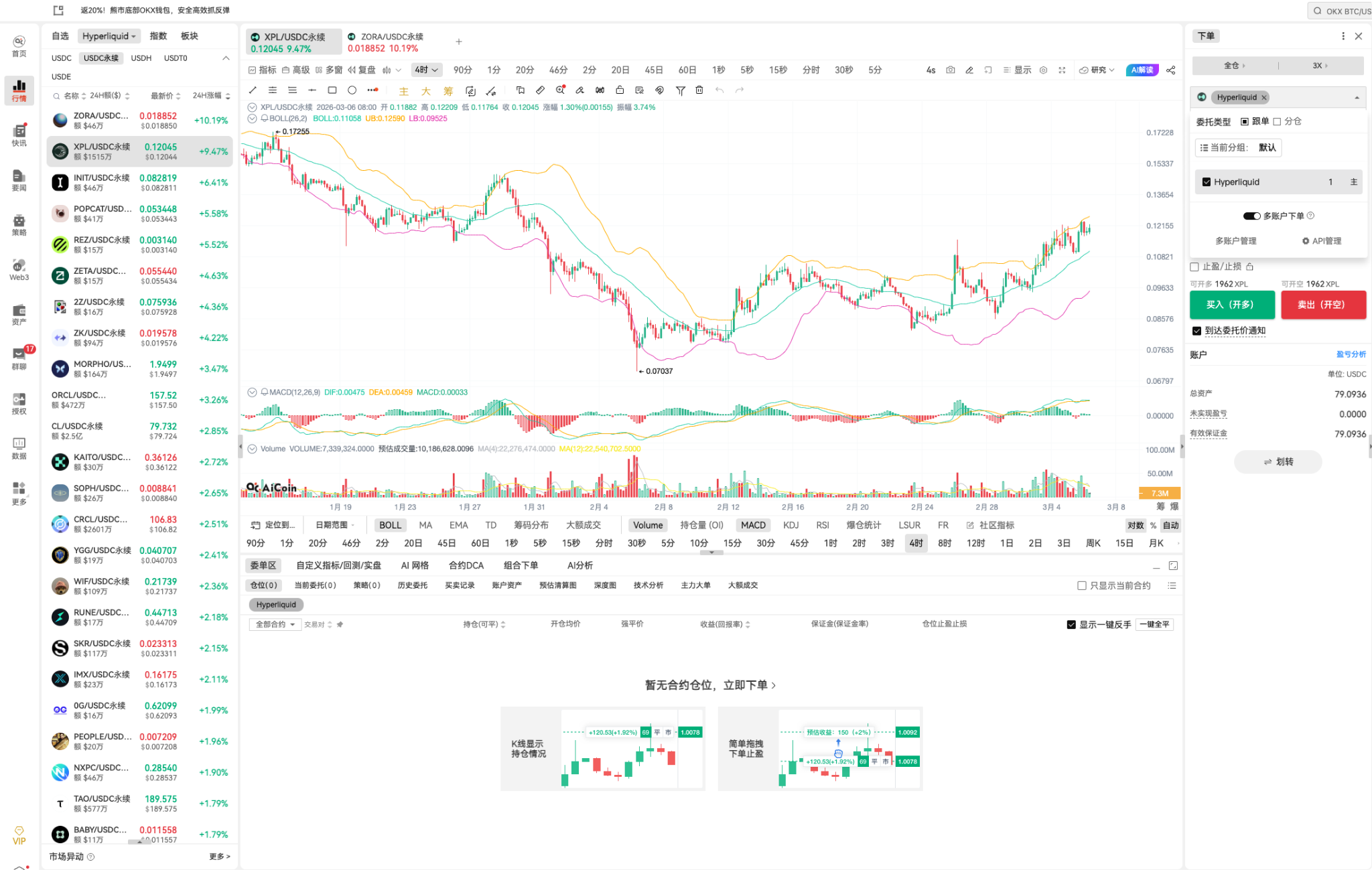
● Extreme scenarios in on-chain contracts: On the on-chain derivatives platform Hyperliquid, the long and short bets on the crude-tracking CL contracts heated up sharply. Meanwhile, high-leverage players in Bitcoin contracts were equally affected—data showed that on the platform, the top long BTC position only had approximately 729 dollars in margin remaining, close to being forcibly liquidated by the system. This seemingly unrelated linkage highlights that macro commodity fluctuations are penetrating the on-chain multi-asset positioning system through sentiment and margin mechanisms.
● Amplifier of leverage and chain reactions: Macro assets like crude oil are variables for many quantitative and multi-asset portfolios, and when their volatility amplifies, the high leverage and real-time liquidation mechanisms of on-chain derivatives can swiftly magnify shocks into cascade liquidations. Passive liquidations due to insufficient margins not only crush single commodities but also, through capital occupation and emotional transmission, trigger cross-commodity "de-leveraging" chain reactions, spreading risk from the commodity market to crypto assets.
● Pressure comparison between traditional and crypto derivatives: In traditional markets, commodity futures also experience violent fluctuations, but are constrained by factors such as margin ratios, trading times, and risk control thresholds, allowing for relatively clear risk-bearing paths for retail and institutional investors; however, in the 7×24-hour world of crypto derivatives, where leverage multiples are higher, the instantaneous release of uncertainty exerts greater pressure on both retail psychology and professional trading risk control models. For many participants, the real challenge is not the direction of profit or loss, but the speed and ruthlessness of the liquidation engines during extreme moments.
Sun Yuchen's Adjustment of 152 Million USDC: Synchronized Squeeze of Liquidity and Sentiment
● Timeline of on-chain actions: Research reports show that as of March 6, Sun Yuchen has recently withdrawn approximately 152 million USDC on-chain, described externally as "rebalancing the wallet", and plans to deposit part of it back into related pools such as LLP. This series of transfers and redeployments has been perceived by the market as a phased reconstruction of its overall asset allocation, coinciding with macro fluctuations and ongoing safety discussions.
● Disturbance of protocol depth and market-making expectations: Withdrawing such a scale of liquidity from Lighter related pools, even with the plans to "re-deposit", is bound to disturb the depth, slippage, and market-making quotes of the protocol in the short term. For pools reliant on a single or few large LPs, a significant adjustment by a whale is sufficient to change market makers' expectations regarding funding costs and impermanent loss, triggering a chain of "follow suit withdrawals" or passive contraction.
● Whale intentions and demonstrative effects: The official narrative is "rebalancing the wallet," but against the backdrop of market turbulence and frequent high-leverage liquidations, the market inevitably speculates whether there are considerations for a re-evaluation of the risk curve behind it. For many small and medium funds, the flow of funds from whales during stressful periods is often seen as a form of "demonstrative behavior"—regardless of their true intentions, such high-profile reallocation actions amplify existing cautious sentiment.
● Coaxial narrative with leverage risk: When we juxtapose the movement of this 152 million USDC with the extreme scenario of high-leverage BTC longs on Hyperliquid having only 729 dollars in margin left, we see that on the same timeline, passive liquidations on the price fluctuation side and active withdrawals on the liquidity side are happening simultaneously. The former magnifies price risk through leverage, while the latter amplifies slippage risk through thinning depth, prompting accelerated recognition of "systemic vulnerabilities" in the market.
Larry Fink's Bet on Tokenization: The Gap Between Wall Street's Vision and Reality
● Clear statement of the tokenization stance: Amidst this cycle of intertwined security and volatility, Larry Fink, CEO of BlackRock, once again threw out a strong viewpoint—"Tokenization will forever change the financial industry and enable freer movement of investments". This is not an abstract slogan but a directive declaration from one of the world's largest asset management institutions: the next phase of financial infrastructure will be rewritten on-chain, and existing assets will gradually be mapped and split.
● Imagination space under funding volume comparison: Research reports indicate that currently, about 4.1 trillion dollars in funds exist in global digital wallets, while the Solana ETF, seen as a "pioneering product", has thus far attracted only about 1.5 billion dollars in inflows. The contrast between these two sets of numbers highlights that tokenization and on-chain assets remain "marginal" in the global funding pool, while also illustrating the space perceived by capital giants—just bringing a small part of the existing stock assets onto the chain could reshape liquidity patterns across multiple markets.
● Path from Bitcoin ETF to tokenized assets: For traditional asset management giants like BlackRock, entering through Bitcoin ETF is the first step to testing compliance boundaries and demand scale. Once demand is validated, expanding to a broader "on-chain tokenized asset" means they seek to control not just a certain type of asset but also the entire chain of custody, settlement, and even secondary liquidity. This path is pulling originally isolated crypto assets into a capital network that is more closely connected to traditional assets like bonds, stocks, and commodities.
● Tension between investment free movement and real concerns: In institutional discourse, tokenization signifies "freer movement of investments", "fragmented holdings", and "24-hour settlement", but juxtaposed with this reality are issues like rounding errors, audit gaps, and concentrated liquidity that protocols, including HypurrFi, still expose. As Wall Street sketches a new blueprint, whether the security, depth, and transparency of the on-chain world are sufficient to bear trillions of dollars in assets becomes the sharpest question in this visionary narrative.
Du Jun's Return to Entrepreneurship: The Race for Entry of a New Generation of Institutions
● Subdued signals behind the understatement: Unlike grand declarations from global giants, Du Jun, co-founder of ABCDE, offered a rather restrained public statement on March 6—"Customer support Xiao Du will soon be online", while also announcing his return to entrepreneurship. This slightly playful comment reflects a choice by a crypto veteran to return from investor to the front line and is interpreted by the industry as preparing for a new platform or service-oriented project.
● Possible directions for new platform entry: Given his early background in exchanges, investment institutions, and existing resources, it is highly probable that the new project will focus on institutional trading, market-making infrastructure, or professional service platforms, rather than purely retail products. Currently, with ETFs, on-chain derivatives, and tokenized assets progressing in parallel, the market urgently needs a comprehensive platform that can provide credit intermediation, risk control tools, and strategy execution for professional funds, aligning closely with the resources Du Jun has accumulated in the past.
● Role of connecting professional capital and market-making needs: As Bitcoin, Solana, and other ETFs open avenues for compliant funds, on-chain derivatives are continually expanding the range of assets; a new generation of platforms needs to understand both traditional trading logic and on-chain liquidity structures. Whether for market makers' capital management or institutional investors' hedging needs, more professional execution and clearing tools are required, providing a practical foundation for the new platform to enter the professional side of the market.
● Dual entry of Wall Street and crypto veterans: When we juxtapose Du Jun's return with Larry Fink's strong bet on tokenization, we can see a pattern of "Wall Street + crypto veterans" entering from dual lines: the former provides capital and discourse power, while the latter offers deep understanding and implementation ability in the on-chain ecosystem. In a phase where security vulnerabilities and liquidity risks are still prevalent, if this dual force can generate synergy at the infrastructure level, it may accelerate the formation of a new order.
Parallel Volatility and Construction: The Next Choice Under Security Shadows
● Same scene of multi-line maneuvering: From the "rounding error" vulnerability disclosed by HypurrFi, to the drastic transmission between crude oil and on-chain contracts, and to Sun Yuchen's USDC adjustment, Larry Fink's tokenization declaration, and Du Jun's return to entrepreneurship, these seemingly dispersed events connect to create a multi-layered market maneuvering picture: technical security, macro prices, liquidity allocation, and institutional layouts overlapping and resonating at the same moment.
● Increase in risk premium and awareness: While clearly prohibiting judgments on subsequent price trends, observable changes include: the frequency and sensation of security events and extreme volatility are pushing market participants to recalibrate risk premiums—requiring higher returns from high-yield protocols, higher margins for high-leverage positions, while also passively increasing the emphasis placed by individuals and institutions on risk management and portfolio hedging.
● Conflict between mid-long term tracks and current shortcomings: On one hand, tokenization, ETFs, and new platform layouts are paving new tracks for mid-long term funds, while the gap between the 4.1 trillion dollars in digital wallet funds and the 1.5 billion dollars in Solana ETF inflows reveals growth potential and institutional ambitions; on the other hand, the security shortcomings in reality—from rounding vulnerabilities to concentrated liquidity—still constrain the entry of larger-scale funds, creating a sharply structural contradiction of "tracks ahead but foundations unsteady" in the current environment.
● Open proposition for participants: In the foreseeable future, the market will still be pulled between volatility and construction. In such an environment, every participant inevitably has to face the same question: how to participate in the next round of financial reconstruction on imperfect infrastructure? Whether to choose to outsource risks to institutions and platforms, or to build safety boundaries through decentralization, reducing leverage, and critically reviewing contracts will become the key watershed determining future returns and survival rates.
Join our community to discuss together and become stronger together!
Official Telegram community: https://t.me/aicoincn
AiCoin Chinese Twitter: https://x.com/AiCoinzh
OKX Welfare Group: https://aicoin.com/link/chat?cid=l61eM4owQ
Binance Welfare Group: https://aicoin.com/link/chat?cid=ynr7d1P6Z
免责声明:本文章仅代表作者个人观点,不代表本平台的立场和观点。本文章仅供信息分享,不构成对任何人的任何投资建议。用户与作者之间的任何争议,与本平台无关。如网页中刊载的文章或图片涉及侵权,请提供相关的权利证明和身份证明发送邮件到support@aicoin.com,本平台相关工作人员将会进行核查。