In the past 48 hours, the cryptocurrency market has completed a textbook-level sentiment switch. On March 5, the price of Bitcoin briefly exceeded the $74,000 mark in the early morning, with a 24-hour increase of over 6%.
Unlike the lethargy of the previous months, this surge came with a reversal of a key indicator—the funding rates of mainstream CEX and DEX finally ended their long period of negative values and rebounded into neutral territory. What does this mean? In simple terms, short sellers have been subdued, and the market has finally stopped "not believing in a bull market."
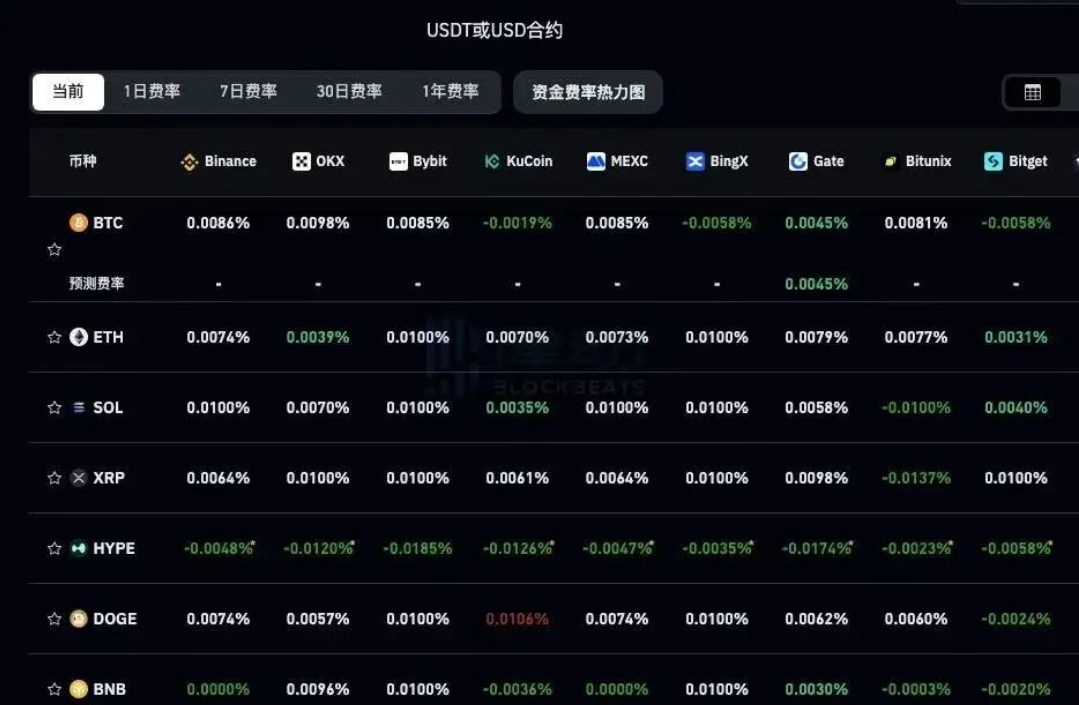
1. From "bearish carnival" to "bullish counterattack": What has happened to the funding rate?
● To understand the significance of this market trend, one must first comprehend the funding rate as an indicator. It is essentially a pressure gauge of bullish and bearish sentiment—when the funding rate is greater than 0.01%, it indicates that the market is generally bullish, and bulls must pay shorts the holding fees; when the rate is less than 0.005%, it reflects general bearish sentiment. Just a few days ago, the market had a completely different face.
● At the beginning of March, when Bitcoin was consolidating around $68,000, the funding rate weighted by open contracts briefly fell to around -0.0022%. This indicated that shorts were paying a small fee to the bulls, and although the magnitude was not large, it reflected the cautious sentiment in the derivatives market.
● At that time, the daily RSI was out of February's oversold zone but remained below the neutral level of 50, indicating that while downward momentum had eased, it did not yet show bullish dominance.
● Earlier in February, the market was even more pessimistic. K33 pointed out in their analysis report that after several months of selling pressure, Bitcoin had entered the most extreme weekly oversold range in history. The options market showed strong bearish sentiment, with investors paying high premiums for downside protection, and negative funding rates indicated that there was sustained demand for deleveraging among bulls or establishing shorts.
● This stubborn sentiment of "shorting on the rise" has nearly become the market norm in recent months. Even as Bitcoin rebounded from $60,000 to above $90,000, the funding rate remained negative or nearly neutral during most of that time, indicating that most people were still maintaining a "do not believe in the rebound" mindset. The bearish sentiment in altcoins was even more resolute and persistent than that for Bitcoin, with funds clearly concentrating on Bitcoin, while other coins bore greater selling pressure.
Then, from March 4 to 5, the situation changed.
● Coinglass data shows that as Bitcoin strongly rebounded above $71,000, the funding rates of mainstream CEX and DEX turned positive, rebounding close to neutral. By the morning of March 5, Bitcoin further broke through $74,000, solidifying this reversal.
● This is an important turning point in sentiment: the persistent, stubborn bearish belief that lasted for several months has finally begun to crumble after prices strongly broke through previous highs. Shorts were either forced to close their positions or join the bulls, leading to a true recovery of market confidence.
2. Resonance of technical and fundamental factors: Why now?
The turnaround in funding rates did not happen in isolation; it formed a perfect resonance with technical breakthroughs.
● From a technical analysis perspective, the trigger for this wave of increase was the price successfully holding above the 100-hour and 200-hour moving averages.
○ Once reclaiming the channel trend line near $67,400, the short-term bias decisively shifted to bullish.
○ Subsequently, buyers broke through a series of resistance levels: reclaiming $70,200, clearing the peaks at $70,940 and $72,174, ultimately targeting the 38.2% Fibonacci retracement level at $74,402. The breakout on March 5 coincidentally validated this technical target.
● However, technical factors are just the surface; the deeper reason is the substantial relief of selling pressure. K33 pointed out in their report that the previous selling pressure mainly came from long-term holders and institutional investors, but recently this selling pressure has begun to alleviate, indicating signs of phased stability in the market.
○ Historical data shows that after such extreme bearish cycles, Bitcoin often sees a phase of rebound. Extreme oversold conditions, deleveraging in derivatives, and recovery of long-term supply all point to opportunities for a phased rebound.
● Meanwhile, positive changes have also emerged on the macro level. With a decline in oil prices and marginal easing of tensions in the Middle East, market risk appetite has started to return. David Morrison, senior market analyst at Trade Nation, points out that Bitcoin has broken through key price levels after approximately four weeks of consolidation, following a previous decline to just above $60,000—its 16-month low. Now the biggest question is whether the upward trend can continue, which means that if there is a pullback, it must hold above $70,000.
3. The deeper meaning of positive funding rates: the market structure is changing
Understanding the changes in funding rates requires looking beyond just the surface values. It is essentially a decisive factor in the battle between bulls and bears.
● When the funding rate is extremely negative, it indicates that the market is bearish, yet it also means that the cost of shorting is high and that there is a massive risk of a short squeeze—bears are making tiny amounts from funding rates while facing unlimited upward risk. Once prices begin to rise, short covering can drive prices even higher, creating a "short squeeze" effect. It is likely that this surge above $74,000 involved a large number of short liquidations and coverages.
● On the other hand, when the funding rate turns positive, it confirms the strength of the bullish trend. It is worth noting that this time, after turning positive, the rate is only "close to neutral," and has not skyrocketed to extreme high levels.
● This might actually be a healthy signal—if the rate were to spike to 0.05% or even above 0.1%, it would suggest that the market is entering a phase of overheating, and a pullback risk might need to be cautioned against in the short term. The current moderate positive rate indicates that there is still room for further increases and that leveraged bulls have not become overly crowded.
● From an institutional perspective, the changes in funding rates also reflect shifts in participant structure. In recent months, even as spot prices rebounded, the perpetual contract market continued to be bearish, largely due to institutions using the rebounds to hedge or establish short positions. However, as prices have broken through previous highs, these strategic shorts are being forced to stop out, leading to a readjustment of institutional positioning.
4. Risks and outlook: What to expect after the reversal?
Even though the funding rate has turned positive and market sentiment has obviously warmed up, it is important to remain somewhat clear-headed.
● First, the sustainability of this surge needs to be validated. As David Morrison mentioned, there is still a risk of false breakouts, so a certain level of caution is needed now. The key support level is at $72,174; if this level cannot be maintained, it will be the first signal that the momentum of this breakout has weakened.
● Second, the options market still shows some cautious signals. Just a few days ago, investors were paying high premiums for downside protection. Although this hedging demand may decrease as prices rise, structural changes in the options market tend to lag behind spot and perpetual contracts and should be monitored continuously.
● Third, on-chain data needs to be followed up on. There have been significant on-chain tracking data showing that 967 Bitcoins were transferred from an unknown wallet to institutional trading platforms; such large transfers may translate into selling pressure. There are also institutions accumulating funds by significantly selling other tokens that could allow for the purchase of over 560 Bitcoins, which may exacerbate market supply tightness. The struggle between bulls and bears is equally intense on-chain.
● From a longer-term perspective, Bitcoin has still accumulated a decline of 16.7% from the beginning of 2026. If this rebound can evolve into a trend reversal, then turning the funding rate from negative to positive is only the first step. Next, we need to see sustained increases in spot trading volume, moderate growth in perpetual contract positions, and more importantly, a macroeconomic environment that does not present new black swans.
The return of the funding rate from negative to neutral appears to be a minor change in a derivatives indicator, but behind it is a complete shift in market sentiment. From "not believing in the rebound" to "being forced to chase high," from "shorting on the rise" to "shifting to bull," this psychological shift is often more significant than the price breakout itself.
Of course, the volatility of the cryptocurrency market will never disappear. As analysts say, capturing every wave requires not only market data but also cross-validation of the microstructure and macro environment. The positive funding rate gives bulls a reason, but the real trend still needs time to validate. For ordinary investors, understanding the logic of this indicator's changes is more important than chasing short-term fluctuations—because in this market, sentiment often precedes price, and the funding rate is the earliest signal light.
Join our community to discuss and grow stronger together!
Official Telegram community: https://t.me/aicoincn
AiCoin Chinese Twitter: https://x.com/AiCoinzh
OKX welfare group: https://aicoin.com/link/chat?cid=l61eM4owQ
Binance welfare group: https://aicoin.com/link/chat?cid=ynr7d1P6Z
免责声明:本文章仅代表作者个人观点,不代表本平台的立场和观点。本文章仅供信息分享,不构成对任何人的任何投资建议。用户与作者之间的任何争议,与本平台无关。如网页中刊载的文章或图片涉及侵权,请提供相关的权利证明和身份证明发送邮件到support@aicoin.com,本平台相关工作人员将会进行核查。


