Written by: Bibi News
The views expressed in this article are solely those of the author and should not be used as the basis for investment decisions, nor do they constitute any investment advice. Readers are advised to strictly comply with local laws and regulations.
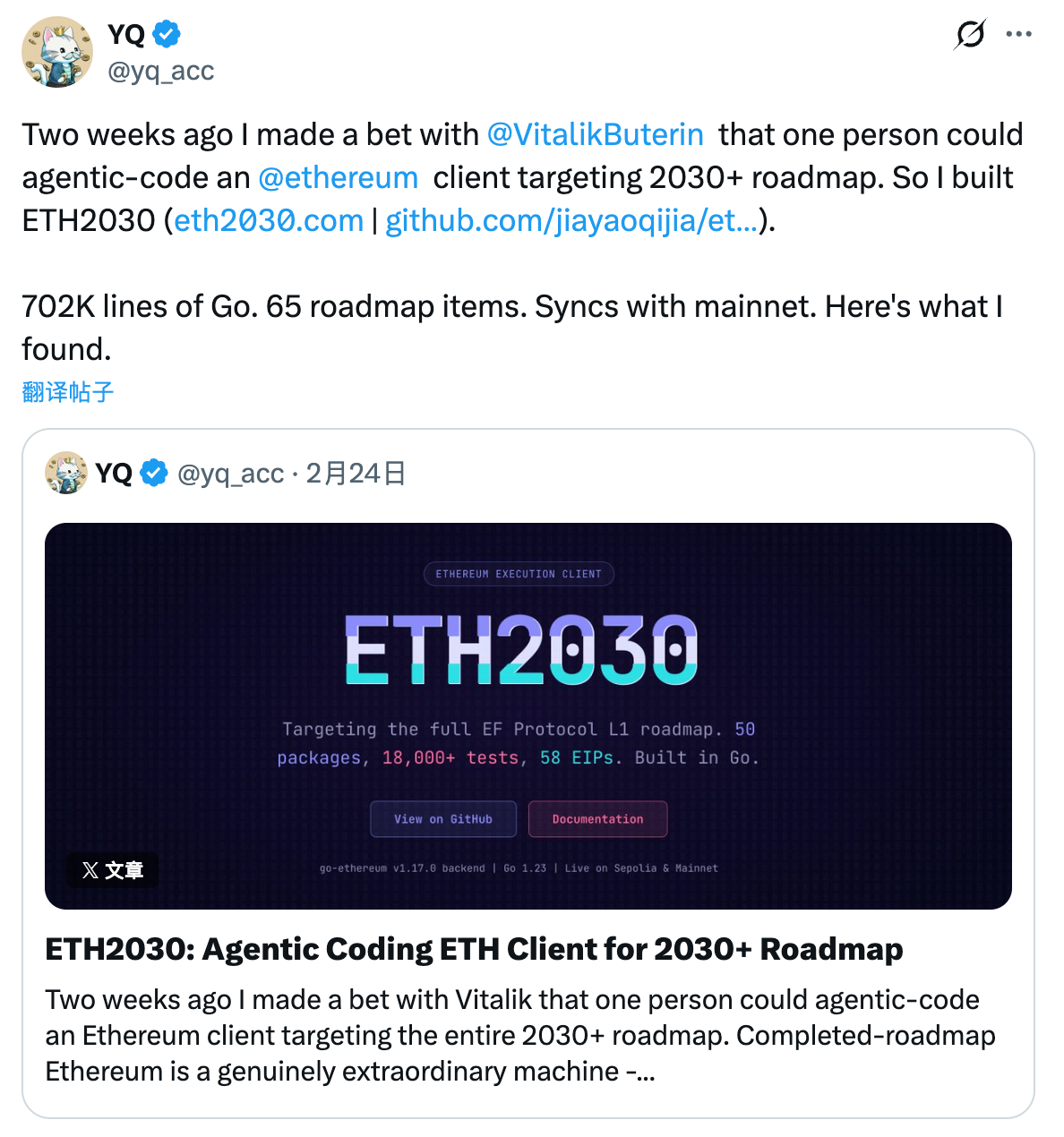
Two weeks ago, Vitalik made a bet with a developer named Yaq: Can one person use AI programming tools to write the entire technical roadmap for Ethereum 2030 + in code?
No one expected this bet would yield results so quickly. But now, Yaq has completed it. 720,000 lines of Go code. It took 6 days, cost $5,750, passed 36,126 official tests, all of which succeeded. The code can compile, run, sync 9,000 blocks per second from the testnet, and connect to the Ethereum mainnet.
This project called ETH2030 may be the largest technical roadmap validation in blockchain history.
6 Days 720,000 Lines
Imagine this scenario: a developer, facing Claude Code (Anthropic's AI programming assistant), wrote 720,000 lines of code in six days.
What does 720,000 lines mean? The Linux kernel has 30 million lines. The Chrome browser has 17 million lines. A complete production-level database has 1 million lines.
Within Yaq's 720,000 lines lies the complete technical blueprint for Ethereum's future five years: full-stack implementations of consensus layer, data layer, execution layer, cryptography parts, zero-knowledge proofs, RISC-V CPU, Verkle trees. These are the most complex parts in Ethereum's plans.
If you tell a software engineer this story, their first reaction is usually: How is this possible?
Because what was done in the past? Assemble a team of ten to twenty people, spending two to three years to create a reference implementation.
But AI changed all of this. Six days, one person, one prompt, one code review process—boom, 720,000 lines of code, able to compile, test, sync the mainnet.
A Super Team of One
This signifies two key changes.
First, costs have decreased by an order of magnitude. Projects that previously required millions of dollars now only cost $5,750. Secondly, the timing for discovering issues has moved forward.
Before Yaq released the code, potential problems were hidden in the specification documents, and no one had truly tried to integrate them all. Now anyone can download the code, see the specific implementation, and raise real questions.
One person using AI is equivalent to having a super team. Yaq validated whether the technical roadmap of a billion-dollar ecosystem is coherent. He exposed the problems hidden deep within the specification documents. He gave the entire community the chance to examine Ethereum's future four years in advance.
But this also exposed the fundamental limitation of AI: no matter what AI can do, it can never make real strategic decisions. Should Ethereum complete this upgrade before 2030? How should the priorities of the roadmap be ordered? Which risks are acceptable? Only humans can answer these questions. Only the Ethereum community can answer.
Yaq's work is to provide a clear framework for this question-answering process. A framework with code, tests, and specific questions.
Challenges of the Theoretical Blueprint
When Yaq stuffed all 65 future upgrades into one code system at once, the perfect blueprint on paper began to reveal challenges at the code level.
Let’s start with cryptography. Yaq wrote the cryptographic part entirely in pure Go language (including BLS signatures, KZG commitments, etc.).
The result was that the speed was 10 to 100 times slower than the professionally optimized version. This isn’t because the code was incorrect; it’s because he intentionally chose a fast verification route. Switching to C or Rust for acceleration would require at least double the development time.
Now everyone can clearly see a key issue: will this speed difference drag the entire system down to a crawl in a real network?
Next is parallel execution. Ethereum wants multiple transactions to run simultaneously, theoretically capable of soaring. But in reality, transactions often conflict with each other, competing for resources.
Even worse, someone might intentionally create conflicts to disrupt the performance of parallel execution. This adversarial risk can only be revealed by actually running the code.
Lastly is the timetable. The 65 upgrades are like a chain; if one link is delayed, all the others have to wait. This fragility, previously hidden in documents that no one had truly tested, has now become something that everyone can discuss and find solutions for in advance.
Yaq did all this not to say the roadmap is unworkable. He wanted to pull these real risks to today, allowing the community to see clearly and understand at the code level, so they can make smarter decisions early.
Challenges of the Next Four Years
There are four years until 2030.
Ethereum needs to complete a transformative upgrade in these four years: increasing processing power from 5 million gas/second to 1 billion gas/second, reducing transaction confirmation from 15 minutes to seconds, allowing ordinary users to independently verify the network with 1 ETH, and even making it possible for Raspberry Pi to run full nodes.
At the same time, it must complete the transition to post-quantum cryptography—nearly 200 million old accounts need upgrades, and 8 stages require precise coordination, with any delays causing a chain reaction.
Meanwhile, competitors like Solana and Monad have already delivered high-throughput solutions in the real world. This is no longer just a technical issue; it's a race against time and confidence.
Yaq simulated the complete Ethereum of five years from now in six days, bringing the issues of 2030 to today.
The code is open-source, and the tests have passed. Now it’s time for the community's engineers, researchers, and cryptographers to deeply examine, find the real bottlenecks, and decide what needs optimization and what needs redesign.
This process may adjust the timetable, but is far better than discovering key design aspects are fundamentally incompatible only in 2028.
A Future Validated Early
Did Vitalik lose the bet? Yaq completed what seemed impossible in just six days.
But on a larger scale, the Ethereum community won. We are no longer just imagining the future based on a paper blueprint; we can download the code, run it, and see what Ethereum will look like in 2030.
We can ask the sharpest questions in advance: Why is this designed this way? What happens under real pressure? Can this assumption hold for four years?
These 720,000 lines of code may become the compass for Ethereum development in the next four years, or they might be significantly rewritten in the community's iterations. But at least, the direction is clear, and the problems are defined.
In the AI era, the boundaries of what one person can do are being continuously broken. What seemed impossible six days ago has now occurred. AI allows us to validate the future at an astonishing speed, providing precise questions rather than just abstract discussions.
Yaq proved that one person + AI can run through what Ethereum will look like in five years, bringing the questions from 2030 to today.
We have the tools to quickly simulate the future, which is both an opportunity and pressure. The opportunity lies in discovering real problems earlier, while the pressure is the need to make decisions faster—because each hesitation allows competitors to advance.
The future is being simulated in advance by our own hands.
免责声明:本文章仅代表作者个人观点,不代表本平台的立场和观点。本文章仅供信息分享,不构成对任何人的任何投资建议。用户与作者之间的任何争议,与本平台无关。如网页中刊载的文章或图片涉及侵权,请提供相关的权利证明和身份证明发送邮件到support@aicoin.com,本平台相关工作人员将会进行核查。