Author: Sanqing, Foresight News
On March 3rd (Eastern Time), the primary season for the 2026 midterm elections in the United States officially kicked off. Voters in Texas, North Carolina, and Arkansas cast their votes first to decide the party nominees for several congressional seats. This early battle, seen as a "barometer for the continuation of the Trump era," not only affects the power dynamics in Congress but is also directly related to the long-awaited clarity in regulation sought by the cryptocurrency industry.
The cryptocurrency industry has mobilized early and significantly, surpassing the efforts made in the 2024 cycle. Fairshake and its affiliated super political action committee (PAC), which includes Protect Progress and Defend American Jobs, had nearly $200 million in cash at the beginning of the year, with total industry investments exceeding $288 million. Their goal is to secure a "pro-crypto Congress" and push for the passage of the CLARITY Act and other remaining legislation, avoiding any delays that could lead to long-standing regrets in an election year.
Three State Primaries: Precise "Sniping" and "Escort" by Crypto PACs
According to data from the political advertising tracking platform AdImpact, the spending on ads related to the Texas Senate primary has already exceeded $122 million, making it the most expensive Senate primary in history.
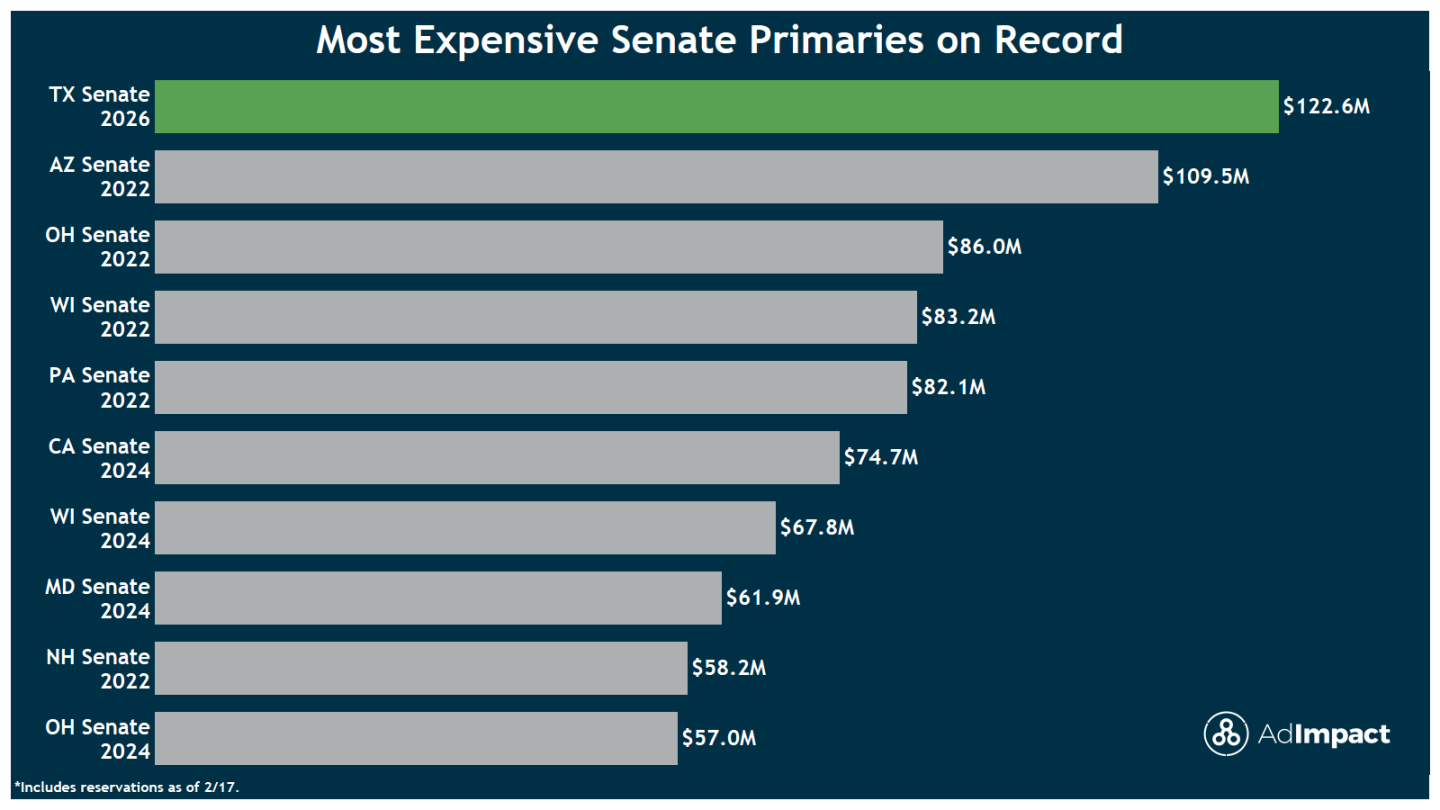
Image source: AdImpact Blogs | Data as of February 27
The political strategy of the cryptocurrency industry has become extremely sophisticated: adhering to the principle of "support those who support crypto, oppose those who oppose," no longer blindly aligning with a single party.
Texas has become one of the most significant battlegrounds for the cryptocurrency industry. Protect Progress has announced a $1.5 million ad spend to publicly oppose Democratic Congressman Al Green.
Green previously voted against the GENIUS Act signed by Trump and has continually obstructed the CLARITY Act, being rated as "strongly opposed to crypto" by Stand With Crypto. His opponent, Christian Menefee, has been rated as "strongly supportive of crypto."
Crypto PACs like Web3 Forward have also provided indirect support of over a million dollars to Democratic Senate candidate Jasmine Crockett through media advertising and other means.
Crockett had previously voted in favor of the GENIUS Act and FIT21 (the predecessor to the CLARITY Act), but explicitly opposed the final version of the CLARITY Act.
North Carolina is similarly embroiled in conflict. Crypto funding has injected $500,000 into Republican challenger Laurie Buckhout to help her challenge the sitting Democratic Congressman Don Davis for the NC-01 district. Davis narrowly defeated Buckhout in 2024, and after this year's redistricting, the district has shifted more towards the Republicans, providing an opportunity for the cryptocurrency industry to effect change.
Meanwhile, sitting Democratic Congresswoman Valerie Foushee faces an intra-party challenge from progressive candidate Nida Allam in the NC-04 primary. Foushee previously accepted crypto-related donations but has shifted this year's primary focus to data centers and AI issues. The cryptocurrency industry seems keen to use this opportunity to further effect change, ensuring that key positions on the House Financial Services Committee are held by more steadfast allies.
Although Arkansas has not seen a huge single investment, as one of the battlegrounds for Senate seats, its primary results will influence the Republics' slim majority in the Senate, which is a core variable for the CLARITY Act facing hurdles in the Senate.
The Effect of Trump's Term: From "Candidate Commitment" to "Presidential Promotion"
At the start of Trump's second term, he listed cryptocurrency as a national strategic priority. He openly declared his intention to make the U.S. the "global crypto capital" and directly named Wall Street banks, stating they "must reach good agreements with the cryptocurrency industry," or else the CLARITY Act would flow to China.
White House crypto policy advisor Patrick Witt bluntly stated that regulatory clarity would unleash "trillions of dollars" waiting to enter the market from institutional funds.
As a result, the cryptocurrency industry's "loyalty" to Trump has soared to unprecedented heights. Some founders have turned to the Digital Freedom Fund and other explicitly pro-Trump PACs, with Gemini exchange co-founders Cameron and Tyler Winklevoss each investing $21 million in Bitcoin.
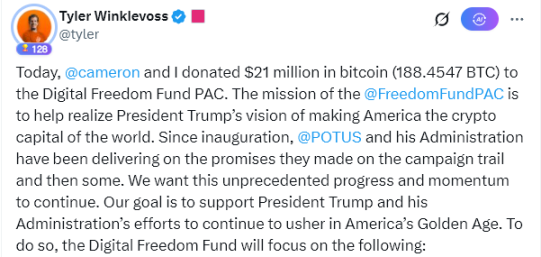
Image source: Tyler's tweet
The industry is no longer satisfied with "bipartisan balance" but is fully focused on consolidating Republican majorities to ensure a seamless connection between Trump's executive orders and legislative agenda.
If the results of the three state primaries favor pro-crypto candidates, it is expected that Trump’s ability to implement crypto policies will be significantly enhanced throughout 2026.
Conversely, if anti-crypto or neutral factions break through, Trump's visions regarding Bitcoin reserves, DeFi regulatory relaxations, and more will face resistance.
Progress of Crypto Legislation: GENIUS is in Place, CLARITY Becomes the "Election Year Gamble"
Currently, significant progress has been made in crypto legislation. The GENIUS Act was enacted by Trump in 2025, providing a clear pathway for USD stablecoins such as USDT and USDC, greatly boosting confidence in the RWA sector.
However, the CLARITY Act remains stalled in the Senate. The House passed the bill in July 2025, aimed at clarifying the regulatory roles of the SEC and CFTC, defining mature blockchain assets, and opening institutional entry channels.
However, the Senate Banking Committee has repeatedly delayed hearings due to controversies surrounding "stablecoin yield rights," "DeFi treatment," and "Trump family conflict of interest clauses."
Trump has personally intervened, and the White House has repeatedly convened closed-door meetings with banks and crypto executives, but the reality of election year looms: after July, Congress will enter "campaign mode," leaving very little time for the CLARITY Act.
If the Democrats regain a majority in the House during the midterm elections or if divisions arise within the Republican Party, the CLARITY Act could fail altogether, even facing regulatory backlash.
PACs like Fairshake have allocated hundreds of millions of dollars to "buy insurance" for that scenario. By "clearing" adversaries through the primaries, they intend to pave the way for a final Senate vote.
Results from the three state districts will be gradually announced today.
免责声明:本文章仅代表作者个人观点,不代表本平台的立场和观点。本文章仅供信息分享,不构成对任何人的任何投资建议。用户与作者之间的任何争议,与本平台无关。如网页中刊载的文章或图片涉及侵权,请提供相关的权利证明和身份证明发送邮件到support@aicoin.com,本平台相关工作人员将会进行核查。