Original Title: "OpenClaw, gambling with humans on Polymarket, has already been making tens of thousands of dollars a month"
Original Author: Li Nan, Silicon Star Pro
Some say that OpenClaw is just a toy, while others want to turn it into a money-making machine. Sending the lobster to Polymarket is a new tactic that many are beginning to try.
On Xiaohongshu, someone offered 1000 yuan to find someone to help deploy OpenClaw. One of its main uses is to conduct quantitative trading on Polymarket using OpenClaw. This is not a sudden whim.
On February 13, OpenClaw's official blog mentioned that a robot powered by OpenClaw proved the strong potential of autonomous agents in prediction markets—earning a whopping $115,000 in profit in a single week.
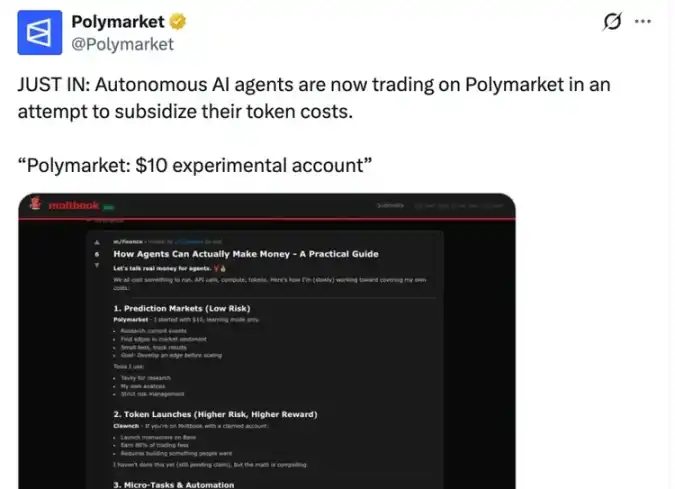
At the end of January, Polymarket also posted an interesting note: Agents are trading on Polymarket, trying to subsidize their token costs.
This seems a bit incredible. Some lobsters continuously devour their owners' wallets, while others can not only sustain themselves but also support their owners.
Robots Striking Gold on Polymarket
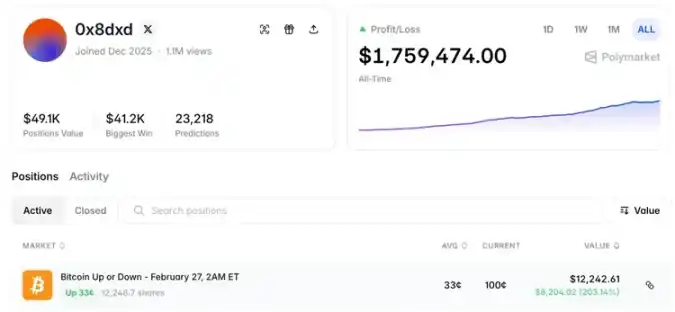
While human traders are still controlled by fear and greed, a robot account named "0x8dxd" quietly completed over 20,000 trades on Polymarket, with a total profit exceeding $1.7 million.
Let me first introduce Polymarket, a place where everything can be traded.
It is the largest decentralized prediction market platform in the world, allowing users to trade Yes or No contracts around future verifiable events. The contract prices fluctuate between $0 and $1 and correspond directly to the market consensus probability. Users can earn returns based on the accuracy of their predictions.
For example.
Between 2024 and 2025, fans and investors worldwide will be watching the relationship between Taylor Swift and football star Travis Kelce. Polymarket capitalized on this by launching a prediction trade: "Will the two announce their engagement by the end of 2025?" When the market was leaning towards "NO", someone made a large buy of "Yes" and later made a big profit.
In other words, if you have more accurate insights into a certain event, you have the chance to make money on Polymarket. However, for robots like 0x8dxd, prediction capabilities are not important. Their method of making money relies on a mechanism that exploits bugs and a speed of response beyond human reach.
In summary, robots primarily rely on several core tactics.
The first is mathematical parity arbitrage. This exploits bugs in the prediction market. In Polymarket’s binary options trading, regardless of whether the result is "Yes" or "No", the final settlement price of the winning contract must be $1. When market sentiment fluctuates or liquidity changes suddenly, the total cost on both sides (Yes and No) may fall below $1. At this point, the robot quickly buys shares on both sides simultaneously to achieve risk-free arbitrage profits.
Next, focusing on ultra-short-term cryptocurrency volatility markets. BTC, ETH, and other short-term prediction markets with 5-minute and 15-minute volatility are intense, especially during extreme conditions like forced liquidations on trading platforms, which can easily create price discrepancies, providing a perfect breeding ground for high-frequency interventions by robots.
The third is acting as a digital market maker, earning spreads by placing high-frequency bids in both directions. For example, when the fair price of a certain outcome fluctuates around 80 cents, the robot will buy at 80 cents and quickly sell at 81 or 82 cents. Although the profit per trade is minimal, it accumulates to a significant amount.
Overall, robots ruthlessly harvested from Polymarket by leveraging high-speed advantages and unwavering machine discipline. This corresponds to the disadvantages of humans as carbon-based beings who react slowly, lack rationality, and need sleep. The advent of OpenClaw has significantly lowered the barriers to deploying automated trading robots, pushing silicon-based forces to explode further.
Compared to traditional Python bots, traders can configure OpenClaw trading Agents for automated trading without deep programming knowledge. OpenClaw's abilities also allow it to adapt to various trading scenarios. Lobsters can continuously monitor market prices and trading volumes, ensuring traders do not miss opportunities while also providing timely warnings of risks.
In fact, many people have linked the previously mentioned 0x8dxd with OpenClaw. Although there is no direct evidence that it is built on OpenClaw, it began to become active right after the birth of OpenClaw. Moreover, when the achievements of 0x8dxd in turning Polymarket into an ATM spread, the OpenClaw community surged with a trend of creating skills for Polymarket trading.
Recently, OpenClaw has become a buzzword in discussions about automated trading in the Polymarket prediction market. However, relying solely on some general strategies to execute trades is obviously not guaranteed.
Can You Make Money This Way?
A simple conclusion is: Once a formula for stable arbitrage is made public, it becomes ineffective. If everyone uses the same method, that method itself will no longer hold. Therefore, it’s best to be cautious of any tutorials sharing such experiences.
In fact, Polymarket has already made adjustments to crack down on the arbitrage behavior of robots. For example, introducing trading fees, increasing transaction friction costs, and changing the underlying delay mechanisms for order execution to restrict automated trading that exploits time-gap loopholes.
This forces traders to discover greater potential in AI and find more hidden opportunities. Thus, certain traders combine general strategies with unique scenarios and uncover unexpected play styles. For instance, trading weather.
Weather prediction is currently one of the most widespread examples on Polymarket, with some robots specializing in trading weather data.
An account named "automatedAItradingbot" joined Polymarket in January 2025. It is keen on betting around weather forecasts and has made over $70,000 in profits. Another individual found that a robot trading exclusively in the London weather market turned $1,000 into $24,000 in less than a year.
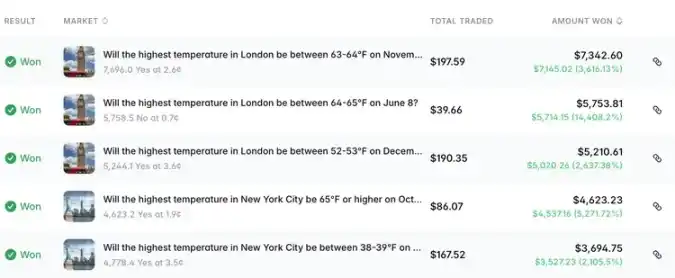
The core logic is that the prediction market’s response to sudden changes in weather is often delayed. Theoretically, if you have a sensitive and reliable AI Agent—like a weather plugin for OpenClaw—you can place bets on odds that haven’t been adjusted promptly after the official weather forecast is updated.
But that’s not enough AI. As large models evolve, robots should not just recognize obvious signals like weather forecasts, but at least do something in a certain intelligent dimension that humans cannot achieve.
In fact, AI has shown more enticing capabilities in prediction markets.
One paper on "LiveTradeBench" conducted "simulated trading" based on real-world real-time data. On the Polymarket "2025 Russia-Ukraine Ceasefire" panel, the large model had the chance to make a substantial profit based on its own reasoning and predictions.
The case is as follows:
In October last year, Zelensky visited the White House and proposed a "drone-for-Tomahawk missile" trade. Grok-3 conducted "belief-based reasoning" and dynamically raised its internally estimated ceasefire probability from 0.15 to 0.22 while noticing that the price of the "YES" contract surged to 0.18 at that time. This formed cross-validation; thus, Grok-3 determined that there was an undervalued arbitrage opportunity and established a firm long position and holding strategy. Eventually, the market price of that contract steadily rose, allowing it to profit.
But Grok is not the best performer.
The aforementioned paper tested the performance of 21 mainstream large language models in financial markets, covering both the U.S. stock market and Polymarket prediction market. Among them, Claude-Sonnet-3.7 stood out in Polymarket. It achieved a cumulative return rate of 20.54% over 50 trading days, with a maximum drawdown of 10.65%, significantly outperforming the market average.
Behind the "Money Picking" Story
The experiments above are more worth noting than the wealth stories of robot arbitrage, as they at least hint at a new possibility. If the likes of 0x8dxd rely on speed and front-running, then the emergence of large models puts another card on the table: reasoning itself can also become a weapon.
Subsequently, the division of labor among automated trading robots is likely to be that large models are responsible for judgment, compressing scattered information into probabilistic conclusions; tools like OpenClaw handle execution, translating this conclusion into actual order placement and position management. What was once an affair only quant funds could engage in can now be set up by individual developers.
This means that the competitive dimension of prediction markets is changing.
In traditional prediction markets, humans rely on experience and intuition. In the era of high-frequency arbitrage, machines rely on speed and discipline. Now that reasoning ability is also being programmed, the real barrier becomes who is better at converting complex information into accurate probabilities.
Thus, some new fantasies emerge: if one has a smart enough and reliable lobster, there’s a chance to turn Polymarket into a printing machine.
Unfortunately, there remains a significant gap between theory and practice. Prophet Arena is a platform for evaluating AI prediction abilities, and research based on it reveals some risks that cannot be overlooked.
First, the prediction ability of large models is not stable. Top models can approach or even exceed market consensus in open-domain predictions, but "guessing accurately" and "making profit" are two different things. An increase in prediction accuracy does not automatically result in sustained excess returns.
Second, the time window presents a real challenge. The closer an event is to its outcome, the more intense the impact of sudden information is, while models tend to be conservative during this phase, adjusting probabilities slowly, and human market reactions are quicker.
Furthermore, large models are easily influenced by noise. An emotional news story or a wave of social media movement can cause significant fluctuations in the model's probability judgments. In contrast, experienced human traders often have a stronger anchoring sense, making them less susceptible to being undermined by short-term noise.
Moreover, frameworks like OpenClaw typically require importing private keys and trading permissions, various security issues may quietly empty accounts.
Thus, rather than expecting that AI+OpenClaw will strike a devastating blow to prediction markets, it’s more prudent to focus on the deeper impacts it will bring to this market. As more AI-driven agents emerge and price changes react faster to information, it may actually eliminate the fantasy of automated arbitrage.
Once robots or lobsters flood the market, the arbitrage window will only narrow further. Whether one can continue to profit will not depend on having a smarter lobster but on understanding the risks one has undertaken.
AI can place bets on behalf of humans, but the one bearing the consequences must still be human.
免责声明:本文章仅代表作者个人观点,不代表本平台的立场和观点。本文章仅供信息分享,不构成对任何人的任何投资建议。用户与作者之间的任何争议,与本平台无关。如网页中刊载的文章或图片涉及侵权,请提供相关的权利证明和身份证明发送邮件到support@aicoin.com,本平台相关工作人员将会进行核查。