With the help of tokenization, will allowing ordinary users to enter unicorns like SpaceX before the bell ring be the new future proposition of RWA?
Written by: Frank
Since 2026, there seems to have been no new battles in RWA.
Looking back over the past 5 years, from stablecoins to U.S. Treasury bonds, to funds and U.S. stocks, mainstream assets have gradually been introduced into the on-chain system, becoming tradable new financial products through tokenization, which has for the most part clarified the on-chain trading logic of TradFi secondary market assets.
However, the primary market, the place where super unicorns like SpaceX, ByteDance, OpenAI, and Anthropic are hidden, still has its doors tightly closed. While users can seamlessly trade Tesla on-chain, it is difficult to buy a "ticket" to SpaceX before the bell rings.
However, since last year, the boundaries have indeed been tested: Robinhood is experimenting with tokenized products of private equity like OpenAI in Europe, Hyperliquid has launched perpetual contracts on SpaceX, and this week MSX introduced on-chain Pre-IPO share issuance of unicorns like SpaceX and ByteDance.
Although these actions follow different paths, they point in the same direction: Pre-IPO, this previously highly closed primary market, is trying to embrace on-chain.
1. Pre-IPO must embrace on-chain
To understand the significance of on-chain for Pre-IPO, we must clarify the unique role that "Pre-IPO" plays in the lifecycle of the capital market.
For a long time, well-known investment myths such as Masayoshi Son’s 6-minute decision to invest in Alibaba, a16z’s early investment in Meta (Facebook), and Sequoia’s successful bet on Coinbase have essentially been telling the same story: to position yourself as an institution before high-quality assets go public, capturing the "spread" of valuation jumps from private equity to public market.
Objectively speaking, this is also what they deserve.
After all, early-stage venture capital is a "probability game." a16z may have invested in hundreds of failed social networks before hitting one Facebook, and Masayoshi Son missed or wrongly invested in countless internet companies before and after betting on Alibaba… Ultimately, bearing extremely high trial-and-error costs, enduring exit cycles of up to a decade, and achieving excess returns from a few successful projects to cover overall losses is the basic business logic of venture capital, as well as the "risk premium" that institutional capital should obtain.
However, when we talk about Pre-IPO (before the listing), the logic undergoes a qualitative change.
Because this is a distinctly different stage, as the "last mile" before going public, the company has grown into super unicorns like SpaceX, ByteDance, OpenAI, and Anthropic, its business model is extremely mature, and the revenue path is clear. Entering at this point, compared to the risks of early-stage venture capital, the risks have significantly decreased, even possessing a certain level of certainty akin to a quasi-secondary market.
Paradoxically, in this highly certain phase, the returns before and after the IPO are often still astonishing. For example, two representative stocks in 2025: Figma's IPO issue price was $33, and its first-day closing price was $115.5, an increase of over 250%, while Bullish's first-day increase was also close to 290%.
This means that those institutions that secured shares before the bell rang took away the richest slices of the cake with very low risk.
Regrettably, even with secondary trading platforms like Forge and EquityZen for unlisted company shares, they generally adopt a peer-to-peer OTC matching model, with minimum investment thresholds often starting in tens of thousands of dollars, and only for accredited investors, ordinary users can still only buy after the IPO bell rings in the secondary market.
From the perspective of capital efficiency, this is itself an inefficient structure: on one side, unicorn valuations continue to soar, while ordinary investors are kept outside the high walls. Consequently, a natural question arises:
Since blockchain can lower the entry barriers to U.S. stocks and achieve asset fragmentation, can it also allow users to share the valuation growth dividends of unicorn assets transitioning from private equity to IPO through tokenization before they are listed?
2. Pathway Game: Perpetual Contracts or Tokenized Mirrors?
The on-chain attempts for Pre-IPO have currently diverged into two distinctly different paths.
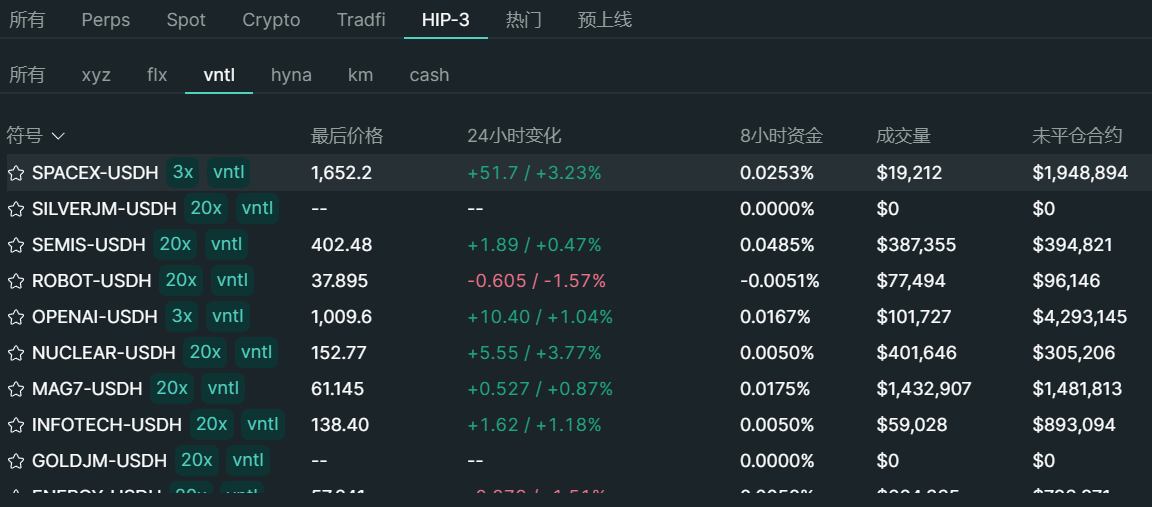
One is the perpetual contract model, represented by Hyperliquid, where developers can customize and deploy perpetual contract products for Pre-IPO assets like OpenAI and SpaceX based on the HIP-3 framework. The core logic is to combine Pre-IPO with perpetual contracts, not involving actual equity delivery but essentially bypassing the equity itself, only providing price exposure, allowing users to bet on the valuation rise and fall of companies like SpaceX and OpenAI.
The advantages are also obvious, such as extremely low entry thresholds, no need for accredited investor certification; transactions are completed instantly, with no complex equity delivery processes, etc.
Actually, at a mechanical level, we can simply understand it as a bet agreement regarding valuations of unicorns like SpaceX, where liquidity is activated by market makers and leverage mechanisms. Because of this, one must always pay attention to whether the oracle is stable, whether the risk control mechanism is reliable, and whether the liquidation in extreme situations is fair.
In addition, from the compliance perspective, whether this model constitutes a disguised securities issuance remains in a gray area in major global jurisdictions.
The other path, however, is far more challenging: under the premise of compliance, allowing users to actually hold tokenized equity assets rather than merely trading prices.
In June 2025, Robinhood's European trial and MSX's launch of a Pre-IPO section in March 2026 pointed towards this direction—both platforms have reached strategic cooperation with U.S. compliant asset tokenization platform Republic, aiming to tokenize real Pre-IPO equity through an SPV (Special Purpose Vehicle) structure, allowing investors to hold legally protected equity shares.
The core value of this model lies in the tokens corresponding to real existing equity, held by regulated third-party custodians, having legal and asset support foundations.
Specifically, Republic uses an "indirect holding SPV structure" to establish an offshore SPV holding the shares of the underlying company and then tokenizing the rights of the SPV to distribute to investors. Although this is still indirect holding, compared to purely derivative products, this model at least establishes a traceability chain of "token→SPV→equity."
Of course, the implementation of this model heavily depends on compliance infrastructure, needing to operate under regulatory frameworks like the U.S. SEC, and collaborate with licensed custodians (such as BitGo Trust Company) to ensure asset safety and legal validity, which also signifies that it is not just product innovation, but a systematic project.
Overall, these two paths represent two distinctly different value orientations: the former (perpetual contracts) is closer to the efficiency logic of DeFi, pursuing extreme liquidity and low thresholds, at the cost of a lack of real connection with the underlying assets; the latter (tokenized equity mirror) is more aligned with the institutional logic of TradFi, with the challenge being the construction of the compliance framework.
However, regardless of which path is chosen, a consensus is being formed that through tokenizing unlisted equity, a "quasi-primary market" situated between primary and secondary is taking shape.
3. From Robinhood to MSX, the Global Bridge of the "Quasi-Primary Market"
The explosion of a market requires not only grand narratives but more critically, entry-level products.
From a technical perspective, tokenization technology has undergone years of engineering validation, with smart contracts, oracles, and on-chain compliance frameworks all possessing the capability to support complex financial products; from an application perspective, DeFi and TradFi have completed initial integration, and global users are increasingly accustomed to sharing the most scarce growth dividends of high-quality assets in a decentralized, permissionless manner.
It can be said that the on-chaining of Pre-IPO assets is at a historical juncture of taking the final step. However, purely DeFi protocols often struggle to independently accomplish user education, compliance connection, and large-scale capital influx, thus at this point, a blockchain infrastructure that can connect traditional financial genes often becomes the most crucial variable between narrative and implementation.
Therefore, looking back, Robinhood's attempt in June 2025 is of profound significance.
As the global benchmark for internet retail brokerage, it allows European users to participate in on-chain share trading of star unicorns like OpenAI and SpaceX with remarkably low thresholds, marking the first time a mainstream brokerage has clearly positioned itself towards the on-chain Pre-IPO market, validating that regulatory frameworks can be flexibly adapted while proving that there is real and strong demand from everyday users for such products.
But Europe is just the beginning. The larger and faster-growing Asia-Pacific market also harbors significant incremental space, and here, there is still a need for a truly meaningful entry-level platform.
This is precisely why MSX’s newly launched Pre-IPO section is worth paying attention to.
On March 2, MSX cooperated with Republic, which originally supported Robinhood's European compliance framework, replicating this validated path in the Asia-Pacific market: the first batch of tokenized equity subscriptions for top unicorns like SpaceX, ByteDance, Lambda Labs, and Cerebras Systems has already opened, with a minimum threshold of only 10 USDT.
To some extent, MSX is playing the role of an "Asian Robinhood"—connecting the scarce equity before the bell with global liquidity after the bell using compliant tokenized structures in the relatively complex regulatory environment of the Asia-Pacific market, bridging over that originally hardest to cross "last mile."
From a broader perspective, the on-chaining of Pre-IPO has never only been a one-sided request from ordinary users, but essentially a mutual endeavor:
Ordinary users need a genuinely equitable entry point to share in the growth dividends of the world’s top unicorns before the bell, rather than waiting outside the secondary market;
Private equity and early shareholders also crave to introduce unprecedented global incremental funds, using on-chain liquidity in exchange for diversified exit options for their holdings;
The demands from both ends resonate perfectly.
Thus from Robinhood to MSX, one in Europe and one in Asia, it indeed illustrates that the Pre-IPO market is gradually transitioning from the primitive form of "peer-to-peer matching" to the tokenization era of "low threshold, high efficiency."
4. Conclusion
The maturity and widespread adoption of underlying technology do not immediately translate into explosive product growth, but when enough accumulation occurs, the delayed wave of innovation can hit harder.
In this sense, on-chain Pre-IPO becoming a mainstream asset class in the next 3-5 years is not without basis: blockchain technology has reached a point where tokenization infrastructure possesses the engineering capabilities to support complex financial products, on-chain compliance frameworks are gradually becoming clearer, and the bilateral trust between institutions and users is slowly but surely being established.
However, the establishment of logic does not equate to the natural occurrence of breaking the deadlock.
Whether the compliance pathway is sufficiently clear, whether the risk control mechanism is genuinely reliable, and whether genuine liquidity can be effectively matched between institutions and retail investors—each of these is a necessary condition that cannot be absent. More importantly, it is not just Robinhood and MSX; there need to be more platforms willing to bear the costs of being "the first to eat the crab," paving the way with real products and real users to provide a replicable route.
In 2026, whether the on-chaining of Pre-IPO will be a fleeting concept game or the true starting point for reshaping the entry rules of capital markets, we will know soon.
免责声明:本文章仅代表作者个人观点,不代表本平台的立场和观点。本文章仅供信息分享,不构成对任何人的任何投资建议。用户与作者之间的任何争议,与本平台无关。如网页中刊载的文章或图片涉及侵权,请提供相关的权利证明和身份证明发送邮件到support@aicoin.com,本平台相关工作人员将会进行核查。