A voice from Mar-a-Lago in Florida instantly shattered the calm weekend of global investors.
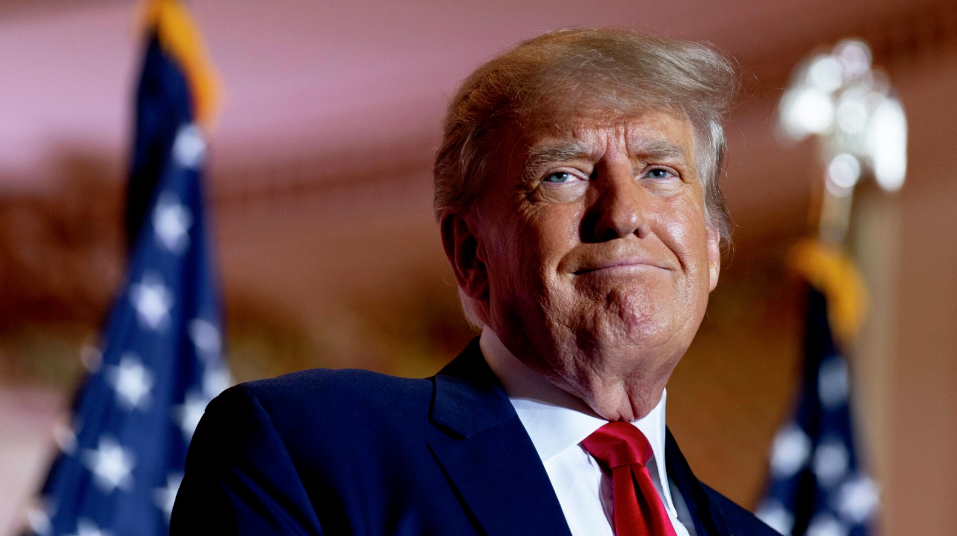
“The real tsunami has not yet arrived; the real waves of impact are coming soon.” U.S. President Trump issued this vividly graphic warning when discussing military actions against Iran. This was not routine diplomatic rhetoric, but rather, a "risk pricing model input variable" that market traders dissected overnight.
From air raid sirens in Tehran to wrecked oil tankers in the Strait of Hormuz; from the sudden collapse of Bitcoin to long lines outside gold shops—within the past 48 hours, the fuse of the Middle Eastern powder keg was ignited once again, and the world is using real money to place bets on this “tsunami.”
1. "The War of Four Weeks" and "No Negotiations": The Air Collision between the U.S. and Iran
● At 9 PM on March 1, the night sky over Tehran was torn apart by explosions. Some facilities of the Iranian Islamic Republic Media Organization were hit, and air raid sirens echoed throughout the city. Almost simultaneously, the U.S. Central Command confirmed that airstrikes against targets in Iran were ongoing. This was not a limited retaliation of “strike and withdraw.”
● On March 2, Trump admitted in a phone interview that three U.S. soldiers died in Iran's retaliatory actions. His exact words carried a rare caution: “These are amazing people, and unfortunately, this situation may happen again.” He provided a timeline for upcoming actions: the military operations against Iran are expected to last about four weeks. “Iran is a large country, it will take about four weeks,” he said.
● However, while Trump released the signal of “four-week war,” he also threw out another confusing olive branch to the public. He claimed that the new Iranian leadership wants to resume negotiations, “They want to talk, and I agree to talk.”
● A few hours later, Iran's Supreme National Security Council Secretary Larijani publicly stated: Iran will not negotiate with the U.S. The door was firmly shut.
● Tehran took action to prove another thing—despite Supreme Leader Khamenei being killed in the airstrike on February 28, there was no power vacuum in the transfer of power and military retaliation. The interim leadership committee has held its second formal meeting, conducting at least nine rounds of strikes against U.S. bases, covering 27 U.S. military installations in the Middle East and surrounding areas.
● An even deadlier move occurred in the Strait of Hormuz. The Iranian Islamic Revolutionary Guard announced a ban on any vessels passing through this global oil transport "main artery" and claimed that three violating British and American oil tankers were hit by missiles. One fifth of the world’s maritime oil was put on hold.
2. Surge in Oil Prices and Gold Frenzy: Traditional Assets’ Stress Response
● On Monday, March 2, global financial markets opened in panic. International oil prices soared like wild horses. Brent crude oil futures jumped as much as 13% at the start, breaking above $82 per barrel; WTI crude oil also rose by more than 10%. This was not a simple emotional outburst—the blockade of the Strait of Hormuz directly threatens the transport of 20 million barrels of crude oil per day. Shipping giant Maersk announced the suspension of all routes through the Strait, and many Japanese shipping companies followed suit.
● “The key issue is how much supply disruption there will be, how long it will last, and how major powers will respond?” The question posed by Daniel Yergin, Vice President of S&P Global, voiced the collective anxiety of the market.
● Saudi Arabia urgently shut down its largest refinery, and Qatar halted liquefied natural gas production. Ironically, on the same day of the fierce battles, OPEC+ announced that eight major oil-producing countries would increase production by 206,000 barrels per day starting in April. This was an absurd hedge between "capacity release" and "transport paralysis"—the increased oil simply could not be transported out.
Gold staged a different scene.
● As the ultimate representative of a safe-haven asset, London spot gold surged after the market opened on March 2, once reaching $5,400 per ounce, with a year-to-date increase of 25%. The world's largest gold ETF—SPDR saw its holdings first exceed 1,100 tons, with continuous capital inflow since February 18.
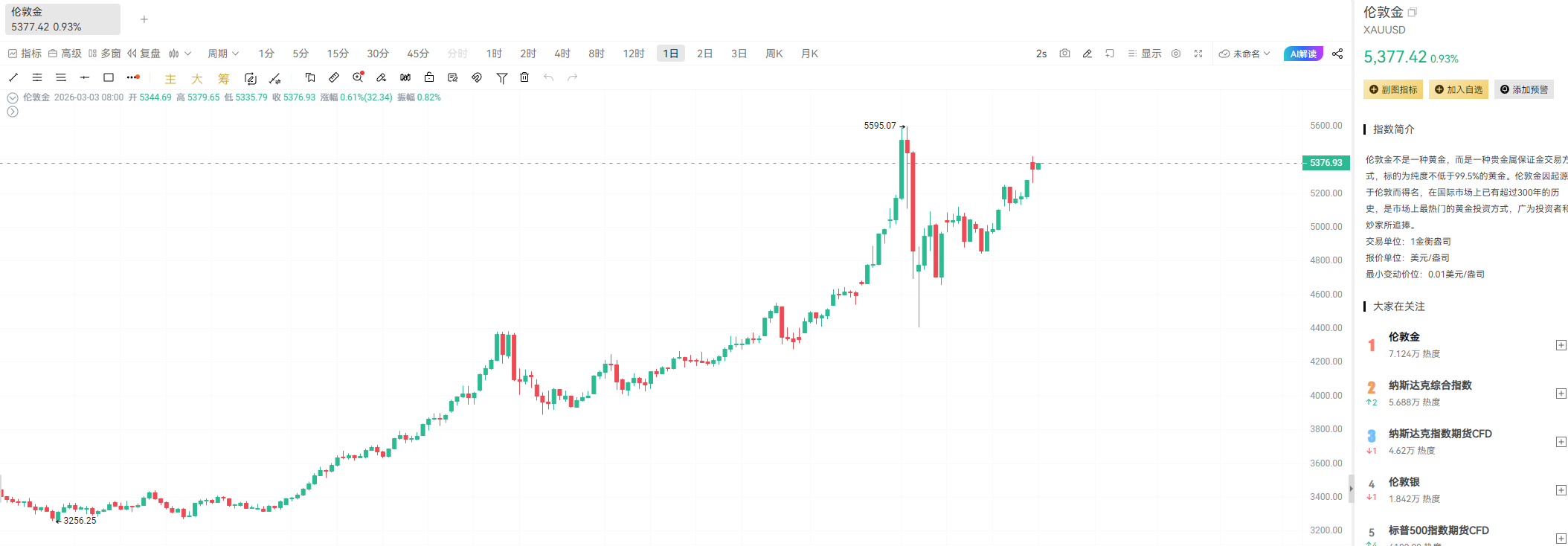
● Qiu Rui, Senior Vice President of the Research and Development Department of Dongfang Jincheng, pointed out that the recent rise in gold prices was mainly driven by a sharp increase in risk aversion, and that short-term volatility would highly depend on the intensity of Iran's counterattacks. However, in the medium to long term, the reconstruction of the global order under the "America First" principle, the weakening of the dollar's credit, and central banks' continued gold purchases have already laid a solid stone for the rise of gold.
3. Bitcoin's "Stress Test": The Illusion and Reality of Digital Gold
In the face of warfare, the cryptocurrency market underwent a brutal “stress test.”
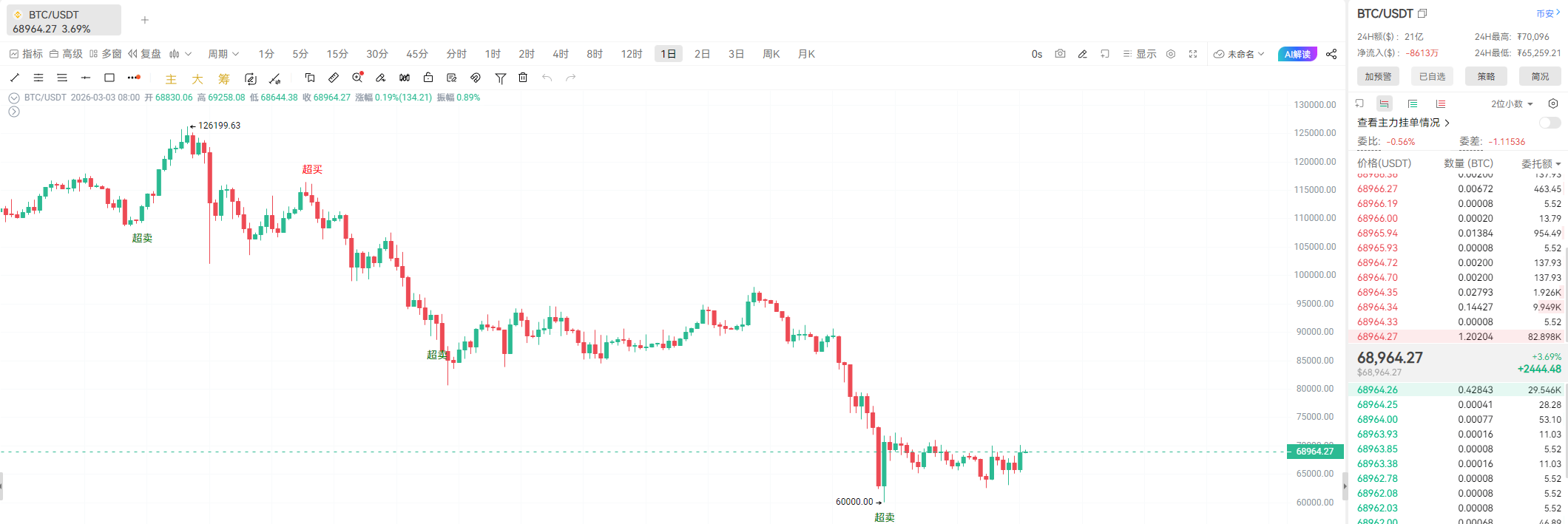
● On February 28, after news of the joint U.S.-Israeli military strikes, Bitcoin plummeted by $2,500 in 45 minutes, briefly breaking below the $63,000 mark. More than $200 million in long positions evaporated within an hour, and the total market capitalization of the entire crypto market shrank by approximately $72 billion. Mainstream exchanges like Binance and Coinbase sold off over $3.5 billion in Bitcoin within 20 minutes, exacerbating the market panic.
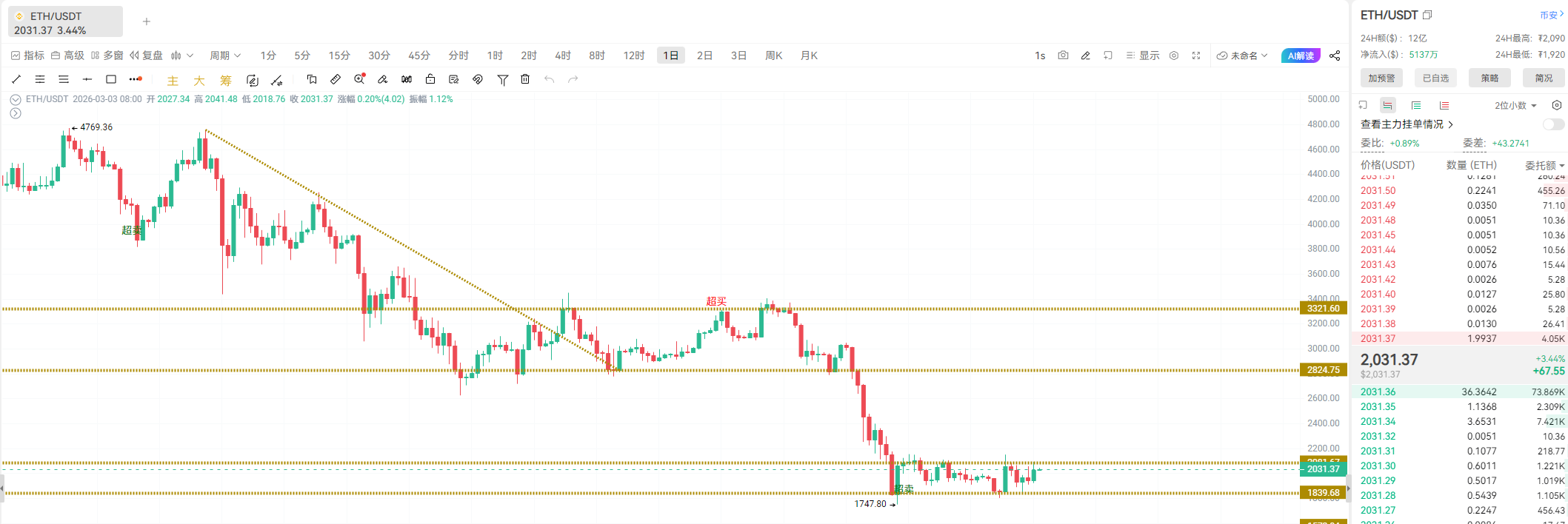
● Ethereum suffered an even greater decline, briefly falling below the $1,900 mark.
This crash punctured a long-standing narrative myth: Is Bitcoin “digital gold”?
● At least during this round of geopolitical crisis, the answer is negative. When real demand for safe haven arises, the first choice for funding remains gold, rather than a crypto asset that requires a network, electricity, and trading depth support.
● A market analyst pointed out that Bitcoin's severe reaction was precisely because it is the most liquid asset traded 24/7—“It was significantly exposed to the panic selling over the weekend.”
However, the subsequent plot twisted.
● As of the evening of March 2, Bitcoin had rebounded to around $66,300. The Bitcoin ETF in the U.S. recorded over $1 billion in net inflow in the past three trading days, seen by CryptoQuant as the “first positive signal after months of stagnation.”
● However, bullish and bearish opinions remain intense. Some traders believe that if the Strait of Hormuz continues to be blocked, soaring oil prices will push up inflation in the U.S., thereby affecting the pace of the Fed's interest rate cuts—which is not good news for risk assets. Pessimists even warn that Bitcoin could pull back 40%-50%, falling to a range of $40,000 to $45,000.
4. Major Powers’ Mediation and Future Variables: Where are the Boundaries of the Tsunami?
● The "four weeks" mentioned by Trump is not just a casual figure. During the Iraq War in 2003, the U.S. also claimed "quick victory," only to become mired in a quagmire for eight years. Now, Iran's counter-offensive has continued for nine rounds, and U.S. military bases are facing a wide range of attacks simultaneously for the first time.
● On March 4, U.S. Secretary of State Rubio, Secretary of Defense Hegseth, and CIA Director Ratcliffe will testify to Congress about Iran's actions. There is a rising chorus within the Democratic Party calling for the invocation of the War Powers Act—indicating that the president does not have the authority to bypass Congress to launch military actions of this scale.
● For investors, the real challenge has never been determining “to strike or not to strike,” but rather finding executable anchor points in uncertain times.
○ First, the passage conditions in the Strait of Hormuz will directly determine the short-term direction of oil prices. If the blockade continues, international oil prices are likely to break above $100.
○ Secondly, whether the logic of gold as a safe haven will be interrupted by profit-taking. The tug-of-war around the $5,400 mark has reflected the market's fragile sentiment.
○ Third, Bitcoin needs to prove itself between the “safe haven narrative” and “risk assets.” Whether the inflow of ETF funds can hedge against macro tightening expectations still needs observation.
5. Finding the Ark Amid the Tsunami
On the night of March 2, the explosions in Tehran may have temporarily ceased, but the nerves of global capital remain taut.
● Trump’s phrase “the real tsunami has not yet come” is both a threat and a prophecy. For crude oil traders, the tsunami implies a new equilibrium above $80 per barrel; for gold investors, the tsunami is a new high point after $5,400; for the crypto market, the tsunami represents the ultimate test of the “digital gold” narrative.
● Historical experiences repeatedly warn the market: in geopolitical conflicts, the most dangerous element is not the known risks, but the imaginations amplified by emotions. When the term “tsunami” flows from the White House to media headlines and then into trading terminals, it has already been imbued with a weight far beyond its literal meaning.
● The real tsunami has not yet come, but the ripples in the market have already begun to reshape the flow of wealth.
Join our community to discuss together and become stronger!
Official Telegram community: https://t.me/aicoincn
AiCoin Chinese Twitter: https://x.com/AiCoinzh
OKX Benefits Group: https://aicoin.com/link/chat?cid=l61eM4owQ
Binance Benefits Group: https://aicoin.com/link/chat?cid=ynr7d1P6Z
免责声明:本文章仅代表作者个人观点,不代表本平台的立场和观点。本文章仅供信息分享,不构成对任何人的任何投资建议。用户与作者之间的任何争议,与本平台无关。如网页中刊载的文章或图片涉及侵权,请提供相关的权利证明和身份证明发送邮件到support@aicoin.com,本平台相关工作人员将会进行核查。