Source: Wintermute
Written by: Jasper De Maere
Translated and organized by: BitpushNews
Bitpush Note:
As a leading market maker in the crypto industry, Wintermute handles hundreds of billions of dollars in trading volume daily. Compared to ordinary researchers, they can penetrate the fog and see the most genuine flow of retail capital. In their latest report, Wintermute has presented a warning sign for the crypto community: the "retail faith" that once supported the crypto market is now wavering. In the past, cryptocurrencies and stocks typically moved in tandem, but starting from the end of 2024, this relationship has completely reversed—retail investors are now faced with a "choose one" question between the two.
Here is the main text:
Retail activity drives the cryptocurrency market. Through speculation, reflexive dip-buying, and agile capital rotation in the token world, retail investors have defined every major market cycle. However, new data indicates that the relationship between retail and cryptocurrencies is changing. For some time, we have observed that the stock market has been attracting retail attention at the expense of altcoins. New data from JP Morgan’s strategy department, combined with our own liquidity data, now indicates that stocks and cryptocurrencies are increasingly becoming complementary risk assets.
Key Insights
Reversal phenomenon: Retail investment activity in cryptocurrencies and stocks used to move in the same direction. However, since the end of 2024, the two have exhibited a reverse relationship: when retail buys stocks, they perform quietly in the cryptocurrency market, and vice versa.
Volatility premium compression: The volatility premium of cryptocurrencies relative to stocks was once its biggest attraction to retail, but it is now structurally compressing, and volatility is no longer a diversification feature of cryptocurrency investments.
Technical driving factors: Some less-discussed technical reasons have accelerated this shift, such as easier access to cryptocurrencies dismantling the "closed audience" effect; meanwhile, analysis driven by large language models (LLMs) is closing the cognitive advantage gap in the stock market, a phenomenon that has yet to occur in the cryptocurrency space.
Traditional indicators failing: Traditional leading indicators of crypto risk appetite (such as M2 money supply) are failing. Investors should increasingly view cryptocurrencies through the lens of a multi-asset portfolio, similar to how they handle other mature asset classes.
Reversal Phenomenon
By overlaying Wintermute's proprietary crypto retail liquidity data with JP Morgan’s retail stock inflow data, we gained a new perspective on observing the relationship between retail stock and crypto activities.
Historically, both have moved in sync until the end of 2024. At that time, risk appetite was high, driving simultaneous buying in both, as they served as outlets for excess capital (see M2) and risk appetite to some extent.
However, since the end of 2024, this relationship has broken down: as retail poured into the stock market at an unprecedented rate, they have remained inactive in cryptocurrencies, and the degree of divergence between the two has now reached historical extremes.
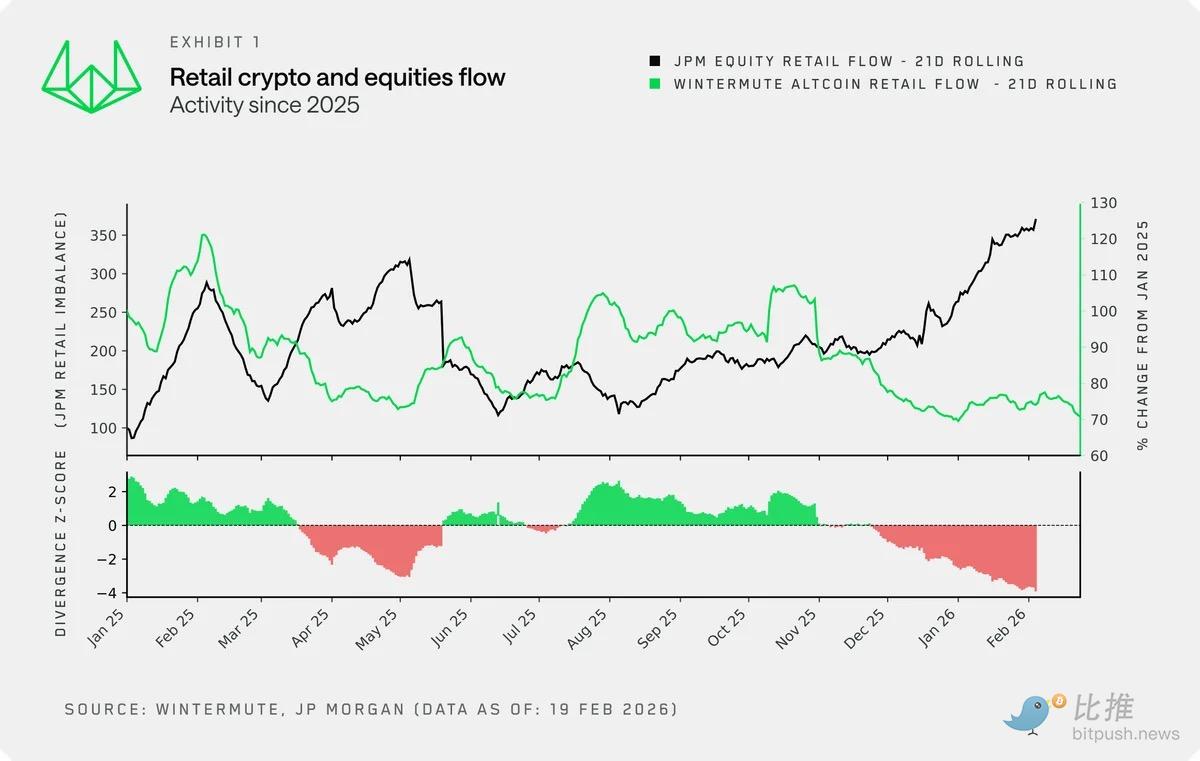
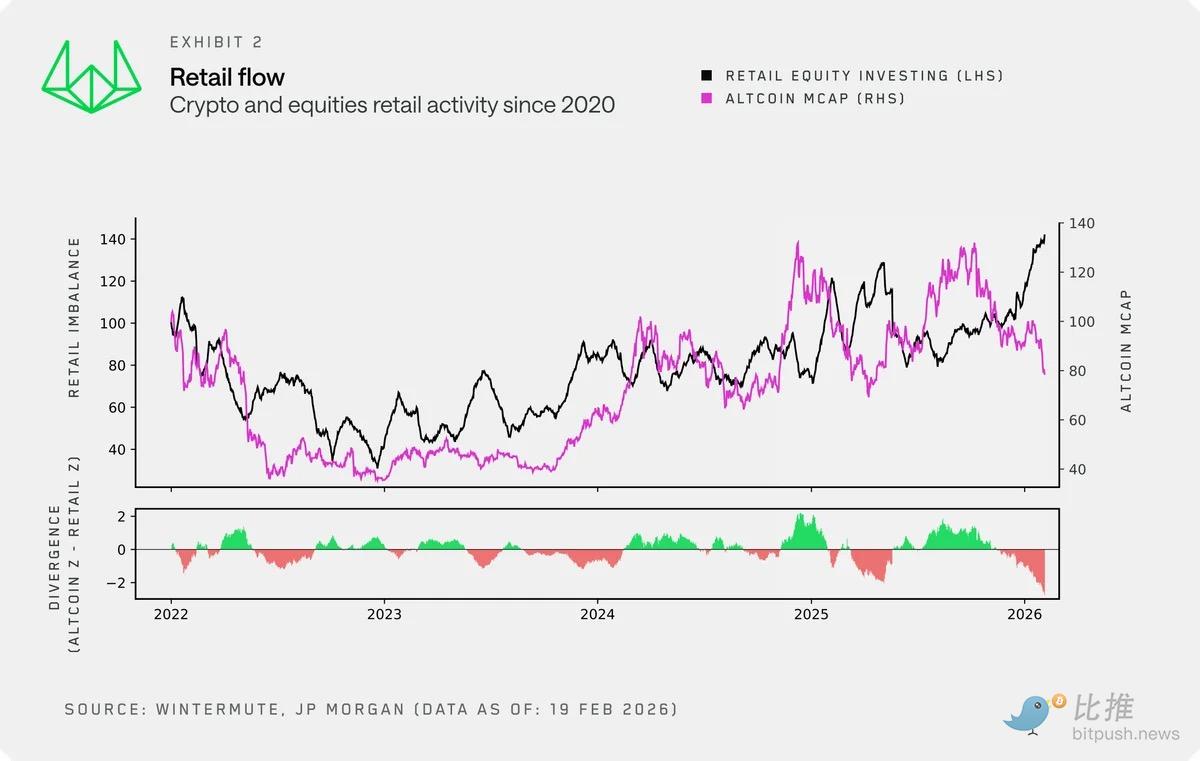
From a broader perspective, we use the market capitalization of altcoins as a long-term proxy for retail crypto activity.
It closely aligns with our retail liquidity data and has a fair and longer historical record. Between 2022 and the end of 2024, cryptocurrencies and stocks fluctuated roughly in sync, both viewed by retail as a single high-risk investment portfolio. The decoupling phenomenon at the end of 2024 is very pronounced, reflecting that retail activity has become more short-term driven, with extreme volatility and, to some extent, a lack of structure.
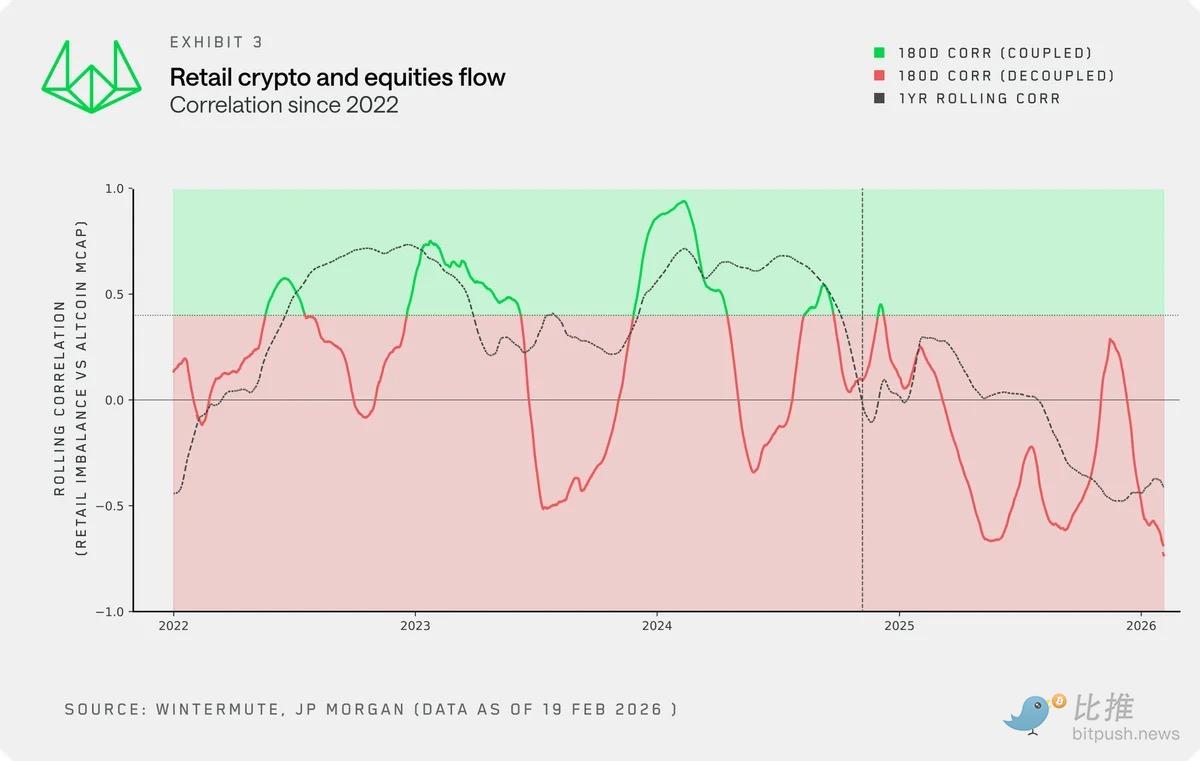
The rolling correlation between retail activity and altcoin market cap confirms this shift. The previously volatile yet generally positive relationship has turned negative. Retail is now allocating between the two rather than injecting funds into both simultaneously.
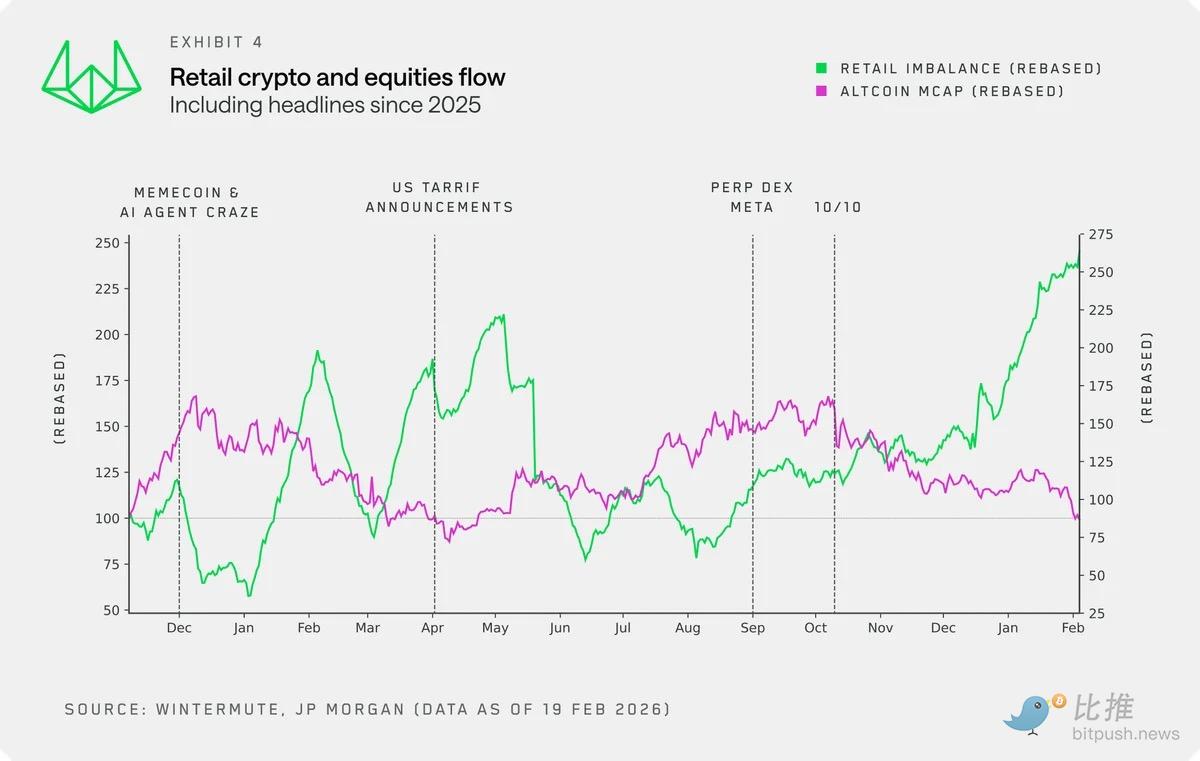
Focusing on 2025 and overlaying key catalysts, this dynamic becomes clearer. Several points are worth noting:
Memecoins and AI agents hit their peak when stock market activity stagnated, as retail found speculative outlets elsewhere.
Retail continues to aggressively dip-buy in the stock market, whether during the announcement of tariff policies in April 2025 or in recent market volatility.
After October 10, the market almost entirely shifted to the stock market, and this trend is still ongoing.
Causality
The rolling correlation between retail activity and altcoin market cap corroborates this shift. The once volatile but generally positive relationship has now turned negative. Retail is now choosing between the two, rather than investing in both at the same time.
This new data also confirms this. Retail activity in the stock market has become a new variable that cryptocurrency investors should closely monitor to identify windows of opportunity for sustained retail inflow into cryptocurrencies.
Volatility = The Product Itself
One reason retail is attracted to cryptocurrencies and remains active is the volatility characteristics of the asset. Volatility is the product. It is the initial force that brought retail into the crypto realm.
However, despite cryptocurrencies' actual volatility still far exceeding that of the stock market, the trend of structural contraction has emerged, and this trend is difficult to reverse in the short term. The volatility ratio of BTC to the Nasdaq index (NDX) has continued to decline, dropping below 2 times at one point in the first half of 2025.
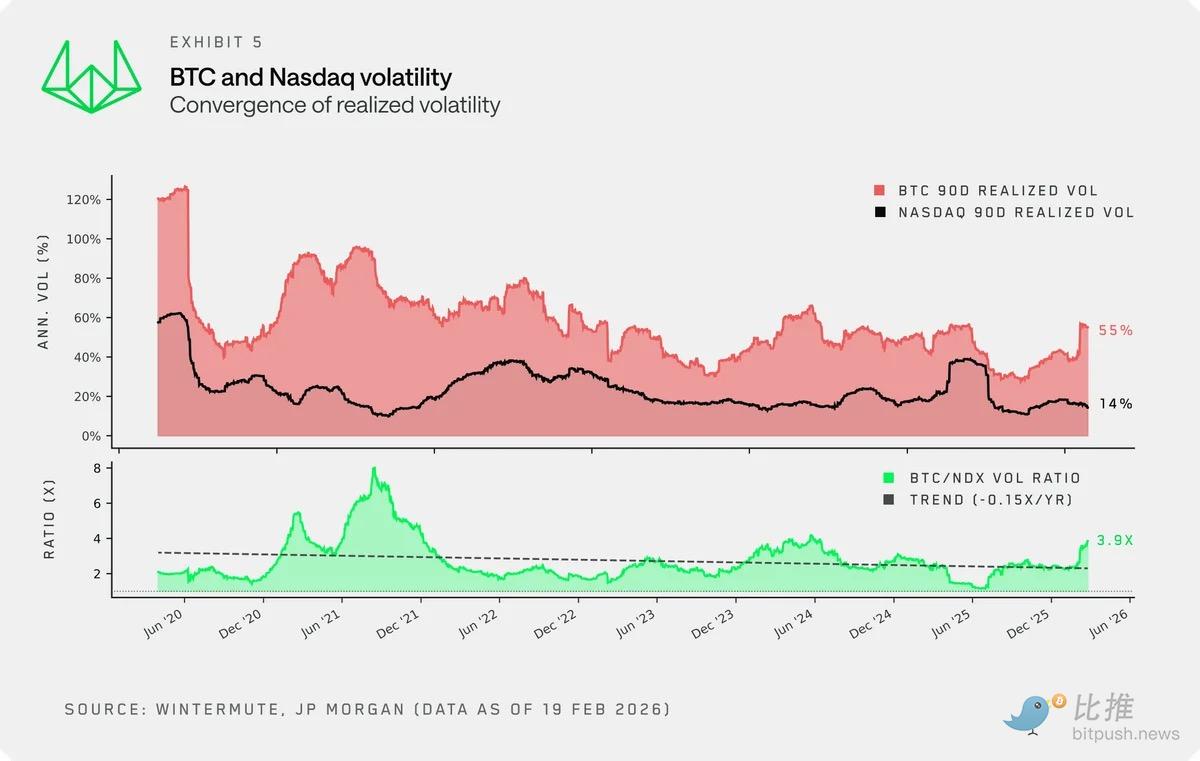
Thoughts on key driving factors:
Maturing market: As mature investors and new liquidity tools like ETFs and DATs increase, the reflexive volatility peaks defined in earlier cycles have been dampened.
Market capacity: With a market capitalization of $2.3 trillion (even 40% lower than historical highs), the needed capital flow to move the market is far higher than it was five years ago.
As volatility compresses, the core appeal of cryptocurrencies to retail is eroding. The "excessive volatility" that defined the 2021-22 cycle and attracted a generation of retail investors is no longer present. For those in pursuit of volatility, stocks are becoming increasingly attractive.
Technical Factors
In addition to structural changes in the crypto market, some technical factors are also accelerating this shift, which is rarely mentioned.
Ease of access to crypto—fintech companies and traditional brokerage platforms are integrating crypto trading (or crypto-native platforms introducing stock trading), which indeed lowers the entry barriers, but the deeper impact is seen in the outflow of capital. In past cycles, cumbersome processes made it easy for funds once deposited in the crypto market to be "locked" in, naturally rotating between various tokens. Nowadays, these smooth inflow and outflow channels mean that funds can flow freely between the stock market and crypto market without facing significant barriers.
Acquisition of information advantages—retail seems increasingly attracted to the stock market, partly because they have gained an unprecedented "analytical advantage" through artificial intelligence (AI). Large language models (LLMs) have significantly enhanced retail investors' analytical abilities, giving them the feeling of competing on equal footing with institutions.
However, this feeling does not exist in the crypto market. While it is feasible to analyze cryptocurrencies based on data, the crypto market lacks a consensus valuation framework, the value capture mechanisms of tokens are unclear, and simultaneously, the investable options keep expanding, all of which make it difficult for retail to feel that they "hold the advantage".
Conclusion
Retail investors, once the most reliable self-reinforcing source of demand in the crypto market, are increasingly satisfying their risk appetites elsewhere.
The stock market not only offers increasingly competitive volatility but also provides a growing analytical advantage, and through existing applications on retail investors' smartphones, it allows for seamless switching from crypto to stock trading.
While cryptocurrencies still hold a place in retail investors' portfolios, they are now just one of many options and no longer the main battleground for speculation.
This transformation should also reshape how investors view the market. Some validated traditional indicators have become ineffective. For crypto investors, merely identifying risk appetite's leading indicators and integrating them with a crypto-native framework is no longer sufficient for winning. Investors need to increasingly view cryptocurrencies from the perspective of cross-asset portfolios, similar to the standard practices in stocks and fixed income arenas.
免责声明:本文章仅代表作者个人观点,不代表本平台的立场和观点。本文章仅供信息分享,不构成对任何人的任何投资建议。用户与作者之间的任何争议,与本平台无关。如网页中刊载的文章或图片涉及侵权,请提供相关的权利证明和身份证明发送邮件到support@aicoin.com,本平台相关工作人员将会进行核查。


