Written by: FinTax
1 Introduction
In the past year, crypto spot ETFs have been launched in multiple markets, creating a more direct connection between crypto assets and the traditional financial system. According to Japanese media reports, the Financial Services Agency (FSA) of Japan plans to amend the Implementation Order related to the Investment Trusts and Investment Corporations Act (referred to as the "Investment Trust Act") to include crypto assets within the scope of specific assets eligible for investment trusts. The FSA expects to submit the bill to the Diet as early as 2026. If the bill is ultimately passed by the Diet, products related to crypto spot ETFs are expected to be listed for trading in Japan as early as 2028, with an anticipated asset scale reaching trillions of yen, promoting brokerages, exchanges, and others to launch supporting services. However, as early as April last year, the discussion document (Examination of the Regulatory Systems Related to Cryptoassets, hereinafter referred to as the "Discussion Paper") released by the FSA clearly pointed out that under the current legal framework, ETFs primarily investing in crypto assets cannot be established. Now, with regulatory discussions continuing, the FSA's policy direction is showing new signals of change.
What do the FSA's attitude shift reflect about the current regulatory trends in Japan? What hurdles must Japan overcome before launching crypto spot ETF trading, and how will market opportunities and compliance thresholds upgrade synchronously? This article will take Japan's planned promotion of crypto spot ETF trading as the entry point, sequentially introducing the basic mechanisms of crypto spot ETFs and their key differences from futures-type products; sorting through the regulatory trend changes reflected in the Discussion Paper and recent developments; and further analyzing the impact of policy evolution on Japan's crypto market ecosystem, financial institutions' business layout, and investors' risk recognition and protection.
2 What is a Crypto Spot ETF: Concepts and Types
2.1 Basic Concepts
ETP (Exchange Traded Product) is a general term for products traded on exchanges, while ETF (Exchange Traded Fund) is the mainstream type operating in the form of a fund. In different jurisdictions, crypto spot products may not all be called ETFs, but due to the trading experience and investor perception being closer to ETFs, they are commonly referred to as crypto spot ETFs. A crypto spot ETF typically refers to a product with actual crypto assets as the underlying, achieving exposure through spot assets. Spot products enhance the convenience of trading and holding but do not eliminate risks such as price volatility, fraud, and market manipulation. When investors transition from self-managed wallets to on-exchange products, the risk structure faced will change, but the most direct variable remains the volatility itself.
To understand crypto spot ETFs, they should be seen as a complete chain.
First is underlying, valuation: Products generally calculate net asset value based on spot market prices or designated indices, while the calculation frequency of net asset value, pricing sources, and handling methods under extreme market conditions will affect tracking effectiveness and investment experience.
Second is custody: The underlying assets of crypto spot ETFs need to be placed within a compliant custody framework, where private key storage, cold storage ratio, access permissions, and audit arrangements are core to risk control, usually managed by regulated custodians.
Third is subscription and redemption, authorized participant mechanism: Authorized participants arbitrage between primary market subscription and redemption and secondary market trading, helping to converge premiums and discounts and affecting liquidity performance; during periods of increased volatility, premiums and discounts as well as trading friction are also more likely to be amplified.
Fourth is trading costs: Trading crypto spot ETFs needs to account for spreads, trading impact costs, and differences in tax treatment across different markets.
2.2 Types: Spot, Futures, Others
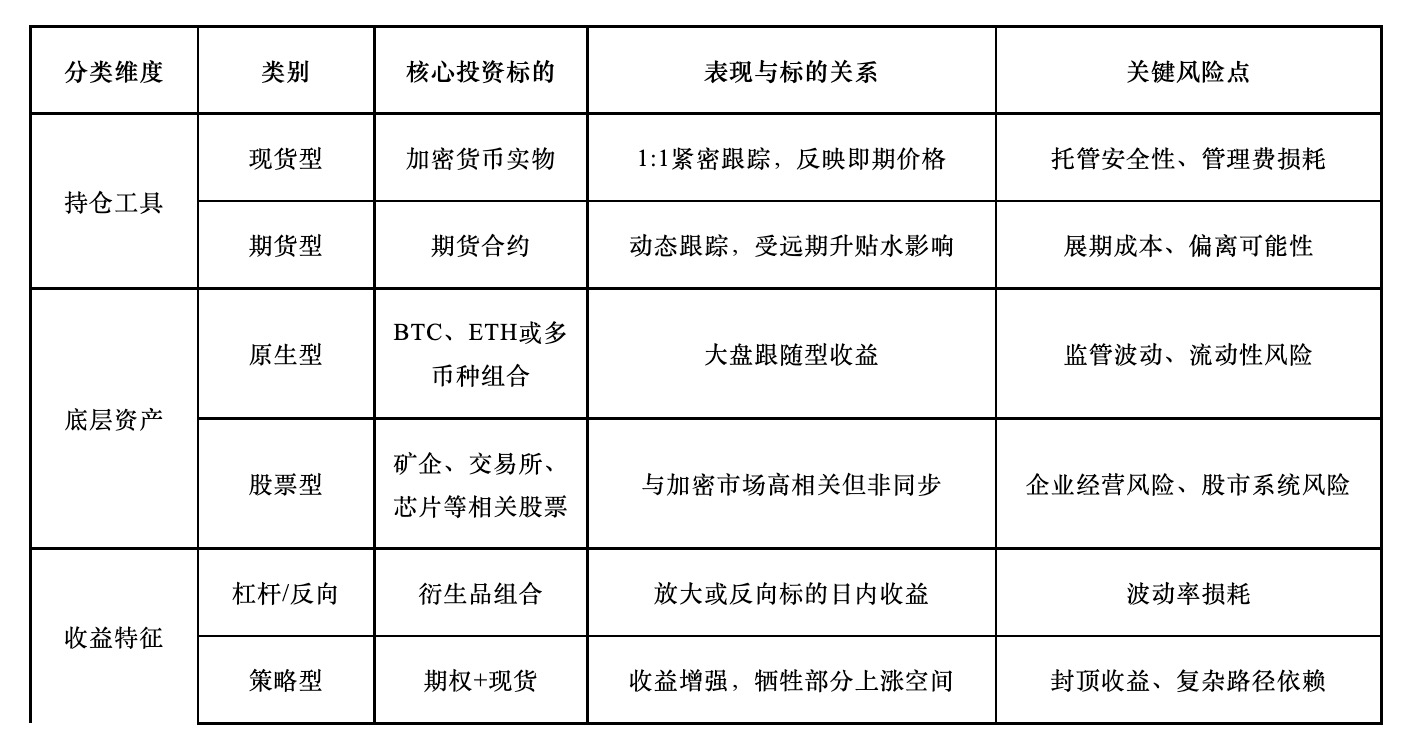
In the investment field, crypto-related on-exchange products can usually be classified according to their primary holding tool types, with the most common being spot holding ETFs and futures contract ETFs. Spot Bitcoin and Ethereum ETFs typically achieve price correlation by holding the crypto assets themselves, while futures-type ETFs achieve this by holding futures contracts based on that crypto asset.
Spot ETFs are open-end funds or similar exchange-traded products listed on exchanges and created and redeemed through an authorized participant mechanism, designed to track the price performance of specific underlying assets primarily through direct holding and custody of those underlying spot assets, with the fund's net asset value calculated based on the fair value of the held spot assets. Spot ETFs can hold either a single asset or a basket of multiple assets. A single asset spot ETF holds a single type of crypto asset like BTC or ETH, while a multi-asset spot basket type holds multiple crypto assets according to an index or combination rules, diversifying single asset risk. Spot ETFs are suitable for investors who wish to gain exposure to crypto asset price performance within the traditional securities account system while being unwilling to manage wallets and private key management themselves, but price volatility of the underlying assets will still directly manifest in the product's net asset value.
Futures ETFs use crypto asset futures contracts as their main holding tool. These ETFs issue publicly traded securities, allowing investors to gain exposure to changes in Bitcoin futures contract prices. Due to contract expiration and rollover mechanisms, investors also need to pay attention to net asset value deviation risks arising from rollovers. Prior to the approval of spot products, the U.S. market had already taken ProShares' Bitcoin Strategy ETF.
Crypto-related on-exchange products can also be classified by their tracking objects into single asset types and index or basket types; and by underlying asset categories into crypto asset types and industry chain stock thematic types. Leveraged, inverse, and certain strategy types belong to products with more complex yield targets and rebalancing mechanisms, commonly reset daily, relying more heavily on paths, and suitable for narrower crowds.
Table1ETFProduct Classification Dimensions
3 From Negation to Promotion: The Shift in Japan's Crypto Asset Regulatory Attitude
3.1 The Dual Impact of Market Structure and International Competition
The positive signals currently released by the FSA regarding crypto spot ETFs contrast sharply with its previously cautious and conservative attitude. This nearly 180-degree shift in attitude relates to both structural changes in the domestic crypto market and the impetus of international market competition.
In terms of Japan's domestic crypto market, previously, Japan's regulation of crypto assets focused more on their payment attributes, including compliance of trading platforms, management of customer assets, and monitoring of price fluctuations. Since 2025, Japan has initiated a series of policy and regulatory updates aimed at officially integrating crypto assets from a marginalized payment method into the mainstream financial system. Legally, the FSA proposed on December 10 last year to shift the regulation of crypto assets from the Payment Services Act (PSA) to the Financial Instruments and Exchange Act (FIEA), treating crypto assets as financial products, thus aligning their legal status with securities. In terms of fiscal and tax support, Japan also released a tax reform blueprint for 2026 at the end of last year, proposing to adjust the taxation on crypto asset gains from a maximum of 55% comprehensive tax to a 20% separate tax. These existing and potentially future policy adjustments together form the institutional foundation for the financial productization of crypto assets, providing ample space for the establishment of a crypto spot ETF market.
Additionally, the international competition of the crypto market and benchmarking against regulatory systems have become driving factors. After U.S. spot Bitcoin products entered the mainstream market, the institutional allocation and compliance service chain quickly improved. For Japan, this is not only an issue of investor product supply but also concerns the competitiveness of financial centers and the attractiveness of capital markets: if Japan remains absent from compliant products for a long time, high-quality flow and service capabilities will overflow, and domestic financial institutions will lack opportunities to accumulate experience in a controllable regulatory environment.
Finally, the FSA's previous Discussion Paper's attitude toward crypto spot ETFs does not mean complete denial but emphasizes their lack of feasibility under the current system; there remains sufficient room for adjustment with changes in market environment and regulatory structure. The FSA's Discussion Paper recognized that crypto assets have demonstrated strong investment attributes in practical applications, and it is deemed necessary to establish regulatory tools that match this. Accordingly, the Discussion Paper proposed a classification regulatory approach for two types of assets:
The first category is financing crypto assets, mainly referring to tokens used for project fundraising or having utility functions, where the regulatory focus is on ensuring the issuer's disclosure obligations, requiring them to clearly specify the use of funds and project progress;
The second category is non-financing crypto assets, such as BTC and ETH, for which lacking a single issuing entity shifts the regulatory focus to fairness in trading.
3.2 Comparison of Regulatory Paths for Offshore Crypto Spot ETFs
From a global perspective, the U.S., EU, and UK represent three different regulatory paths for crypto spot ETFs: the U.S. allows spot products to enter the mainstream market while strengthening rules, disclosures, and market monitoring; the EU emphasizes a preemptive framework by establishing unified regulations to reduce regulatory arbitrage space; the UK has long prioritized retail protection, first restricting the availability of high-risk products, and then discussing boundary adjustments under stricter promotion and risk disclosure conditions. Weighing the characteristics of these three paths, Japan may adopt a middle path between openness and constraints in the future: while introducing compliant products, enhancing disclosure, suitability management, and anti-fraud requirements to improve regulatory oversight and investor protection levels.
Table 2 Global Jurisdiction Comparison of Crypto Spot ETF Regulations
Region | Regulatory Path | Examples | Reference Meaning |
United States | Grant access first, then strengthen monitoring | In January 2024, the first batch of spot Bitcoin products was approved; approximately $4.6 billion traded on the first day; as of October 2025, the asset scale held by relevant products is about $122 billion, roughly 7% of the total market capitalization of Bitcoin at that time; proceeding more cautiously with other coins, starting to consider Ethereum-type products by the end of 2024. | Spot products can enter the mainstream market but need to be accompanied by disclosure, market monitoring, and risk management mechanisms, and species expansion is typically more cautious. |
European Union | Framework first, unified rules | MiCA covers regulations including crypto asset issuance, information disclosure, authorization, and supervision; in August 2023, Jacobi launched the European spot Bitcoin ETF (BCOIN) on the Amsterdam Euronext and emphasized compliance with sustainable disclosure requirements. | Establishing rules first helps reduce regulatory fragmentation and arbitrage space, providing a more stable compliance expectation for institutional capital. |
United Kingdom | Retail protection prioritized | The FCA announced in 2020 a ban on selling crypto derivatives to retail investors and included certain crypto-related exchange-traded notes in restrictions, with the ban taking effect from 2021; in 2025, a proposal was put forth to allow retail purchases of crypto exchange-traded notes, but emphasized the high-risk attributes. | More cautious regarding retail, providing investor protection red lines. |
4 Impact Forecast of Japanese Crypto Spot ETFs
4.1 Current Status of the Japanese Market
The Japanese crypto market has expanded significantly in recent years. As of July 2025, there are approximately 13.2 million domestic crypto trading accounts, although fewer than securities accounts, there is still growth potential; the total crypto assets held by investors once reached approximately 5 trillion yen in July 2025, then declined to about 4.9 trillion yen in September due to fluctuations, but overall remains on an upward trend, reflecting an increased interest in risk assets amid mismatched inflation and income growth backgrounds. Meanwhile, consultations and complaints have increased concurrently. FSA data show that in the fourth quarter of 2024, there were 1,304 consultations and complaints related to crypto, higher than previous quarterly levels. The regulatory aspect faces dual pressure overall: it must provide compliant participation channels while continuously focusing on investor protection and financial security.
4.2 Impact Forecast: Local Market and Investors
If crypto spot ETFs are approved and launched in the Japanese market, the most direct impact will be the migration of investment funds into Japan’s crypto investment. In this hypothetical scenario, some funds that originally traded directly on trading platforms may shift to products within the securities account system, potentially putting pressure on domestic trading platforms from retail transactions and the diversion of existing assets.
For traditional financial institutions, the potential landing of crypto spot ETFs represents both a business innovation opportunity and a stress test for compliance and reputational risks. Given the significant price volatility of crypto assets, once products enter the market and encounter a rapid withdrawal, factors such as the sufficiency of risk disclosure, compliance of sales processes, and whether products match clients' risk tolerance will be scrutinized rigorously. Considering the ongoing focus on fraud solicitation and operational safety in regulatory discussions, internal control capabilities will become the core threshold for institutions to advance related products under the hypothetical access framework.
For investors, global asset management firms, family offices, hedge funds, and other institutions or accounts that focus on Asian allocation opportunities will likely pay closer attention to the progress of Japan's crypto spot ETFs. If Japan permits the launch of crypto spot ETFs in the future, it would effectively add an entry acceptable under compliance systems within a mature capital market, facilitating the optimization of asset allocation: products can be traded using securities accounts, with periodic reports and information disclosures being more standardized, custody provided by regulated institutions, and internal compliance approvals being easier to advance.
免责声明:本文章仅代表作者个人观点,不代表本平台的立场和观点。本文章仅供信息分享,不构成对任何人的任何投资建议。用户与作者之间的任何争议,与本平台无关。如网页中刊载的文章或图片涉及侵权,请提供相关的权利证明和身份证明发送邮件到support@aicoin.com,本平台相关工作人员将会进行核查。


