Original Title: It's Too Obvious. What If AI Doesn't Actually End The World?
Original Author: The Kobeissi Letter
Original Translator: Deep Tide TechFlow
Deep Tide Introduction: As AI tools such as Anthropic demonstrate astonishing capabilities in code and workflow automation, the market has fallen into a panic of "AI apocalypse," with hundreds of billions in market value evaporating in an instant. However, this article presents an enlightening counter perspective: the short-term shocks triggered by AI are not a harbinger of economic collapse, but an inevitable process of significantly reduced "cognitive costs." The author points out through a comparison of the PC revolution of the 1980s and productivity historical data that when technology makes knowledge acquisition cheap and abundant, the true "abundant GDP" era will begin. This is not just a reconstruction of the labor force, but a necessary path towards geopolitical relaxation and a global explosion of productivity.
The full text is as follows:
The stock market just wiped out $800 billion in market value as the idea of "AI taking over the world" becomes a consensus viewpoint. This viewpoint is too obvious. And "the obvious" trades never really win.
The reason this apocalyptic scenario has gone viral is that it captures some instinctual feelings. It portrays AI not as a productivity tool, but as a macroeconomic destabilizer capable of triggering negative feedback loops: layoffs lead to weakened consumer spending, weakened consumer spending leads to more automation, and automation accelerates layoffs.
The obvious fact is: AI is not just another software function or efficiency-enhancement tool. It is a universal capability shock that simultaneously touches every white-collar workflow. Unlike any revolution in history, AI is becoming skilled at "everything" at once.
But what if the apocalyptic scenario is wrong? It assumes that demand is fixed, assumes that productivity improvements won't expand markets, and assumes that the speed of system adaptation cannot outpace the speed of destruction.
We believe there is a second path, which is greatly underestimated. Those early signs that seem like systemic collapse, such as the "take downs" from Anthropic, may ultimately be the beginning of the largest productivity expansion in history.
Before we begin, please bookmark this article and refer back to it repeatedly over the next 12 months. While the analysis below is not a certainty, it is important to remember that humans always find a way to turn things around; and the free market can always self-correct.
Anthropic's "Takedowns" are Real
First, we must state that we cannot ignore the market. Anthropic is disrupting the world with Claude, causing Fortune 500 companies to lose hundreds of billions in market value.
This is a story we've seen several times already by 2026: Anthropic releases a new AI tool, with Claude making substantial advances in programming and workflow automation, leading to a collapse in the market of the targeted industries within hours.
If you haven't been paying attention, here are some examples:
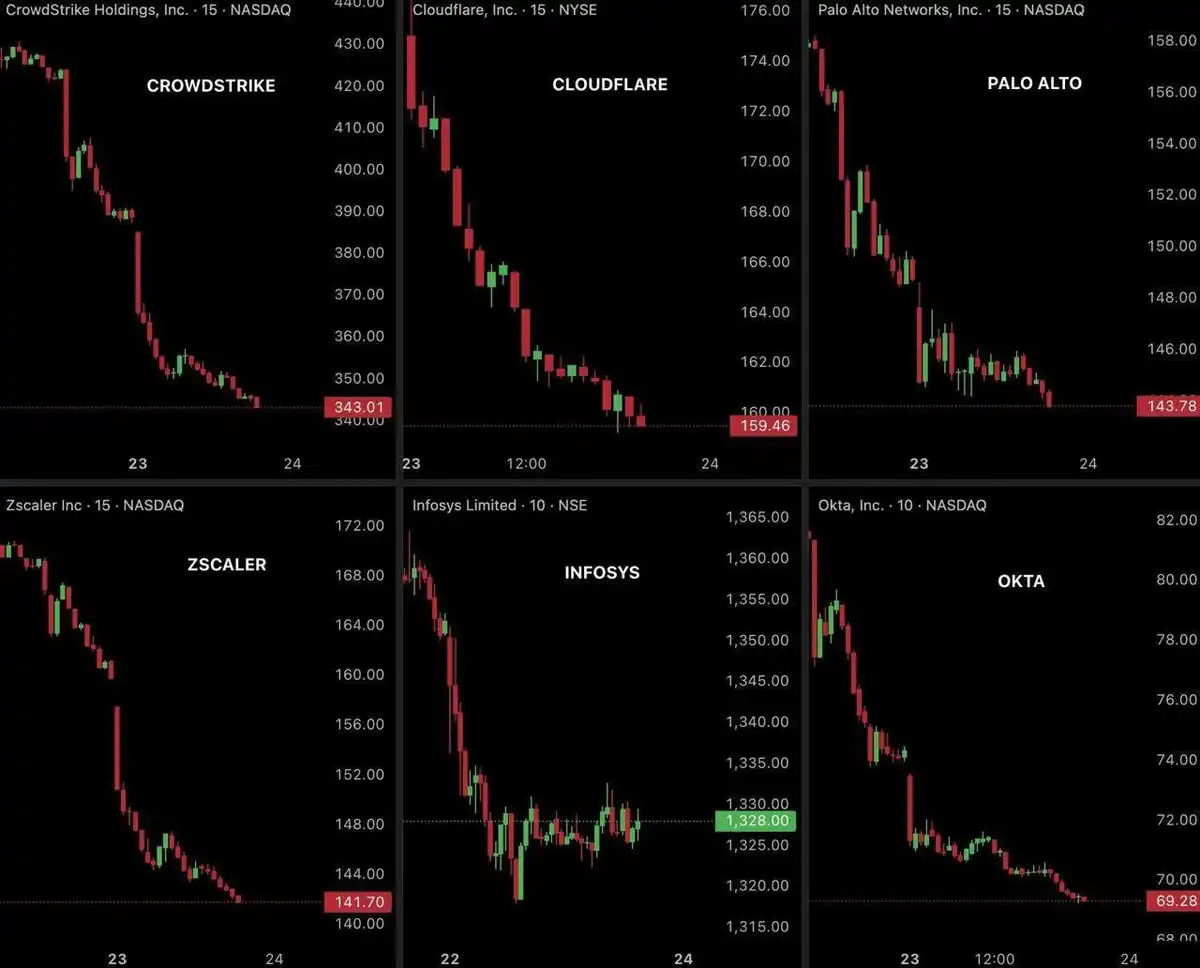
Stock reaction to Claude's announcement
IBM shares ($IBM) just had their worst day since October 2000 after Anthropic announced Claude could simplify COBOL code. Adobe ($ADBE) has dropped -30% this year as generative capabilities have compressed creative workflows. The cybersecurity sector collapsed following the release of "Claude Code Security."
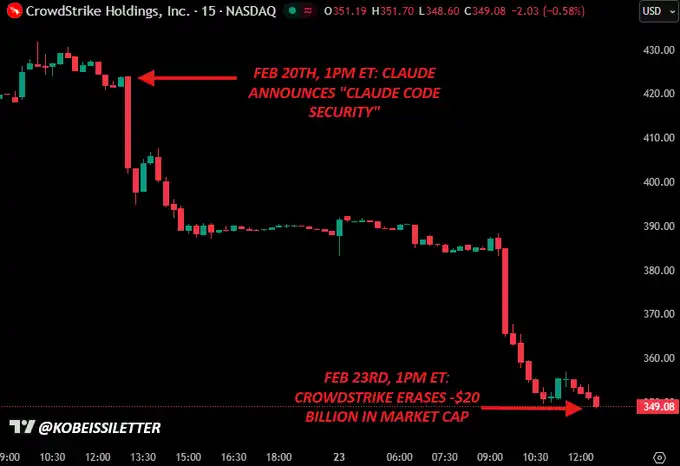
In the aforementioned example, CrowdStrike stock ($CRWD) plummeted almost the minute Claude announced "Claude Code Security."
On February 20 at 1 PM Eastern time, Claude announced "Claude Code Security." This is an automated AI tool that scans for vulnerabilities in codebases.
Just two trading days later, CrowdStrike stock ($CRWD) evaporated $20 billion in market value under the influence of this news.
These reactions are not irrational. The market is trying to price in real-time profit compression. When AI replicates workers' jobs, pricing power shifts to the buyers. This is a first-order effect, and it is very real.
Commoditization does not equal collapse. On the contrary, it is a way for technology to lower costs and expand access. Personal computers commoditized computing, the internet commoditized distribution, the cloud commoditized infrastructure, and AI is commoditizing cognition.
There is no doubt that some traditional workflows will experience a compression of profit margins. The question is whether lower cognitive costs will lead to economic collapse or allow for radical expansion.
The "Doom Loop" Assumes Demand is Fixed
The bearish narrative creates a simplified linear model: AI gets better, companies reduce layoffs and wages, and then purchasing power declines, leading firms to reinvest in AI to defend profits, and so on. This assumes a completely stagnant economy.
History shows that this is not the case. When the cost of producing something collapses, demand rarely stays the same; instead, it expands. When computing costs decrease, we do not consume the same amount of computing at a cheaper price. We consume an order of magnitude more computing and build entirely new industries around it.
As shown below, the price of personal computers today is 99.9% cheaper than in 1980.
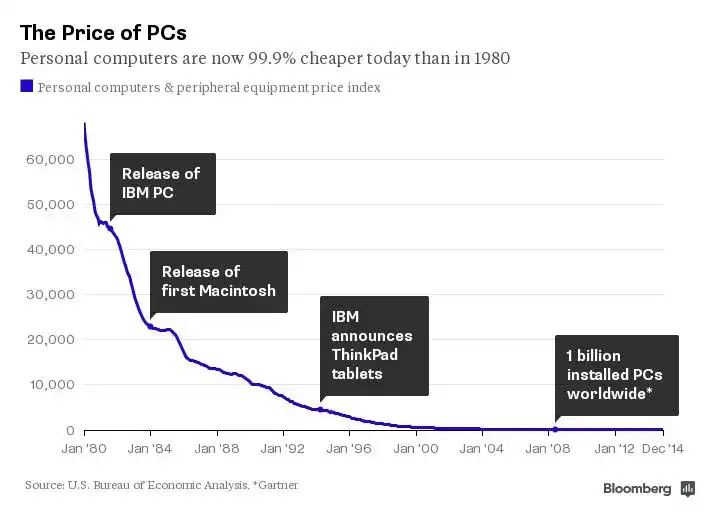
Figure Caption: Price Trends of Personal Computers from 1980 to 2015
AI lowers costs across every industry, and when the cost of services decreases, purchasing power increases regardless of whether wages rise.
The doom loop will only dominate if AI replaces labor without significantly expanding demand. If cheap computation and productivity give rise to entirely new consumption categories and economic activities, then the optimistic scenario emerges.
The Real Shock is Price Collapse, Not Unemployment
Investors find it easier to pitch the "obvious" layoff story, but the price compression that the service industry is experiencing is the bigger news. Jobs involving knowledge are expensive because of the scarcity of knowledge — this sounds simple, but it is true. And an abundance of knowledge supply leads to a decrease in the prices of knowledge work.
Think of medical management, legal documentation, tax filings, compliance checks, marketing production, basic programming, customer service, and educational tutoring. These services consume substantial economic resources largely because they require trained human attention. AI is lowering the marginal cost of that attention.
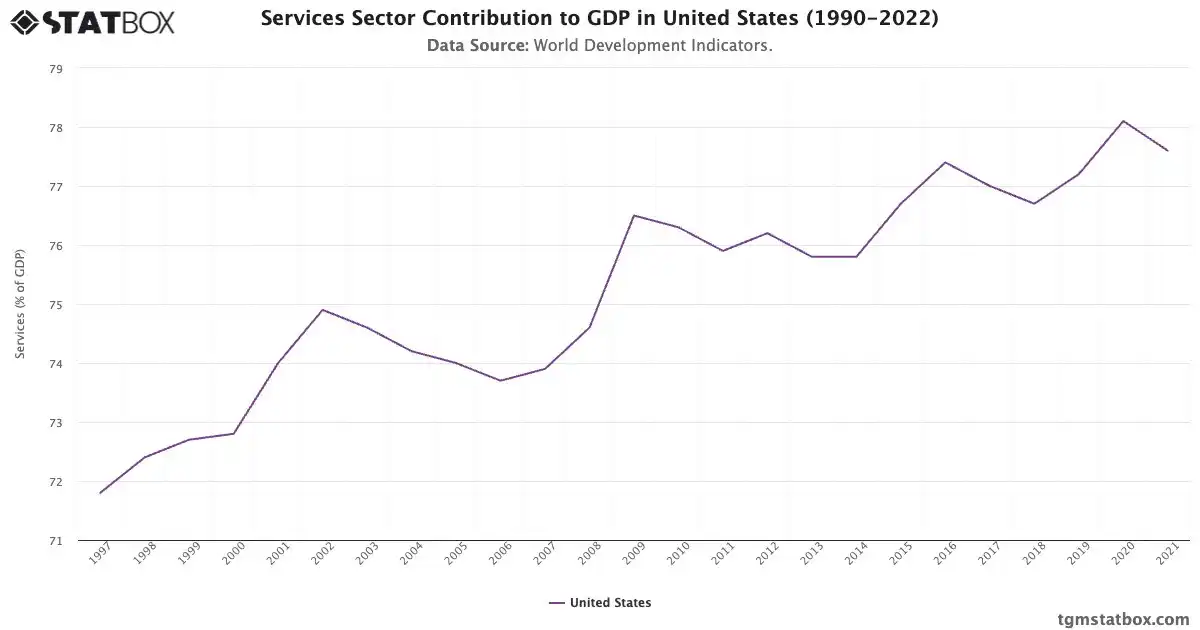
In fact, as shown below, the U.S. service industry contributes nearly 80% of U.S. GDP.
If the cost of operating a business decreases, small businesses become more accessible; if the cost of acquiring services decreases, more households will participate. To some extent, the advances in AI can act as a form of "invisible" tax cuts.
Those companies whose profits rely on high-cost cognitive labor may suffer losses, but the broader economy will benefit from lower service inflation and higher real purchasing power.
From "Ghost GDP" to "Abundant GDP"
The bearish argument relies on "Ghost GDP," which is output reflected in the data but does not benefit households. The optimistic counterargument is what we call "Abundant GDP," which combines output growth with declines in living costs.
"Abundant GDP" does not require soaring nominal incomes; it requires the rate of price decline to be faster than the rate of income decline. If AI lowers the costs of services essential to many, then even if household wage growth slows, their real gains will increase. Thus, productivity enhancements do not disappear but are conveyed through lower prices.
This may explain why productivity has consistently outperformed wage growth over the past 70 years:
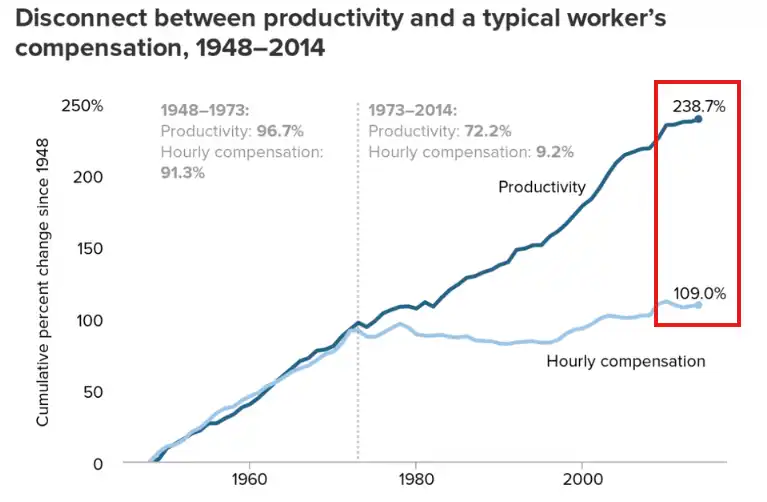
The internet, electricity, mass manufacturing, and antibiotics have all provided new methods to increase output and decrease costs, despite these processes being destructive and volatile. However, looking back, these changes have permanently improved living standards.
A society that reduces wasted time navigating complex systems and paying redundant services will, in effect, become more prosperous.
The Labor Market is Restructuring, Not Disappearing
A core concern is that AI will disproportionately impact white-collar jobs, which drive non-essential consumption and housing demand. This is true and a reasonable concern, especially given the already vast wealth gap.
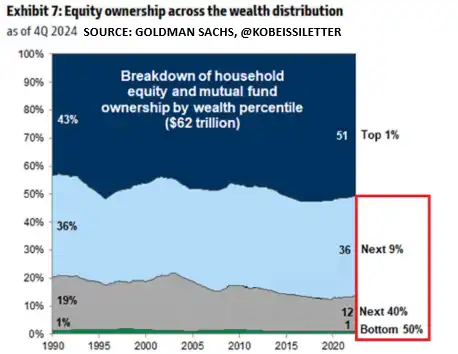
However, AI faces more difficulties in terms of dexterity in the physical world and human identity recognition. Skilled trades, hands-on healthcare, advanced manufacturing, and experience-driven industries still maintain structural demand. In many instances, AI is a complement to these roles, not a replacement.
More importantly, AI lowers the barriers to entrepreneurship. When one can automate accounting, marketing, support, and programming tasks, starting small businesses becomes easier. We are optimistic about small businesses.
Indeed, removing barriers to access through AI may be the solution to the wealth gap issues we currently face.
The internet killed certain job categories, but it created entirely new professions. AI may follow a similar pattern, compressing certain white-collar functions while expanding self-directed economic participation in other areas.
Stay tuned; we will continue modularizing the third part (the final part) for you. This section will explore the evolution of the SaaS business model, AI's reshaping of market structures, the actual performance of productivity data, and an underestimated perspective: how AI-driven "abundance" reduces global conflict.
The "Demise" Story of SaaS
AI is clearly putting pressure on the traditional SaaS (Software as a Service) business model. Procurement teams are finding negotiations increasingly difficult, and some long-tail software products are facing structural resistance. But SaaS is merely a delivery mechanism, not the endpoint of value creation.
The next generation of software will be adaptive, agent-driven, outcome-based, and deeply integrated. The winners will not be static tool providers but those who can best adapt to change.
Every technological upheaval rearranges the stack; companies that price static workflows will inevitably struggle. Meanwhile, those with data, trust, computational power, energy, and validation may thrive.
A compression of profits in one level does not signify the collapse of the entire digital economy; it marks a transformation.
AI Restructures the Market
Bears believe that agentic commerce will destroy intermediaries and eliminate transaction fees. To some extent, this is true. As friction decreases, extracting fees becomes more difficult.
As shown below, even before AI became what it is today, trade volumes in stablecoins had already been skyrocketing. Why? Because the market always favors efficiency.
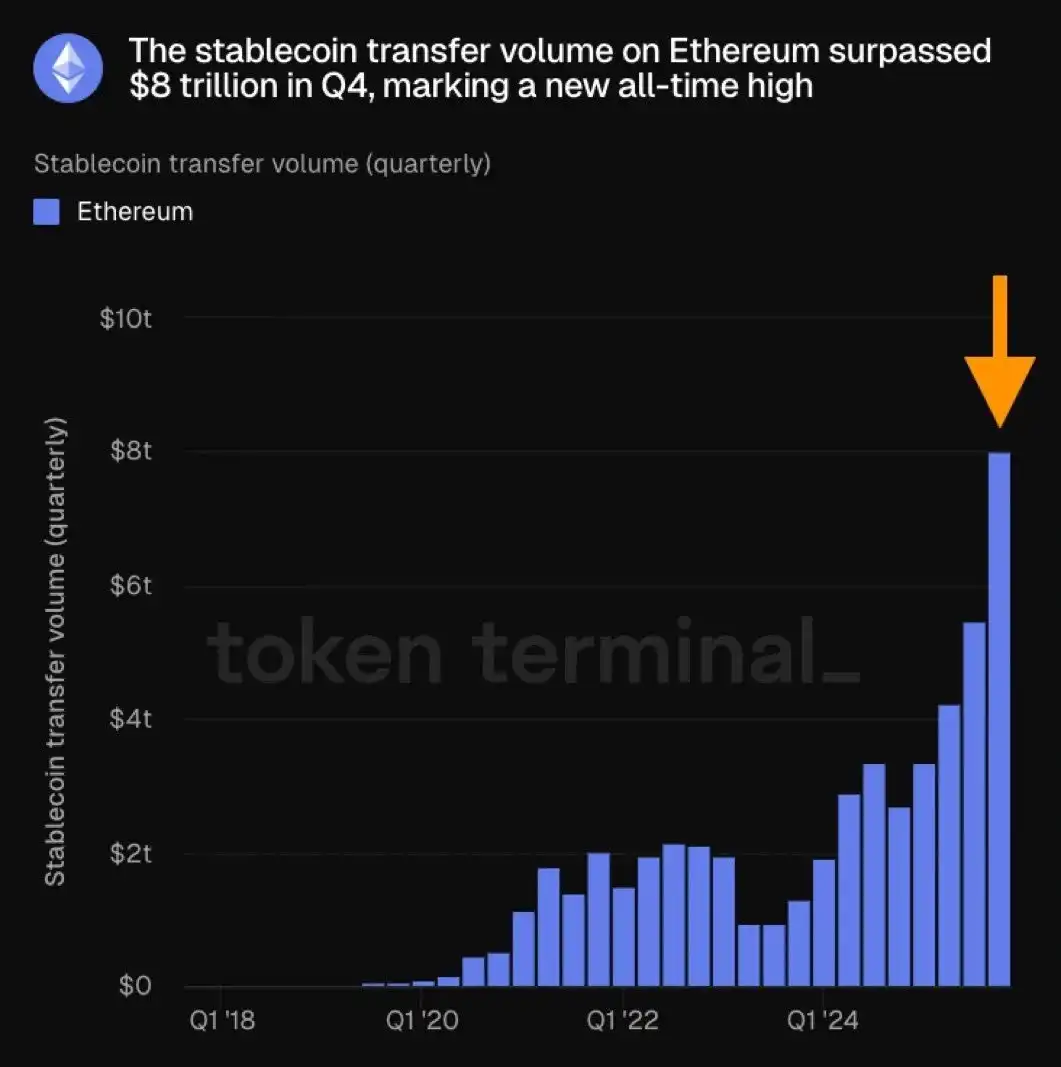
Lower systemic friction will also expand transaction volumes. When price discovery functions improve and transaction costs decline, more economic activity occurs. This is a bullish trend.
Agents representing consumers may compress the profits of platforms based on "habits." However, they can synchronize to increase total demand by reducing search costs and improving efficiency.
Productivity is the Core Variable
The ultimate determinant of optimistic outcomes is productivity. If AI can provide sustained productivity improvements in healthcare, government management, logistics, manufacturing, and energy optimization, then the result will be shared prosperity for all of humanity and lowered barriers to access.
Even sustained increments of 1-2% productivity growth over a decade can produce enormous compounding effects.
The macroeconomic shifts driven by AI have already spurred some of the best investment opportunities in history. This is a field we have spent countless hours analyzing and continue to stay ahead of.
As shown below, thanks to AI, productivity has already begun to accelerate. In Q3 2025, U.S. labor productivity accelerated, achieving the strongest growth in two years:
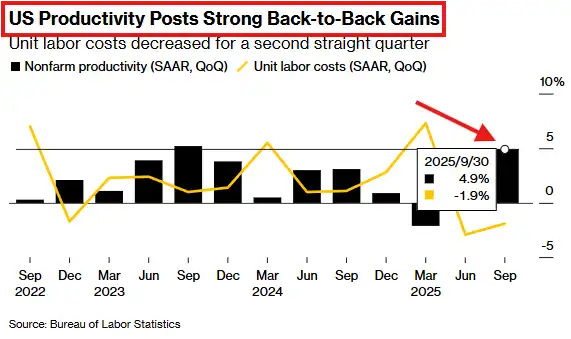
The pessimistic view assumes that gains in productivity would flow entirely to AI model builders without translating into broader benefits. The optimistic view holds that price compression and the formation of new markets will broadly transmit those gains.
Abundance Reduces Conflict, Not Just Lowers Costs
Among the impacts of AI-driven "abundance," the least discussed is geopolitics. For much of modern history, wars have been about the struggle for scarce resources: energy, food, trade routes, industrial capacity, labor, and technology. When resources are constrained and growth feels like a zero-sum game, competition arises among nations. But abundance changes everything.
If AI substantially lowers the production costs of energy, design, logistics, and services, the global economic pie will grow larger. When productivity rises and marginal costs decline, economic growth becomes less dependent on pilfering advantages from others. This will end wars and may lead to the most peaceful period in human history.
The same goes for economic warfare, like the trade war we are currently in its second year.
Tariffs are tools for protecting domestic industries from cost competition in a resource-scarce world. But if AI causes production costs to collapse everywhere, why would we still need tariffs? In an environment of high abundance, protectionism becomes economically inefficient.
History shows that periods of technological acceleration often reduce global conflict in the long run. The post-World War II industrial expansion decreased the incentives for major powers to confront each other directly.
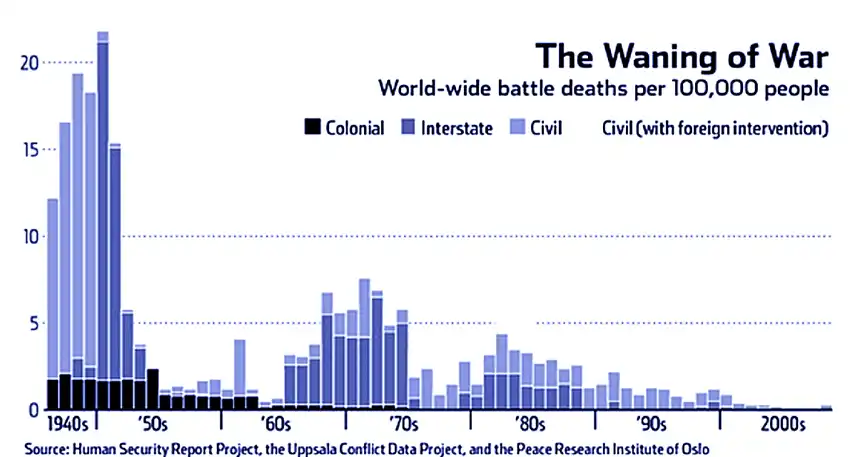
AI-driven abundance may accelerate this dynamic. If energy management is more efficient, supply chains are more resilient, and production is more localized through automation, nations become less vulnerable. As economic security rises, geopolitical aggression becomes irrational.
The most optimistic AI outcome is not just higher productivity or higher stock indices, but a world where economic growth is no longer a zero-sum game.
Conclusion: What if the World Doesn’t End?
AI amplifies outcomes. If institutions can't adapt, it can amplify vulnerabilities; if productivity outpaces destruction, it can amplify prosperity.
Anthropic's "takedowns" signal that workflows are being repriced and cognitive labor is becoming cheaper, which is a clear transformation.
But transformation does not equal collapse, just as each major technological revolution always appears to be destabilizing at first.
Today's most underestimated possibility is not utopia but abundance. AI may compress rents, reduce frictions, and restructure the labor market, but it may also bring about the largest real productivity expansion in modern history.
The distinction between a "global intelligence crisis" and "global intelligence prosperity" is not about capabilities but about adaptation.
And this world always finds ways to adapt.
Finally, those who can remain objective and follow processes during the current turbulent times are welcoming the best trading environment in history.
Deep Tide Introduction: As AI tools such as Anthropic demonstrate astonishing capabilities in code and workflow automation, the market has fallen into a panic of "AI apocalypse," with hundreds of billions in market value evaporating in an instant. However, this article presents an enlightening counter perspective: the short-term shocks triggered by AI are not a harbinger of economic collapse, but an inevitable process of significantly reduced "cognitive costs." The author points out through a comparison of the PC revolution of the 1980s and productivity historical data that when technology makes knowledge acquisition cheap and abundant, the true "abundant GDP" era will begin. This is not just a reconstruction of the labor force, but a necessary path towards geopolitical relaxation and a global explosion of productivity.
免责声明:本文章仅代表作者个人观点,不代表本平台的立场和观点。本文章仅供信息分享,不构成对任何人的任何投资建议。用户与作者之间的任何争议,与本平台无关。如网页中刊载的文章或图片涉及侵权,请提供相关的权利证明和身份证明发送邮件到support@aicoin.com,本平台相关工作人员将会进行核查。


