In the past week, the cryptocurrency market made many participants feel something more unsettling than the price drop—a sense of numbness lingering in the air.
After multiple attempts to hit the $70,000 mark failed, Bitcoin opted to seek liquidity downwards. On February 24, the market once again experienced a wave of drastic selling, with Bitcoin briefly dropping below $63,000, a daily decline of over 5%. This crash resulted in more than 130,000 investors being liquidated, with over $400 million evaporating in just a day.
However, more concerning than the paper losses is the absence of a rebound attempt.

1. The Broken $1900 and the Real Bottom Line
● "The fact that there hasn't been a decent rebound attempt is more convincing than the choppy range of the market itself." The top market maker Wintermute commented on the current market situation in the latest market report.
● In their view, since the series of liquidations two weeks ago, the market's "internal injuries" are much more serious than they appear on the surface. Price movements are showing volatility, liquidity is becoming thin, and trading ranges are narrowing, all pointing to one fact: the market lacks a belief with a clear directional sense.
● For Ethereum, dropping below $1900 this week is a sensitive signal. But Wintermute calmly pointed out that this price point is more of a psychological level rather than a technical hard bottom. What really needs attention, and could become a dividing line between bulls and bears, is around $1600.
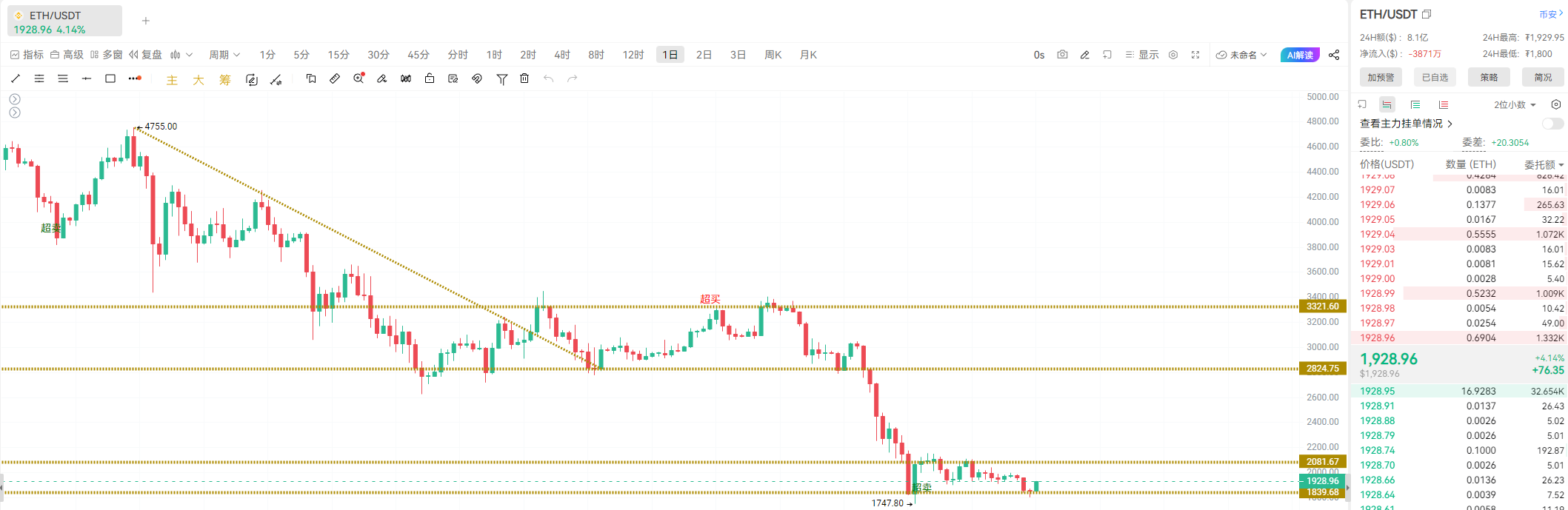
● This means that if short sellers press the price below $1900, it may not be enough to trigger panic; however, testing the key area of $1600 may signify a reassessment of the entire market structure.
2. The Absence of Institutions and the Illusion of Stabilization
More worrying than the price itself is the flow of funds.
Wintermute's observations show that although Ethereum's price seemed to stabilize at a certain moment, the most critical variable—institutional demand—has not returned. This is starkly different from what we saw in the rebound at the end of last year, when institutional funds showed a clear willingness to enter the market within the $85,000 to $95,000 price range (for Bitcoin). Now, that willingness has vanished.
The inactivity in the derivatives market further illustrates the issue:
● The basis is at a multi-month low: This means investors are no longer willing to pay a premium for future expectations, and the market lacks bullish sentiment;
● The bearish options skew continues to rise: Smart money is paying a higher cost to buy "insurance" for their spot positions;
● Open contracts continue to decline: Since October of last year, this data has been on a downward trend, indicating that existing funds are leaving, and new capital is not entering.
Funds flowing through trading desks are also skewed towards selling activities. Although there was a brief interesting signal midweek—some high-net-worth investors showed sporadic interest in certain altcoins—this "spark of confidence" quickly dissipated in the defensive market atmosphere. As Wintermute stated, the current trading activity is motivated by "protection" rather than "belief".
3. Macroeconomic Pressure and the 'Identity Crisis' of Altcoins
If we broaden our perspective, the sluggishness of the crypto market is not an isolated phenomenon.
● Wintermute's analysts pointed out that the current market is in a transition period of macro logic. The Federal Reserve is unable to ease policies due to persistent inflation, yet cannot raise interest rates due to economic slowdown, thus facing a dilemma. Meanwhile, capital is flowing from growth stocks to defensive assets and real assets—gold, industrials, and defense sectors are absorbing the funds fleeing from tech stocks.
In this context, Bitcoin and Ethereum are classified by the market as "high-risk assets," coming under pressure alongside tech stocks.
● A deeper issue lies in the exhaustion of the industry's narrative itself. At the recently concluded Hong Kong Consensus conference, the Wintermute team returned with a slightly pessimistic consensus: besides mainstream assets, tokens are falling into an "identity crisis".
● Founders generally feel that fundraising is more difficult now, with investors demanding to see real revenue and user data rather than empty narratives. Token issuance increasingly resembles a distraction, with mercenary-like farmers quickly cashing out, making it difficult for the issuance to convey lasting value. The market generally perceives yield-bearing products as saturated; while prediction markets and options fields still seem unequipped.
4. Vitalik's Sell-Off and the Market's Interpretation
In the market's sluggish moments, every on-chain action is scrutinized under a magnifying glass.
● Ethereum co-founder Vitalik Buterin has been continuously selling ETH over the past few days. Data shows that as of February 24, Vitalik had sold a total of 3765 ETH in 3 days, cashing out around $7.08 million. If we extend the time frame to February 2 to the present, he has sold a total of 10,723 ETH, with a total value of about $21.74 million, at an average selling price of around $2027.
● However, it is important to note that Vitalik's sell-off is not without reason. He disclosed a donation plan on January 30, stating that he would extract 16,384 ETH to support the development of open-source, full-stack, verifiable software and hardware. As of now, the amount sold accounts for approximately 65.44% of that donation plan. This suggests that these sales are likely meant for public welfare and research support, rather than private cashing out.
● However, in a market with fragile sentiment, outflows from Vitalik's address will still be interpreted as "selling pressure." When the founder is also selling coins (regardless of the purpose), retail investors' confidence is inevitably affected.
5. Repairing Takes Time, More Need for Belief
Overall, the current cryptocurrency market is at a delicate turning point.
● Wintermute believes that the market is undergoing structural changes, which is a recalibration of the industry paradigm. Despite weakening sentiment, people have not given up on crypto; expectations have simply risen. Investors are now demanding real evidence, founders are under pressure to focus on acquiring real users, and tokens face stricter evaluations of value capture.
● This "reset," while challenging, may be healthy. As Wintermute founder Evgeny Gaevoy stated, the market is shedding the "Trump rally" type of frenzy, cleansing speculative visitors while keeping true believers.
● For Ethereum, the $1600 line is not only a technical level but also a touchstone for market belief. If institutional demand cannot return, and the derivatives market remains sluggish, then any rebounding may be temporary.
● Conversely, if solid buying support appears in this area, it may indicate that the market has squeezed out the last bubble, preparing for genuine rebuilding. For ordinary investors, it might be worth asking yourself one question: when the price falls towards $1600, do you see risk or opportunity? The divergence in the market often lies here.
Join our community, let's discuss and become stronger together!
Official Telegram community: https://t.me/aicoincn
AiCoin Chinese Twitter: https://x.com/AiCoinzh
OKX Welfare Group: https://aicoin.com/link/chat?cid=l61eM4owQ
Binance Welfare Group: https://aicoin.com/link/chat?cid=ynr7d1P6Z
免责声明:本文章仅代表作者个人观点,不代表本平台的立场和观点。本文章仅供信息分享,不构成对任何人的任何投资建议。用户与作者之间的任何争议,与本平台无关。如网页中刊载的文章或图片涉及侵权,请提供相关的权利证明和身份证明发送邮件到support@aicoin.com,本平台相关工作人员将会进行核查。


