Original | Odaily Planet Daily (@OdailyChina)
Author | Ethan(@ethanzhang_web3)
RWA Sector Market Performance
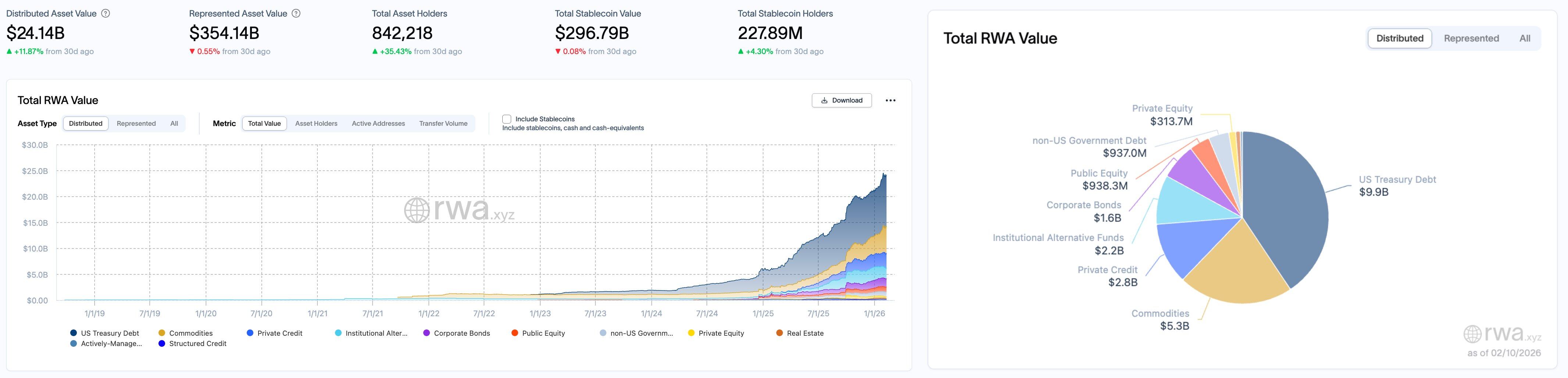
According to rwa.xyz data panel, as of February 24, 2026, the total value of RWA on-chain (Distributed Asset Value) increased from $24.14 billion on February 10 to $25.07 billion, an increase of about $930 million over two weeks, with a growth rate of about 3.85%. The scale of on-chain assets continues to reach record highs. The total value of representative assets (Represented Asset Value) rose from $354.14 billion to $362.56 billion, an increase of about $8.42 billion, with a growth rate of about 2.38%.
The user side experienced a first decline, with the total number of asset holders dropping from 842,200 to 710,400, reducing by about 131,800, a decrease of about 15.65%. In terms of stablecoins, the total market capitalization remained stable, slightly decreasing from $296.79 billion to $296.10 billion, a reduction of about $690 million, a decline of about 0.23%; however, the number of stablecoin holders significantly increased from 227.89 million to 236.91 million, an increase of about 9.02 million, with a growth rate close to 4%, indicating that the user base of on-chain funds continues to expand.
In terms of asset structure, U.S. Treasury bonds increased from $9.9 billion to $10.6 billion, an increase of about $700 million, with a growth rate of over 7%, making it the single sector contributing the most to the total amount this period. The scale of commodity assets remained around $5.3 billion, essentially unchanged from two weeks ago, staying at a high level. Private credit slightly rose from $2.8 billion to $2.9 billion, continuing moderate expansion. Institutional alternative funds remained around $2.2 billion, with little change, staying in a range; in comparison to the above assets, other asset categories showed smaller fluctuations.
Trend Analysis (ComparisonLast Week)
Overall, compared to February 10, during this phase of the RWA market, the scale of on-chain distributed assets continues to expand, with U.S. Treasuries becoming the main direction for capital absorption, while commodities and private credit remain stable at high levels, with incremental structural growth more concentrated in low-risk or highly liquid categories. In addition, the stablecoin market cap remained flat but the user base increased significantly, and overall risk preference remained moderate, with funds not migrating en masse to high-volatility or low-liquidity assets; the structural focus still leans toward balancing yield certainty and liquidity.
Market keywords: decrease in holders, strengthening of U.S. Treasuries, investment in low risk.
Key Event Review
The U.S. Securities and Exchange Commission (SEC) updated FAQs related to Rule 15c3-1 (Net Capital Rule) on its official website on February 19, clarifying how broker-dealers handle the discount calculation when determining net capital for proprietary payment stablecoin positions.
The response indicated that if a broker-dealer categorizes its proprietary-held payment stablecoins as having a "ready market" under Rule 15c3-1, a 2% haircut can be applied based on the side with the higher market value among long or short proprietary positions when calculating net capital. SEC staff will not raise objections to this processing method.
SEC cryptocurrency working group chair Hester Peirce also subsequently issued a statement supporting this processing method. She emphasized that stablecoins are an important infrastructure for blockchain payments and transactions, and reasonable capital treatment helps broker-dealers utilize stablecoins more effectively in custody, settlement, and tokenized securities-related businesses. She believes that compared to some brokers potentially adopting a 100% discount out of caution, the 2% discount better reflects the reserve backing of payment stablecoins primarily composed of U.S. dollars and high-quality short-term assets.
RWA Based on Hong Kong Assets Not Subject to Regulatory Authority in China
Along with the People’s Bank of China and eight departments jointly issuing the "Notice on Further Preventing and Disposing of Risks Related to Virtual Currency" (referred to as "Document No. 42"), the regulatory framework for RWA issued overseas based on domestic assets in China is beginning to take shape. The overall tone of Document No. 42 is a strict ban on domestic issues and strict management of RWA abroad.
According to regulatory insiders, Hong Kong is one of the offshore issuance locations for RWA, and RWAs based on Hong Kong assets are not within the regulatory scope of Document No. 42, and thus are not under the responsibility of domestic regulatory authorities. Currently, there are no RWA based on domestic securities or funds in offshore locations like Hong Kong; if there are, they would be overseen by the institution department of the China Securities Regulatory Commission, although "originally it was all not allowed." Now, "there is no statement that it is all not allowed," but strict regulation applies to the outbound issuance of RWA. This does not imply "encouragement"; it must not be interpreted as "promoting development."
U.S. Securities and Exchange Commission (SEC) Chair Paul Atkins and Commissioner Hester Peirce stated that regulators are considering introducing an "innovation exemption" for on-chain securities to incrementally advance the integration of tokenized securities into the U.S. capital markets.
Atkins pointed out during the ETHDenver event that this exemption mechanism would allow limited trading of certain tokenized securities on new platforms while gaining practical experience for the establishment of a long-term regulatory framework. Peirce reiterated that tokenized securities fundamentally still fall under the category of securities and should be cautiously promoted under the existing legal framework.
Over the past year, traditional financial institutions, including Nasdaq and DTCC, as well as several cryptocurrency companies, have explored the tokenized stock business. If the SEC approves the related paths, cryptocurrency platforms might offer blockchain-based traditional stock trading, competing with traditional brokers.
Currently, the demand for tokenized stock trading globally continues to rise. Kraken reported that its xStocks product has achieved a cumulative trading volume of $25 billion; Robinhood’s RWA blockchain project also surpassed 4 million transactions in its first week. The SEC stated it will adopt a "gradual" approach to balance innovation and investor protection.
U.S. Senator: CLARITY Act Expected to Pass in April, Coinbase Indicates "Path Forward"
U.S. Senator Bernie Moreno stated that the cryptocurrency market structure bill, the "CLARITY Act," is expected to pass Congress before April. Moreno mentioned in an interview with CNBC that a clear path has emerged for advancing the bill.
Coinbase CEO Brian Armstrong indicated in the same interview that there were previous disagreements regarding the interest terms and regulatory attributions for stablecoins, but currently all parties are seeking a "win-win" solution. Reports suggest that the earnings clause for stablecoins is one of the main points of contention in the bill’s advancement.
Moreno also stated that he does not believe the results of the midterm elections will affect the bill's progress. Related officials from the White House previously expressed positive expectations for the bill's advancement at the beginning of this year.
The U.S. Securities and Exchange Commission released content from Chair Paul Atkins's discussion at the ETHDenver conference, disclosing that the following matters will be considered in the coming weeks and months:
1. Establishing a framework to explain how to view crypto assets subject to investment contract obligations—how such investment contracts are concluded and terminated;
2. Establishing innovative exemptions to facilitate limited trading of certain tokenized securities on new platforms while looking to establish a long-term regulatory framework;
3. Proposing rulemaking aimed at establishing reasonable pathways for raising funds by selling crypto assets;
4. Issuing no-action letters and exemptions to provide clearer information, including addressing wallets that do not need to register under the Securities Exchange Act;
5. Developing rules regarding broker-dealers’ custody of non-securities crypto assets (including payment stablecoins);
6. Establishing rules for modernizing transfer agent structures to adapt to the roles that blockchain can play in record keeping;
7. Providing additional guidance and no-action letters to help the crypto community understand how existing rules apply to unique real-world situations.
Total Market Value of RWA Assets on Ethereum Chain Surpasses $15 Billion
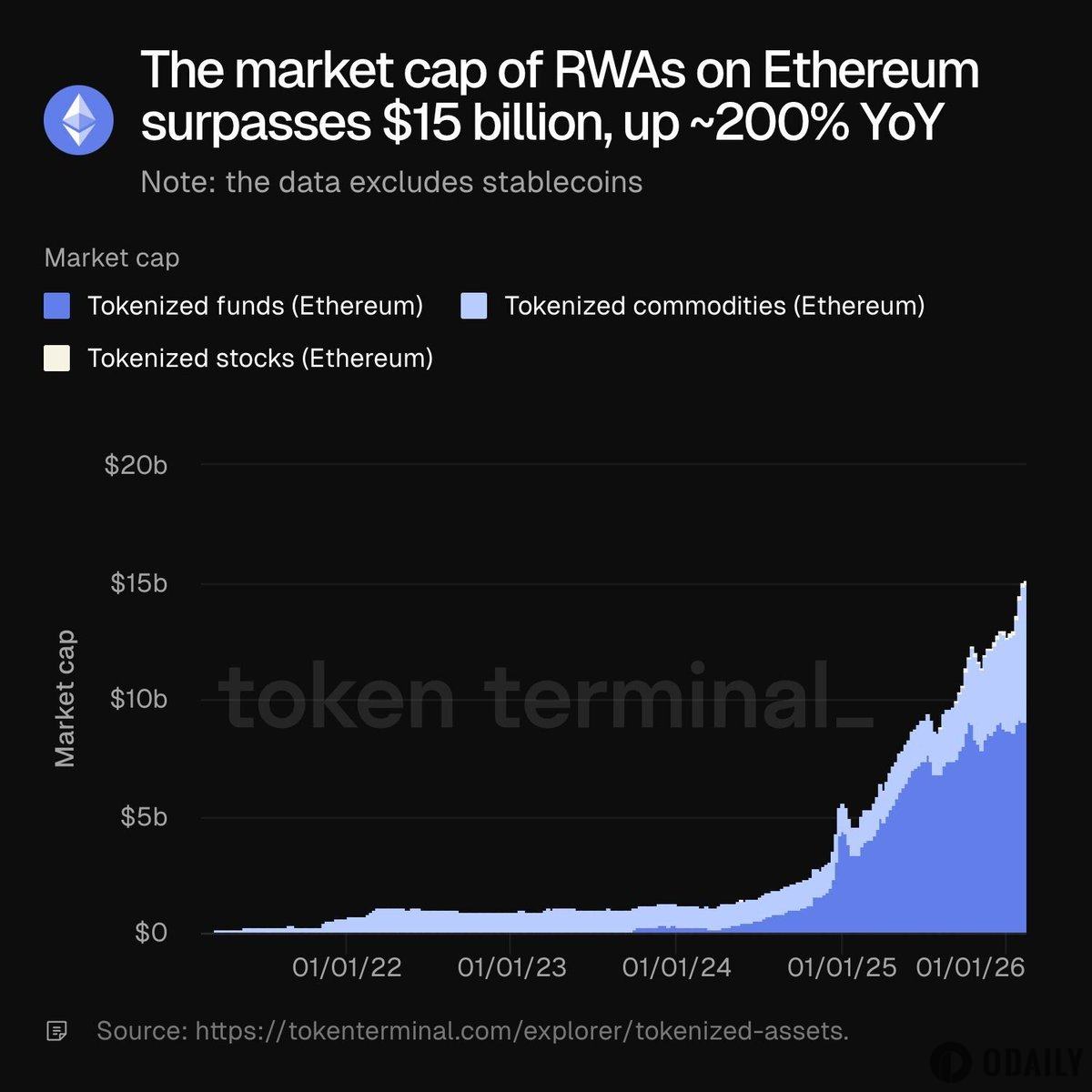
On February 17, Token Terminal data showed that the total market value of RWA assets on the Ethereum chain (including tokenized funds, tokenized commodities, and tokenized stocks) had exceeded $15 billion, a year-on-year increase of about 200%.
OneChain Officially Announces Completion of Series A Strategic Financing of $67 Million
OneChain recently officially announced the completion of Series A strategic financing of $67 million. This financing will mainly be used to build a complete RWA (Real-World Assets) on-chain infrastructure aimed at institutional asset issuers, financial institutions, and global investors, providing a one-stop solution for issuance, management, rights confirmation, and liquidity trading of real assets.
This round of financing is jointly invested by Bitgo Capital, East Bank, PACIFIC BANK, and UBpay, with GBEX Holdings serving as the exclusive financial advisor for this financing.
Tokenizing Real-World Value (OneChain) is dedicated to converting real-world value into on-chain assets and serves as a global compliance RWA asset issuance and management platform.
WLFI: USD1 Encountered Organized Attack, Token Still Maintains 1:1 Peg
WLFI stated that USD1 encountered an organized attack on the morning of that day. The announcement noted that related personnel had hacked multiple WLFI co-founders' accounts, spreading negative information through channels while establishing a substantial number of WLFI short positions.
WLFI stated that USD1 relies on the 1:1 asset backing and minting and redemption mechanisms, and it is still trading at par with the pegged asset. The team emphasized its commitment to continue with the established plan and advised users to rely on information from official certified channels.
Hot Project Updates
Ondo Finance (ONDO)

One-Sentence Introduction:
Ondo Finance is a decentralized finance protocol focused on tokenizing structured financial products and real-world assets. Its goal is to provide users with fixed-income products, such as tokenized U.S. Treasuries or other financial instruments, through blockchain technology. Ondo Finance allows users to invest in low-risk, high-liquidity assets while maintaining decentralized transparency and security. Its token ONDO is used for protocol governance and incentive mechanisms, and the platform also supports cross-chain operations to expand its application scope within the DeFi ecosystem.
Latest Update:
On February 12, Ondo Finance announced that tokenized stocks from Ondo Global Markets are now live on the DeFi lending market, starting with SPYon and QQQon, and have been integrated with Morpho and Gauntlet. Ondo's tokenized stocks and ETFs can now serve as efficient risk management collateral within Ethereum DeFi.
On February 13, Ondo Finance posted on the X platformthat the Ondo tokenized stock DeFi application, supported by Chainlink as the official data oracle, is now live. Institutional-grade priced assets like QQQon and TSLAon have been unlocked as high-quality collateral on-chain. With TradFi liquidity and oracle data, Ondo's tokenized U.S. stocks can now support on-chain lending and structured products, with Euler Finance treasury launching first, managed by Sentora and secured by Chainlink. This marks the first use of tokenized stocks as collateral in Ethereum DeFi.
Previously, Bloomberg senior ETF analyst Eric Balchunas noted on X platformthat 21Shares is applying to issue Ondo ETF.
MSX (STONKS)
One-Sentence Introduction:
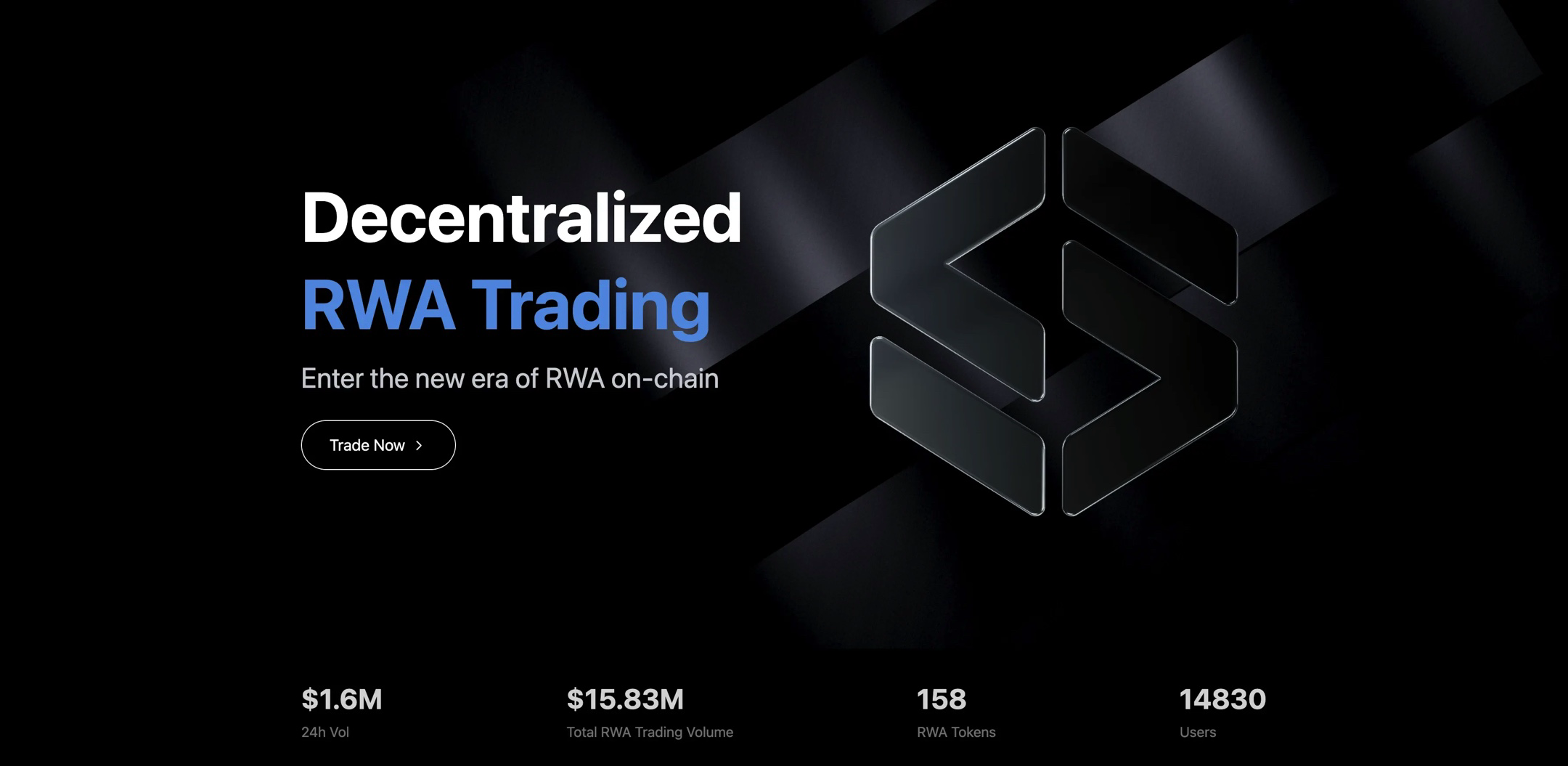
MSX is a community-driven DeFi platform focusing on tokenizing and trading RWA such as U.S. stocks on-chain. The platform collaborates with Fidelity to achieve 1:1 physical custody and token issuance. Users can mint stock tokens like AAPL.M and MSFT.M using stablecoins such as USDC, USDT, USD1, and trade them around the clock on the Base blockchain. All transactions, minting, and redemption processes are executed by smart contracts, ensuring transparency, security, and auditability. MyStonks aims to bridge the gap between TradFi and DeFi, providing users with a high liquidity, low barrier entry for on-chain U.S. stock investments, establishing a "Nasdaq for the crypto world."
Previous Updates:
On February 11, Maicong MSX announced that its official website msx.com completed an overall design upgrade on February 11, 2026. This revision focuses on "visual reconstruction, interactive optimization, and brand conveyance," including the adoption of dark financial color schemes, introduction of new skeuomorphic styles and character elements, and restructuring the layout of market and functional modules. In terms of interaction, the website increased page whitespace based on a grid system to minimize non-critical information interference while concentrating and streamlining entrances and buttons for high-frequency areas like market data, positions, and order placement to shorten operational paths. Additionally, the website uniformly uses brand green to mark critical operations and status feedback, enhancing the readability of key steps like ordering and confirmation, reducing the risk of misclicks and misjudgments.
On January 13, Maicong MSX announced a change in its RWA spot trading fee collection model. After the adjustment, this section transitioned from the original "dual-sided fee" to a "one-sided fee." The specific execution standard is a maintenance fee of 0.3% on the buying side, with the selling fee dropping to 0. This means that when users complete a "buy + sell" full transaction loop, the overall transaction cost will be reduced by 50%. This rate policy is now in effect across the MSX platform, covering all listed RWA spot trading pairs.
Furthermore, Maicong MSX officially published a review article for the year 2025 "Anchoring the Era Window, Building a New Ecosystem for On-Chain U.S. Stocks", reflecting on the phased achievements of the year.
Related Links
"Robinhood Breaks into L2, Focusing on RWA Tokenization"
"After Document No. 42's Tone Setting, What is the Best RWA Token Standard?"
免责声明:本文章仅代表作者个人观点,不代表本平台的立场和观点。本文章仅供信息分享,不构成对任何人的任何投资建议。用户与作者之间的任何争议,与本平台无关。如网页中刊载的文章或图片涉及侵权,请提供相关的权利证明和身份证明发送邮件到support@aicoin.com,本平台相关工作人员将会进行核查。


