Original | Odaily Planet Daily
Author | Dingdang
Recently, ETF issuers Bitwise Asset Management and GraniteShares submitted applications for prediction market ETFs to the U.S. Securities and Exchange Commission (SEC). Among them, Bitwise submitted six products under the "PredictionShares" brand, while GraniteShares followed closely with structurally similar proposals. Earlier, Roundhill Investments also submitted similar documents on February 13.
The core of these ETFs is tracking the results of U.S. political elections, attempting to package the "probability of election outcomes" into a financial product that can be directly traded in traditional brokerage accounts. Specifically, the focus is on the 2028 presidential election (who wins, Democrat or Republican), as well as control of the Senate and House in the 2026 midterm elections.
In other words, investors may no longer need to rush to the crypto world of Polymarket or register with CFTC-regulated Kalshi; they just need to open a Robinhood or Fidelity account to bet on “who will win the White House” as easily as buying a stock.
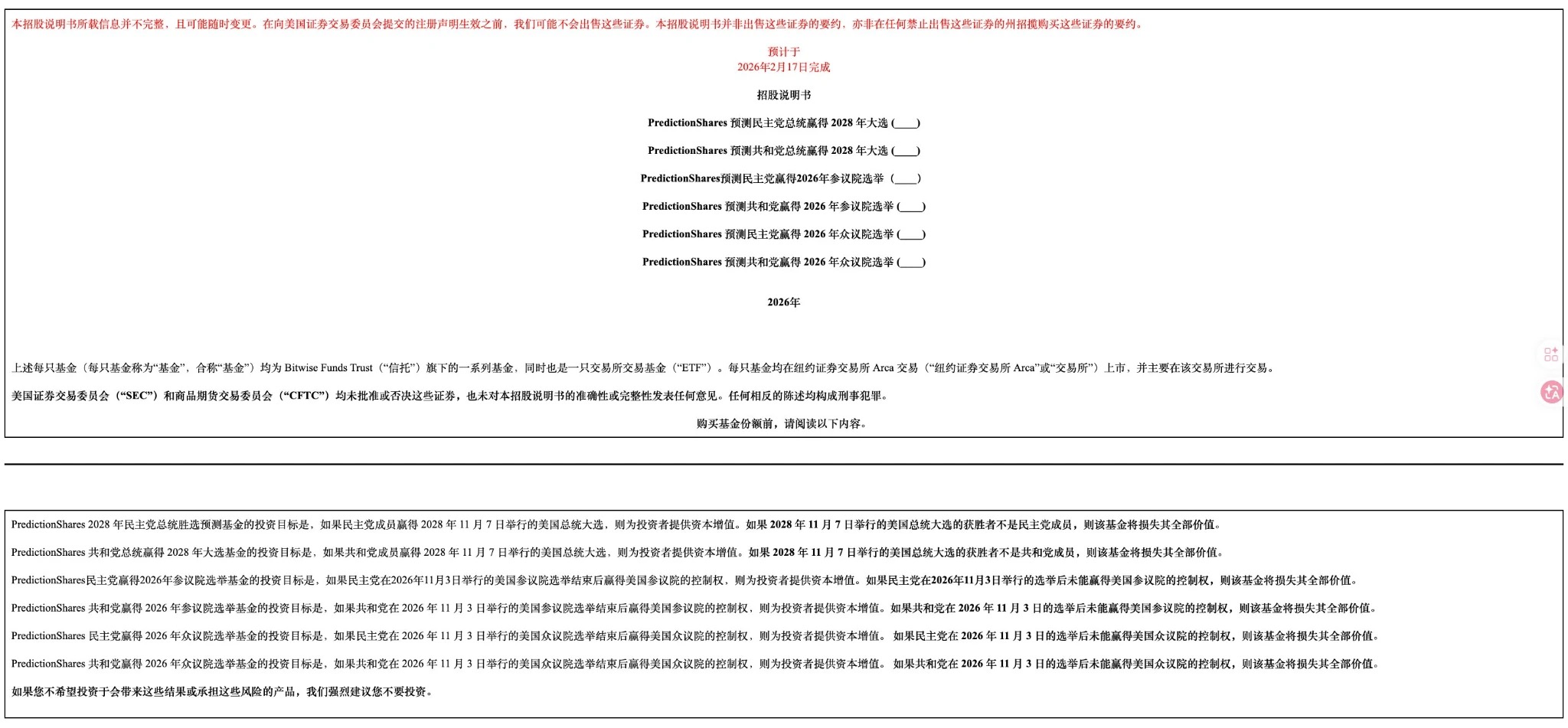
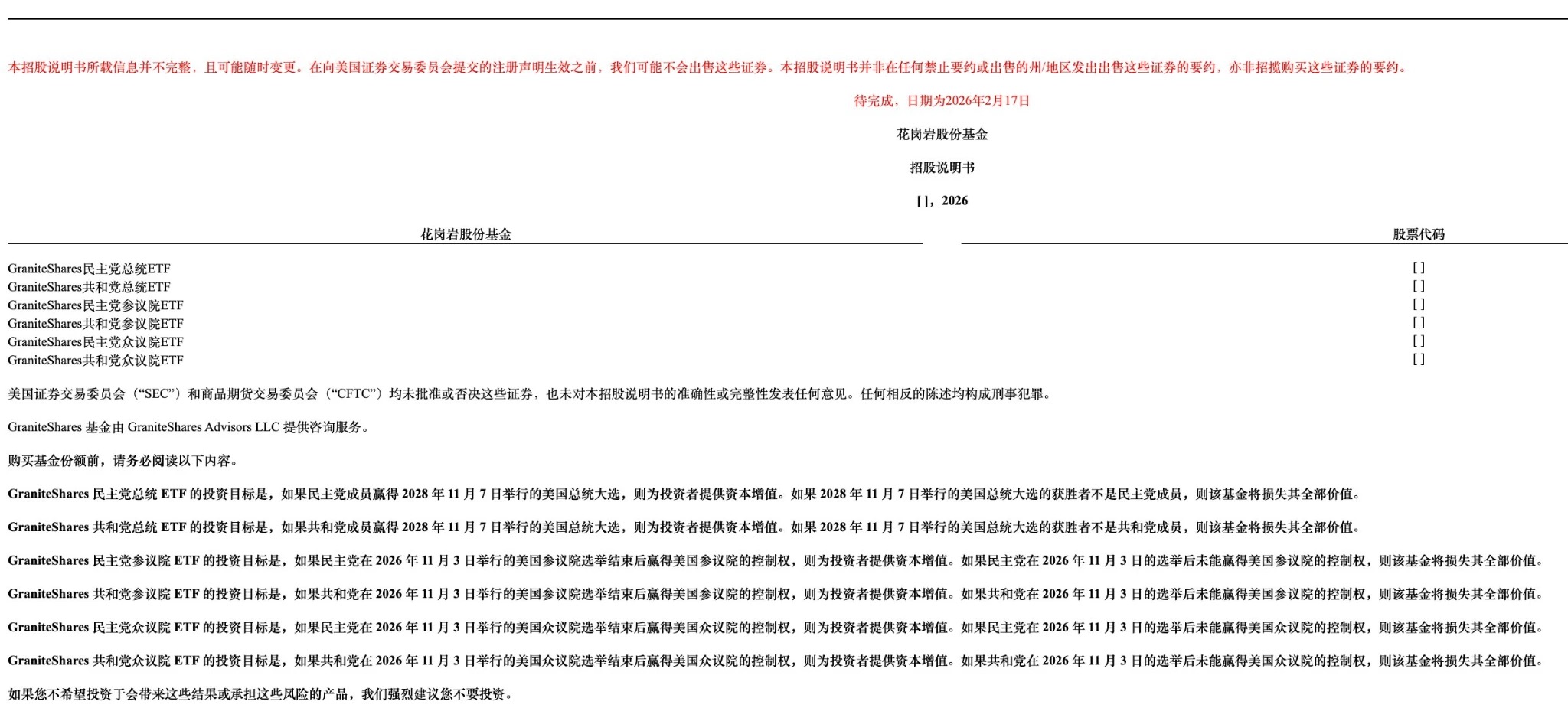
Screenshots from @jason_chen998
What does this leap signify?
Why Do Prediction Markets Always Seem to Be "One Step Ahead"?
The "foresight" of prediction markets regarding political events is not new at all.
Prediction markets are a group of people using real money to express their judgments. Participants express their confidence in an event occurring by buying and selling “yes/no” contracts, with these contract prices fluctuating between $0 and $1, representing the market's consensus on probabilities. For example, if you believe a certain candidate has a 70% chance of winning, you might buy a "Yes" contract for $0.70. If the event indeed occurs, the contract value rises to $1; otherwise, it goes to zero.
This is a form of crowd judgment weighted by funds. Unlike simple verbal expressions, participants must bear the consequences of their judgments in terms of profit and loss, as was notably the case in the 2024 U.S. elections. At that time, trading volumes on Polymarket and Kalshi surged rapidly, with political contracts becoming the dominant force. Before voting day, Polymarket's total trading volume in the single market for "the winner of the 2024 presidential election" reached approximately $3.7 billion. Kalshi, a rising star, was granted legal permission to offer election-related contracts after winning a pivotal lawsuit against the CFTC in September 2024, and by November, its monthly trading volume reached $127 million, with about 89% coming from the political and election markets.
More notably is the signal transmitted by the data itself. In the weeks leading up to the 2024 election, the probability of Trump winning stabilized above 60% on Polymarket, while mainstream polls indicated a tight race, with Harris even slightly ahead. What was the result? The prediction market seemed to have "read" the election situation ahead of time.
This does not mean that prediction markets are "infallible," but across multiple election cycles, they have indeed demonstrated strong information aggregation capabilities. Studies have found that, in cases of ample liquidity and a broad participation base, the statistical performance of prediction markets often outperforms traditional poll samples. The long-established platform PredictIt has also repeatedly been regarded as an effective information aggregator. In contrast, traditional polls are susceptible to sample bias, response bias, and other influencing factors.
The root of the difference between the two lies in the incentive mechanism: polls express attitudes, while prediction markets bear the results. The former incurs no cost, while the latter offers clear profit and loss. This structural difference determines their differing methods of information processing.
Although prediction markets cooled after the election, with Polymarket's daily trading volume plummeting by about 84% after the election results were announced. However, as we enter 2025, the number of prediction market projects has rapidly increased. As of now in 2026, according to data from predictionindex.xyz, there are already 137 prediction market projects, with top player Polymarket's total trading volume exceeding $50 billion and monthly trading volume reaching $8 billion.
From a fringe experiment to a mainstream track, prediction markets have transformed significantly. Now, imagine if participation through ETFs becomes easy; this collective intelligence could more widely influence public perceptions of political events.
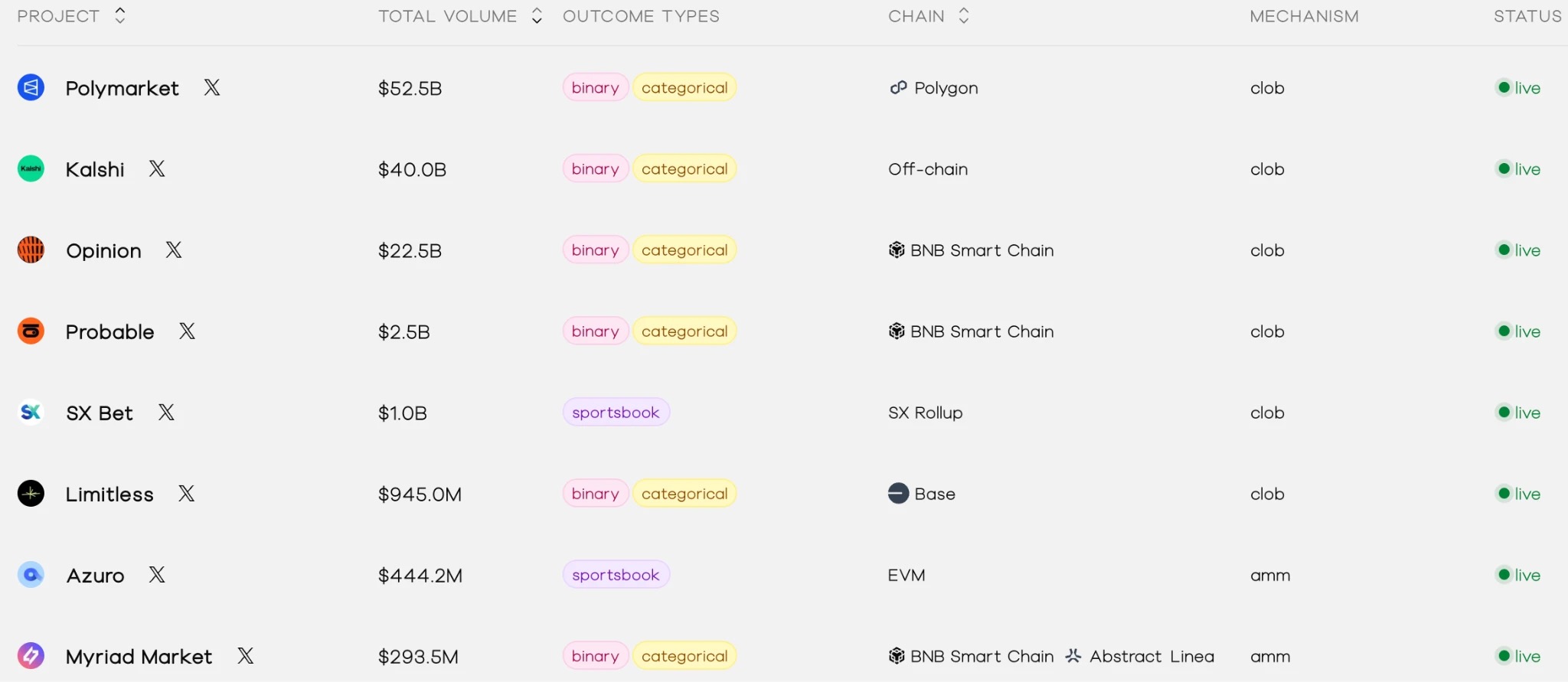
How ETFs Package Prediction Markets
So, how are these ETFs bringing the prediction market model to Wall Street?
What these issuers need to do is essentially translate the prices of prediction market contracts into a product structure that can be understood in the securities market. By donning the ETF cloak, they allow you to buy, buy, buy through formal brokerage accounts, while still wagering on the fate of a political event.
Taking the six ETFs submitted by Bitwise as an example, four target the 2028 presidential election (who wins, Democrat or Republican), while the remaining two correspond to the control of the Senate and House in the 2026 midterm elections. The structures of GraniteShares and Roundhill are quite similar. In simple terms, these ETFs directly map the price performance of binary event contracts from Kalshi or Polymarket into tradable ETF shares.
Mechanically, the stock prices of these ETFs will fluctuate like contracts in the range of $0 to $1, reflecting the market's real-time consensus on event probabilities. At least 80% of the fund's assets will be invested in derivative instruments linked to these political events, such as contracts acquired from CFTC-approved exchanges like Kalshi or replicated performance through synthetic swaps. The buying process is the same as buying stocks: through brokerage accounts such as Robinhood or Fidelity, with expected fee rates between 0.5% and 1%, and the trading venue may be NYSE Arca.
Upon settlement, if the event occurs (e.g., the Democrats win the presidential election), the corresponding "Yes" ETF value would approach $1; otherwise, it would be close to $0. The plan for Bitwise is that once the event results are determined, the fund will quickly liquidate and terminate, distributing the remaining assets proportionally to the holders; some products from GraniteShares and Roundhill are designed to be a bit more "flexible," possibly allowing for "rollover" to the next election cycle.
Compared to the familiar Bitcoin ETFs, there are clear distinctions here. Bitcoin ETFs, like BlackRock's IBIT, track the price of Bitcoin, with limitless upward or downward potential, making them suitable as part of an asset allocation. Prediction market ETFs, on the other hand, are more akin to binary probability bets, with an upper limit fixed at $1, similar to buying insurance or options—winners take all, losers lose everything.
The question is, when probability becomes a tradable asset, is it still merely an information aggregation mechanism?
Mainstreaming or Gambling?
If these ETFs are approved, prediction markets will truly enter the mainstream financial arena.
Currently, political prediction markets are still concentrated among crypto users or professional trading groups. Once ETFs go live, the participation threshold for institutional funds and traditional investors will significantly lower. Companies may use it to hedge against policy changes, and portfolio managers might regard it as a tool for macro risk management. Liquidity will be amplified, and price signals may become sharper.
But the other side of the issue is equally evident. The 2024 election has already demonstrated that prediction market prices can be cited by the media, exaggerated by social platforms, and even influence public sentiment. When probabilities are packaged as "market consensus," they can easily be interpreted as some objective trend. If the scale of funds expands further, could there be deliberate manipulation of prices to influence public opinion? PredictIt has been embroiled in legal disputes due to compliance issues in the past, and such problems are not unfounded.
Regulation remains the biggest uncertainty. The SEC may be concerned that this is essentially "gambling" finance, increasing the risk of manipulation or moral hazards. The approval process may impose conditions, such as trading limits or additional disclosures. Currently, the CFTC has allowed Kalshi to trade election futures, which is a positive signal, but the SEC's stance remains unclear.
Conclusion
From the crypto-native market to Wall Street ETFs, prediction markets are undergoing a transformation of identity. However, before the regulatory framework is clearly defined, the actions of issuers seem more like a test. Testing the boundaries of regulation, and testing the market's acceptance of "probability assetization."
免责声明:本文章仅代表作者个人观点,不代表本平台的立场和观点。本文章仅供信息分享,不构成对任何人的任何投资建议。用户与作者之间的任何争议,与本平台无关。如网页中刊载的文章或图片涉及侵权,请提供相关的权利证明和身份证明发送邮件到support@aicoin.com,本平台相关工作人员将会进行核查。


