Text | Kaori
Editor | Sleepy.txt
In February 2026, MrBeast officially acquired the teen-focused digital banking unicorn Step. Through this transaction, he directly gained a complete financial foundation including accounts, card issuing, and credit establishment.
In October last year, MrBeast had just submitted the trademark application for "MrBeast Financial," covering decentralized exchange operations, cryptocurrency payment processing, investment management, and other fields. A month before, the financial company BitMine, holding 4.3 million Ethereum and aiming to control 5% of Ethereum's total supply, injected $200 million into MrBeast's enterprise.
A 27-year-old internet celebrity who buried himself alive on YouTube and built pyramids in the desert took less than four months to receive a check from a top Wall Street strategist, obtain a banking license, and acquire 7 million teenage users.
In recent years, MrBeast has sold chocolates, Hurricane Film has sold clothing, Li Dan has sold snacks, and Li Jiaqi has sold lipsticks. The business logic of these influencers has remained at an elementary stage of monetizing traffic through selling goods. Now, MrBeast has completed the leap from consumer goods retail to financial infrastructure.
By making a consumer product and connecting it to MrBeast's distribution engine, it can become the most profitable business line in the entire company. Feastables chocolate has already validated this model, and acquiring Step represents his desire to replicate the same script in financial services.
The difference is that the revenue ceiling per individual customer in financial services is ten times higher than that of a chocolate bar.
The Collapse of a Unicorn
To understand the business logic behind this transaction, one needs to see clearly the difficulties Step has faced in recent years.
This company's core audience is teenagers aged 13 to 18, who legally cannot independently open credit card accounts, engage in high-risk investments, or even have formal job income. Relying on them to make money is too difficult; income is mostly based on pocket money given by parents, earning little interest, or occasionally getting cashback from spending.
Although Step has accumulated 7 million users, it has always been a business losing money while generating buzz. Compliance, risk control, customer service, technical maintenance—each requires continuous investment, while the profit margins from teenage users are extremely thin.
This high-growth, low-profit model could still tell a story during the capital frenzy of 2021, but by 2025, the market had lost faith. Venture capital began tightening its purse strings, making financing increasingly difficult for Step.
An even more fatal blow came from regulatory concerns. Step's partner bank, Evolve Bank & Trust, frequently faced stop-work orders from the Federal Reserve in the second half of 2024. This bank was ordered to make rectifications due to anti-money laundering and data security issues, directly preventing Step from launching its planned profit-rich financial products targeted at teenagers.
All compliant pathways for expanding new sources of profit were cut off, forcing Step's management to face two choices: either drastically reduce staff and shrink operations, waiting for the market to rebound, or find a buyer and sell at a good price while they still have leverage. They chose the latter.
MrBeast's offer was not particularly generous; industry insiders estimated it to be a discounted acquisition. But for Step's investors, this may already be the best exit opportunity.
With the same 7 million users and the same bank license and technological framework, why can this asset become a high-profit cash printer in MrBeast's hands, while it was merely a burning money burden for others?
The answer is simple: customer acquisition cost.
The customer acquisition cost for traditional consumer banking applications typically ranges from $100 to $300 per user. Star companies like SoFi and Chime need to invest hundreds of millions of dollars in marketing each year to maintain user growth.
What is the cost of producing a video by MrBeast? According to internal data from Beast Industries, the production cost of a YouTube video ranges from $500,000 to $2 million. But this video can garner 100 million to 300 million views. If 1% of viewers register for Step, that translates to 1 million to 3 million new users. Spreading this cost across users brings the customer acquisition cost to less than $1.
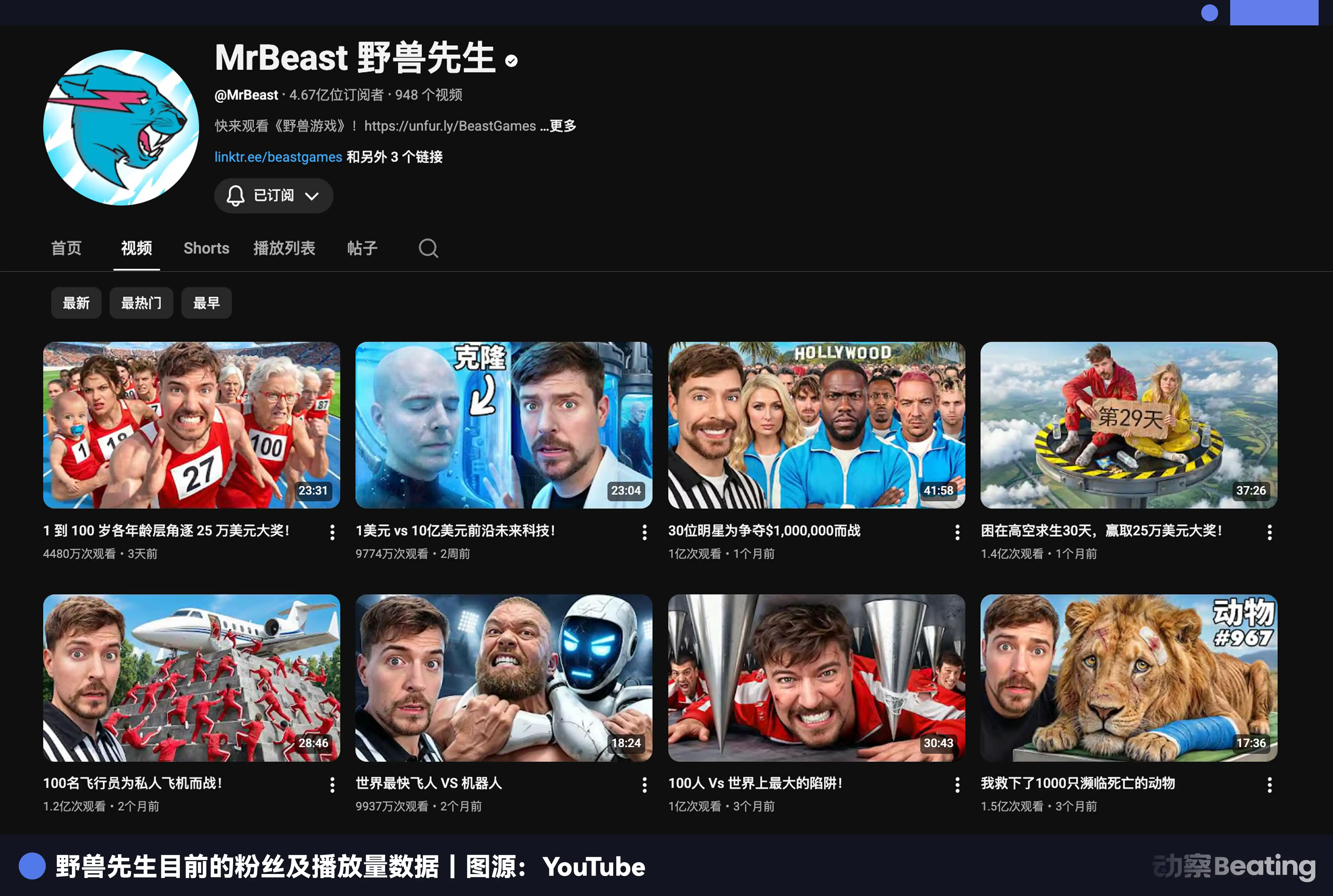
More importantly, this method of customer acquisition requires virtually no additional marginal cost. MrBeast is already creating content and releasing videos. Integrating Step's promotions into his videos is just a quick task. When your marketing channels across platforms like YouTube, TikTok, and Instagram collectively boast 600 million followers, the customer acquisition cost can approach zero.
This cost advantage is unmatched by any traditional fintech company.
From Chocolate to Bank Cards
MrBeast is not the first influencer to attempt cross-border selling through content creation. The business logic among these creators is quite similar, utilizing celebrity effects for first-order conversion, turning fans into consumers.
However, this model has a fatal flaw: it relies on a continuous traffic dividend, lacking repurchase stickiness. A fan might buy a product once due to liking it, but it's difficult to sustain repeat purchases. The customer lifecycle value is very short, and the ceiling of the business model is low.
MrBeast has chosen a completely different path.
In 2022, he launched his own chocolate brand, Feastables, which completely overturned the traditional logic of the food industry.
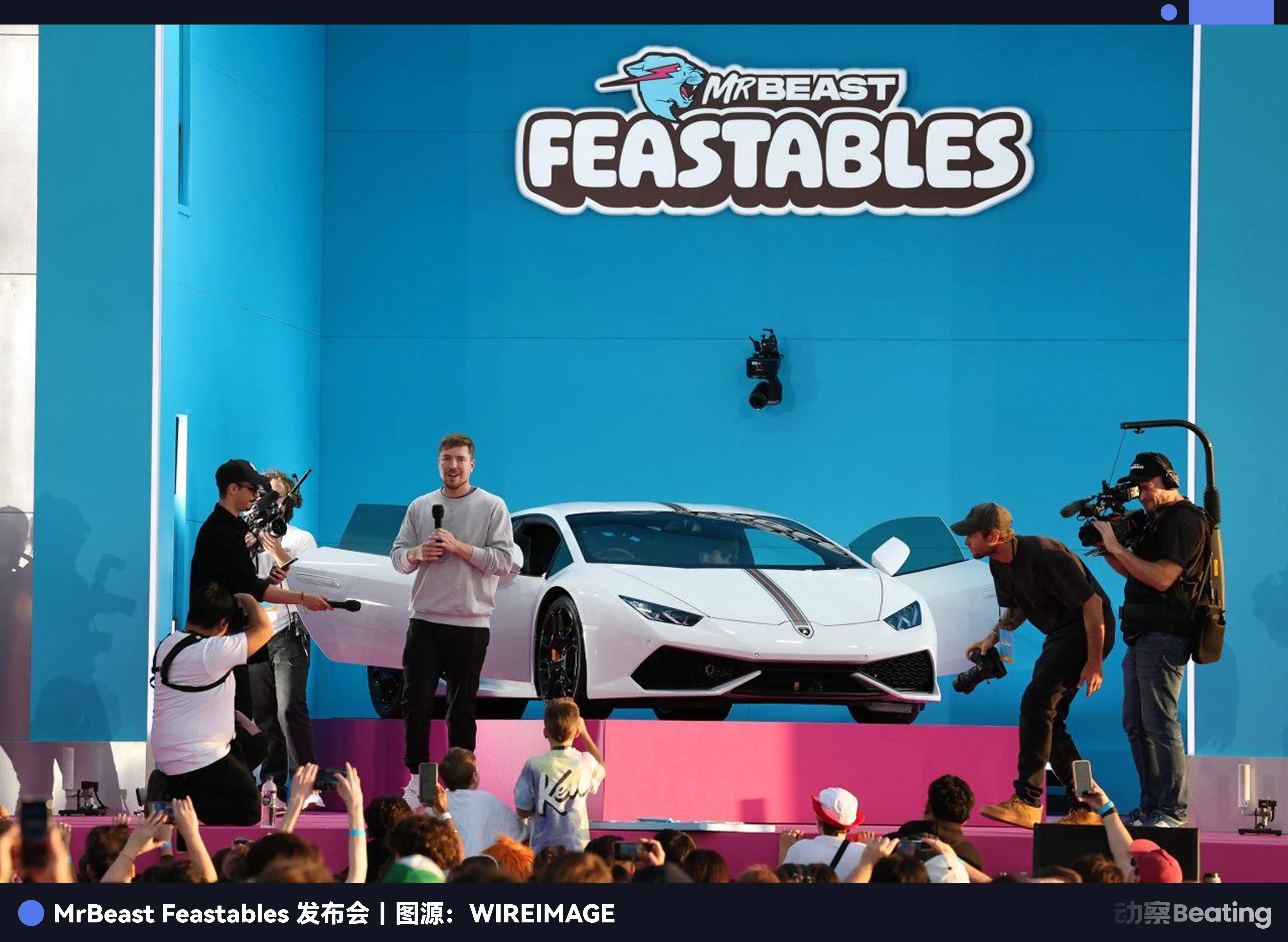
MrBeast did not spend a dime on traditional advertising; all marketing was completed through his content. He designed various challenges in his videos, integrating Feastables as rewards or props. Fans are not just consumers; they become participants in the content.
Although MrBeast's annual content production brings in over $100 million in media revenue, the hefty investment in content production caused the media business to lose nearly $80 million in 2024, urgently needing a high-margin product line for support. Feastables achieved revenue of $250 million in 2024, with profits exceeding $20 million, surpassing MrBeast's YouTube ad revenue share and Prime Video programs for the first time, becoming Beast Industries' most profitable business line.
This proved one thing: when you have a sufficiently powerful distribution capability, you can plug any product into this engine and then wait for it to take off.
Chocolate is like this, energy bars are like this, and hamburgers are like this. So, what about bank cards?
The acquisition of Step is essentially about transferring the Feastables script to financial services. The difference is that this time there is no need to build supply chains, brands, or channels from scratch. With 7 million existing users, a complete banking license, and a mature technical framework, all the infrastructure is already in place. What MrBeast needs to do is simply connect his distribution engine.
Moreover, the value ceiling per client in financial services far exceeds that of a chocolate bar. If a Step user remains active, they can deposit, spend, invest, and borrow on the platform. As they grow older, their financial needs will become more complex, contributing increasing revenue to the platform. This is a truly valuable asset for the long term.
But merely having customer acquisition efficiency and distribution capability is not enough; the financial industry already has too many mature players. SoFi, Chime, and Cash App possess full licenses and full product lines, accumulating tens of millions of users. Why should MrBeast be able to take future customers away from them?
Capturing Them Before College Loans
2025 will be a watershed year; life is getting tougher for digital banks, customer acquisition is becoming difficult, and growth is slowing.
As an emerging fintech bank, SoFi’s core barrier is in college loan restructuring and one-stop financial services. Its typical user profile is 25 to 35 years old, young professionals who have recently graduated or been working for a few years, burdened with student loans and needing lower-rate refinancing solutions. Surrounding this core need, SoFi builds a complete set of financial services including deposits, investments, insurance, and wealth management consulting.
This model has been very successful over the past decade, but it is actually too late. When a young person enters college and begins to incur loans, their financial habits have already started to form. They might already have their first bank card, gotten used to a certain payment app, or built trust in a brand.
In contrast, 88% of Step’s users are opening their first bank account. Their ages are concentrated between 13 to 18 years, and they have not yet developed any financial habits or loyalty to any brand. Whoever occupies this blank period first will hold the future.
This means MrBeast has completed credit locking five years earlier than SoFi's potential customers enter college. By the time these kids turn 18, they will be accustomed to using Step for spending, saving, and checking bills. Their first paycheck will be deposited into Step, their first installment payment will be completed on Step, and their first investment will also start from Step.
At that point, SoFi will have to pay a much higher price to win these users than they would now.
More critically, the value propositions of the two are entirely different. SoFi offers professional financial tools, certified financial planning advice, systematic investment seminars, and optimized loan rates.
These are very appealing to mature financial consumers, but for a 15-year-old student, they are quite boring.
MrBeast offers social currency. Step provides 10% cash back on spending, serves as the only channel to participate in MrBeast's video challenges, and may even provide opportunities to meet MrBeast in the future. For Generation Z, this sense of participation and belonging far exceeds the allure of a 0.5% interest rate on deposits.
Thus, the diversion here is not taking existing users away from SoFi; instead, it is locking in new users before SoFi even has to pay to reach them.
Moreover, the very rules of the game are changing.
When Countries Start Focusing on Teen Accounts
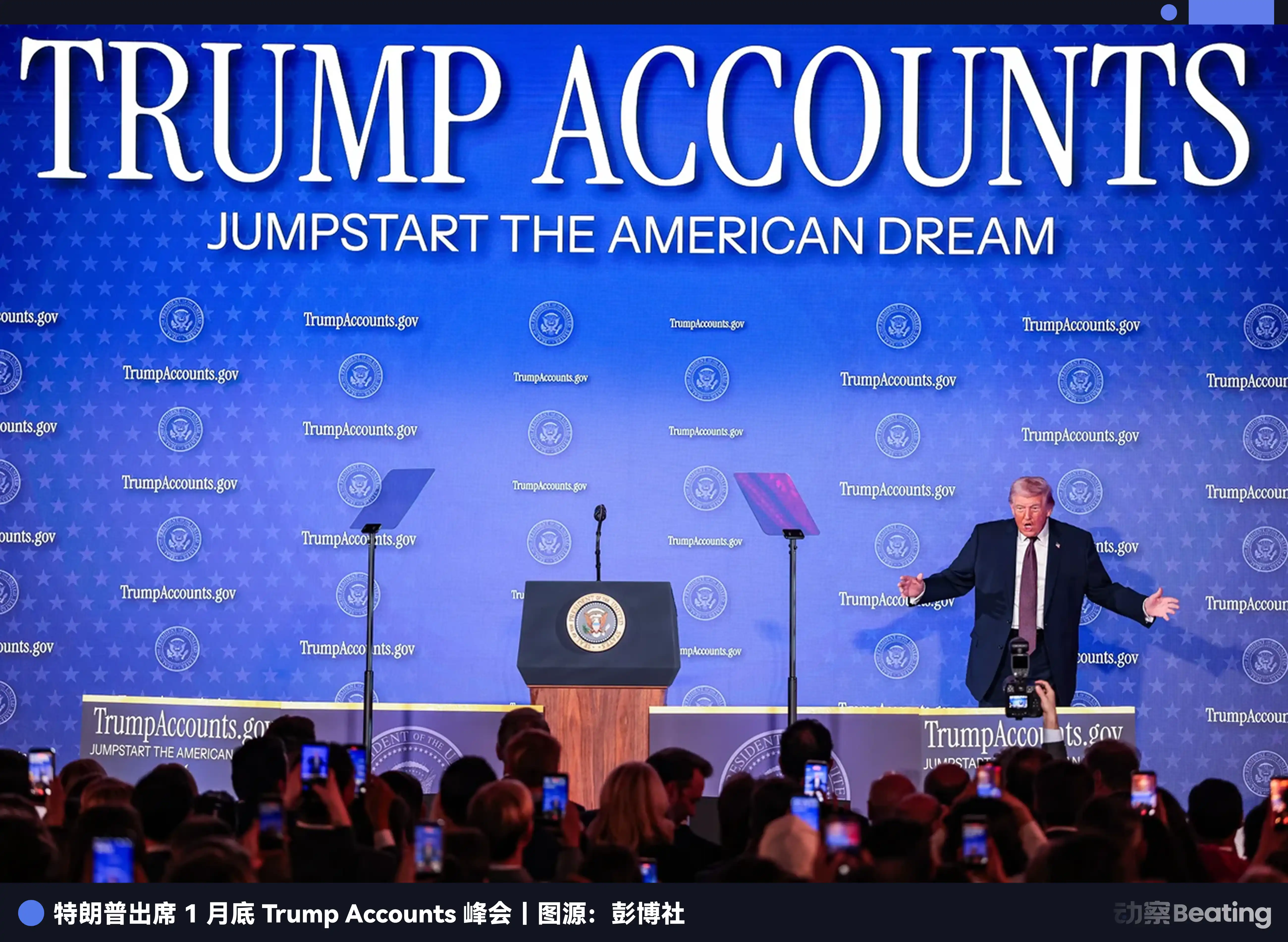
On January 20, 2026, the U.S. Treasury released a policy framework called Trump Accounts. This document proposed automatically creating a government-backed investment account for every child born in the United States, with an initial deposit to encourage families to continue saving, allowing this money to become their first pot of gold when the child comes of age.
The symbolic significance of this policy surpasses its practical operational meaning. Its real impact lies in turning every child's first investment and first account into a national narrative and institutional design.
Wall Street immediately caught wind of this shift; JPMorgan clearly stated at its strategic meeting at the end of January 2026 that it would intensify investment in financial services for teenagers. Bank of America announced it would promote youth savings plans nationwide. Even the traditionally conservative Wells Fargo began exploring partnerships with schools to launch financial education courses.
This will inversely raise the strategic weight of youth accounts across the entire industry. Banks previously considered kids to be broke and ignored them; now everyone realizes this is a fundamental battle for the future.
This is a huge boon for Step and MrBeast. The 7 million teenage users they have accumulated in recent years have transformed from a potentially valuable asset into a currently strategic and scarce resource.
MrBeast is riding the national, bank, and fintech waves as they reevaluate the narrative around teen accounts; timing sometimes matters more than effort.
But this is merely the beginning of the story. Once MrBeast has secured the underlying traffic and successfully intercepted future clients of traditional financial institutions, will he be satisfied merely as a mover of fiat currency?
The Intent of the Strongest Ethereum Bull
After BitMine's $200 million investment announcement in MrBeast, the cryptocurrency community reacted with some shock.
This is not an ordinary venture capital firm; BitMine is a global leader in Ethereum financial services, holding over 4.3 million ETH, valued at over $10 billion at that time. Their goal is very clear: to control 5% of Ethereum's total supply and become the most influential participant in this ecosystem.
Tom Lee is one of Wall Street's most renowned Ethereum bulls. He has publicly stated multiple times that Ethereum will become the foundational protocol for future financial infrastructure, similar to TCP/IP in the internet age. But he also understands that while Wall Street grasps technology and the potential of smart contracts, it does not understand how to reach young people and the next generation's digital lifestyle.

MrBeast has become the bridge connecting these two worlds.
In BitMine's investment logic, Step's 7 million teenage users are a perfect testing ground. These kids have no burdens of thought from the old financial world and enjoy new things. By planting the seeds of decentralized finance in them now, when they become the backbone of society in a decade, adopting digital assets will be a natural choice.
As early as October 2025, Beast Industries quietly applied for the trademark "MrBeast Financial," explicitly mentioning cryptocurrency payments, exchanges, and investment management.
MrBeast is not satisfied with doing retail banking using fiat currency; he wants to turn Step into an entry point connecting traditional finance and crypto finance.
In an interview regarding that investment, Beast Industries' CEO Jeff Housenbold expressed, "We look forward to further exploring ways to collaborate with BitMine and introducing DeFi into the upcoming financial services platform."
Of course, navigating regulatory hurdles is challenging. The SEC has always been monitoring cryptocurrency, particularly red-flag issues involving minors. However, MrBeast's team is clearly well-prepared, having hired former SEC officials as advisors and maintaining communication with regulators, proceeding cautiously.
Additionally, the relatively friendly attitude of the Trump administration towards cryptocurrency has led to the "Trump Accounts" policy not explicitly closing doors on digital assets. Some believe that allowing young people to engage with cryptocurrency early, learning risk management, might be a good thing.
Conclusion
Wall Street understands K-lines, valuations, and asset portfolios, but they do not understand today's children.
They do not comprehend why a 13-year-old child would open an account just to participate in a video challenge; they do not understand why, compared to a century-old bank, a child would trust a YouTube creator more.
But MrBeast understands. He knows that Generation Z does not want cold, hard accounts; they want fun, cool experiences, and conversations they can boast about with friends.
This is the power of generational change. When the rules of the game are rewritten, the rulers of the old world often cannot react in time and are eliminated by the rules of the new world.
In February 2026, MrBeast's acquisition of Step may just be the start of this financial revolution. Looking back in ten years, we might find this was truly the watershed moment.
免责声明:本文章仅代表作者个人观点,不代表本平台的立场和观点。本文章仅供信息分享,不构成对任何人的任何投资建议。用户与作者之间的任何争议,与本平台无关。如网页中刊载的文章或图片涉及侵权,请提供相关的权利证明和身份证明发送邮件到support@aicoin.com,本平台相关工作人员将会进行核查。


