Original Author: Andjela Radmilac
Original Compilation: Saoirse, Foresight News
Bitcoin trades continuously around the clock, but the CME Bitcoin futures market takes a break on weekends. This mismatch in trading hours creates the CME gap, which tends to occur during periods of maximum market pressure.
The CME gap refers to the blank area on the CME futures chart that forms between the closing price on Friday and the first trade price when the market reopens on Sunday evening (U.S. time). CME futures trade weekly, taking weekends off, while the spot price of Bitcoin continues to fluctuate. When the opening price significantly deviates from the Friday closing price, a gap appears on the chart, and the intervening blank area is referred to as the gap.
Previous reports from CryptoSlate have already clarified: gaps are not some mysterious force; they simply reflect a time record where one market is closed while another is still trading. They are unrelated to prophecy, merely manifesting in the chart's time misalignment.
The recent market fluctuations serve as a clear real-life example.
On the CME Bitcoin continuous futures chart, the closing price on January 30 (Friday) was approximately $84,105, while the Sunday opening was around $77,730, leaving a weekend gap of about $6,375. The downward trend then accelerated.
On February 5, at opening, Bitcoin fell from about $72,999, reaching as low as $62,181 on Coinbase, and on the morning of February 6, it approached $60,000 before bouncing back to the mid-$60,000 range. The CME's 30-minute chart formed a similar pattern, hitting a low near $60,005 before rebounding to around $66,900.
Even with such severe volatility, the previously over $80,000 price point on Friday remained far above. As of February 6, this gap remained open, as the price never returned to that area.
This is crucial because it addresses the real question most non-traders want to ask when they hear the word "gap": why does the Bitcoin price sometimes seem to exist in two entirely different worlds, and why does this misalignment gradually disappear within a week?
How a Weekend Market Closure Creates a Gap
The CME's cash-settled Bitcoin futures have trading hours from Sunday evening to Friday afternoon, with brief pauses each day and complete closure over the weekend. However, there is no closure mechanism for the spot Bitcoin market, so if there is a significant fluctuation on Saturday, the CME cannot record it in real-time, leading to a direct gap on the chart during that time.
When the CME reopens, it does not continue trading from the Friday closing price but instead starts at the market price at the opening. If the spot price drops 8% or rises 6% during the closure, the first futures transaction price will reflect that change, compounded by the basis at the opening time. The end result is a significant gap on the chart, with the blank space between the Friday closing price and the Sunday opening price being the gap.
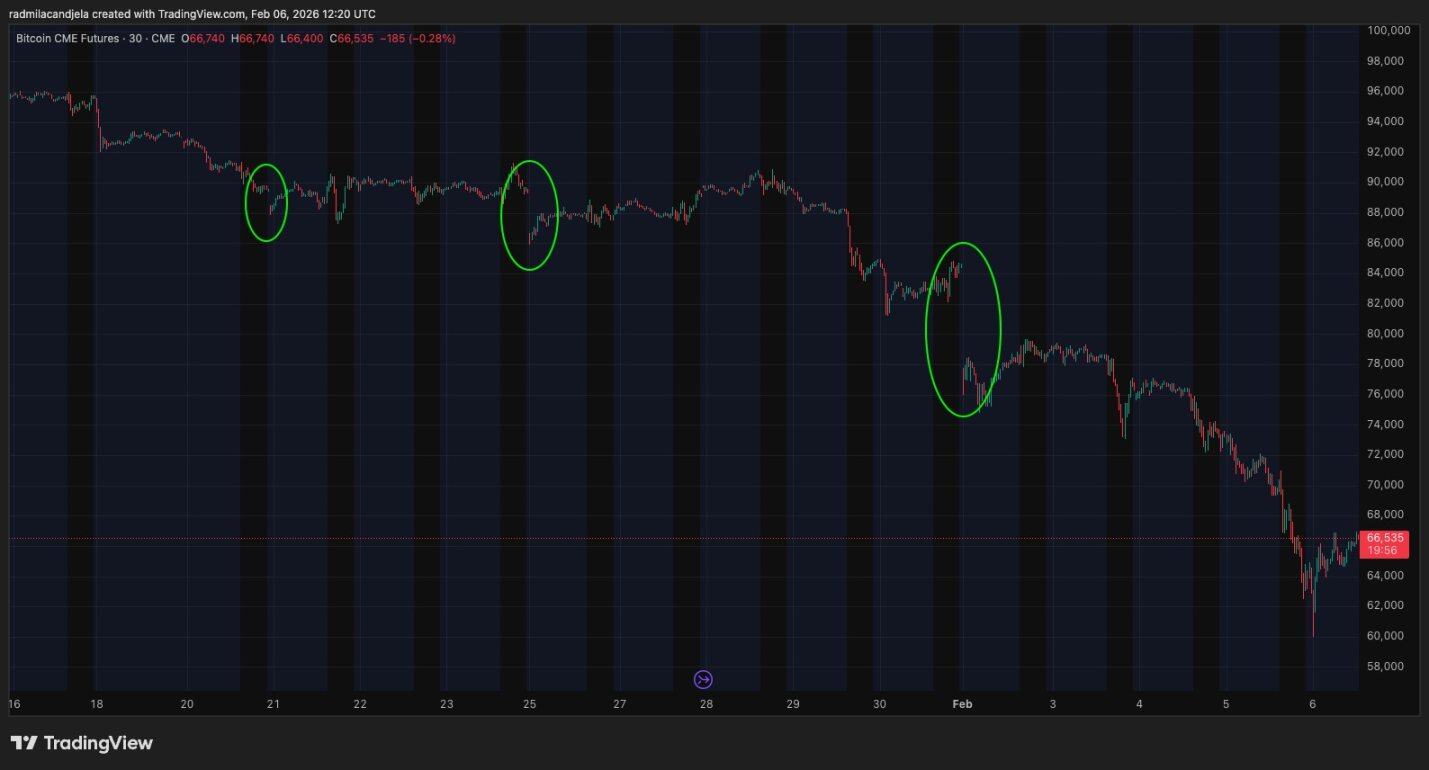
CME Bitcoin futures chart from January 15, 2026, to February 6, 2026 (Source: TradingView)
What truly matters is the subsequent price movements: the existence of the gap is merely a "calendar fact," while gap filling is a type of "market behavior."
You can think of a gap as a few pages skipped in a book. Friday ends in suspense, and over the weekend, three chapters are written elsewhere, while the CME returns with an entirely new chapter. The skipped pages remain absent on the CME chart, but the story in the spot market has long since continued.
This is also why the "gap meme" appears so persuasive during such market conditions:
- When the market is stable, the opening price is close to the Friday closing price, with no obvious gap;
- When volatility is intense, the blank area is huge, and the human brain instinctively tends to treat it as an "unfinished matter."
Misconceptions and Realities:
- Misinformation: CME gaps must always be filled.
- Reality: Gaps often do get filled because liquidity returns to the CME, leading the market to converge; however, there is no strict rule that they must be filled. In trending markets, gaps can remain open for a long time.
Why Gaps Are Often Filled, and Last Week Revealed Their Boundaries
CryptoSlate has previously explained: this situation occurs frequently because once CME resumes trading, there is a real incentive for futures and spot prices to converge.
This convergence arises from a series of simple, repetitive logics:
If the price difference between futures and spots is too large, there is a potential for arbitrage. Institutions that can participate in both markets can buy low and sell high, profiting as the price difference narrows.
This is a convergence process driven by arbitrage and relative value positions, rather than a belief that Bitcoin must rise or fall. Even those who don't trade can understand: two related markets, once liquidity is restored and risk controls are active, rarely tolerate a significant price disparity for long.
There's also the attention effect. Gaps are now widely tracked and discussed, receiving particular attention during price fluctuations. When a large number of traders focus on the same price level, liquidity tends to pool there, making it easier for the price to return to that area, especially in fluctuating and mean-reverting markets.
CryptoSlate's previous research data also supports that gap filling rates are high and that many gaps are quickly filled after CME resumes trading. This explains why the myth of "gaps must be filled" is so widely believed—there are enough historical cases to mislead people into thinking it is a law, even though it is not.
The importance of the February 5 - 6 price action lies in how it showcased the boundaries of this "rule."
Bitcoin fell significantly, quickly rebounding after touching $60,000, leading to over $1 billion in liquidations within 24 hours.
In such an environment, the significance of the CME gap diminishes greatly.
When the market is focusing on sell-offs and leveraging is forcibly cleared, the price will not care about the missing candlesticks on last week's CME chart; it only concerns itself with where the current real buying power lies.
Coinbase and CME fell in sync down to just above $60,000, before rebounding to the mid-$60,000 range. The closing price of around $84,105 on the previous Friday no longer acts as a "gravitational point" for price, but more like a distant marker.
This further demonstrates: open gaps are better suited for explaining price actions rather than predicting them.
- When the market is stable, gaps tend to fill quickly because the price itself is fluctuating, and liquidity is willing to return to previous levels.
- When the market is under pressure, open gaps simply remind us that prices have gone too far and are unlikely to return to previous closing levels in the short term. This is not a failure of theory, but rather a normal function of it - it illustrates the consequences of the movements over the weekend that went uncorrected.
Reports on corporate Bitcoin holdings on February 6 made this situation extend beyond mere chart culture.
CryptoSlate reported that Bitcoin's drop to $60,000 further magnified unrealized losses for corporate holders, causing significant pressure on companies exposing themselves to Bitcoin dynamics through stock price logic.
This also made this round of declines particularly different: it did not remain confined within the crypto market but spread to balance sheets and public narratives.
In this type of market action, the price will not return to last Friday’s closing price just because a gap exists.
Consider the CME gap as a price level that traders might watch, rather than a target Bitcoin "should" reach.
Gaps are most effective when the market is mean-reverting and liquidity is willing to return to old prices;
In liquidation waves and trending markets, gaps can remain open for long periods because the market is dealing with matters more critical than "chart symmetry."
免责声明:本文章仅代表作者个人观点,不代表本平台的立场和观点。本文章仅供信息分享,不构成对任何人的任何投资建议。用户与作者之间的任何争议,与本平台无关。如网页中刊载的文章或图片涉及侵权,请提供相关的权利证明和身份证明发送邮件到support@aicoin.com,本平台相关工作人员将会进行核查。


