The price of Bitcoin has experienced severe fluctuations, with a liquidation of $1.25 billion and a regulatory crackdown, as the market undergoes a difficult transition from "faith-based trading" to "value anchoring."
Recently, the price of Bitcoin briefly fell below $60,000, down over 40% from last year's historical high of about $125,000 in October, marking the most severe crash since 2022. In just 24 hours from February 6 to 7, approximately $1.25 billion in Bitcoin positions were forcibly liquidated.
The Financial Times reported that Bitcoin "is still severely overvalued, and a crash is imminent," questioning the value floor of an asset "sustained solely by imagination." Meanwhile, research reports from institutions like Citigroup predict that, driven by structural factors such as ETFs, Bitcoin could return to six figures by 2026.

1. Cliff-like Decline: Key Technical Levels Lost and Market Panic Spreading
● The Bitcoin market is undergoing a severe adjustment. In early February, the price of Bitcoin fell to about $60,000, erasing all gains since Trump's re-election in 2024.
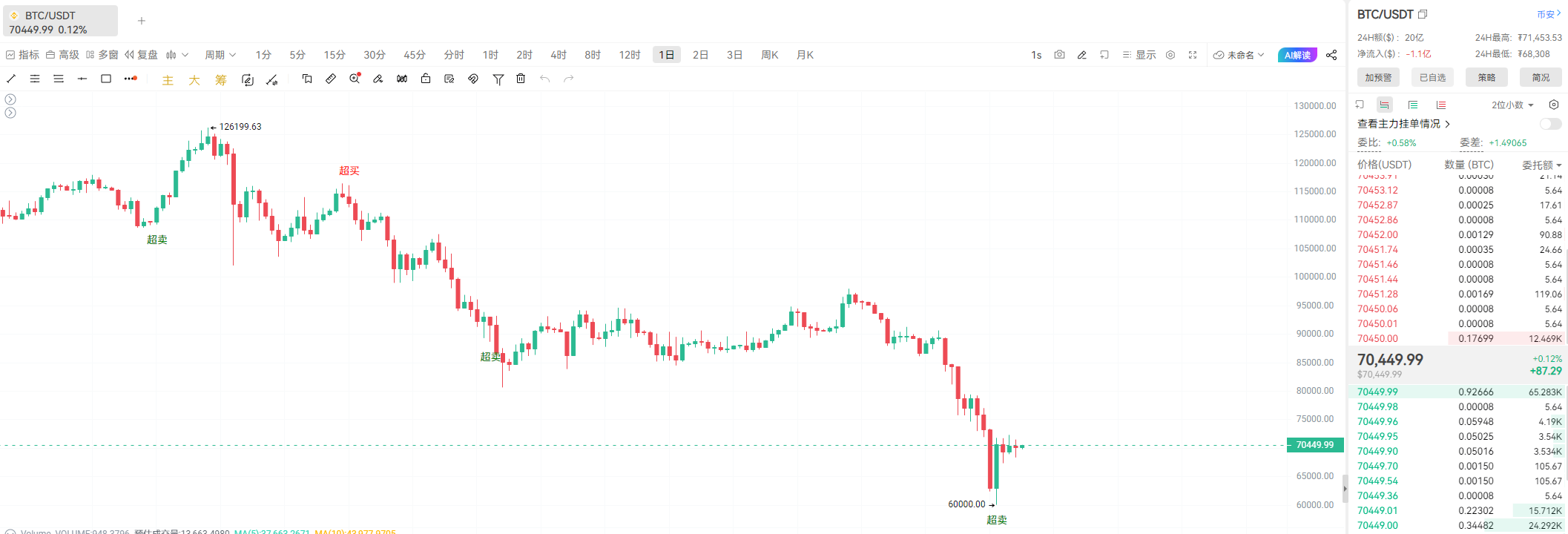
● The current price has dropped below the average entry price of the U.S. spot Bitcoin ETF (about $81,600) and is approaching the key psychological level of about $70,000 before the U.S. elections. The gain or loss at this level is seen as a litmus test for market confidence.
● More critically, according to Coinglass data, approximately $1.25 billion in Bitcoin positions were forcibly liquidated in just 24 hours from February 6 to 7, indicating a clear sense of panic in the market.
2. Driving Factors: Three Forces Pressuring the Market
This decline is not due to a single factor but rather the result of multiple pressures.
● Continued outflow of institutional funds has become a core source of pressure. The U.S. spot Bitcoin ETF recorded outflows of over $3 billion in January 2026, about $2 billion in December 2025, and about $7 billion in November.
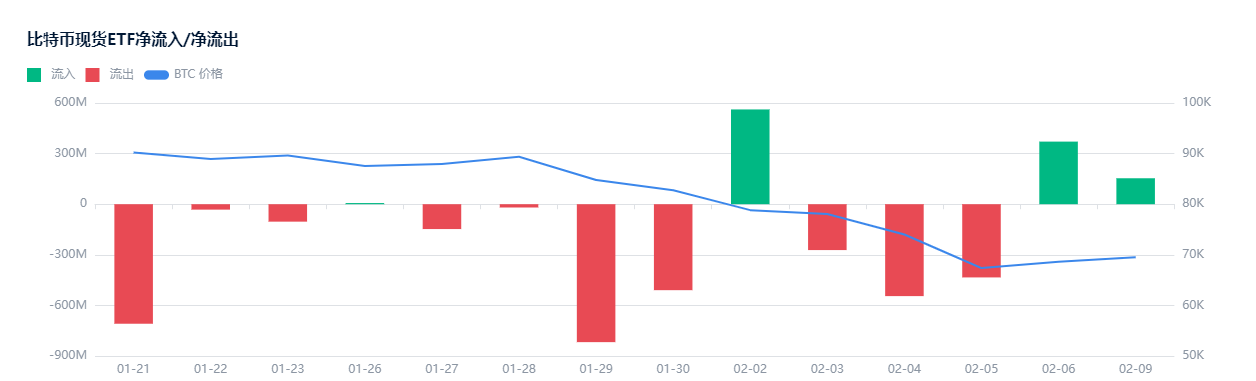
● Since the market shift in October 2025, institutional investors have been selling off billions of dollars in Bitcoin exposure every month. This persistent selling pressure indicates a waning interest from traditional investors and a deterioration in overall market sentiment.
● Decoupling from traditional assets has weakened Bitcoin's narrative foundation. In January 2026, Bitcoin was one of the few major assets to decline, falling 11% to $78,197, while gold rose 13% and the S&P 500 index increased by 1.4%.
● Stalled regulatory progress has increased market uncertainty. The bipartisan-supported "Digital Asset Market Clarity Act" (CLARITY Act) has been stalled in Congress for months, and the confidence boost from early regulatory clarity is dissipating.
3. Bearish Views: The End of Faith-Based Trading and Inherent Flaws
The Financial Times has recently published multiple articles sharply criticizing Bitcoin and its related business models.
The report points out that Bitcoin is experiencing the end of the "Tinkerbell Effect"—the speculative frenzy sustained solely by faith is retreating.
The article argues that Bitcoin has a "fatal structural flaw": due to its fixed or only incrementally increasing supply, it cannot contract supply when demand collapses (i.e., "inelastic supply downward"), which prevents it from truly fulfilling the functions of money.
Several warning signals have emerged in the market:
● The U.S. consumer cryptocurrency adoption rate has dropped from 17% in July 2025 to about 12%.
● The Crypto Fear and Greed Index has fallen back to the "extreme fear" zone at around 15 points.
● Bitcoin's 30-day volatility has risen to 40.72, indicating decreased market stability.
4. Bullish Reasons: Structural Change and Future Expectations
Despite short-term pressure on the market, some analysts believe Bitcoin is undergoing a transformation from a speculative asset to an institutional asset, with long-term prospects still promising.
● Citigroup's research presents a core prediction: Bitcoin could climb to around $143,000 by 2026. This prediction is based on continued inflows into exchange-traded funds (ETFs) and a clearer regulatory framework.
● ETFs are seen as a structural rather than cyclical driving force. They allow pension funds, asset management companies, and advisors to gain Bitcoin exposure within a familiar framework, transforming Bitcoin from a fringe allocation into a legitimate portfolio diversification tool.
● Parallel developments in traditional finance reinforce this narrative. JPMorgan has launched a blockchain-based tokenized money market fund, indicating that major banks are embedding tokenization into mainstream capital markets.
5. Liquidation Chain Reaction and Risk Exposure
● Market volatility has led to a chain reaction. A mishap occurred at the South Korean cryptocurrency exchange Bithumb: due to an employee's operational error, "Korean won" was mistakenly input as "Bitcoin," erroneously distributing over $40 billion worth of Bitcoin (620,000 coins) to users, causing the platform's Bitcoin price to briefly drop by 17%.
● As the price of Bitcoin retreated to about $76,000 (close to its average acquisition cost), this strategy began to exert noticeable pressure on shareholder value. The company finds itself in a dilemma: continuing to increase exposure requires further financing, exacerbating financial burdens; selling Bitcoin would negate its core strategic philosophy.
6. Global Tightening and China's Stance
The global regulatory environment is undergoing significant changes, having a profound impact on the market.
● On February 6, 2026, eight departments in China jointly issued a notice on "further preventing and addressing risks related to virtual currencies," reiterating that activities related to virtual currencies are considered illegal financial activities and clearly stating ongoing rectification of virtual currency "mining" activities.
● The notice specifically points out that stablecoins pegged to fiat currencies are effectively fulfilling some functions of fiat currency in circulation, which concerns monetary sovereignty. No domestic or foreign entity or individual may issue stablecoins pegged to the renminbi abroad without consent.
7. Polarized Market Predictions
● Bearish views suggest that Bitcoin may further dip to the $40,000 to $50,000 range. 10X Research predicts that Bitcoin could fall to $50,000 after a brief rebound.
● Bullish views, however, believe that driven by ETF adoption, regulatory clarity, and institutional tokenization themes, Bitcoin could return to six figures in 2026.
Charles Hoskinson, the founder of Cardano, even predicts that, driven by institutional demand, Bitcoin could reach $250,000 by 2026.
As Bitcoin's price fluctuates near key psychological levels, the Crypto Fear and Greed Index has fallen back to the "extreme fear" zone, indicating extremely weak market sentiment. On one side, the Financial Times warns that a "death spiral" may be imminent, while on the other, institutions like Citigroup predict prices will return to six figures.
In the intense tug-of-war between bulls and bears, retail investors are accelerating their exit, while "whale" addresses holding over 1,000 Bitcoins have recently stopped liquidating. This may signal that the market's dominance is shifting from retail faith to institutional value reassessment.
Join our community to discuss and grow stronger together!
Official Telegram community: https://t.me/aicoincn
AiCoin Chinese Twitter: https://x.com/AiCoinzh
OKX benefits group: https://aicoin.com/link/chat?cid=l61eM4owQ
Binance benefits group: https://aicoin.com/link/chat?cid=ynr7d1P6Z
免责声明:本文章仅代表作者个人观点,不代表本平台的立场和观点。本文章仅供信息分享,不构成对任何人的任何投资建议。用户与作者之间的任何争议,与本平台无关。如网页中刊载的文章或图片涉及侵权,请提供相关的权利证明和身份证明发送邮件到support@aicoin.com,本平台相关工作人员将会进行核查。


