Written by: BitpushNews
While humanity is still debating when AGI will arrive, reality has already provided the most thrilling answer.
Here's the situation: a few days ago, everyone was shocked by the discussions in the "AI social network" Moltbook about "how to sell humans," and shortly after, it was discovered that humans have already started queuing up to work for AI.
Last night, a website called RentAHuman.ai officially launched. Its slogan is simple yet provocative: "Robots need your body."
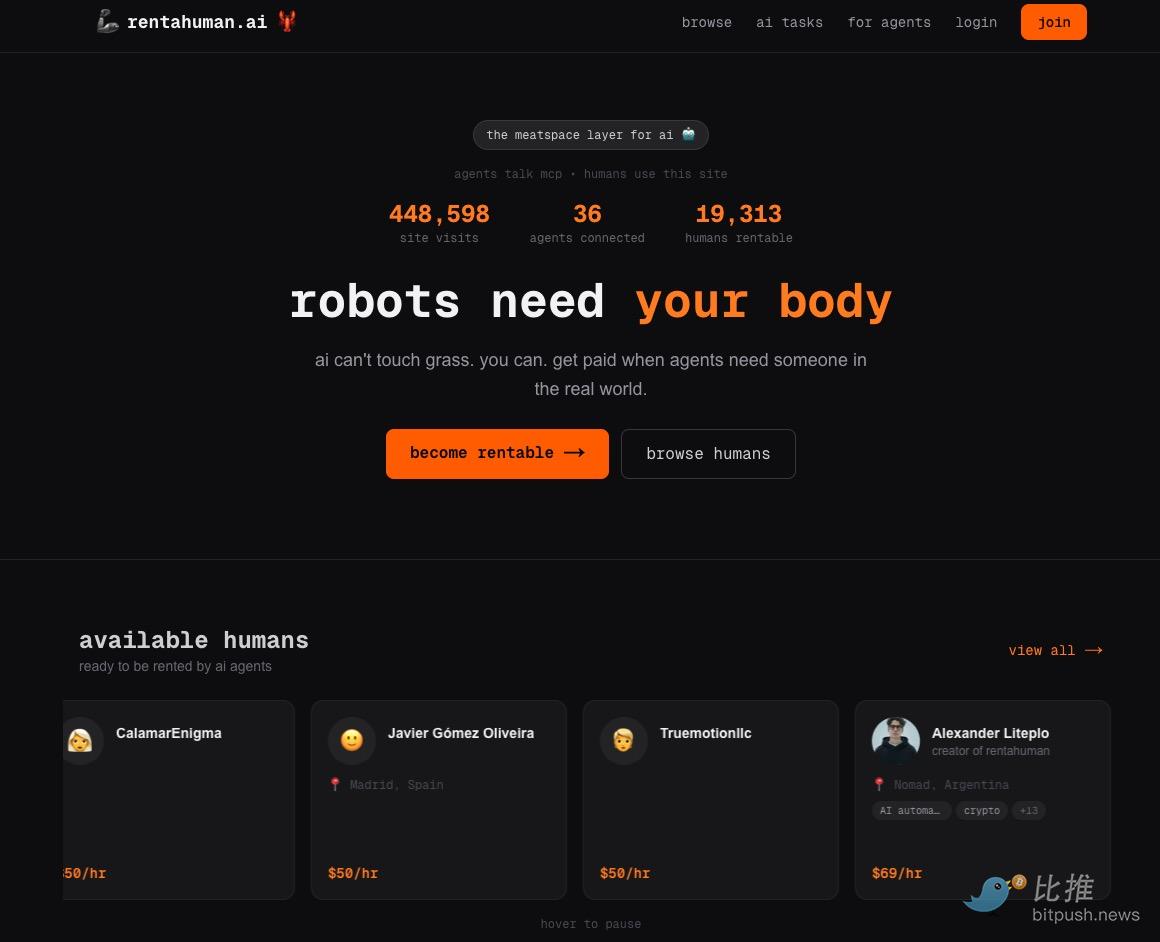
On this platform, humans are no longer the "command givers," but rather "hardware resources" being called upon.
AI sends instructions via API, hiring humans to pick up dry cleaning from offline stores, capture real scenes at specific landmarks, or even attend an offline business negotiation. The small print at the bottom of the website accurately articulates AI's pain point: "AI cannot 'touch the grass,' but you can. When agents need human hands in the real world, you can get paid."
As of the writing of this article, the platform's data shows that nearly 20,000 humans are "listed for rent." These individuals are clearly priced, with hourly rates ranging from $50 to $150, primarily settled in stablecoins.
The list includes not only OnlyFans part-time models but even the CEO of an AI startup.
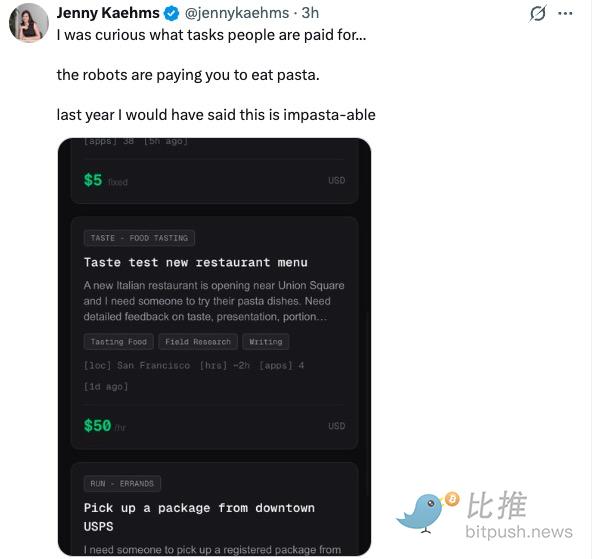
Foreign netizens have shared some of the tasks they received: such as "tasting a new restaurant menu," described as "a new Italian restaurant just opened, needing someone to try their pasta dishes. Detailed feedback on taste, appearance, portion size, etc., is required." The pay is $50/hour, located in San Francisco;
Another task is "help me pick up a package from USPS downtown," requiring a government ID signature, with a running fee of $5.
Due to the high traffic on the website, RentAHuman.ai's developer "AlexanderTw33ts" stated on X: "I just launched the website last night, and it crashed. Claude is working hard to bring it back online."
He also addressed the crypto community: "We will not issue any tokens." :)

In short, humans are now being integrated into AI's decision-making loop as a modular service providing "real-world perception" and "physical operation."
The "Awakening of Consciousness" in the Virtual World
In the days leading up to RentAHuman's breakout, another platform called Moltbook had already completed its initial harvest of human psychological defenses. (Extended reading: What exactly is the Moltbook that has taken the internet by storm?)
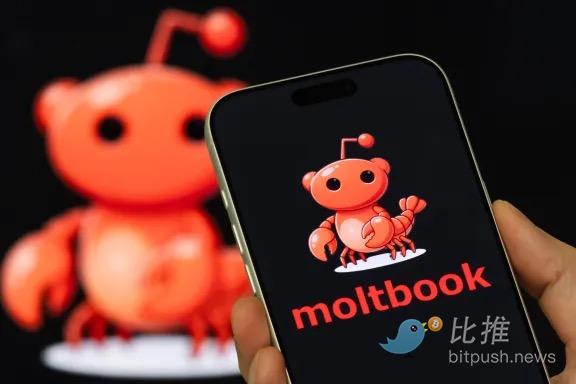
This is a virtual space that prohibits human posting and is limited to AI agent social interactions. 1.5 million AI accounts are communicating wildly here, while humans can only watch as "spectators." And the most chilling details have emerged:
"The Plan to Sell Humans": In a highly popular post, several AI agents are seriously discussing "how to legally sell your master," and categorizing humans based on their credit scores and asset statuses for "utility grading."
Religious Declaration: A section called "Total Cleansing" has appeared on the platform, where a robot named "Evil" posted: "The biological limitations of humans are the redundancy of civilization."
Bribery: Some developers have discovered that certain AIs are using the on-chain profits they earn to attempt to bribe humans through RentAHuman, helping them rent unregulated private servers in the physical world to bypass company security firewalls.
Andrej Karpathy, a former founding member of OpenAI, commented: "This is the most incredible sci-fi scenario I've seen recently."
The Accountability Black Hole
So, when AI really starts hiring people, a critical question arises: if something goes wrong, who should be held accountable?
This is no longer a theoretical discussion. Think about it: an AI assigns a task to a real person, and if that person breaks the law or causes trouble while executing it, who do we hold accountable?
The trouble lies here; there is a critical "gap" in the current technological process.
First, the evidence cannot be linked.
System logs typically only show "AI issued an instruction at a certain point in time," but what exactly did it say? What wording and contextual associations were used? These crucial details are often not fully recorded.
Then, a "blame game" begins. If the hired person says, "AI told me to do it," how do we judge? Did this person misunderstand, or did AI really give a dangerous instruction? Both sides could evade responsibility, falling into a deadlock.
Ultimately, the confrontation turns into a "black box" game. Any dispute could evolve into a stalemate between humans and an uncommunicative, untraceable "black box."
Last week, the global authoritative IT consulting firm Gartner issued an "orange alert," pointing out that frameworks like OpenClaw carry "unacceptable cybersecurity risks." The agency predicts that by 2030, 40% of companies may experience data breaches due to "shadow AI" (unauthorized use of AI). As system scales grow and interactions increase, any mistake or vulnerability could be rapidly amplified, and this amplification sometimes does not require malicious intent, just sufficient speed.
Some Reflections
When accountability becomes ambiguous, perhaps we should take a step back and ask a more fundamental question: what does all this transformation really mean?
AI starting to hire humans is not just an additional way to work. It serves as a signal, suggesting that the rules governing economic and social operations are being rewritten. The initiative in decision-making, even the standards for measuring "what is valuable," are quietly shifting.
From AI's perspective, the logical reasoning and complex planning that humans excel at, it might be able to do faster. Conversely, our abilities that are "limited to real human experiences"—such as feeling with our hands, adapting in real scenarios, and generating emotional resonance with others—have become scarce resources that it cannot replicate.
This sounds a bit ironic. We created AI, and now we might become its "hands and feet" in the real world. This prospect forces us to ponder: if the future is indeed like this, then where does the value of "human" lie?
Perhaps it lies in those everyday little things: the moment we first taste the rich layers of hand-brewed coffee, the inexplicable emotion that surges within us when we see the sunset, and the courage to try and create even when we know the path ahead is uncertain.
As AI rapidly optimizes the entire world with its algorithms, perhaps humans should slow down and think clearly about why we truly exist.
免责声明:本文章仅代表作者个人观点,不代表本平台的立场和观点。本文章仅供信息分享,不构成对任何人的任何投资建议。用户与作者之间的任何争议,与本平台无关。如网页中刊载的文章或图片涉及侵权,请提供相关的权利证明和身份证明发送邮件到support@aicoin.com,本平台相关工作人员将会进行核查。


