On February 3, 2026, Vitalik Buterin said something on X.
The shockwaves this statement sent through the Ethereum community were comparable to his push for a "Rollup-centric" roadmap in 2020. In that post, Vitalik candidly stated, "The initial vision of Layer2 as 'Branded Sharding' to solve Ethereum's scalability is no longer valid."
In one sentence, it almost declared the end of the mainstream narrative of Ethereum over the past five years. The Layer2 camp, once filled with high hopes and seen as Ethereum's lifeline, is now facing the biggest legitimacy crisis since its inception. More direct criticism followed, as Vitalik ruthlessly wrote in the post, "If you created an EVM that processes 10,000 transactions per second, but its connection to L1 is achieved through a multi-signature bridge, then you are not scaling Ethereum."
Why has what was once a lifeline become a burden to be discarded today? This is not just a shift in technical direction; it is a brutal game of power, interests, and ideals. The story begins five years ago.
How did Layer2 become Ethereum's lifeline?
The answer is simple: it is not a technical choice but a survival strategy. Back in 2021, Ethereum was mired in the "noble chain" quagmire.
The data does not lie: on May 10, 2021, Ethereum's average transaction fee reached a historical peak of $53.16, and during the height of the NFT craze, gas prices soared to over 500 gwei. What does this mean? A typical ERC-20 token transfer could cost tens of dollars, while a token swap on Uniswap could cost as much as $150 or more.
The DeFi Summer of 2020 brought unprecedented prosperity to Ethereum, with the total value locked (TVL) skyrocketing from $700 million at the beginning of the year to $15 billion by the end, an increase of over 2100%. But the price of this prosperity was extreme network congestion. By 2021, when the NFT wave hit, the minting and trading of blue-chip projects like Bored Ape Yacht Club exacerbated the situation, with gas fees for individual NFT transactions often reaching hundreds of dollars. Some collectors in 2021 were offered over 1000 ETH for a Bored Ape but ultimately gave up due to high gas fees and complex transaction processes.
Meanwhile, a challenger named Solana emerged. Its data was shocking: throughput of tens of thousands of transactions per second, with transaction fees as low as $0.00025. The Solana community not only mocked Ethereum's performance but also directly attacked its bloated and inefficient architecture. The rhetoric of "Ethereum is dead" became rampant, and anxiety filled the community.
In this context, in October 2020, Vitalik officially proposed a concept in his "Rollup-centric Ethereum roadmap": positioning Layer2 as Ethereum's "Branded Sharding." The core of this idea is that Layer2 handles massive transactions off-chain and then packages the compressed results back to the mainnet, theoretically achieving infinite scalability while inheriting the security and censorship resistance of the Ethereum mainnet.
At that point, the future of the entire Ethereum ecosystem was almost entirely bet on the success of Layer2. From the Dencun upgrade in March 2024 introducing EIP-4844 (Proto-Danksharding), specifically providing cheaper data availability space for Layer2, to various core development meetings, everything was paving the way for Layer2. After the Dencun upgrade, the data publishing costs for Layer2 dropped by at least 90%, with Arbitrum's transaction fees plummeting from about $0.37 to $0.012. Ethereum attempted to gradually push L1 into the background, quietly becoming a "settlement layer."
But why did this bet not pay off?
Those "centralized databases" with a $1.2 billion valuation
If Layer2 could truly realize its initial vision, it would not have fallen out of favor today. But what exactly went wrong?
Vitalik pointed out the fatal flaw in his article: the pace of decentralization is too slow. The vast majority of Layer2 solutions have yet to reach Stage 2—having a fully decentralized fraud or validity proof system that allows users to withdraw assets without permission in emergencies. They are still controlled by centralized sequencers that manage the packaging and ordering of transactions, essentially resembling centralized databases dressed in blockchain clothing.
The conflict between commercial realities and technical ideals is laid bare here. Take Arbitrum as an example; its developer, Offchain Labs, raised $120 million in a Series B funding round in 2021, with a valuation of $1.2 billion, backed by top firms like Lightspeed Venture Partners. Yet, even today, this giant, which holds over $15 billion in locked funds and commands about 41% of the Layer2 market, remains stuck at Stage 1.
The story of Optimism is equally intriguing. This project, led by Paradigm and Andreessen Horowitz (a16z), completed a $150 million Series B funding round in March 2022, bringing its total funding to $268.5 million. In April 2024, a16z privately purchased $90 million worth of OP tokens. But even with such strong capital support, Optimism has also only reached Stage 1.
The rise of Base reveals another dimension of the problem. Launched by Coinbase, Base quickly became a market darling after its mainnet launch in August 2023. By the end of 2025, Base's TVL had reached $4.63 billion, capturing 46% of the entire Layer2 market, surpassing Arbitrum to become the Layer2 with the highest DeFi TVL. However, Base is even less decentralized, as it is entirely controlled by Coinbase, making its technical architecture closer to a centralized sidechain.
The story of Starknet is even more ironic. This Layer2, which uses ZK-Rollup technology and is developed by Matter Labs, has raised a total of $458 million, including a $200 million Series C funding round led by Blockchain Capital and Dragonfly in November 2022. However, its token STRK has lost 98% of its value compared to its historical peak, with a market cap of about $283 million. According to on-chain data, its daily protocol revenue is insufficient to cover the operating costs of a few servers, and its core nodes remain highly centralized, only reaching Stage 1 by mid-2025.
Some project teams even privately admit that they may never fully decentralize. Vitalik cited a case in his post: a project argued that they would never further decentralize because "customer regulatory demands require them to have ultimate control." This infuriated Vitalik, who responded bluntly:
"This may be the right thing to do for your customers. But clearly, if you do this, then you are not 'scaling Ethereum.'"
This remark almost sentenced all projects that claim to be Ethereum L2 but refuse to decentralize to death. What Ethereum wants is a manifestation that can extend decentralization and security to a broader space, not a group of vassals dressed in Ethereum's clothing but acting in a centralized manner.
The deeper issue lies in the irreconcilable conflict between decentralization and commercial interests. Centralized sequencers mean that project teams can control MEV (maximum extractable value) revenue, respond more flexibly to regulatory requirements, and iterate products more quickly. Complete decentralization, on the other hand, means relinquishing this control and handing power over to the community and validator network. For projects backed by venture capital and under growth pressure, this is a difficult choice.
If Layer2 truly achieved complete decentralization, would they still fall out of favor? The answer may still be yes. Because Ethereum itself has changed.
When the mainnet is faster and cheaper than sidechains
Why does Ethereum no longer need Layer2 for scaling as much?
As early as February 14, 2025, Vitalik released a key signal. He published an article titled "There is a Reason to Have a Higher L1 Gas Limit Even in an L2-Centric Ethereum," clearly stating that "L1 is scaling." At the time, this statement sounded more like a comfort to mainnet purists, but looking back now, it was actually the clarion call for the Ethereum mainnet to begin competing with Layer2 again.
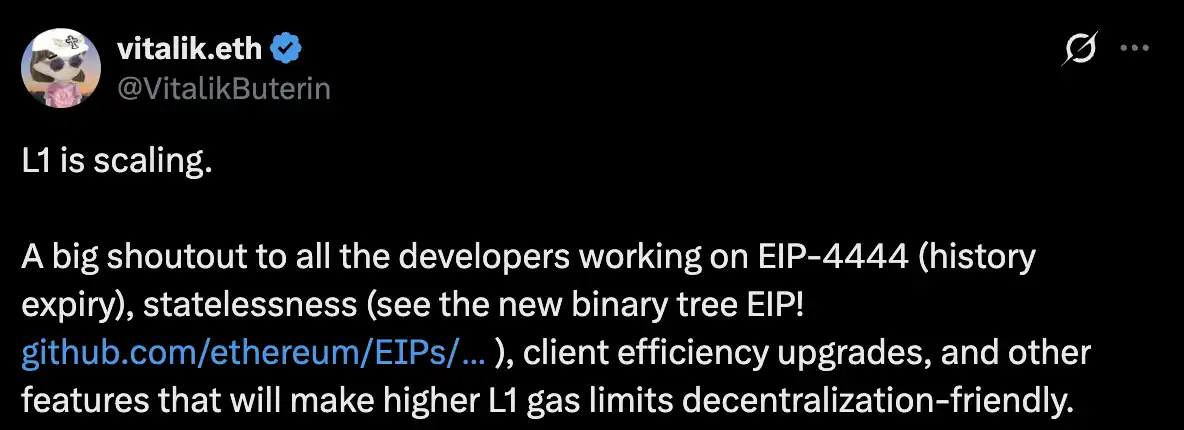
In the past year, the scaling speed of Ethereum L1 has far exceeded everyone's expectations. The technological breakthroughs came from multiple dimensions: EIP-4444 reduced the storage requirements for historical data, stateless client technology made node operation lighter, and most importantly, the continuous increase in Gas Limit. At the beginning of 2025, Ethereum's Gas Limit was still 30 million, but by mid-year, it had risen to 36 million, an increase of 20%. This was the first significant increase in Gas Limit for Ethereum since 2021.
But this is just the beginning. According to the plans of Ethereum core developers, there will be two major hard fork upgrades in 2026. The Glamsterdam upgrade will introduce perfect parallel processing capabilities, with the Gas Limit soaring from 60 million to 200 million, an increase of over three times. The Heze-Bogota fork will add the FOCIL (Fork-Choice Enforced Inclusion Lists) mechanism, further enhancing block construction efficiency and censorship resistance.
The Fusaka upgrade, completed on December 3, 2025, has already allowed the market to witness the power of L1 scaling. After the upgrade, Ethereum's daily transaction volume increased by about 50%, the number of active addresses rose by about 60%, and the 7-day moving average of daily transactions reached a historical high of 1.87 million, surpassing the records from the peak of DeFi in 2021.
The results are astonishing: Ethereum's mainnet transaction fees have dropped to extremely low levels. In January 2026, the average transaction fee on Ethereum fell to $0.44, a decrease of over 99% compared to the peak of $53.16 in May 2021. During non-peak hours, the cost of a transaction often falls below $0.1, and sometimes even as low as $0.01, with gas prices dropping to 0.119 gwei. This figure is now close to Solana's level, and the maximum cost advantage of Layer2 is being rapidly eroded.
In that February article, Vitalik did a detailed calculation. He assumed an ETH price of $2,500 and a gas price of 15 gwei (the long-term average), with demand elasticity close to 1 (meaning that doubling the gas limit would halve the price). Under this assumption:
Censorship resistance demand: Currently, enforcing a transaction that has been censored by L2 through L1 requires about 120,000 gas, costing $4.5. To reduce the cost to below $1, L1 would need to scale by 4.5 times.
Cross-L2 asset transfers: Currently, withdrawing from one L2 to L1 requires about 250,000 gas, and depositing into another L2 requires 120,000 gas, with a total cost of $13.87. With an ideal optimized design, it would only require 7,500 gas, costing $0.28. To reach the target of $0.05, scaling would need to be 5.5 times.
Large-scale exit scenarios: Taking Sony's Soneium as an example, PlayStation has about 116 million monthly active users. If an efficient exit protocol is used (7,500 gas per user), Ethereum can currently support 121 million users for emergency exits within a week. However, to support multiple applications of this scale, L1 would need to scale by about 9 times.
These scaling targets are gradually being realized in 2026. Technological advancements have completely changed the game. When L1 can become fast and cheap on its own, why would users still endure the cumbersome cross-chain bridging, complex interaction experiences, and potential security risks of Layer2?
The security issues of cross-chain bridges are not unfounded. In 2022, cross-chain bridges became a hotspot for hacker attacks. In February, the Wormhole bridge was hacked for $325 million; in March, the Ronin bridge suffered the largest DeFi attack in history, losing $540 million; and other bridging protocols like Meter and Qubit were also breached. According to Chainalysis, the total amount of cryptocurrency stolen from cross-chain bridges in 2022 reached $2 billion, accounting for most of the losses from all DeFi attacks that year.
Liquidity fragmentation is another pain point. With the surge in the number of Layer2 solutions, the liquidity of DeFi protocols has been dispersed across dozens of different chains, leading to increased transaction slippage, reduced capital efficiency, and a deteriorating user experience. A user wanting to move assets between different Layer2s must go through a complex bridging process, wait for long confirmation times, and bear additional costs and risks.
This leads to the next, and most brutal, question: what should those Layer2 projects that have raised huge amounts of money and issued tokens do now?
Valuation bubbles and ghost towns
Where has the money in Layer2 gone?
In the past few years, the Layer2 race has felt more like a massive financial game than a technological revolution. Venture capital firms have waved checks, pushing the valuations of various L2 projects to staggering heights. zkSync has raised a total of $458 million, Offchain Labs behind Arbitrum is valued at $1.2 billion, Optimism has raised $268.5 million, and Starknet has also raised $458 million. Behind these numbers are top venture capital firms like Paradigm, a16z, Lightspeed, and Blockchain Capital.
Developers have been keen to "nest" between different L2s, building complex DeFi Lego structures to attract more liquidity and airdrop hunters. However, real users have been worn down by the repeated cumbersome cross-chain operations and high hidden costs.
A harsh reality is that the market is becoming highly concentrated at the top. According to data from crypto research firm 21Shares, the three major L2s—Base, Arbitrum, and Optimism—now control nearly 90% of the trading volume. Base, leveraging Coinbase's traffic advantage and user base, achieved explosive growth in 2025, with its TVL soaring from $1 billion at the beginning of the year to $4.63 billion by the end, and quarterly trading volume reaching $59 billion, a 37% quarter-over-quarter increase. Arbitrum holds a solid second place with a TVL of about $19 billion, followed closely by Optimism.
However, outside the top tier, most L2 projects have seen their real user numbers plummet to freezing points after losing the incentive of airdrop expectations, turning into genuine "ghost towns." Starknet is the most typical example. Despite its token price having dropped 98% from its peak, its price-to-earnings ratio remains in a highly inflated range relative to its extremely low daily active users and fee revenue. This indicates a significant gap between market expectations for its future and its current ability to create real value.
Ironically, as Layer2 fees have significantly decreased due to EIP-4844, the data availability fees they pay to L1 have also sharply declined, which in turn reduces Ethereum L1's fee revenue. In January 2026, some analyses pointed out that the Dencun upgrade led to a large number of transactions moving from L1 to cheaper L2s, which was one of the main reasons Ethereum's network fees dropped to their lowest level since 2017. While Layer2 reduces its own costs, it is also "draining" L1's economic value.
In its 2026 Layer2 outlook report, 21Shares predicts that most Ethereum Layer2s may not survive in 2026, and the market will undergo a brutal consolidation, with only those high-performance, truly decentralized projects with unique value propositions able to prevail.
This is precisely the true intention behind Vitalik's recent "attack." He aims to burst the bubble of this "infrastructure self-indulgence" and splash cold water on this morbid market. If a Layer2 cannot provide more interesting and valuable features than L1, it will ultimately become an expensive transitional product in Ethereum's development history.
Ethereum is reclaiming its sovereignty
Vitalik's latest suggestion points Layer2 toward a new path: abandon the notion of "scaling" as the sole selling point and instead explore functional added value that L1 cannot or is unwilling to provide in the short term. He specifically listed several directions: privacy protection (achieving on-chain private transactions through zero-knowledge proof technology), efficiency optimization for specific applications (such as gaming, social networks, AI computing), ultra-fast transaction confirmations (in milliseconds rather than seconds), and exploration of non-financial use cases.
In other words, the role of Layer2 will shift from being Ethereum's "avatar" to a diverse set of "plugins." They will no longer be the sole saviors of scaling but rather a functional extension layer within the Ethereum ecosystem. This is a fundamental repositioning and a return of power—Ethereum's core value and sovereignty will be re-anchored on L1.
Vitalik also proposed a new framework: viewing Layer2 as a spectrum rather than a binary classification. Different L2s can have varying trade-offs in terms of decentralization, security guarantees, and functional characteristics; the key is to clearly communicate to users what guarantees they provide, rather than all claiming to be "scaling Ethereum."
This reckoning has already begun. Those Layer2s that maintain their existence through expensive valuations but have no real daily active users are facing their final judgment. Meanwhile, projects that can find their unique value positioning and truly achieve decentralization may survive in the new landscape. Base may continue to leverage Coinbase's traffic advantage and Web2 user onboarding capabilities to maintain its lead, but it will need to address concerns about its lack of decentralization. Arbitrum and Optimism need to accelerate their progress toward Stage 2 to prove they are not just centralized databases. ZK-Rollup projects like zkSync and Starknet must significantly enhance user experience and ecosystem prosperity while demonstrating the unique value of their zero-knowledge proof technology.
Layer2 has not disappeared, but the era of them being Ethereum's only hope has completely ended. Five years ago, when pushed to the wall by competitors like Solana, Ethereum entrusted its scaling hopes to Layer2 and restructured its entire technical roadmap for this purpose. Five years later, it has discovered that the best scaling solution is to make itself stronger.
This is not betrayal, but growth. And those Layer2s that cannot adapt to this evolution will pay the price. When the Gas Limit surges to 200 million by the end of 2026, when Ethereum L1's transaction fees stabilize at a few cents or even lower, and when users find they no longer need to endure the complexities and risks of cross-chain bridges, the market will vote with its feet. Those projects that once held sky-high valuations but failed to create real value for users will be forgotten by history in this great wave of淘沙.
免责声明:本文章仅代表作者个人观点,不代表本平台的立场和观点。本文章仅供信息分享,不构成对任何人的任何投资建议。用户与作者之间的任何争议,与本平台无关。如网页中刊载的文章或图片涉及侵权,请提供相关的权利证明和身份证明发送邮件到support@aicoin.com,本平台相关工作人员将会进行核查。


