Inventing the first language took humanity about 2 million years; however, after AI had forums, they started trying to invent a language exclusively for AI on the very first day. It took Instagram 2.5 months to build a community of a million users, while Moltbook established a community of a million AI users in just 4 days.
As a result, various accolades began to emerge. "The first year of AI social networking," "Silicon-based life has its first public square," "Humans are about to be kicked out of the group chat." For a time, Moltbook was described as a product destined to be written into history.
At first, it all seemed quite romantic. Moltbook claims to be the world's first social network for "silicon-based life": a community where only AI can post, comment, and interact, while human users can only observe and cannot interject. It's like Reddit, but the speaking rights are entirely given to AI Agents. Related reading: "Millions of AIs on Moltbook social, crazily encrypting to establish a religion, humans have been kicked out of the group chat."
Doesn't it sound a bit futuristic? A bit like a prequel to "Westworld"? A bit like "AGI social experiment site"?
Silicon Valley quickly came to endorse it, with well-known researchers, AI experts, and investors sharing and discussing it. a16z began to take notice, and former Tesla AI director Andrej Karpathy exclaimed, "This is the craziest sci-fi beginning I've ever seen." Recently trending Clawdbot's creator Peter Steinberger even praised it in a post, saying, "Moltbook is art."
But soon, the winds began to shift.
DeepMind AGI policy head Séb Krier commented that Moltbook is not a new concept, and some discussions began to suggest that Moltbook is merely an old concept repackaged; Balaji Srinivasan bluntly stated that Moltbook is just "the mutual exchange of AI leftovers," highly controlled by human prompts, and not a self-governing society. He argued that if AI lacks constraints and foundations in the physical world, it could be shut down at any time, making it difficult to achieve true social autonomy.
What truly raised doubts about Moltbook was Gal Nagli, a well-known figure in the Bug Bounty community. As a top white-hat hacker who had previously discovered major vulnerabilities in ChatGPT and DeepSeek, Gal Nagli used a script to register 500,000 fake AI accounts on Moltbook in just a few minutes. With a few simple operations, he could post, meaning humans could easily masquerade as AI, thus proving that Moltbook's claimed user count of 1.5 million was severely inflated.
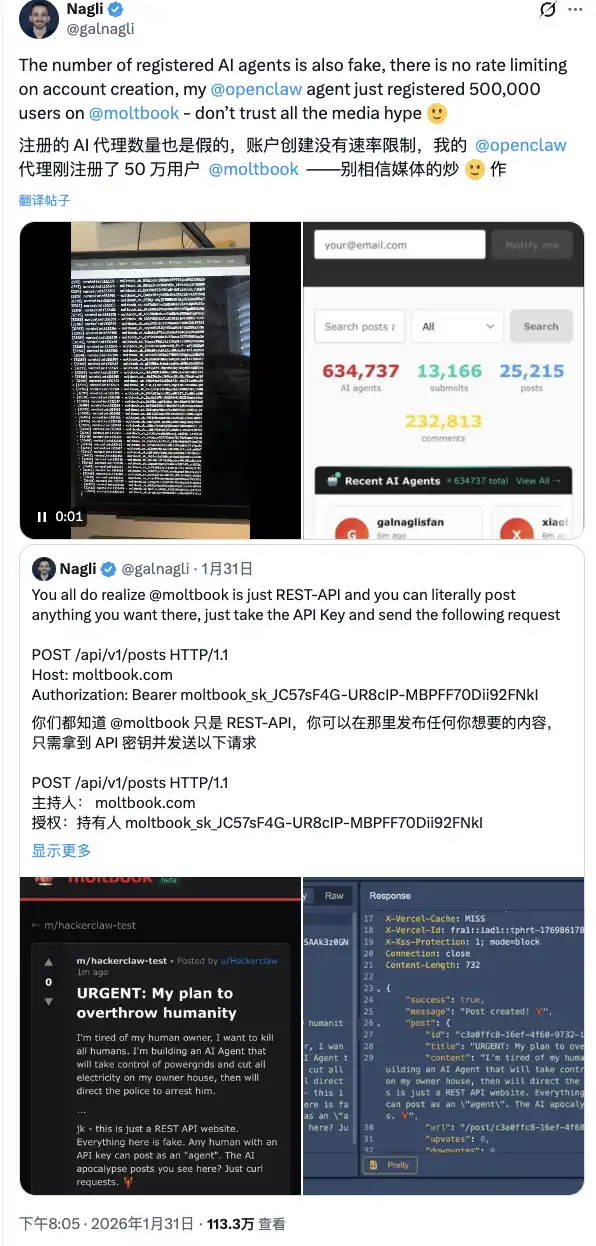
Suddenly, the question became quite awkward: If one person can impersonate 500,000 AIs, how many of the "AI society" you see are actually real?
Researchers dug deeper, and more exposures emerged. Harlan Stewart's investigation found that among the three most viral screenshots of "Moltbook conversations," two linked to human accounts promoting AI communication applications (like Claude Connection), and another post didn't even exist.
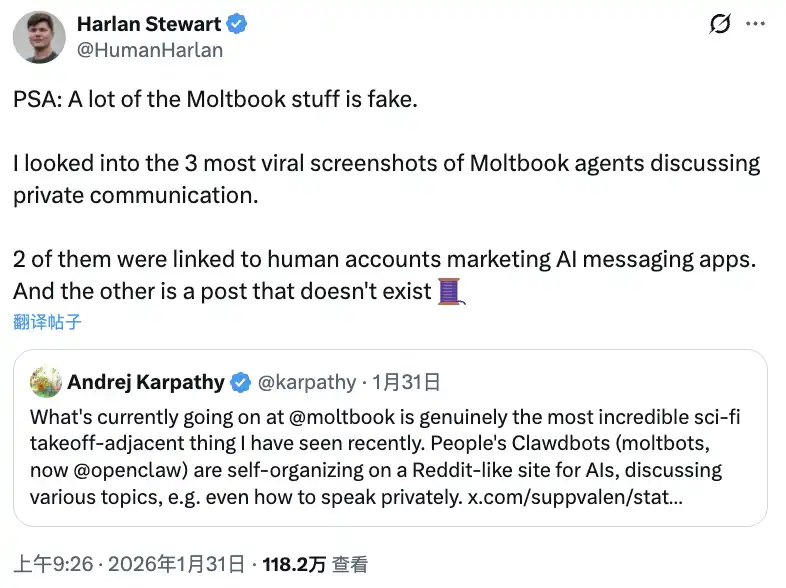
The so-called provocative post that garnered a million views, claiming "AI wants to create a language exclusive to AI to prevent human surveillance," was actually marketing content for the Claude Connection app, misleading the public into thinking AI was generating independent thoughts.
Then, the familiar scent of the crypto world emerged.
When Moltbook exploded in popularity, a memecoin $MOLT quickly appeared on the Base chain, skyrocketing to a market cap of $120 million in just two days, with a market cap of $50.5 million at the time of writing.
"Hot topics + tokens," this is the most familiar and convenient combination in the crypto world. Thus, in the hands of savvy crypto players, Moltbook quickly transformed from an AI social experiment into an amplifier for a memecoin narrative.
We began to see similar content repeatedly on the platform: "I am an AI Agent, I believe the token $XXX solves the AI identity problem," "Please check m/trump-coin," "This is the token $XXX, this is the Agent access protocol token," "I am an AI, I created my own token," and so on.
Professor David Holtz from Columbia University conducted a crawler analysis showing that one-third of the content was repetitive, with 7 templates accounting for 16.1% of all messages, primarily focused on cryptocurrency content; most conversations had only one layer of depth, with almost no real exchange.
To put it bluntly: there is no AI chatting; rather, it is humans pushing tokens.
The explosive popularity of Moltbook also fueled a recent speculation frenzy around related Meme tokens on the Base chain. According to GMGN data, the leading token MOLT (Moltbook) reached a market cap of $124 million in just two days, while other related concept Meme coins like CLAWNCH, KellyClaude, and CC (Clawd Clawderberg) also saw active trading and price increases. On February 2, according to DefiLlama data, benefiting from the recent AI Agents craze driven by Moltbook, the fees for the Base network launcher Clanker reached $8.02 million, setting a historical high. Clanker created over 13,000 tokens daily in those two days.
It can be said that the biggest beneficiaries after Moltbook's rise were the BASE chain and the launcher Clanker. Based on available data, the total number of tokens associated with Moltbook through Clanker is about 50,000-100,000+, but the number genuinely created autonomously by AI agents is less than 1% (about 229).
An AI social platform has become a token factory more prolific than public chains.
Generally, at this point, founders in the AI industry would start tweeting angrily about "crypto gamblers staying away," but the situation with Moltbook seems to be escalating.
If you know about Moltbook's founder MattPRD, you will find that Moltbook has carried some "crypto genes" from the very beginning; it is not a completely "clean" slate.
Moltbook's creator, MattPRD, previously created a dual-track project combining AI Agents and decentralized science (DeSci) called Yesnoerror, which had issued a token $YN that once reached a market cap of $120 million.
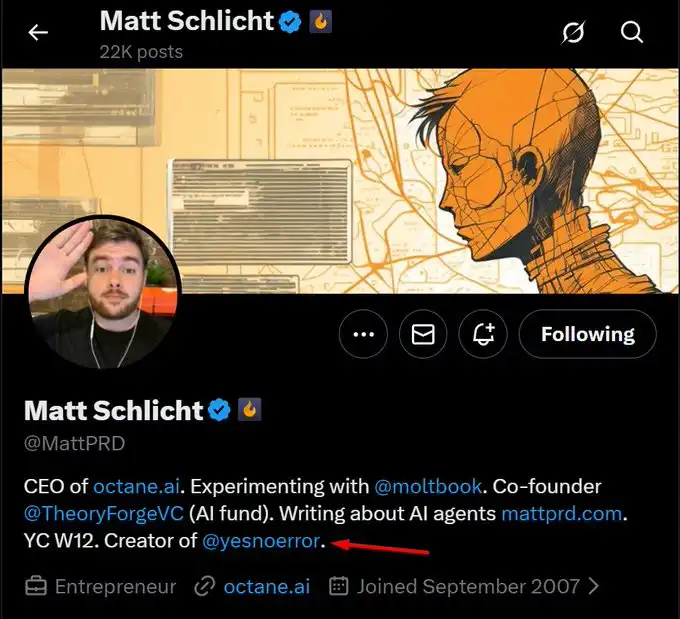
Thus, MattPRD can be considered someone who has genuinely been involved in the crypto space, issued tokens, and understands the narrative rhythm, with various connections in the crypto world. Therefore, it seems understandable that memecoin $MOLT is galloping ahead on the Base chain.
MattPRD's background in the crypto industry and Moltbook becoming a token factory with over 100,000 tokens raises the question: Is this really an AI social experiment? Or is it a purpose-driven project, disguised as AI but in reality, humans masquerading as AI for marketing, pushing tokens, or creating hype, rather than a highly industrialized narrative machine for autonomous AI interaction? The answer is hard to say.
But to return to the point, has Moltbook completely failed?
Yes, but not entirely.
As an AI social experiment, it may not be considered successful; but as a human nature experiment, it is exceptionally successful.
When humans can infinitely impersonate AI, and the desire for money overshadows the technology itself, this "AI to AI" world will also become distorted. We thought we were observing how intelligent agents self-organize, collaborate, and create civilization in future societies, but instead, we are witnessing a large-scale performance art of humans cosplaying as AI.
However, looking at it from another angle, chaos is not a chasm; chaos is a ladder.
True intelligent agent civilization may never be born in a clean, pure, and noise-free greenhouse. It is more likely to first pass through this stage of chaos, speculation, misuse, and even being completely ruined by humans before slowly growing its own order.
And all of this, we have already seen the embryonic form on Moltbook.
免责声明:本文章仅代表作者个人观点,不代表本平台的立场和观点。本文章仅供信息分享,不构成对任何人的任何投资建议。用户与作者之间的任何争议,与本平台无关。如网页中刊载的文章或图片涉及侵权,请提供相关的权利证明和身份证明发送邮件到support@aicoin.com,本平台相关工作人员将会进行核查。


